morning rituals
Morning Manifestation Routine in 5 Minutes
A quiet morning manifestation routine using future-self audio: five minutes of listening, one cue, one action, and a softer way to begin without waking earlier.

The kettle clicks before the house has decided what kind of day it will be. A morning manifestation routine can be five minutes: sit down, listen to future-self audio, choose one small action, and carry the feeling into the first ordinary thing you do.
Why can five minutes be enough for a morning manifestation routine?
Five minutes is enough when the practice is specific, repeated, and tied to something you already do.
Most mornings are not empty. They have socks, water, children, messages, dogs, late trains, and the strange fog of waking. A routine that asks for 45 clean minutes may sound beautiful at night and collapse by 7:12 a.m. A 5-minute practice survives because it does not ask the morning to become someone else.
Behavior researcher BJ Fogg often teaches that small habits work because they reduce friction. His Tiny Habits model can begin with actions that take under 30 seconds. The point is not that 30 seconds is magic. The point is that the nervous system learns, “I can do this.” A 5-minute morning ritual gives your attention a place to return before the day starts naming you.
Habit research says the same thing in a less romantic voice. In a 2009 study in the European Journal of Social Psychology, Phillippa Lally and colleagues found that habit automaticity took anywhere from 18 to 254 days, with an average of 66 days. The range matters. You are not late if the practice takes time to feel natural.
This is where the AYA Method comes in quietly. The AYA Method is a daily audio manifestation practice. Each day you listen to a short personalized recording — your Dream-Self Moment — narrated from the version of you who has already manifested the life you intend. Listening is the practice. Repetition is the work. The audio is the method.
A small practice repeated honestly can become a room inside the day.
What do you need before you begin?
You need one cue, one audio, and one private minute before the world starts asking for you.
Do not begin by redesigning your life. Begin with a cue that already exists. Sitting up. Turning on the kettle. Putting your feet on the floor. Opening the curtains. Habit researchers Wendy Wood, Jeffrey Quinn, and Deborah Kashy reported in 2002 that about 43% of daily actions were repeated in the same context. Context is not a detail. It is the handle.
Your cue should be ordinary enough to survive a tired morning. If you only practice when candles are lit and the room is quiet, you may practice 3 days out of 10. If you practice after brushing your teeth, you may practice on the hard mornings too. The cue is not glamorous. It is reliable.
You also need your future-self audio ready before morning. Not found. Not edited. Not reconsidered. Ready. Edison Research’s Infinite Dial 2024 reported that 47% of Americans age 12 and older had listened to a podcast in the last month. Your brain already knows how to receive a voice through headphones. This practice uses that familiar door for something more intimate.
If you use the app, the Dream-Self Moment is the center. The daily affirmation and Manifestation Board can support it, but they are not the pillars. Audio is the method. If you want the wider frame, the manifestation guide gives language for intention, attention, and repetition without making the morning heavy.
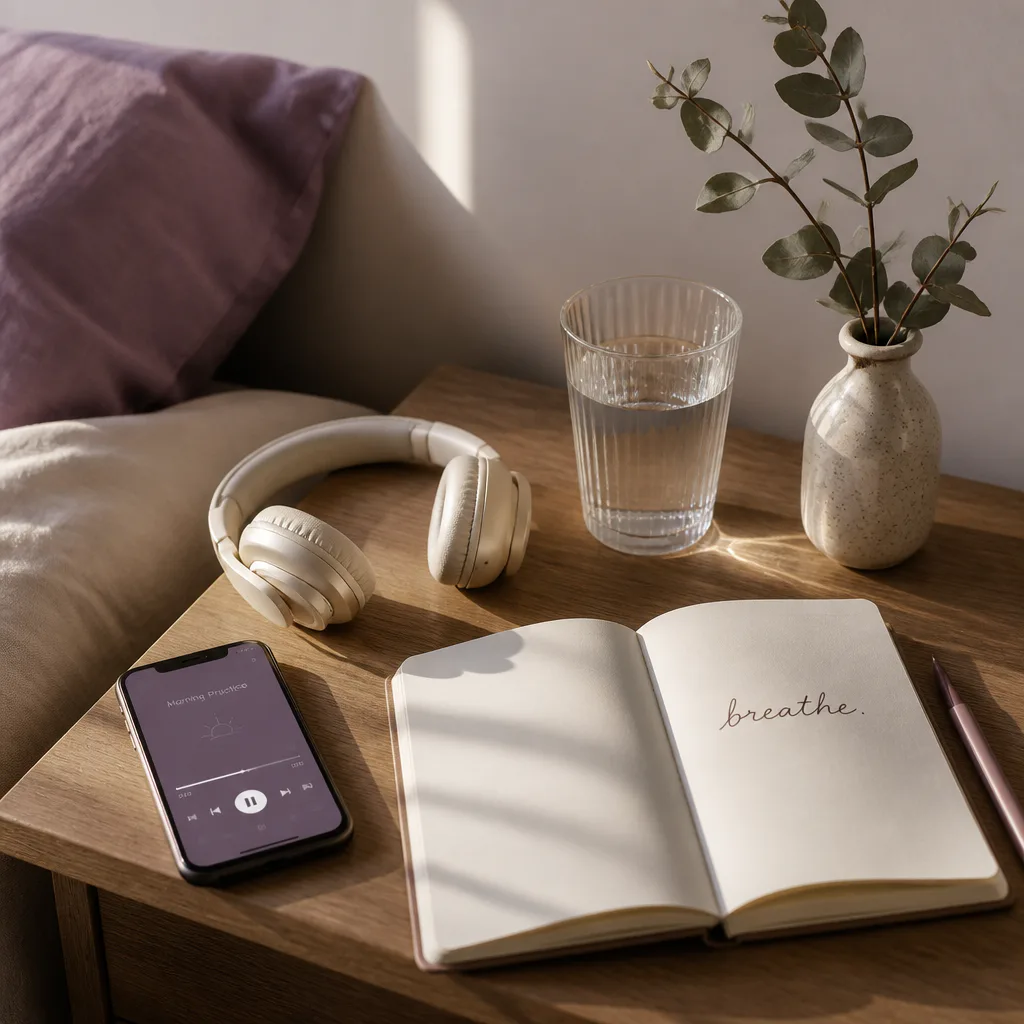
A simple setup looks like this:
- Headphones within reach
- One 3 to 4 minute Dream-Self Moment
- A chosen cue you already repeat
- One word to carry afterward
- No phone scrolling before listening
How do you do the 5-minute routine, step by step?
You listen first, then choose one small action that proves the future self is not only an idea.
Set a timer if it helps, but do not turn the routine into a performance. The shape matters more than the mood. Some mornings you will feel open. Some mornings you will feel flat. Both count. In Gollwitzer and Sheeran’s 2006 meta-analysis of 94 studies, implementation intentions, the simple if-then plans people make before action, showed reliable effects on goal completion. “After I start coffee, I listen” is enough of a plan.
Here is the 5-minute version:
- Minute 0:00 to 0:30: Arrive. Sit down. Put both feet on the floor. Take 3 slower breaths. You are not trying to become calm. You are letting the body know you are here.
- Minute 0:30 to 3:30: Listen. Play your future-self audio. Let the voice speak from the life you are practicing toward. If your attention wanders, return to the next sentence.
- Minute 3:30 to 4:00: Name one word. Choose one quality you heard. Clear. Tender. Steady. Chosen. Honest. Write it down if there is paper nearby.
- Minute 4:00 to 4:45: Choose one action. Make it visible and small. Send the email. Drink water. Put the card away. Step outside for light.
- Minute 4:45 to 5:00: Seal it. Say, “Today, I practice this.” Then stand up.
Dr. Andrew Huberman often recommends getting outdoor light within the first hour after waking, usually 2 to 10 minutes depending on cloud cover. If your chosen action is stepping outside after listening, the body receives a second cue: morning has started. You do not need to make it sacred. You need to make it repeatable.
| Minute | What you do | Why it matters |
|---|---|---|
| 0:00-0:30 | Sit and breathe | Marks a clear beginning |
| 0:30-3:30 | Listen to audio | Gives the mind a future-self script |
| 3:30-4:00 | Name one word | Turns the audio into memory |
| 4:00-4:45 | Choose one action | Brings identity into behavior |
| 4:45-5:00 | Say the line | Closes the practice gently |
This is also where affirmations can help. One affirmation can become the sentence you carry after listening. It is not there to replace the audio. It is there to keep one part of the audio warm in your pocket.
The future self becomes easier to believe when you let her choose your next small act.
What should future-self audio actually say?
Future-self audio should speak from the life you are practicing as if it is already known, specific, and lived in.
Vague language fades quickly. Specific language stays. “I am healthier” is softer than it needs to be. “I wake and put water beside the bed before I touch my phone” gives the mind an image. Mental imagery research has long suggested that the brain responds strongly to concrete simulation. A 1994 meta-analysis by Driskell, Copper, and Moran reviewed 35 studies and found mental practice improved performance, especially when paired with physical action.
Good future-self audio does not scold the current self. It does not say, “You finally fixed yourself.” It says, “You know how to begin now.” That difference is not cosmetic. Shame may start a behavior for a day. Safety helps it return tomorrow.
A useful Dream-Self Moment includes 4 parts:
- A present-tense scene: where you are, what you touch, what the morning sounds like
- A chosen identity: the kind of person you are practicing being
- A clear behavior: what you actually do today
- A remembered feeling: not a high, but a quiet sense of “this is mine”
Joe Dispenza often speaks about mental rehearsal as a way of teaching the body a new state before circumstances change. You do not have to adopt every claim around that work to use the practical point: repeated inner rehearsal can influence what you notice, choose, and repeat. The AYA version keeps the practice small. Listen. Remember. Act.
If you are building language for your own audio, try a line like: “I move through the first hour without abandoning myself.” Or: “I answer the day from the person I am becoming, not from the panic I inherited.” One true sentence can outlast a beautiful page.
How do affirmations and a Manifestation Board support the audio?
They support the audio by giving you something to remember and something to see, but they should not take over the method.
The daily affirmation is best when it is short enough to return to under pressure. Research on self-affirmation has a serious body behind it. In a 2014 review in the Annual Review of Psychology, Cohen and Sherman described how self-affirmation can help people respond to threat with less defensiveness. That does not mean every sentence works. It means a well-chosen sentence can help you stay connected to what matters.
For this morning manifestation routine, the affirmation should come after listening. Let the audio speak first. Then choose one line that feels like a thread. If your Dream-Self Moment shows you calmly asking for what you need, the affirmation might be, “My needs are allowed to have a voice.” If it shows you finishing work without rushing, it might be, “I can move steadily and still arrive.”
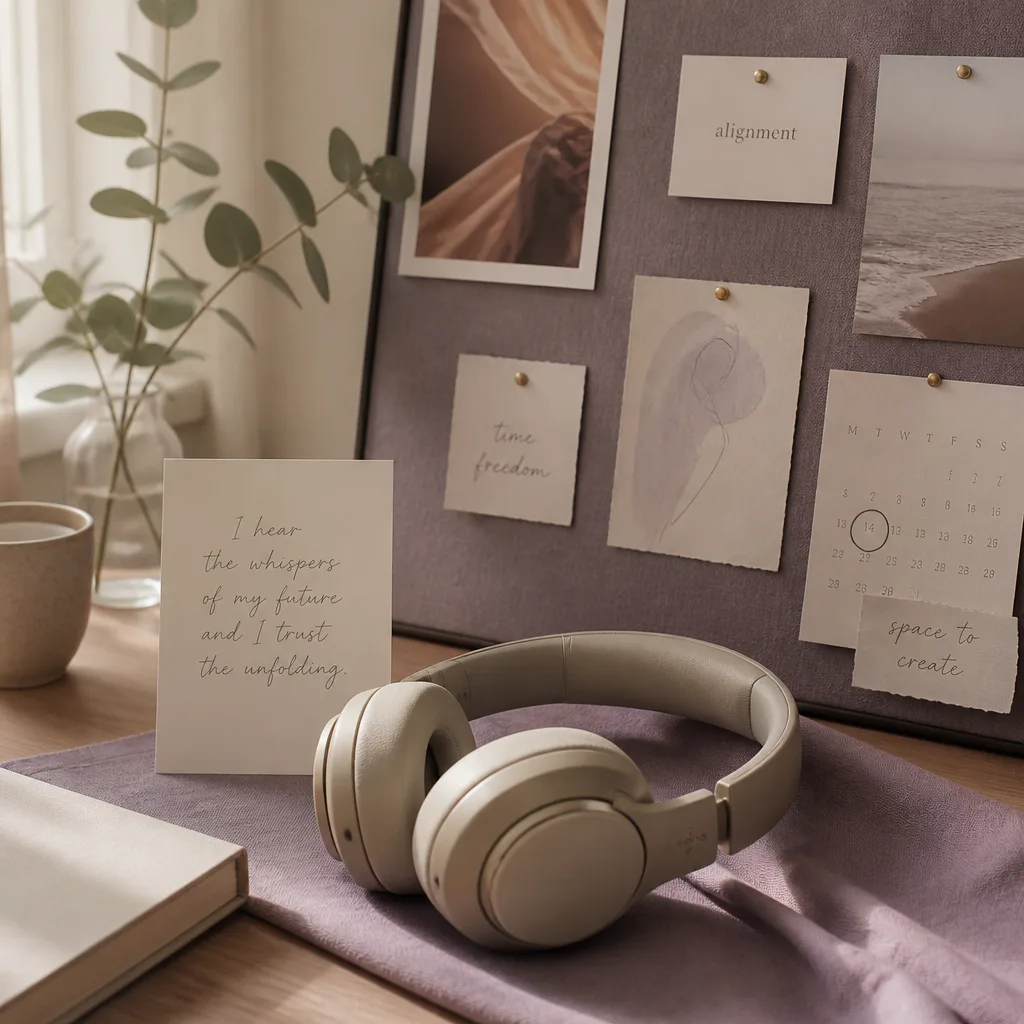
A Manifestation Board works differently. It is visual. It can hold images, words, dates, or symbols that remind you what you are practicing toward. A 2011 study by Gabriele Oettingen and colleagues found that positive fantasies alone can sometimes reduce effort when they replace planning. That is the caution. The board should point you back to action, not become a place where action goes to sleep.
If timing or mood matters to you, astrology and manifestation can offer a reflective frame. Use it lightly. The morning still comes down to a cue, a voice, and one choice you can make before the day gets loud.
The board shows it. The affirmation names it. The audio lets you hear yourself living it.
What if your morning is messy, loud, or already late?
You keep the routine by making it smaller, not by waiting for a better morning.
There will be mornings when someone needs you. There will be mornings when sleep was thin. There will be mornings when the phone wins for 12 minutes before you remember yourself. This does not mean the practice is broken. It means you are practicing inside a real life.
The American Psychological Association’s 2023 Stress in America report found that 36% of adults said they did not know where to start when it came to managing stress. That number feels human. When the day is already crowded, the kindest start is not a dramatic reset. It is one next thing you can actually do.
Use a fallback version for those mornings:
- Put one hand on your chest or the edge of the sink.
- Listen to the first 60 seconds of your Dream-Self Moment.
- Choose one word.
- Do one matching action before noon.
That is not failure. That is maintenance. James Clear popularized the “never miss twice” rule in habit writing, but the older truth is simpler: missing once is data, not identity. Return the next morning. Or return at lunch. The time is useful, but the relationship is the real practice.
You can also lower the sound without lowering the meaning. Listen while making tea. Listen while sitting in the car before school drop-off. Listen with one earbud while the house is noisy. The ritual does not need perfect conditions. It needs permission to be imperfect and still count.
If you want a wider language for this, the manifestation pillar names manifestation as a practice of attention and lived choice. Not escape. Not pretending. A quiet rehearsal of who you are willing to be next.
How do you know the routine is working?
You know it is working when your choices begin to echo the person you hear in the audio.
Do not measure the practice only by mood. Mood is weather. Behavior is evidence. After 7 days, ask: Did I listen at least 4 times? Did I choose one action after listening? Did one sentence stay with me during the day? A simple 7-day check is more useful than judging yourself after one distracted morning.
You can track 3 signs:
- Return: you come back to the cue more often than not
- Recognition: the audio starts to feel familiar, even if not fully believed
- Behavior: one small action changes, repeats, or becomes easier
In Lally’s 2009 habit study, missing one opportunity did not erase progress when people returned to the behavior. That is worth remembering. The practice does not need a perfect streak to become real. It needs repair.
There is also a subtle sign. You may notice the voice of the future self becoming available at strange times: while reaching for your phone, before replying too quickly, while deciding whether to keep a promise to yourself. This is why the AYA Method begins with listening. A voice repeated in the morning can become a remembered choice at 3 p.m.
If you want to pair it with writing, keep the journal short. One line is enough: “Today I heard __, and I will do __.” A 2018 review in Advances in Psychiatric Treatment noted that expressive writing studies often use 15 to 20 minute sessions, but your morning does not need that length. Your line is a bridge, not a separate project.
The sign is not that life suddenly becomes easy. The sign is that you abandon yourself a little less often.
The morning can stay small, and still be yours.