frequencies binaural
528 Hz Manifestation: Play Dream-Self Audio First
528 Hz manifestation works best when the tone supports your Dream-Self audio, not replaces it. A quiet guide to order, timing, and daily listening.
The room is dim. Your phone is face down. For 528 Hz manifestation, play your Dream-Self audio first, then use the 528 Hz tone as a quiet support. The frequency may help you settle, but the personalized audio tells your mind what to rehearse and remember.
What is 528 Hz manifestation really asking you to do?
528 Hz manifestation asks you to pair a steady sound with a clear inner rehearsal of the life you’re practicing.
The number gets a lot of attention. It often gets called a repair frequency, a heart frequency, or a tone linked with healing. Some of those claims go much further than the research can carry. What you can say more carefully is this: sound changes state. Music can affect breathing, heart rate, attention, and mood. A 2018 small Japanese study reported that five minutes of music tuned around 528 Hz was associated with lower salivary cortisol compared with 440 Hz in that setting. That’s interesting. It’s not a promise.
Manifestation still needs content. A tone by itself doesn’t know what you want to practice. It doesn’t know the room you want to wake in, the work you want to do, the apology you want to make, or the calm you want to keep when someone doubts you. This is where manifestation has to become specific enough to be lived.
Sound can’t do your choosing for you. It can only give your nervous system a softer room to choose from.
So the question isn’t whether 528 Hz is magic. The better question is whether it helps you stay with the image, sentence, and felt identity long enough for repetition to matter. In behavior science, repetition is not decorative. A 2009 study in the European Journal of Social Psychology found habit formation took an average of 66 days, with wide variation from 18 to 254 days. The body learns slowly. It likes proof.
Why should the Dream-Self audio come first?
The Dream-Self audio comes first because it gives the practice its direction before the frequency gives it atmosphere.
The AYA Method is a daily audio manifestation practice. Each day you listen to a short personalized recording — your Dream-Self Moment — narrated from the version of you who has already manifested the life you intend. Listening is the practice. Repetition is the work. The audio is the method.
That order matters. As a former architect, I think of this like drawing a plan before choosing the light fixture. The tone is the fixture. Lovely, maybe. Supportive, maybe. But the plan tells the room what it’s for. If you begin with 528 Hz and never name the self you’re rehearsing, you may relax without redirecting anything.
A 2020 paper in Social Cognitive and Affective Neuroscience described self-referential processing as involving midline brain regions, including parts of the medial prefrontal cortex. In plain words, the mind treats self-relevant material differently. Your own future, spoken in language that feels like yours, has a different job than a generic sound file.
Try this order for seven days:
- Sit in the same place.
- Listen to your Dream-Self Moment once.
- Let one sentence stay after the audio ends.
- Start 528 Hz at a low volume.
- Breathe naturally for five minutes.
- Write one small action you’ll take today.
The practice gets stronger when it has a doorway. The Dream-Self audio is the doorway.
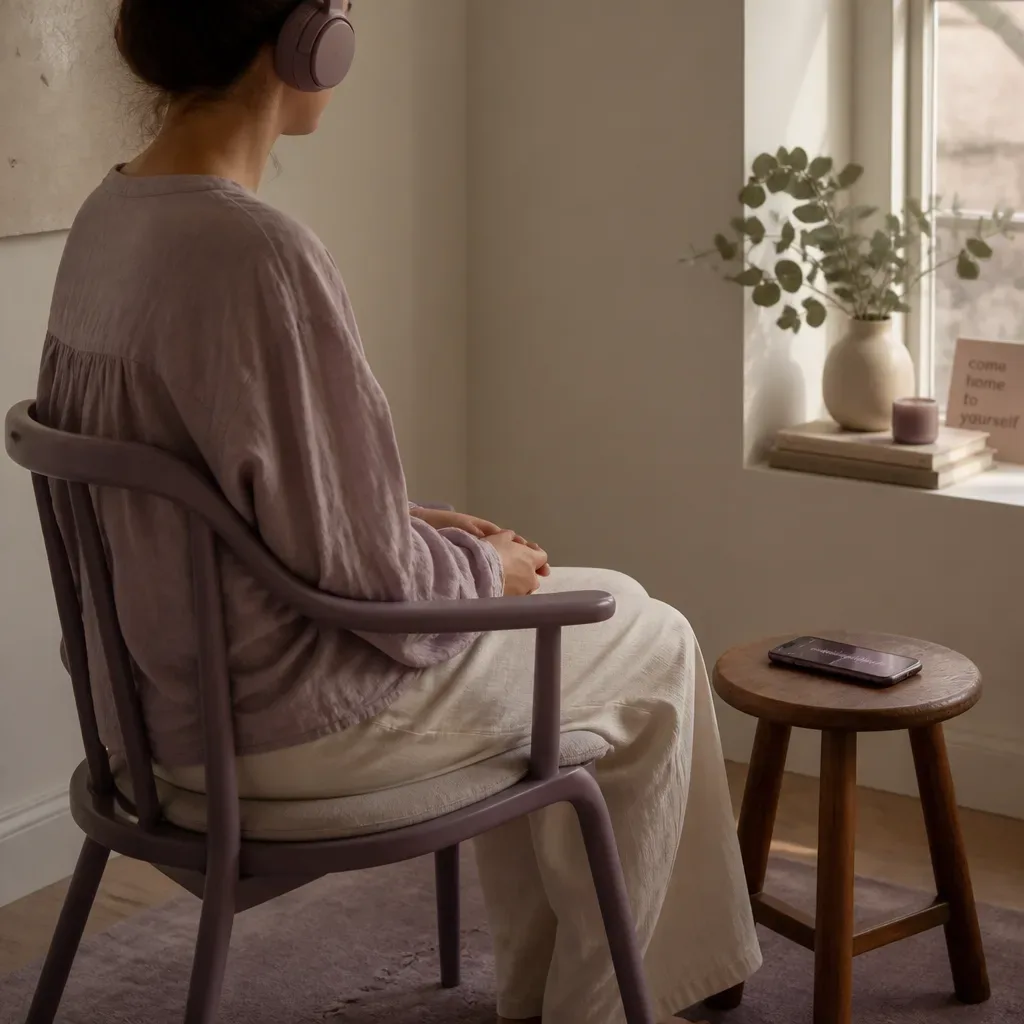
How do you set up a quiet 528 Hz manifestation session?
Set up the session so there are fewer decisions than excuses.
Choose one place. Not the perfect place. One place. A chair near a window. The left side of the sofa. The edge of your bed before the day starts asking for things. Environmental design research has repeated one simple lesson for decades: cues shape behavior. In 2011, BJ Fogg’s behavior model described action as the meeting point of motivation, ability, and prompt. Your chair can become the prompt.
Keep the session small enough to repeat. Twelve minutes is enough. Three to five minutes for the Dream-Self audio. Five to seven minutes for 528 Hz. One minute to write. If you’re using headphones, keep the volume lower than you think. The World Health Organization has warned that listening levels above 85 decibels for long periods can risk hearing damage, so soft is not only gentle. It’s sensible.
Here is the simplest layout:
| Part | Time | Purpose |
|---|---|---|
| Arrive | 1 minute | Sit, silence notifications, soften the jaw |
| Dream-Self audio | 3 to 5 minutes | Hear the identity you’re rehearsing |
| 528 Hz tone | 5 to 7 minutes | Stay settled after the words |
| One sentence | 1 minute | Carry the practice into the day |
The tone should not compete with the audio. Don’t layer 528 Hz under your Dream-Self Moment unless the recording was made that way and remains clear. Speech needs space. Research on cognitive load, including John Sweller’s work from the late 1980s onward, keeps pointing to the same truth: the mind has limited working memory. Don’t make it fight for the sentence meant to guide it.
A quiet practice is not a weak practice. It is a practice with fewer leaks.
What should you listen for during the Dream-Self Moment?
Listen for the sentence that feels believable enough to repeat and brave enough to change your next choice.
You don’t need to strain. You don’t need to visualize every detail with cinematic precision. Many people can’t. A 2015 University of Exeter study on aphantasia helped bring attention to the fact that some people have little or no voluntary visual imagery. That doesn’t make them bad at manifestation. It means the practice may arrive through words, body sensation, memory, or knowing.
During the Dream-Self Moment, notice three things:
- A phrase your body softens around.
- A detail that feels ordinary, not theatrical.
- A next action that becomes harder to ignore.
If your audio says you’re calm in a meeting, don’t chase a grand sign. Watch for the tiny rehearsal. Maybe your shoulders drop. Maybe you pause before answering. Maybe you open the document you’ve avoided for 11 days. The nervous system trusts evidence more than drama.
This is also where affirmations can help, if you use them lightly. One affirmation after the audio can act like a label on the drawing. It shouldn’t replace the whole plan. In the AYA app, the daily affirmation is a complement. It gives you a line to carry, while the Dream-Self Moment gives you the scene, voice, and felt direction.
Neville Goddard wrote often about assuming the feeling of the wish fulfilled. Joe Dispenza speaks in a different vocabulary about rehearsing a future state until the body begins to recognize it. You don’t have to accept every claim from either teacher to see the shared instruction: practice the self before the proof fully arrives.
Where does 528 Hz fit after the audio?
528 Hz fits after the audio as a holding sound, not as the main instruction.
Once your Dream-Self Moment ends, let the tone begin. Low volume. No scrolling. No checking whether you feel different after 30 seconds. Just sit. The point is not to test the frequency like a machine in a lab. The point is to give the nervous system a steady background while the words you heard continue to settle.
Research on binaural beats and frequency-based listening is mixed. A 2019 meta-analysis in Psychological Research found that binaural beats may have small effects on memory, attention, anxiety, and pain perception, but results varied by frequency, duration, and study design. That means you can be curious without handing your authority to the tone.
I like to treat 528 Hz the way I treat morning light in a room. It doesn’t decide what the room is for. It helps the room become usable. If the tone irritates you, stop. If it makes you sleepy at 9 a.m., use it at night instead. If silence works better, choose silence. Your body is allowed to give feedback.
You can also compare it with other symbolic timing systems, if those help you stay attentive. Some readers use astrology and manifestation as a calendar cue: new moon, first day of the month, birthday, Monday morning. Fine. Just don’t let the calendar replace the listening. A date can invite you to begin. It can’t practice for you.
The frequency is furniture. The audio is the room.
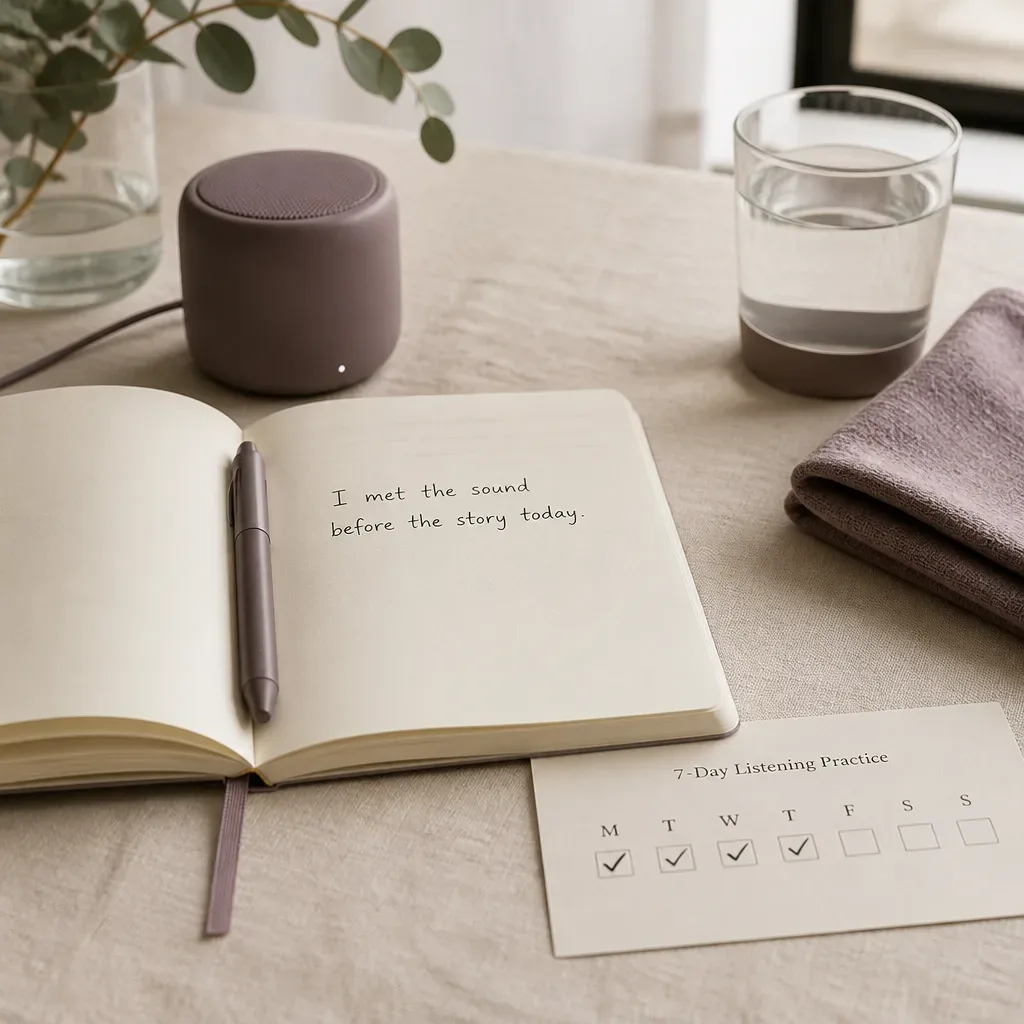
How can you make this a seven-day practice?
Make it a seven-day practice by changing nothing except your willingness to return.
Seven days is short enough to finish and long enough to reveal friction. If you miss a day, don’t turn it into a character study. Resume. Clinical habit work often focuses less on perfection and more on cue, routine, and reward, a loop popularized by Charles Duhigg and grounded in decades of behavioral psychology. The cue is your place. The routine is the audio, then 528 Hz. The reward is one clean sentence you can live today.
Use this simple tracker:
| Day | Dream-Self audio | 528 Hz after | One sentence written |
|---|---|---|---|
| 1 | □ | □ | □ |
| 2 | □ | □ | □ |
| 3 | □ | □ | □ |
| 4 | □ | □ | □ |
| 5 | □ | □ | □ |
| 6 | □ | □ | □ |
| 7 | □ | □ | □ |
Keep the written sentence plain. Not a paragraph. Not a promise made from panic. One line. For example: I answer the email before noon. I eat sitting down. I speak once in the meeting. I move the invoice from draft to sent. Manifestation becomes real when it asks something small and honest from the day.
If you use a Manifestation Board, treat it as a visual companion, not the main practice. Look at it after listening, the same way an architect reviews a drawing after visiting the site. The board reminds the eye. The audio trains the ear. The body follows what gets repeated.
What mistakes make 528 Hz manifestation feel unclear?
The practice feels unclear when the frequency becomes a substitute for attention, action, or self-honesty.
The first mistake is turning the tone up too loud. Louder doesn’t mean truer. In audio health guidance, the 60/60 rule is often used as a simple safety cue: listen at no more than 60 percent volume for no more than 60 minutes at a time when using headphones. Your 528 Hz session is much shorter than that, but the principle holds. Gentle is enough.
The second mistake is collecting tools. A frequency, a candle, a journal, a playlist, a moon phase, a long list of affirmations, a timer, a crystal, a second playlist. At some point the practice becomes a storage problem. Most clutter is deferred decision-making. Inner clutter works the same way.
The third mistake is using 528 Hz to avoid the sentence you already heard. If your Dream-Self audio keeps pointing toward rest, repair, or one brave message, the tone won’t make that instruction disappear. It may make the room quieter. You still have to choose.
If you want a wider frame for the practice, read the AYA Method as the center, then place frequency work around it. You can also return to the main manifestation guide when you need a plain definition, or the affirmations guide when you want one sentence to carry. Keep the architecture clean.
Here is the order to remember:
- Audio first.
- Frequency second.
- One sentence third.
- One small action next.
The self you’re rehearsing doesn’t need a louder sound. She needs a place you return to.
Stay here, softly, and listen.