affirmations
Affirmations for Women: Choose Daily Phrases
Affirmations for women work best when they feel believable, specific, and repeated daily. Learn how to choose phrases that meet your real life.

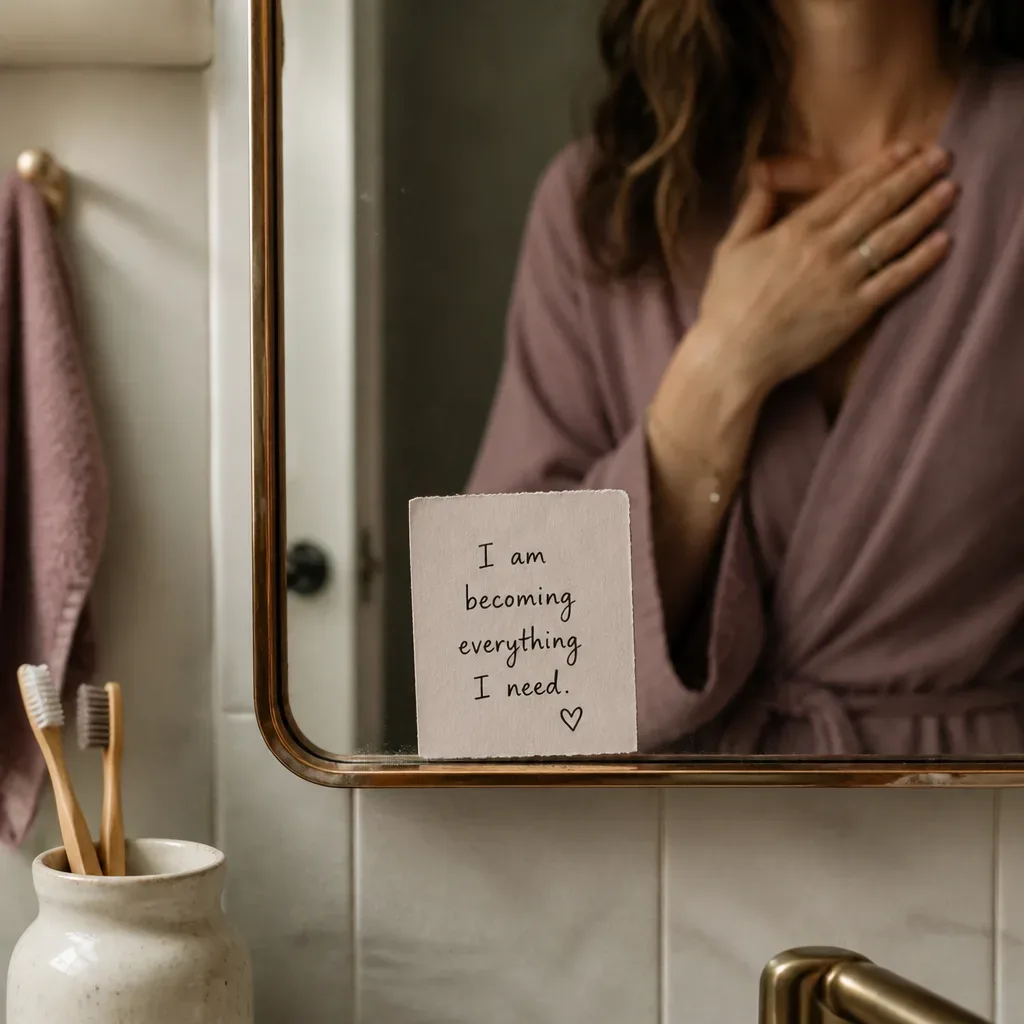
A sticky note on the mirror can help, but only if the words are true enough to enter. Affirmations for women work best when they’re specific, believable, repeated daily, and tied to real pressure points: body, work, love, money, voice, rest, and self-trust.
What makes affirmations for women work better?
Affirmations work better when they protect what you value instead of pretending nothing hurts.
The phrase has to meet a real moment. Not a glossy version of you. The woman standing in the bathroom at 7:12 a.m., deciding whether to answer the message too quickly. The woman with the tight jaw before a meeting. The woman who’s tired of being nice at the cost of being honest. Google sees about 6,600 U.S. searches a month for “affirmations for women,” which tells you something simple: many women want words that feel like ground.
Self-affirmation theory began with psychologist Claude Steele in 1988. The idea isn’t that a sentence magically changes your life. It’s that remembering a core value can help you stay steady when your self-image feels threatened. In a 2014 review, Geoffrey Cohen and David Sherman wrote that self-affirmation can reduce defensive reactions and support adaptive behavior under stress.
That matters because women are often trained to monitor themselves. Voice. body. tone. face. desire. According to Pew Research Center reporting on gender and work, many women still describe pressure around caregiving and professional credibility, even when they’re highly capable. A good affirmation doesn’t deny that pressure. It gives you a clean place to stand inside it.
Try this rule: if the affirmation asks you to abandon your body, it isn’t yours yet.
Useful affirmations often share 4 traits:
- They’re specific: “I can speak before I’m fully ready.”
- They’re believable: “I’m allowed to begin again.”
- They’re brief: 6 to 12 words is enough.
- They’re repeatable: you can say them on an ordinary Tuesday.
For a broader foundation, you can read the Affirmations pillar, which names the practice without asking it to become everything.
How do you choose a phrase your body believes?
You choose a believable phrase by starting one step below the sentence you wish were true.
If “I’m confident” makes your chest go tight, don’t force it. In 2009, Joanne Wood and colleagues published research in Psychological Science showing that repeating very positive self-statements could make people with low self-esteem feel worse. The sentence wasn’t wrong in a moral sense. It was too far away. The nervous system often refuses a leap that the mind can perform on command.
I see this in somatic work all the time. A woman says, “I’m safe,” and her hands clench. So we edit. “Right now, I’m in this room.” Then, “Right now, my feet can feel the floor.” Then, maybe later, “I can meet this moment without leaving myself.” That last sentence has more truth in it because the body helped write it.
A phrase becomes useful when it lowers the inner argument.
Use this 5-step way to choose your daily phrase:
- Name the pressure. What hurts, repeats, or tightens?
- Name the value. What do you want to remember there?
- Write the sentence. Keep it present tense and plain.
- Test it in the body. Say it once and notice breath, jaw, belly, hands.
- Soften if needed. Add “I’m learning,” “I can,” or “today.”
Here’s a small table you can keep close:
| If the pressure is | Try a phrase like |
|---|---|
| Overgiving | I can care without disappearing. |
| Body criticism | My body is not a public project. |
| Work doubt | I can speak clearly and stay kind. |
| Money fear | I can make one honest choice today. |
| Love anxiety | I don’t have to chase what is steady. |
In small intervention studies, self-affirmation exercises often take 5 to 15 minutes. The length is not the point. The contact is.
How should you use daily affirmations without making them another task?
Use affirmations by attaching one short sentence to a cue that already exists.
You don’t need a new morning routine. You need one honest sentence placed where your day already opens. Habit researcher Phillippa Lally and colleagues found in a 2009 study that habit automaticity took an average of 66 days, with a wide range from 18 to 254 days. The finding is merciful. It says your timing can be human.
Choose one cue. Not six. After brushing teeth. Before opening your laptop. While the kettle heats. When you touch the door handle before work. Say the phrase once slowly. Then say it again with less effort. The second repetition often tells the truth.
A simple daily practice can look like this:
- Put one hand somewhere neutral: sternum, ribs, or lower belly.
- Read or speak the affirmation once.
- Pause for one full breath.
- Repeat it in a softer tone.
- Ask, “What changes by one percent?”
That last question matters. In behavior change research, small, repeatable actions tend to outlast dramatic attempts. Dr. Andrew Huberman often speaks about nervous system state and behavior, and while affirmations aren’t a cure-all, tone and breath do change how a sentence lands. A phrase shouted over fear rarely becomes trusted.
You can also write it once. Handwriting slows the mind. One 2014 study by Mueller and Oppenheimer found that students taking longhand notes processed concepts differently than those typing notes verbatim. Your affirmation is not a lecture, but the principle helps: slower contact can mean deeper contact.
Which affirmations are useful for common parts of a woman’s life?
The most useful affirmations name the part of life where you keep leaving yourself.
Start with one area. Body. Work. Love. Motherhood. money. aging. Desire. grief. You’re not trying to cover your whole life before breakfast. In the American Psychological Association’s 2023 Stress in America report, adults named money, health, family responsibilities, and the future as common stressors. Women often carry several of these at once, sometimes invisibly.
Here are phrases to choose from, edit, or outgrow.
For the body
- My body is allowed to change and still be mine.
- I can listen before I judge.
- I don’t have to earn tenderness.
- My breath can be small and still count.
For work and visibility
- I can be clear without being harsh.
- I’m allowed to take up the full sentence.
- My preparation counts, even when I’m nervous.
- I don’t need to over-explain my knowing.
For love and relationships
- I can want closeness without abandoning myself.
- I can tell the truth before I resent the silence.
- I don’t have to perform ease.
- Steady love doesn’t require me to disappear.
For rest and care
- Rest is part of how I stay here.
- I can stop before I collapse.
- My worth isn’t measured by usefulness.
- One quiet hour is not a failure.
The sentence that makes you cry is not always the one to use daily. Sometimes it’s too open. Sometimes it needs a companion sentence with edges. If “My worth isn’t measured by usefulness” brings grief, pair it with “Today, I can leave one thing unfinished.” That gives the body something to do.
For more on how these phrases sit inside a larger practice, read Manifestation. The best words don’t float away. They return you to one next action.
When should affirmations become part of a manifestation practice?
Affirmations help manifestation when they support the identity you’re rehearsing through repeated listening and action.
This is where I bring in the AYA Method, quietly. The AYA Method is a daily audio manifestation practice. Each day you listen to a short personalized recording — your Dream-Self Moment — narrated from the version of you who has already manifested the life you intend. Listening is the practice. Repetition is the work. The audio is the method.
Notice the order. Audio first. The daily affirmation and Manifestation Board are complements. They can help you remember the state you’re practicing, but they don’t replace listening. If the Dream-Self Moment gives your future self a voice, the affirmation is a small sentence you can carry into the grocery store, the meeting, the text you’re afraid to send.
Neuroscience research on self-affirmation has found measurable brain activity. In a 2016 paper in Social Cognitive and Affective Neuroscience, Cascio and colleagues reported that self-affirmation activated regions associated with self-related processing and valuation, including the ventromedial prefrontal cortex. That doesn’t make every affirmation true. It suggests the brain can respond differently when the self is spoken to through value.
Women often ask whether to use “I am” statements. Sometimes, yes. Neville Goddard used “I am” language as a way of inhabiting a chosen assumption. Joe Dispenza also teaches mental rehearsal and emotional familiarity with a future self. Use what helps, but stay honest. If “I am wealthy” makes your stomach reject the sentence, try “I’m learning to make choices from steadiness.”
The quiet test is simple: does the phrase make the next true action easier?

What mistakes make affirmations feel false?
Affirmations feel false when they skip the body, deny reality, or demand a feeling on command.
The first mistake is choosing a phrase because it looks good on a graphic. Pretty words can still be wrong for your nervous system. Wood’s 2009 study is useful here again: very positive statements may backfire when they widen the gap between the current self and the stated self. If the phrase creates shame, edit it.
The second mistake is using affirmations to silence grief, anger, or fear. “I’m grateful” can be true. It can also be a lid. A better phrase might be, “I can feel grief and still choose dinner.” That sentence respects the body’s weather without letting it run the whole house.
The third mistake is changing phrases too often. Many women keep searching because the first sentence doesn’t give an instant feeling. But repetition is part of why affirmations work at all. A 2015 health behavior study in the self-affirmation field found that value-based reflection could increase openness to health messages, but the effect depended on context and follow-through. Words are a beginning, not proof.
Avoid these patterns:
- Too grand: “Everything always works for me.”
- Too vague: “I’m radiant.”
- Too harsh: “I never doubt myself.”
- Too performative: “I’m thriving,” when you need sleep.
- Too borrowed: a phrase that belongs to someone else’s life.
Better:
- I can take one clean step.
- I can be honest without attacking myself.
- I can rest before I’m empty.
- I can let support reach me.
If you like symbolic timing, you might also enjoy Astrology and manifestation. Just keep the sentence close to your actual day. The moon can mark a moment. Your body still has to believe the words.
How do you keep the practice going when nothing seems to change?
You keep going by measuring contact, not drama.
Some days the phrase will feel flat. That doesn’t mean it failed. In meditation research, brief daily practices often show benefits through consistency rather than intensity. A 2014 review in JAMA Internal Medicine found moderate evidence that mindfulness meditation programs improved anxiety, depression, and pain. Affirmations are not the same as meditation, but both ask something similar: return, return, return.
Track smaller signs. Did you pause before apologizing? Did you ask for time? Did you eat before you were shaking? Did you let a compliment land for 3 seconds longer than usual? These count. The nervous system often changes in small votes before it changes its whole law.
You can use a 7-day note like this:
| Day | Phrase | Body response | One small sign |
|---|---|---|---|
| 1 | I can speak clearly. | Tight throat | I wrote the email. |
| 3 | I can speak clearly. | More breath | I didn’t over-explain. |
| 7 | I can speak clearly. | Steadier chest | I asked the question. |
If after 7 days the phrase still feels punishing, it’s not failure. It’s information. Change one word. “I am safe” can become “I can look for one safe thing.” “I trust myself” can become “I can listen to myself for one minute.” That minute is not small when you’ve been trained to leave.
Return to the Affirmations pillar when you need more language. Return to the AYA Method when you want the sentence held inside daily audio. Return to Manifestation when you need the bigger frame. Keep the affirmation humble enough to use.
One sentence. One breath. Still yours.
Listen on Aya

