astrology manifestation
Autumn Equinox Manifestation: Listen Before Balance
An autumn equinox manifestation ritual for quiet seasonal reset: listen first, name what is true, release what is finished, and choose one daily return.

A candle on the table. A window half open. Autumn equinox manifestation works best when you listen before you try to balance your life. Use the equinox as a seasonal pause: hear your Dream-Self Moment, write what is true, release one finished thing, and choose one daily return.
What does the autumn equinox actually ask of you?
The autumn equinox asks you to notice equal light and dark, then stop pretending balance means doing everything at once.
Astronomically, an equinox happens when the Sun crosses the celestial equator. NASA describes this as a twice-yearly event, usually around March 20 and September 22 or 23. On those dates, day and night are close to equal, though not perfectly equal because of atmospheric refraction and the size of the solar disk. Close is the point. Nature is rarely exact. It is still precise.
For manifestation, the autumn equinox is not a magic switch. It is a date with texture. A marked threshold gives the mind something to hold. Behavioral science calls this the fresh start effect. In a 2014 paper, Hengchen Dai, Katherine Milkman, and Jason Riis found that temporal landmarks, such as birthdays, new weeks, and new years, can increase aspiration-related behavior. A season can do that too.
If you follow astrology and manifestation, the autumn equinox also begins Libra season in tropical astrology. Libra is often associated with reciprocity, proportion, and the relational mirror. You do not need to believe every symbol literally. You can still let the season ask a useful question: where am I giving more truth than I receive?
Balance is not a pose. Balance is an honest distribution of attention.
This ritual begins there. Not with control. Not with a long list. With listening. The old mistake is trying to make the self behave before the self has been heard. The quieter way is to let the future self speak, then let the present self respond.
Why should listening come before balance?
Listening comes before balance because a regulated body can choose more clearly than a rushed mind.
The the AYA Method is a daily audio manifestation practice. Each day you listen to a short personalized recording — your Dream-Self Moment — narrated from the version of you who has already manifested the life you intend. Listening is the practice. Repetition is the work. The audio is the method.
That order matters. You do not begin by improving yourself. You begin by hearing yourself from a future that already feels lived-in. This is close to mental rehearsal, a practice used in sports psychology and behavior change research for decades. It is also close to what Neville Goddard called living from the wish fulfilled, though Aya keeps the practice simple, audible, and daily.
Dr. Andrew Huberman has often spoken about the way repeated cues shape nervous system state, especially when tied to time of day, breath, and attention. The point is not to force a mood. The point is to create a repeatable condition. Four minutes of listening can become a threshold your body recognizes.
In a 2006 meta-analysis in Psychological Bulletin, Peter Gollwitzer and Paschal Sheeran reviewed 94 studies on implementation intentions and found medium-to-large effects on goal achievement. The pattern was simple: when people linked a desired action to a specific cue, follow-through improved. Listening before balance can become that cue.
You are not late because you are unbalanced. You are often unbalanced because you never paused long enough to hear what matters.
For the equinox, listen before you write. Listen before you choose what to release. Listen before you call something a problem. The future self may not sound dramatic. She may simply sound calm. That is enough.
How do you prepare the room without making the ritual too ornate?
Prepare the room by removing one distraction, choosing one object, and letting the space become quiet enough to tell the truth.
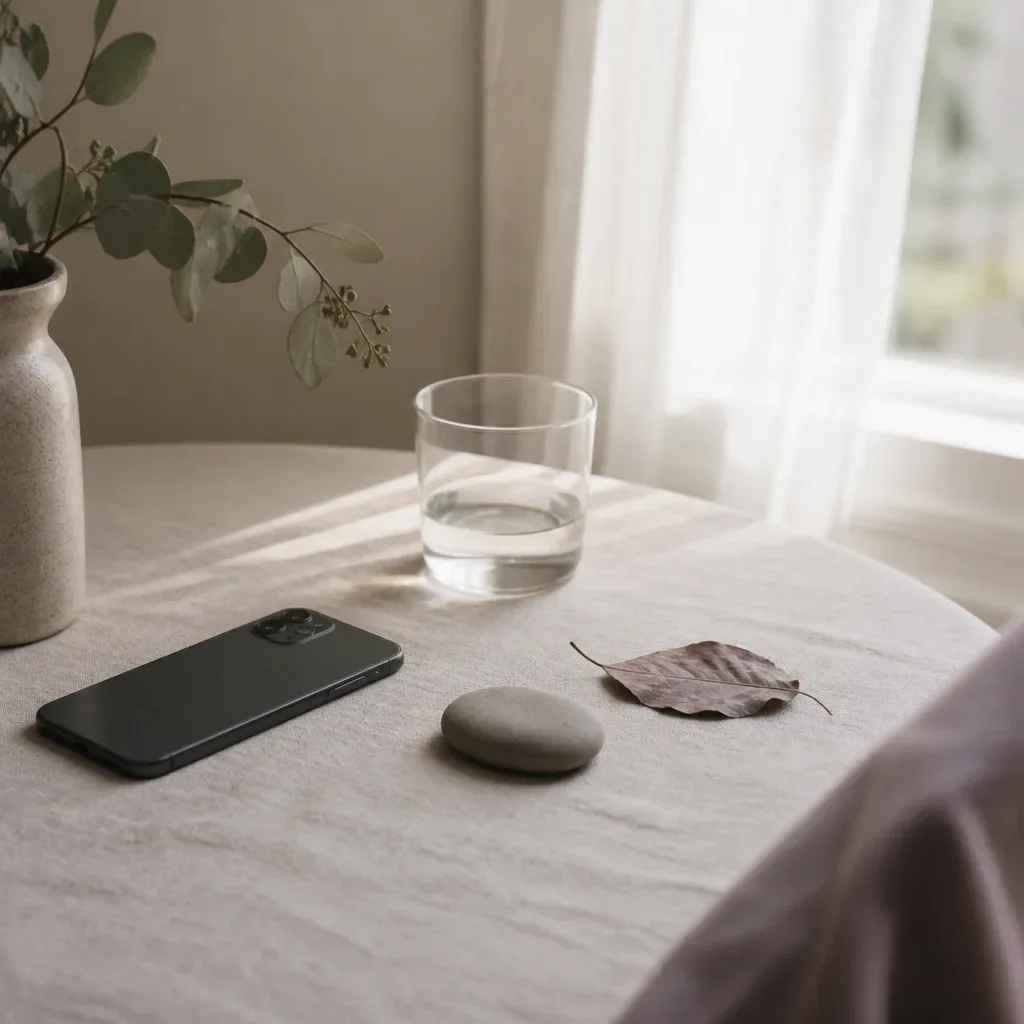
You do not need a full altar. You need a surface. A table, a windowsill, the corner of a bed. Place one thing there that says autumn to you: a leaf, a fig, a cup of tea, a stone from a walk, a photograph you keep meaning to frame. The object is not decoration. It is a marker. It tells the mind, this is different from scrolling.
Keep preparation under 3 minutes. That boundary protects the ritual from becoming another performance. A 2022 American Psychological Association report found that 27 percent of adults said they were so stressed they could not function on most days. When life feels crowded, a ritual that asks for too much will be abandoned. Small is merciful. Small survives.
Use this order:
- Put your phone on silent, unless you are using it for the audio.
- Open a window or light one candle.
- Place one seasonal object nearby.
- Put paper and pen within reach.
- Take 5 slow breaths before you press play.
If you practice with the broader manifestation tradition, remember that form is only helpful when it serves attention. A ritual can be beautiful and still avoidant. A ritual can be plain and completely true.
Here is the quiet test: does this room help you listen, or does it help you perform someone else’s idea of spirituality?
The equinox does not need you to prove devotion. It asks for enough stillness to notice what has become heavy.
What should you write after the audio ends?
After the audio ends, write three honest lines: what you want, what you fear, and what you already know.
Do not write the life story. Do not explain yourself to the page. Give yourself 5 minutes, because a time limit keeps the mind from making a courtroom out of a notebook. In small expressive writing studies, including James Pennebaker’s early work from the 1980s and 1990s, brief written disclosure was linked with improved well-being for some participants. The effect is not a promise. It is a clue. Words can move pressure out of the body.
Use these prompts:
- What do I want to be real by winter?
- What am I afraid will happen if I receive it?
- What do I already know, but keep negotiating with?
- What relationship, habit, or desire needs a cleaner exchange?
- What would balance look like if it were quiet, not impressive?
The third question is often the doorway. You already know more than you admit. You know which plan has gone stale. You know which promise has become too expensive. You know which desire is still true, even after months of pretending it is not.
If you use a daily affirmation, keep it close to the page. One sentence. No grand claims. The affirmations practice is most useful when it supports what you can believe enough to repeat. Research by Joanne Wood and colleagues in 2009 suggested that very positive self-statements could make some people with low self-esteem feel worse. So do not shout over your doubt. Speak under it.
A good equinox affirmation might be: I can choose one true exchange at a time. Another might be: I no longer confuse tension with devotion.
The page is not asking you to be impressive. It is asking you to be accurate.
How do you release something without making it dramatic?
Release one specific thing by naming the cost it has had and choosing the first day you will stop feeding it.
Autumn has a way of making release look graceful. Leaves let go. Light thins. Markets fill with roots and dark fruit. But human release is rarely that elegant. Often it is administrative. You cancel the recurring thing. You stop answering the message at midnight. You remove the app from the home screen. You tell the truth before resentment writes the script.
Choose one thing only. The nervous system learns through repetition, not heroic overload. In habit research, BJ Fogg’s Tiny Habits model and related behavior design work emphasize that small actions tied to existing routines are more likely to last. James Clear popularized a similar idea with the 1 percent improvement frame. The number is not sacred. The mercy is.
Try this table before you decide:
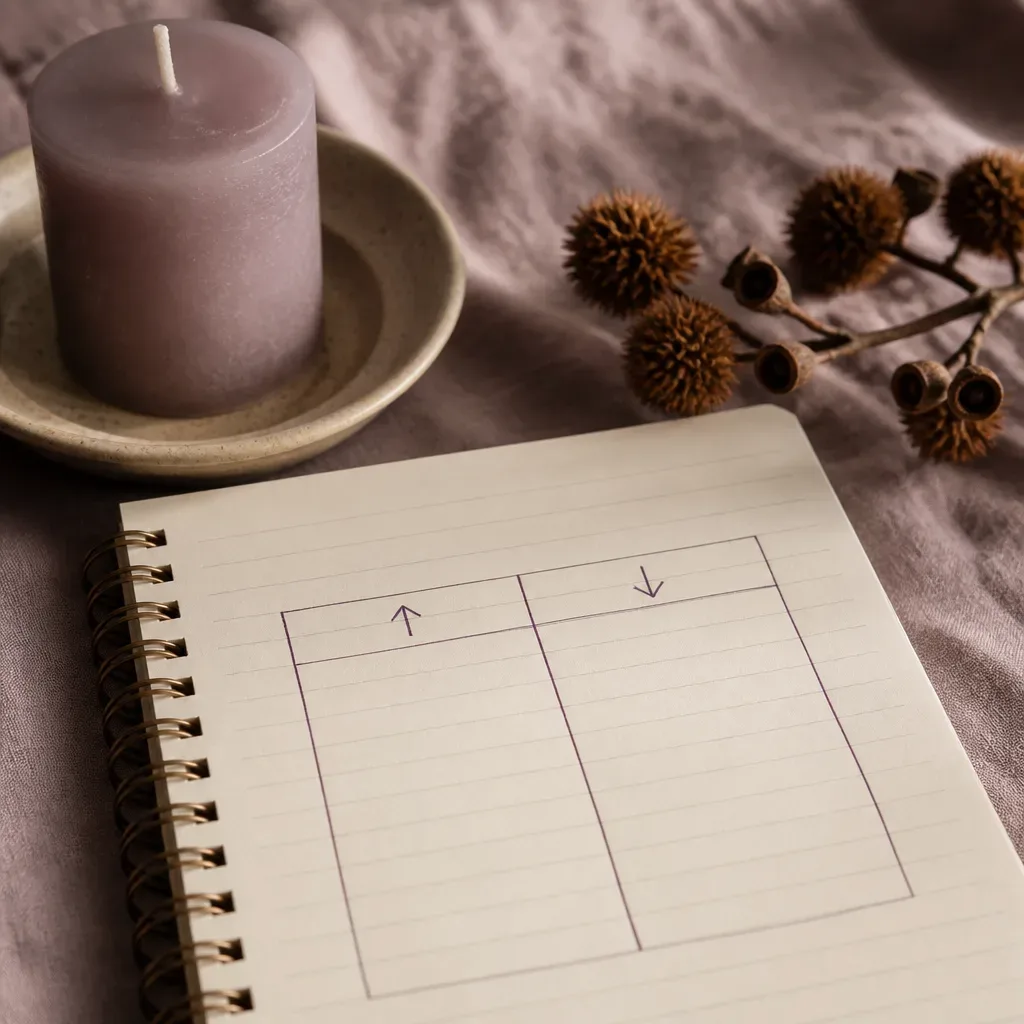
| What I might release | The hidden cost | The first quiet stop |
|---|---|---|
| Saying yes too quickly | Resentment by Thursday | Wait 24 hours before answering |
| Checking messages before listening | Borrowed urgency | Play audio before opening inbox |
| Repeating an old identity | Smaller choices | Use one new sentence daily |
| Over-planning the season | No room for signal | Choose 3 priorities, not 12 |
The most honest release is usually small enough to do today.
You may want fire, ceremony, a torn page. That is allowed. But the real release is not the burning. It is the next ordinary refusal. If you burn a note and return to the same bargain tomorrow, the ritual was theatre. If you change one cue, the ritual has begun.
How do you choose a manifestation intention for the next season?
Choose an intention that can be heard daily, pictured simply, and practiced in one small behavior.
An autumn equinox manifestation intention should not be a wish with costume jewelry on it. It should be plain enough to return to after a bad night of sleep. Try this structure: by winter, I am practicing the identity of someone who does this. Not someone who has everything fixed. Someone who repeats one true thing.
Joe Dispenza often speaks about rehearsing a future state until the body begins to know it as familiar. You do not have to take every claim beyond the evidence to use the practical part: repetition teaches recognition. Cognitive science has long shown that repeated attention strengthens recall. The spacing effect has been observed since Hermann Ebbinghaus in the 1880s and remains one of the most reliable findings in learning research.
Use this 3-part filter:
- Can I hear it in my Dream-Self Moment without flinching?
- Can I name one behavior that proves it quietly?
- Can I repeat that behavior for 14 days?
Fourteen days is not a law. It is a container. A 2009 study by Phillippa Lally and colleagues in the European Journal of Social Psychology found habit formation varied widely, with an average of 66 days for a behavior to become automatic. So 14 days will not make you finished. It will make you honest. You will know whether the intention belongs to you.
If your intention is relational, keep it clean. I receive care without auditioning for it. If it is creative, make it measurable. I photograph for 20 minutes every Saturday morning. If it is financial, avoid fantasy and choose contact. I look at the numbers every Friday without punishment.
The intention is not a spell. It is a place to return.
What does the 18-minute autumn equinox ritual look like?
The ritual is 18 minutes long: prepare, listen, write, release, and choose one daily return.
Here is the whole practice, held simply:
| Minute | Practice | What to do |
|---|---|---|
| 0 to 3 | Prepare | Clear one surface, choose one object, take 5 breaths |
| 3 to 7 | Listen | Play your Dream-Self Moment without writing yet |
| 7 to 12 | Write | Answer desire, fear, and already-known truth |
| 12 to 15 | Release | Name one finished weight and its first stop |
| 15 to 18 | Return | Choose the cue you will repeat for 14 days |
The listening portion is the center. Not the paper. Not the candle. Not the seasonal object. In Aya, the audio carries the method. The app also includes supportive features like a daily affirmation and a Manifestation Board, but those are complements. If you only have time for one thing, listen.
There is good reason to keep this ritual short. According to the CDC, about 1 in 3 adults in the United States report not getting enough sleep. When people are tired, elaborate self-care often becomes another demand. Eighteen minutes is long enough to mark the season and short enough to be repeated.
Your daily return might be:
- Listen after brushing your teeth at night.
- Write one line after the audio.
- Put one hand on your chest before opening messages.
- Read the intention before making a yes-or-no decision.
- Review the Manifestation Board once a week, after listening.
For more seasonal context, let astrology and manifestation be a map, not a rulebook. The sky can mark time. Your listening tells you what the time is for.
How do you keep the ritual alive after the equinox passes?
Keep the ritual alive by choosing one cue and repeating it daily, even when it feels too simple to count.
The equinox is the doorway. The days after it are the practice. This is where most people lose the thread, not because they are weak, but because they make the next step too large. If your ritual requires a perfect mood, it will disappear. If it requires one press of play, it has a chance.
Attach listening to something that already happens. Morning tea. Teeth. The first lamp in the evening. The last 4 minutes before sleep. In the 2006 implementation intention meta-analysis, the cue mattered because it reduced the number of decisions required. Less deciding often means more doing.
Track only 14 days. Use marks, not paragraphs. A dot on paper. A small line in the calendar. The goal is not surveillance. It is remembrance. After 14 days, ask: does this intention still feel true? Has the release changed anything? Do I hear my Dream-Self Moment differently now?
If you want more language around the practice, return to the AYA Method and the wider manifestation guide when you need clarity. If you need one sentence to carry, use this: I listen before I balance.
The season will keep changing without your permission. That can be a comfort. You do not have to hold the whole autumn at once. You only have to return to the sound of the self who knows.
Listen first. Then let the day answer.