evening rituals
Bedtime Manifestation Routine After a Bad Day
A soft bedtime manifestation routine for bad days: settle your body, listen to future-self audio, and sleep without arguing with the day.

The lamp is on. Your jaw still holds the day. A bedtime manifestation routine after a bad day should not ask you to be cheerful; it should help your body soften, listen to one true future-self cue, and let sleep carry what your mind can’t finish tonight.
Why does a bad day feel louder at bedtime?
A bad day feels louder at bedtime because quiet removes the distractions that were holding your feelings at the edge.
During the day, you move from message to task to decision. At night, the room stops moving. That stillness can make the mind replay the awkward sentence, the missed call, the bill, the silence from someone you wanted to hear from. A 2022 American Psychological Association report found that 27% of U.S. adults said most days they were so stressed they couldn’t function. By evening, stress doesn’t always disappear. Often, it waits.
Your brain also has a reason for reviewing danger. The psychologist Roy Baumeister and colleagues wrote in 2001 that negative events tend to affect people more strongly than neutral or pleasant ones. This is sometimes called negativity bias. It isn’t a flaw in you. It’s an old protection pattern. Your mind is asking, “What hurt, and how do I stop it next time?”
A bedtime practice works when it respects that pattern without feeding it. You don’t need to argue the day into becoming good. You need to stop treating the worst moment as the most important teacher in the room. One quiet sentence can be enough: I saw what happened. I don’t have to rehearse it to be safe.
The National Sleep Foundation often names 7 to 9 hours as the recommended sleep range for most adults. But the number isn’t the whole story. What happens in the final 20 minutes before sleep can become the emotional doorway you pass through all night. If that doorway is self-blame, you may wake already braced. If it’s return, the body has a different instruction.
The day can be real without being final.
This is where manifestation becomes less about forcing a mood and more about choosing what gets the last word. Not the bad meeting. Not the argument. Not the version of you who thinks one hard day means you’re behind. The last word can be small. It can be yours.
What should you do in the first three minutes?
In the first three minutes, lower the room, name the day once, and give your body a signal that the danger has passed.
Start with the room because the body believes what it can sense. Dim one light. Move one object off the bed. Put the phone face down or across the room. A 2019 review in Chronobiology International noted that evening light exposure, especially from screens, can delay melatonin timing in many people. You don’t need a perfect sleep cave. You need fewer instructions coming at you.
Then name the day without building a case. Try one of these:
- Today was hard, and I don’t have to solve it tonight.
- I was hurt, and I can still be kind to myself.
- I made it to the end of the day.
- This is not the whole story.
A sentence is not a spell. It is a boundary. It tells the mind, “You have been heard.” The mistake is trying to process the whole day in bed. Bed is not a courtroom. You don’t need to present evidence for your exhaustion.
Here is the first three-minute reset:
- Minute 1: Dim the light and place the phone out of reach.
- Minute 2: Say one plain sentence about the day.
- Minute 3: Exhale longer than you inhale, five times.
Dr. Andrew Huberman has often discussed the role of physiological sighing: a double inhale followed by a long exhale. In a 2023 Stanford-led randomized study published in Cell Reports Medicine, five minutes of cyclic sighing improved mood and reduced breathing rate more than mindfulness meditation in that small sample. You don’t have to make it formal. Two or three slow sighs can tell the body, “We’re not still in the moment that hurt.”
A bad day wants to become an identity. A ritual turns it back into weather.
How do you use audio without trying too hard?
Use audio by letting listening be the practice, not another task to perform.
The AYA Method is a daily audio manifestation practice. Each day you listen to a short personalized recording — your Dream-Self Moment — narrated from the version of you who has already manifested the life you intend. Listening is the practice. Repetition is the work. The audio is the method.
This matters most after a bad day. When you’re tired, written prompts can feel like homework. Visualization can feel far away. Even affirmations can start to sound like another test if your nervous system is saying, “Not tonight.” Audio asks less of you. You press play. You receive the voice. You let your future self speak when your present self has no more sentences.
Neuroscience doesn’t prove manifestation in a simple one-to-one way. It does show that repetition changes familiarity. Research on mental rehearsal, from sports psychology to clinical behavioral practice, has shown that repeated imagery can influence confidence, attention, and readiness. A 2018 review in Frontiers in Psychology described mental imagery as recruiting many of the same neural systems used in perception and action. That doesn’t mean the mind controls every outcome. It means attention is not neutral.
The app also includes a daily affirmation and a Manifestation Board, but those are complements. On a hard night, don’t make three practices out of one need. The audio is enough. If you use the board, glance once. If you use the affirmation, choose one line. Then return to listening.
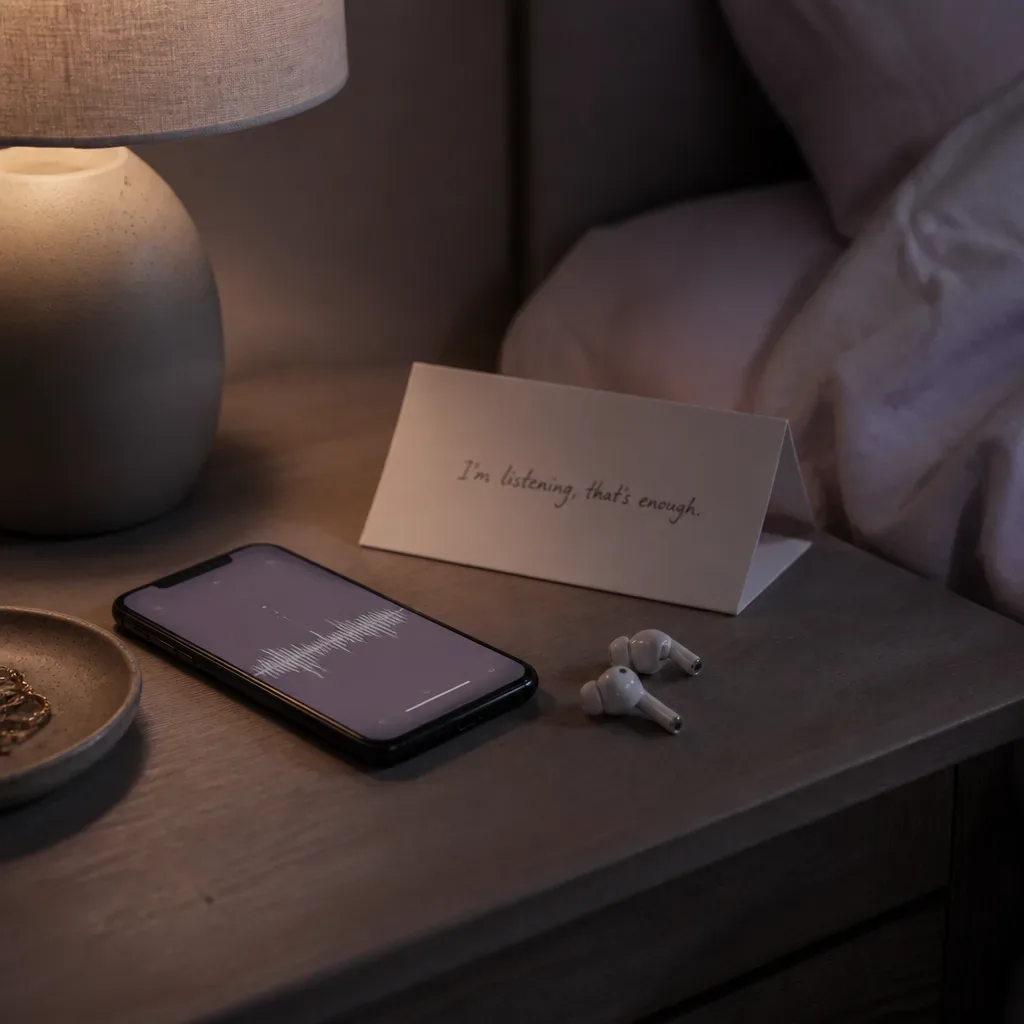
Your Dream-Self Moment should not scold you into becoming better. It should sound like the version of you who has lived through this and knows you are still here. If you want more language for spoken belief, the Affirmations pillar can help you keep the sentence clean and believable.
Listening is an act of consent. You are letting a kinder future enter the room before sleep.
What does an 18-minute bedtime manifestation routine look like?
An 18-minute routine works best when it moves from body, to attention, to audio, to sleep.
You can shorten it. You can repeat one piece. The order matters more than perfection because it follows how the body settles: first the senses, then the breath, then the story. The Centers for Disease Control and Prevention reported that about 1 in 3 U.S. adults don’t get enough sleep. A routine won’t fix every structural reason for that. It can still give your night a more merciful shape.
| Time | Practice | What it tells your body |
|---|---|---|
| 0:00-2:00 | Lower the room | Fewer demands now |
| 2:00-4:00 | Name the day once | I don’t need to replay this |
| 4:00-7:00 | Breathe and unclench | The threat has passed |
| 7:00-13:00 | Listen to your Dream-Self Moment | A steadier self is available |
| 13:00-16:00 | Choose one morning cue | Tomorrow can begin small |
| 16:00-18:00 | Lights down, no more fixing | Sleep is allowed |
At minute seven, begin the audio. Lie down before you press play. Don’t sit upright like a student trying to get it right. If your mind wanders, let it. The return is part of the practice. Meditation research often uses 8-week programs, such as Mindfulness-Based Stress Reduction, to study change over time. Aya’s rhythm is smaller and daily. The smallness is the mercy.
At minute thirteen, choose one morning cue. Not a plan for your whole life. One cue. Drink water. Open the curtains. Reply to one message. Step outside for 2 minutes. The cue matters because the mind trusts what it can picture. In behavior research, BJ Fogg’s Tiny Habits model places emphasis on small actions attached to existing routines. A bad day may tell you everything is broken. One cue says, “No. There is still an entry point.”
If you track your practice, keep it binary. Listened: yes or no. Slept: eventually. No scores. No spiritual grades. No punishment. A ritual that becomes a report card will not hold you on the nights you most need holding.
What if your thoughts keep arguing with the practice?
If your thoughts keep arguing, stop trying to win and give them a smaller job.
The mind loves debate at bedtime because debate feels like control. It says, “If I solve this now, I won’t feel it tomorrow.” But sleep loss makes emotional regulation harder. A 2019 paper in Nature Human Behaviour reported that sleep disruption can increase next-day anxiety, with deep sleep appearing to have an anxiety-reducing role. So the kinder move may be to stop solving and protect sleep.
Use a parking sentence. Write it on paper if needed: I will look at this at 10:00 tomorrow. Not at 2:00 a.m. Not while lying in the dark. Tomorrow at 10:00. This is not avoidance. It’s timing. Architects know this well. You don’t inspect a cracked wall by candlelight and call that the final drawing.
You can also use a three-column release:
| Thought | Bedtime response | Morning action |
|---|---|---|
| I ruined it | I don’t know the full outcome tonight | Send one repair message if needed |
| I’m behind | The bed is not a planning desk | Pick the first task after breakfast |
| I can’t change | Change can be repeated quietly | Listen again tomorrow |
For some people, worry is persistent and clinical. If your nights include panic, trauma recall, or ongoing insomnia, it may be time to speak with a licensed clinician. Cognitive Behavioral Therapy for Insomnia, called CBT-I, has strong evidence and is recommended by the American College of Physicians as a first-line treatment for chronic insomnia. A manifestation routine can sit beside care. It doesn’t need to replace it.
The practice is not here to silence you. It is here to stop the argument from becoming your lullaby.
How can astrology support the night without taking over?
Astrology can support the night when it gives you language for reflection, not a verdict on who you are.
Some nights, you may want a symbolic frame. The moon phase. A transit. A house theme. Used gently, astrology can help you ask better questions: What am I releasing? What wants patience? What pattern is asking to be seen? Used harshly, it can become another reason to fear the night. Keep it soft.
Pew Research Center reported in 2018 that about 29% of U.S. adults believe in astrology. That number doesn’t make astrology science. It does show that many people use symbolic systems to make meaning. Meaning can be useful when it calms the body and clarifies the next honest step. It becomes less useful when it makes you feel trapped.
A simple moon-based prompt can be enough:
- New moon: What small beginning can I protect tomorrow?
- First quarter: Where do I need courage without pressure?
- Full moon: What truth is too loud to ignore?
- Last quarter: What can I stop carrying into bed?
If you like this kind of reflection, Astrology and manifestation offers a wider frame. Keep the hierarchy clear. Your nightly audio remains the practice. Astrology is a lens. A lens helps you see; it does not live your life for you.
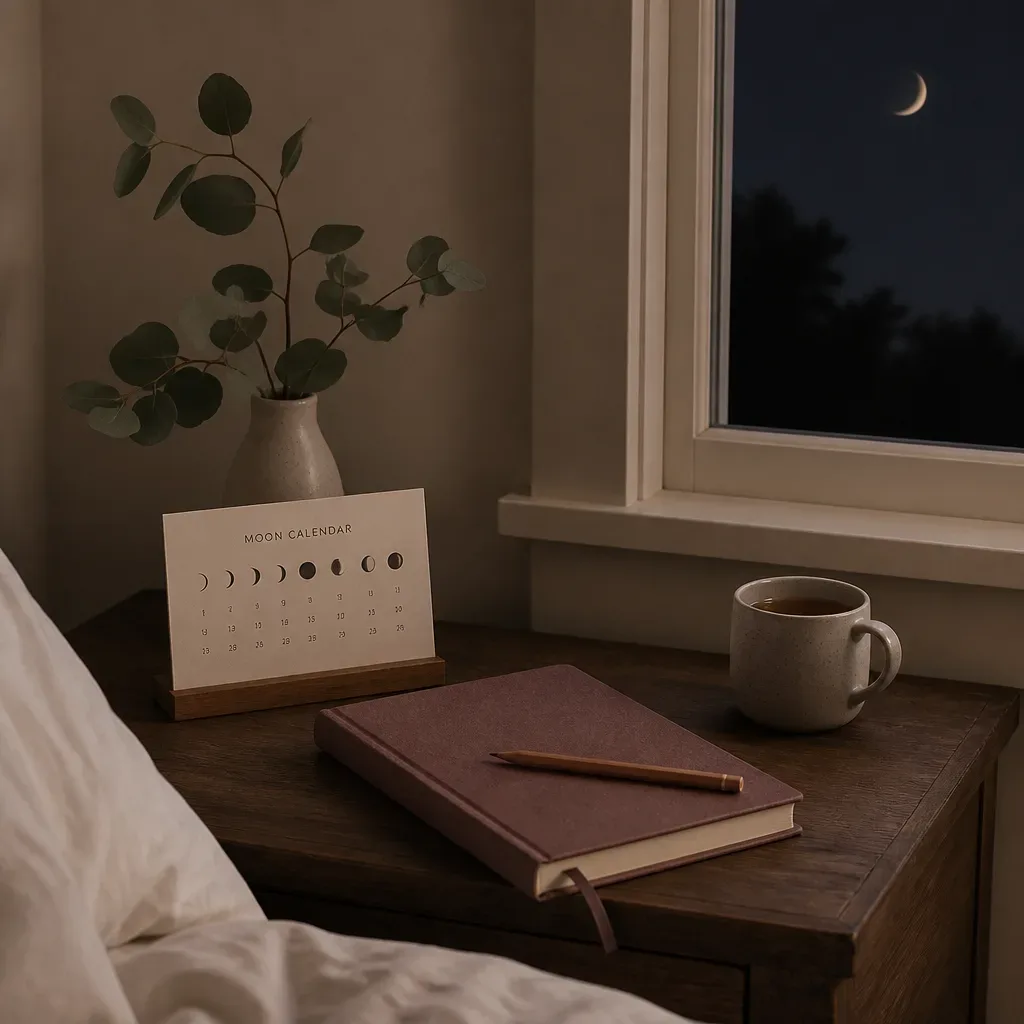
On a bad day, symbols should bring you home to your own agency. If a reading makes you more afraid, close it. Return to breath. Return to the Dream-Self Moment. Return to the sentence that doesn’t demand a performance: I can be with tonight as it is.
What should you repeat tomorrow night?
Repeat the smallest version of the routine tomorrow night so your mind learns that return is available more than once.
One good night is kind. Repetition is what teaches. In habit research, automaticity often takes longer than the old 21-day myth. A 2009 study by Phillippa Lally and colleagues in the European Journal of Social Psychology found that habit formation took 66 days on average, with wide variation. That should relieve you. Missing one night doesn’t erase the pattern. Returning is the pattern.
Use this minimum version when the day has been heavy:
- Put the phone away.
- Say: This day is complete enough.
- Take three long exhales.
- Listen to your Dream-Self Moment.
- Sleep without reviewing your worth.
Use the fuller version when you have room. Add a line in a notebook. Add one affirmation if it feels true. Add one glance at your visual cue if your Manifestation Board helps you remember what you’re tending. But don’t confuse more with better. More can become noise. Better is often quieter.
For a wider foundation, you can return to the manifestation pillar and notice the same principle: attention, repetition, and lived action belong together. A bedtime routine is one doorway. The morning will still ask for choices. The practice doesn’t remove life. It changes the state from which you meet it.
I tell my design students that a room is shaped by what you refuse to store there. The same is true for the mind before sleep. Don’t store the whole bad day in the bed. Let the bed be a place where the next self can find you.
Tonight, make the room soft enough to hear yourself return.
Listen on Aya

