audio manifestation
Binaural Beats Manifestation vs Future-Self Audio
A quiet comparison of binaural beats manifestation and future-self audio, with research notes, use cases, and a softer way to choose your practice.
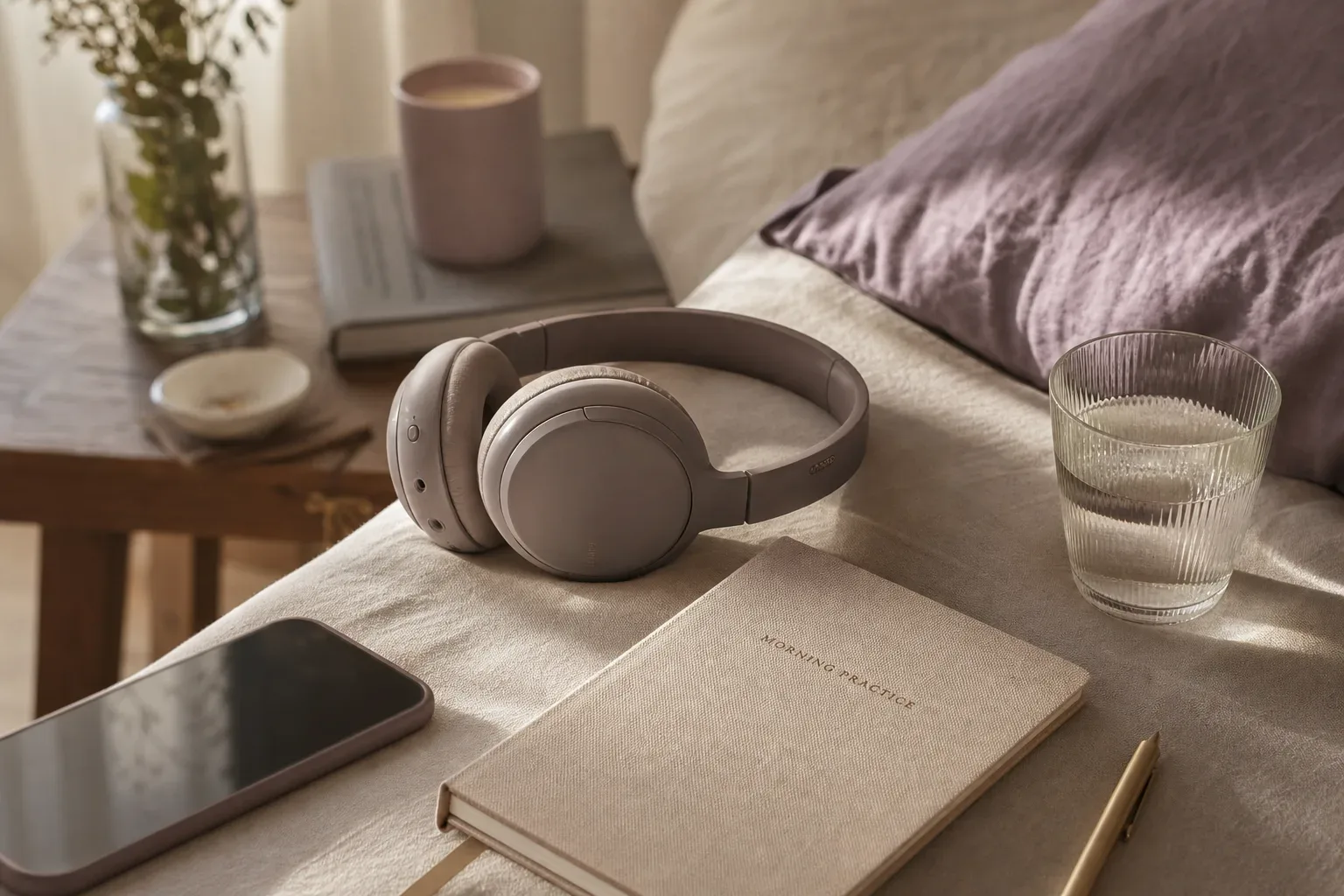
The headphones are on the bedside table. If you’re choosing between binaural beats manifestation tracks and future-self audio, the difference is simple: binaural beats may shift your state; future-self audio gives that state a story, a voice, and a self to rehearse every day.
What are you actually comparing?
You’re comparing a sound-based state cue with a narrated identity practice.
Binaural beats happen when each ear hears a slightly different tone and the brain perceives a third rhythmic pulse. The classic explanation comes from Gerald Oster’s 1973 paper in Scientific American, which described how a 300 Hz tone in one ear and a 310 Hz tone in the other can create the perception of a 10 Hz beat. That number matters because 10 Hz sits near the alpha range, often linked with relaxed wakefulness in EEG research.
Future-self audio is different. It doesn’t mainly ask the brain to follow a beat. It asks you to listen to a version of you who speaks as if the desired life is already real. The language is the cue. The repetition is the container. The body begins to know the scene because it has heard it before.
This is where the AYA Method sits. The AYA Method is a daily audio manifestation practice. Each day you listen to a short personalized recording — your Dream-Self Moment — narrated from the version of you who has already manifested the life you intend. Listening is the practice. Repetition is the work. The audio is the method.
A comparison helps because both practices can feel quiet from the outside. Eyes closed. Phone near the pillow. A few minutes of listening. But the inner task isn’t the same.
| Practice | Main cue | Best for | Limit |
|---|---|---|---|
| Binaural beats | Perceived frequency difference | Settling attention or mood | The content is often generic |
| Future-self audio | Personalized narration | Rehearsing identity and choice | It asks for daily repetition |
| Both together | State plus story | Short pre-practice settling | Too much sound can blur the message |
A frequency can open the door. A voice tells you where you are.
Do binaural beats manifestation tracks change the brain?
Binaural beats may influence attention or mood for some listeners, but the research is modest and not all findings agree.
The strongest honest answer is careful. A 2019 meta-analysis by Garcia-Argibay, Santed, and Reales reviewed studies on binaural auditory beats and found that effects depended on exposure time, frequency range, and outcome measured. Some studies reported changes in anxiety, memory, or attention. Others found little. This doesn’t make binaural beats useless. It makes them specific. They aren’t a guarantee. They’re a condition.
For manifestation, that matters. Many binaural beats manifestation tracks promise theta access, instant calm, or faster receiving. The quieter truth is better: a repetitive sound can help the nervous system stop reaching for the next thing. In a 2020 review in Psychological Research, auditory beat stimulation was still described as a field needing stronger controls, especially because expectation can shape outcomes. If you believe a track will settle you, that belief may be part of what settles you.
That’s not a flaw. The placebo effect is still the body responding. In pain research, placebo responses can show measurable brain activity, including studies from Benedetti and colleagues in the early 2000s. The body isn’t fake because belief is involved. It is beautifully suggestible.
Use binaural beats when you need a low-verbal practice. Use them when words feel like too much. Use them when you want to soften the surface of the mind before choosing a clearer inner picture through manifestation practice.
They are not, by themselves, a complete map of becoming.

What does future-self audio train instead?
Future-self audio trains self-recognition, not just relaxation.
Your brain treats the future self strangely. Research by Hal Hershfield and colleagues, including a 2011 study in the Journal of Marketing Research, found that people who saw age-progressed images of themselves were more willing to allocate money toward retirement. The future felt less like a stranger. That small shift changed present behavior.
Audio can do a related thing without the image. When you hear a future-self narration, the self you’re rehearsing becomes less abstract. You aren’t only saying, “I want a calmer life.” You’re hearing what your morning sounds like when calm is ordinary. You’re hearing how you answer a message. How you leave the room. How you trust the next small choice.
That specificity is the difference. Generic sound may quiet the room. Personalized audio places you inside the room.
There is also a memory reason this can work. Mental rehearsal has been studied in sports psychology for decades. A well-known 1995 paper by Driskell, Copper, and Moran reviewed mental practice and found it improved performance, especially when paired with physical practice. Manifestation is not the same as shooting a free throw. Still, the principle is useful: repeated inner rehearsal can prime later action.
Future-self audio also sits near self-affirmation research, but it isn’t the same as repeating one line. Cohen and Sherman wrote in the Annual Review of Psychology in 2014 that self-affirmation can reduce defensiveness and help people stay open to change under threat. A daily affirmation can support the work. So can a Manifestation Board. But in AYA, they are complements. The audio is the method.
The body listens for what the mind repeats.
Which one should you use, and when?
Use binaural beats for state, future-self audio for direction, and choose based on what feels missing today.
If you’re scattered, a binaural track may help you settle enough to listen. If you’re calm but vague, future-self audio will usually serve you better. Manifestation without specificity can become fog. Specificity doesn’t need to be loud. It needs to be true enough that your body can practice it.
Here’s a simple way to choose:
- If your body is tense, start with 2 to 5 minutes of quiet sound or breath.
- If your mind is vague, choose future-self audio with concrete scenes.
- If you’re repeating old choices, listen to the same Dream-Self Moment daily for at least 7 days.
- If you’re using affirmations, keep them short and connected to behavior.
- If you’re tired, lower the volume and make the practice smaller.
The seven-day frame is not magic. It is just long enough to notice pattern. Many habit studies use longer windows; Phillippa Lally’s 2009 study in the European Journal of Social Psychology found habit formation averaged 66 days, with a wide range from 18 to 254 days. Still, one week can show you what your body resists, repeats, and begins to remember.
You can also think of the choice somatically:
- Binaural beats ask, “Can I settle?”
- Future-self audio asks, “Can I recognize myself there?”
- Affirmations ask, “What sentence am I willing to repeat?”
- A visual board asks, “What image keeps calling me back?”
For more on spoken practice, the affirmations guide is useful. Just keep the hierarchy clear. If you’re using Aya, the Dream-Self Moment leads. The other tools gather around it.
A calm state is not the same as a chosen self.
Can the two be used together without confusing the practice?
Yes, if binaural beats support the listening rather than compete with it.
The most common mistake is layering too much. A theta beat, rain sound, spoken affirmations, background music, subliminal lines, and a future-self narration can become noise. Your body may relax, but the message gets harder to receive. Cognitive load research has shown for decades, including John Sweller’s work from the late 1980s, that too much incoming information makes learning harder. The same principle applies here. A soft practice can still be crowded.
If you want both, make the order clean. Let binaural beats be a threshold. Then let future-self audio be the room.
Try this structure:
| Minute | Practice | Purpose |
|---|---|---|
| 0:00-2:00 | Quiet breathing or low binaural beat | Settle the body |
| 2:00-7:00 | Future-self audio | Rehearse the desired self |
| 7:00-8:00 | Silence | Let the body register it |
| Later | One daily affirmation, if needed | Carry the cue into action |
Dr. Andrew Huberman often points to the role of state in learning and plasticity, especially the need for attention and later rest. You don’t need to turn that into a performance. You only need to notice whether your listening is clearer after the beat or less clear. The body gives data. It may be small data, but it is yours.
If astrology is part of your reflective rhythm, keep it as context rather than command. You might use astrology and manifestation to choose a theme for the week, then let the audio stay personal and grounded. A moon phase can mark time. It cannot listen for you.
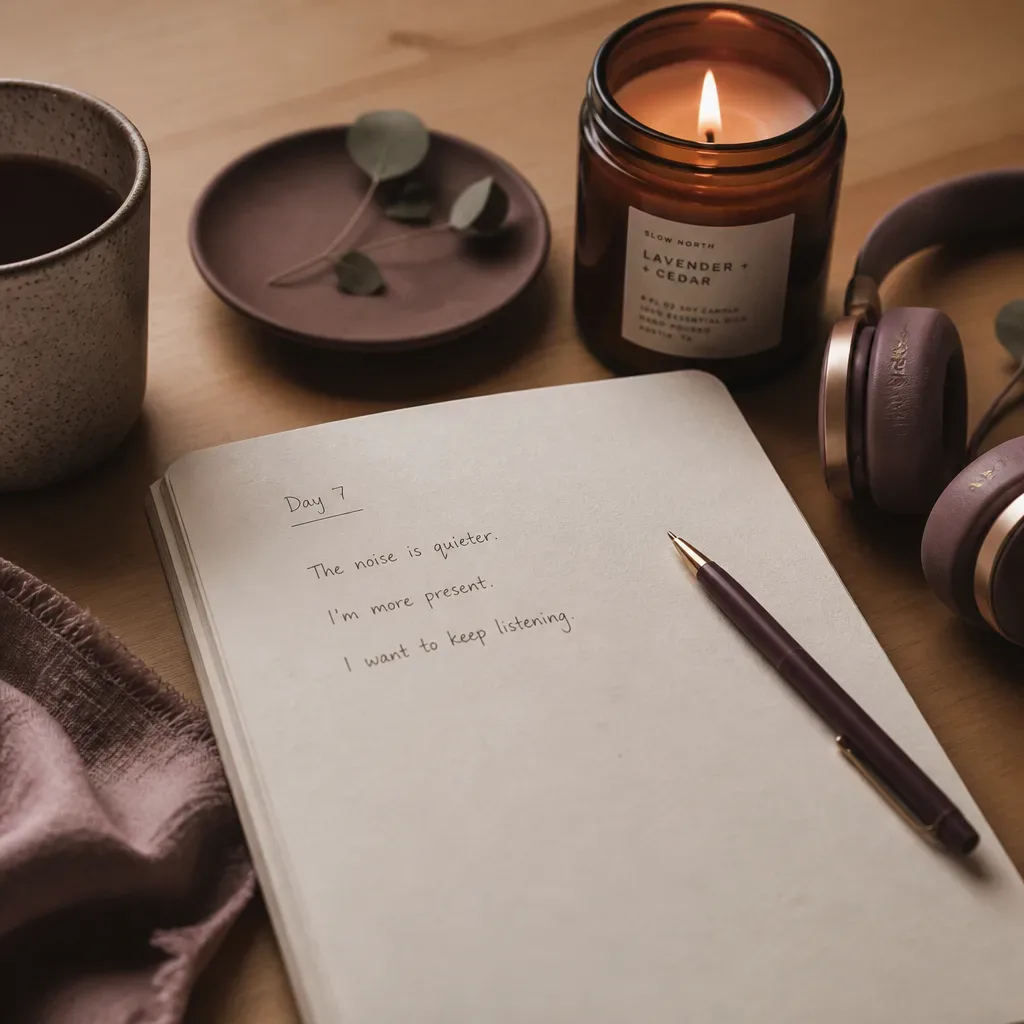
What should you listen for after seven days?
After seven days, listen for evidence in your choices, not only in your mood.
A practice that only feels good while it’s playing may still be kind. But manifestation practice asks for more than a pleasant listening session. It asks whether your day begins to move differently. Did you answer one message with less panic? Did you pause before saying yes? Did you choose the walk, the invoice, the boundary, the page? These are small signs. They count.
In behavior research, self-monitoring is one of the more reliable supports for change. A 2012 review by Michie and colleagues on behavior change techniques found self-monitoring appeared often in effective interventions. You don’t need a complex tracker. Three notes are enough.
After each listen, write:
- What did my body do? Jaw, breath, belly, shoulders.
- What line stayed with me? One sentence only.
- What small choice followed? Something observable within 24 hours.
This keeps the practice honest. Binaural beats manifestation tracks can sometimes invite you to measure by sensation alone: tingles, heaviness, floating, sleepiness. Sensation matters. I teach through sensation. But sensation is not the whole truth. The body also speaks through the choices it can now tolerate.
The Princeton Engineering Anomalies Research program, often called PEAR, studied intention and random systems for almost 30 years before closing in 2007. Its findings remain debated. That debate is a reminder to stay humble. Not everything meaningful can be proved neatly. Not everything unproved should be believed without care.
The cleanest question is not, “Did this track make something happen?” It is, “Did this practice help me become more available for the next true action?”
That is where audio manifestation becomes less about force and more about relationship. You listen. You repeat. You notice. You return.
The future self is not far away when the next choice knows her name.
Which practice is the quieter long-term choice?
Future-self audio is usually the quieter long-term choice because it gives repetition a specific identity to return to.
Binaural beats can still be useful. I don’t dismiss them. Some evenings, the body doesn’t want language first. It wants tone. It wants the room dim. It wants permission to stop solving. A 15-minute track can be a gentle bridge from effort into receptivity. That is real enough.
But long-term manifestation needs a remembered self. It needs language that repeats until it becomes familiar. Neville Goddard wrote often about assuming the feeling of the wish fulfilled. Joe Dispenza teaches forms of mental rehearsal that pair emotion, attention, and imagined future scenes. You don’t have to follow either teacher completely to see the shared thread: the mind practices a self before the outer life fully confirms it.
Future-self audio makes that practice listenable. It gives you a beginning, middle, and return. It doesn’t ask you to invent the scene every time. It lets the nervous system meet the same cue again, the way dancers return to a phrase until it no longer feels separate from the body.
If you’re comparing the two, let it be simple:
- Choose binaural beats when you need a state change.
- Choose future-self audio when you need self-rehearsal.
- Choose both only when the sound makes the words easier to receive.
- Choose silence when your body has heard enough.
The practice that lasts is often the one that asks the least performance from you. A few minutes. The same voice. The same future, spoken as already yours. For a wider frame, read the manifestation pillar and then come back to the headphones on the table.
Listen for the version of you that doesn’t need to shout.