vision boards
Digital Vision Board App vs Future-Self Audio
A digital vision board app helps you see the life you're choosing, while future-self audio helps you rehearse it daily. Here's what to use.
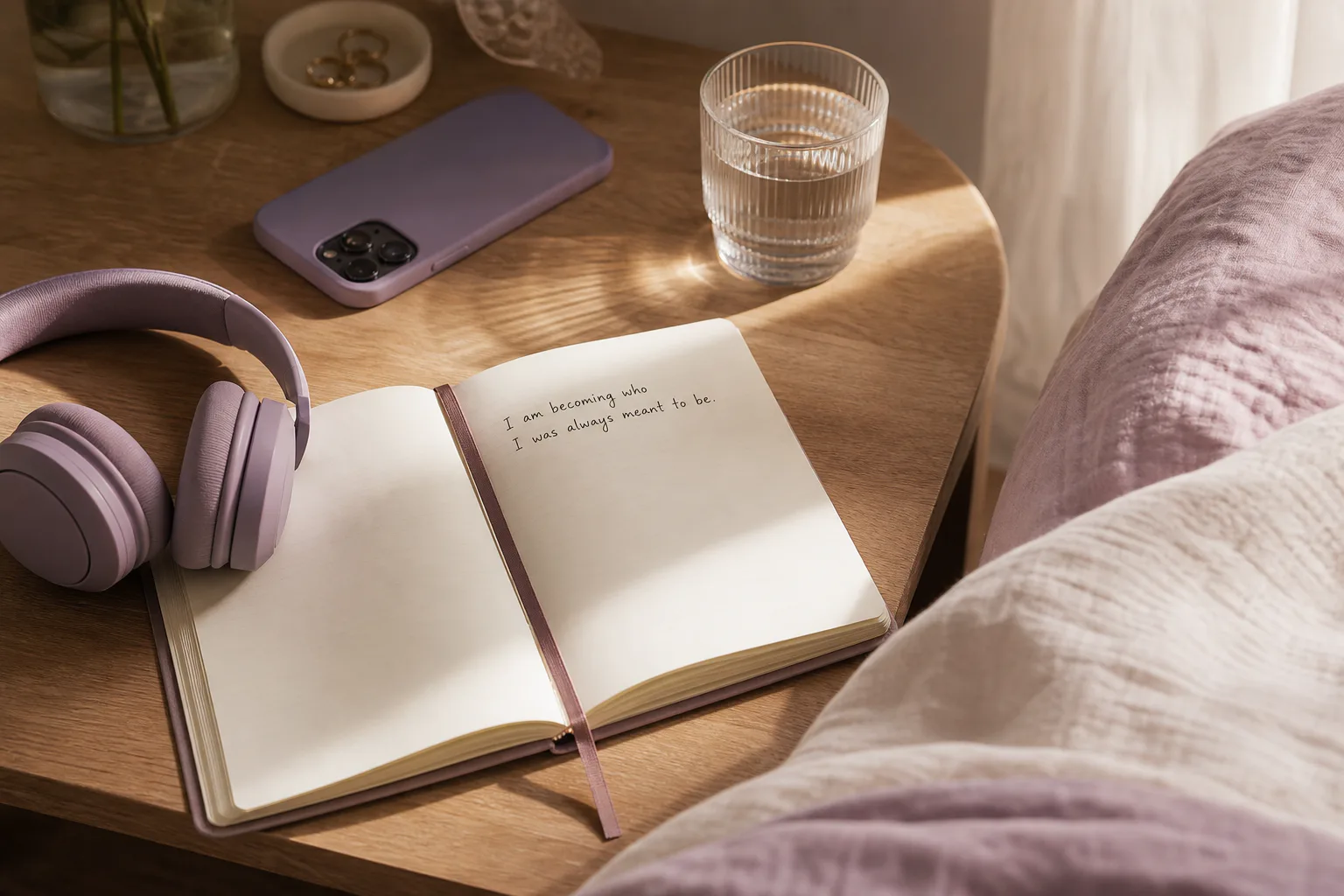
Your phone is face down beside the bed. Headphones nearby. If you’re choosing between a digital vision board app and future-self audio, use the board to see your desire, and use audio to practice it daily. The board reminds you. The voice rehearses you into recognition.
What does a digital vision board app actually do for you?
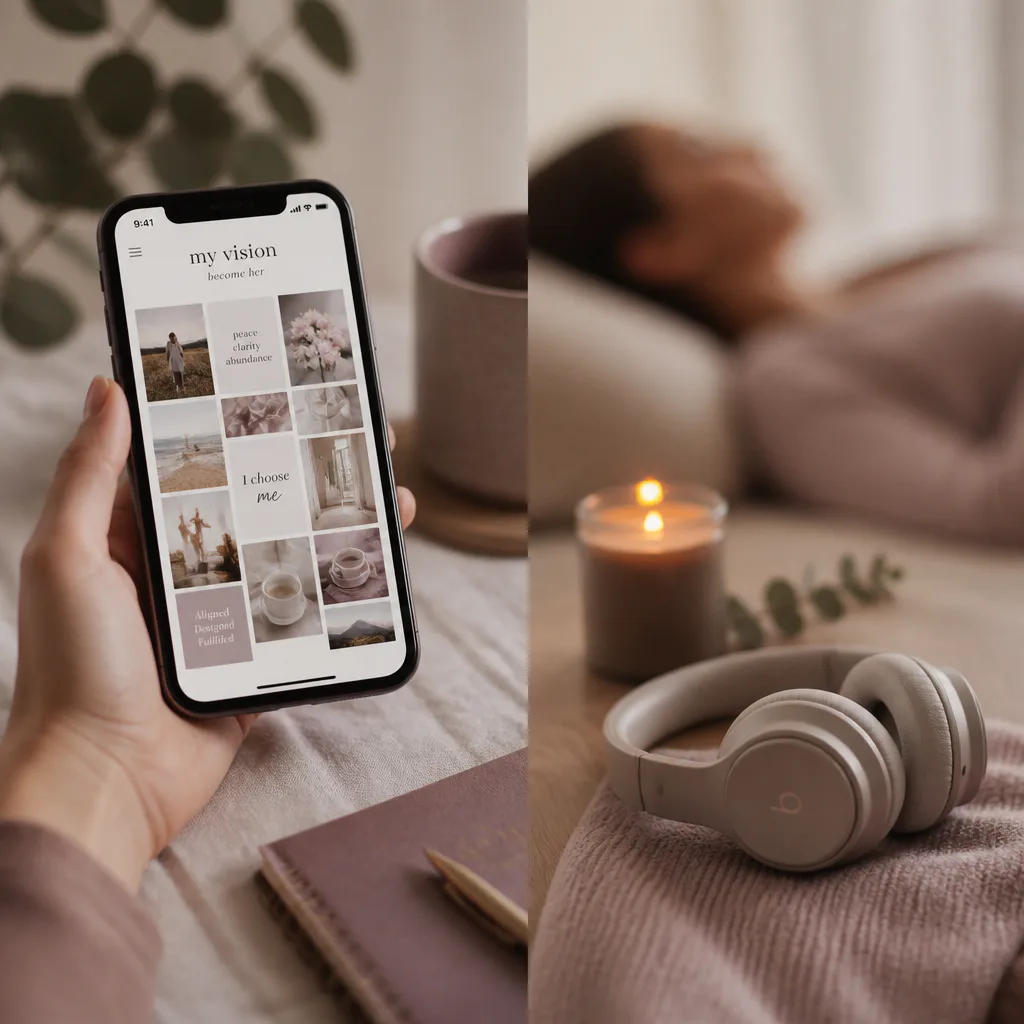
A digital vision board app gives your intention a visual place to live.
That sounds small. It isn’t. A board gathers images, words, colors, dates, and symbols into one surface you can return to. In the older paper version, you cut and pasted. In the digital version, you collect and arrange. The practice is not the collage itself. The practice is the attention you bring back to it.
Visual cueing has a long life in behavior research. In one often-cited line of work, implementation intention studies by psychologist Peter Gollwitzer found that specific cues such as “when X happens, I’ll do Y” can improve follow-through across many settings. A vision board isn’t the same as a plan, but it can become a cue. It says: remember this. Choose from here.
A digital board has three clear strengths:
- It stays with you on the device you already check dozens of times a day.
- It can be changed in under 5 minutes when a goal becomes more precise.
- It can hold visual proof, not only aspiration: screenshots, notes, rooms, offers, routes, names.
The quiet risk is that it becomes decoration. You can spend 90 minutes choosing images and only 9 seconds feeling the truth of them. That ratio matters. In a 2011 paper in the Journal of Experimental Social Psychology, researchers Heather Kappes and Gabriele Oettingen found that positive fantasies alone could reduce effort because the body sometimes reads imagined completion as partial satisfaction.
A board works best when it doesn’t flatter you. It should tell the truth. Not the shiny version. The living version.
If you want a deeper foundation, the Manifestation pillar holds the broader practice: attention, repetition, self-concept, and the way desire becomes daily contact rather than wishful waiting.
What does future-self audio do differently?
Future-self audio gives your intention a voice you can hear before you fully believe it.
A digital board asks you to look. Audio asks you to listen. That difference changes the body of the practice. You can close your eyes. You can be tired. You can be in the dark. You can receive the same words again, and repetition is not a flaw here. It’s the work.
The AYA Method is a daily audio manifestation practice. Each day you listen to a short personalized recording — your Dream-Self Moment — narrated from the version of you who has already manifested the life you intend. Listening is the practice. Repetition is the work. The audio is the method.
Mental rehearsal has been studied for decades, especially in sport, pain care, and behavior change. A 1995 meta-analysis by Driskell, Copper, and Moran found that mental practice had a positive effect on performance, with stronger results when people had some familiarity with the task. You don’t need to pretend audio replaces action. It prepares the inner stance from which action becomes less foreign.
This is where future-self audio is different from a static board. It has sequence. It has timing. It can name the ordinary life around the desire: how you wake, how you speak, how you choose, how you return after doubt. Neville Goddard called this living from the fulfilled state. Joe Dispenza speaks often about rehearsing a new self until the body begins to know it. You don’t have to adopt every claim to understand the useful center: what you repeat becomes easier to access.
A picture can show you the door. A voice can help you walk toward it.
The app also includes a daily affirmation and a Manifestation Board, but those are complements. They sit around the practice. The listening remains the center.
Which one is easier to use every day?
Future-self audio is usually easier for daily use because it asks for less active effort.
This matters more than people admit. Most practices don’t fail because the person is unserious. They fail because the practice requires too many small decisions. What image should I open? What should I feel? How long should I look? Did I do it correctly? By the time the mind has asked four questions, the body has already reached for coffee.
The average adult in the United States checked a phone 144 times per day in a 2023 Reviews.org survey. Even if that number is imperfect, the direction is familiar. The phone is close. But closeness doesn’t equal care. A digital vision board app can be easy to open and still easy to ignore.
Here’s the clean comparison:
| Daily factor | Digital vision board app | Future-self audio |
|---|---|---|
| Best sense used | Sight | Hearing |
| Daily effort | Choose, look, interpret | Press play, listen |
| Works with eyes closed | No | Yes |
| Best time | Morning review or evening reset | Bed, walk, bath, quiet commute |
| Risk | Becomes visual clutter | Becomes background sound |
| Best role | Reminder | Practice |
Dr. Andrew Huberman has often described behavior change through the lens of nervous system repetition and state. One practical takeaway is simple: the state you’re in while practicing matters. If you’re tense, rushing, and scrolling past your board in 3 seconds, the board may not land. If audio helps you slow your breathing for 4 minutes, the same intention may feel more available.
Use the daily tool you can repeat when you’re not impressive. That is the honest test.
A good practice survives an ordinary Tuesday. It survives low sleep, a full inbox, and the version of you who doesn’t want to be coached.
When should you choose a digital vision board app first?
Choose a digital vision board app first when your desire needs shape, language, and visual specificity.
There are seasons when you don’t yet know what you’re asking for. You feel the edge of it. You know the old life is too tight. But the new one is blurry. In that season, a board can help you sort. You collect 20 images, then notice only 5 are true. You delete the rest. That deletion is part of the practice.
A board is especially useful when the desire has a visible form. A home. A studio. A city. A body of work. A calmer calendar. A relationship rhythm. A financial number written plainly. Specificity matters: studies on goal-setting, including Locke and Latham’s work across more than 35 years, consistently show that specific and challenging goals tend to improve performance more than vague goals.
You might choose a board first if:
- You don’t know what your desire looks like yet.
- You need to separate borrowed goals from real ones.
- You respond strongly to images, rooms, textures, and written phrases.
- You want one place to gather proof and reminders.
- You’re building language for your future-self audio.
The board can become a listening brief. You look at it and ask: what would this version of me say in the first person? How would she describe the morning? What has changed in the way she makes decisions? From there, the audio becomes more precise.
This is also where Affirmations pillar can help. A good affirmation isn’t a slogan pasted over fear. It’s a sentence you can stay near without leaving yourself. If your board has a phrase that makes your body soften, keep it. If it makes you perform, revise it.
Your board doesn’t need more beauty. It needs more honesty.
When should you choose future-self audio first?
Choose future-self audio first when you already know the direction and need daily contact with it.
Some desires are not visually complicated. You know the house. You know the work. You know the relationship pattern. You know the feeling of being steady with money, or respected in your craft, or rested inside your own life. The issue isn’t clarity. The issue is repetition.
Future-self audio is useful here because it puts the desired self into narrated time. Instead of staring at an image of a kitchen, you hear yourself moving through a morning in that kitchen. Instead of looking at a number, you hear the choices of the person who can hold that number without panic. The practice becomes less about wanting and more about recognition.
In small studies on self-affirmation, including work by Creswell and colleagues published in Psychological Science in 2013, affirming personal values appeared to reduce stress responses during difficult tasks. Future-self audio is not identical to values affirmation, but it uses a related human opening: the self becomes more stable when it’s spoken to with care and specificity.
Choose audio first if:
- You keep making boards but don’t return to them.
- You understand your desire but don’t feel close to it.
- You need a practice that works in bed or before sleep.
- You want fewer choices and more repetition.
- You tend to over-edit visuals until the practice becomes another project.
There is a reason daily audio can feel almost too simple. The mind likes labor it can measure. It trusts a full notebook, a rebuilt board, a long ritual. But nervous systems often learn through repetition, not spectacle. Five minutes repeated 30 times is a different teacher than 2 hours performed once.
For a wider view on timing, symbols, and self-reading, Astrology and manifestation can be useful, especially if you use celestial cycles as reflective prompts. Keep it gentle. The chart can be a mirror. It doesn’t need to become a command.
Can you use both without making the practice too much?
Yes, you can use both if each tool has one clear job.
The board holds the image. The audio carries the rehearsal. That’s enough. Trouble begins when every tool is asked to do every job. Then the practice becomes crowded. You open the board, change the images, rewrite the affirmation, check the moon, track the habit, judge your mood, and call it devotion. It may only be noise.
A simple 7-day rhythm can keep it clean:
- Day 1: Build or refresh the board for 20 minutes.
- Day 2: Listen to future-self audio once, without editing anything.
- Day 3: Look at the board for 60 seconds, then listen.
- Day 4: Listen only.
- Day 5: Add one real-world proof point to the board.
- Day 6: Listen before sleep.
- Day 7: Remove one image that no longer feels true.
That is plenty. In behavior design, BJ Fogg’s Stanford model places ability beside motivation and prompt. A behavior is more likely when it’s easy enough to do when prompted. This is why a 4-minute listening practice may outlast a 45-minute visual ritual. Not because it’s grander. Because it’s repeatable.
If you use Aya, the board can support the Dream-Self Moment without competing with it. Your digital board might hold the room, the phrase, the number, the face, the city street. Your audio lets the future self speak from inside that life.
A vision board is the part of the practice you can see. It doesn’t have to be beautiful. It has to be true.
For more context on the visual side, the Manifestation Board section inside the AYA Method explains how visual reminders can sit beside the daily recording without becoming the center of the method.
What should you use tomorrow morning?
Use future-self audio tomorrow morning, then let the digital vision board app support it later in the day.
Morning is tender. The mind is suggestible, but it’s also easily hijacked. A 2019 survey from RescueTime reported that many users averaged over 3 hours of phone time per day, and the first check often happened within minutes of waking. If your board lives inside the same device as messages, news, and comparison, you need a softer entry.
Try this instead:
- Put headphones beside the bed tonight.
- On waking, listen to your Dream-Self Moment before opening messages.
- Let one sentence stay with you.
- Later, open your digital vision board app for 60 seconds.
- Touch one image and name one small action for the day.
This order protects the inner practice. First, you hear who you’re practicing being. Then you see the cues that support her. Then you do one small thing. Not a dramatic thing. A real thing.
The digital vision board app you choose matters less than the way you return to it. Some people need folders and templates. Some need one plain board with 9 images. The best tool is not the one with the most features. It’s the one that leaves you more honest after using it.
If you’re choosing between the two because you only have 5 minutes, choose audio. If you have 10 minutes, listen first and look second. If you have a quiet Sunday, refine the board so Monday’s audio has a clearer world to speak from.
You don’t need a louder practice. You need one you can hear.
Stay with the voice that brings you home.