astrology manifestation
Full Moon Release Ritual: 3-Minute Listening Practice
A quiet full moon release ritual for three minutes of listening, naming, and letting go without candles, pressure, or a perfect lunar setup.

A full moon release ritual can be three minutes long: arrive, listen, name one thing to put down. You do not need a perfect altar or a late night. The full moon gives you a visible mark in time. The listening gives your mind a quieter instruction.
What is a full moon release ritual really for?
A full moon release ritual is for noticing what has become too heavy to keep rehearsing.
The moon does not need you to be theatrical. It is already doing its old work. NASA describes the lunar cycle as about 29.5 days, from one new moon to the next. That rhythm is useful because it gives you a recurring place to pause. Not because the sky is grading you. Because humans remember better when a practice has a cue.
In my greenhouse, I mark the full moon with a kettle, not a ceremony. One mug. One chair. Sometimes a stem of rosemary because rosemary keeps its scent after being touched. The point is not to make the room sacred. The point is to stop moving long enough to hear what you already know.
A release ritual is not punishment. It is not a way to shame yourself for wanting, grieving, comparing, repeating, or hoping. The quiet work is smaller than that. You ask one question: what am I done carrying in this form?
Research on implementation intentions, led by psychologist Peter Gollwitzer, has shown that simple if-then cues can improve follow-through across many studies. A full moon can be one of those cues. If the moon is full, then I pause for three minutes. That is enough structure for the nervous system to recognize a doorway.
You do not release by becoming a different person. You release by telling the truth without adding a performance.
If you already practice astrology and manifestation, this ritual keeps the astrology gentle. The full moon is not a demand. It is a lamp. It lets you see what is ready to be set down.
Why keep the ritual to 3 minutes?
Three minutes keeps the ritual small enough to repeat and honest enough to finish.
Long rituals can be beautiful. They can also become another place to fail. The National Center for Health Statistics has reported that many adults struggle with sleep and stress symptoms, and when the body is tired, a 45-minute practice can feel like one more locked door. Three minutes gives you a way in. You can do it before bed. You can do it after washing your face. You can do it while the kettle cools.
The shortness matters. In behavior research, tiny actions are easier to connect to existing cues. BJ Fogg’s work at Stanford has often used the idea that a behavior becomes more likely when it is small, specific, and attached to something already happening. Full moon, cup of tea, three minutes. That is a clean shape.
Here is the whole practice:
- Minute 1: arrive. Sit down. Let the room be ordinary. Take one slow breath and name three real things you can see.
- Minute 2: listen. Play your short audio, or listen inwardly for the sentence your wiser self would say without urgency.
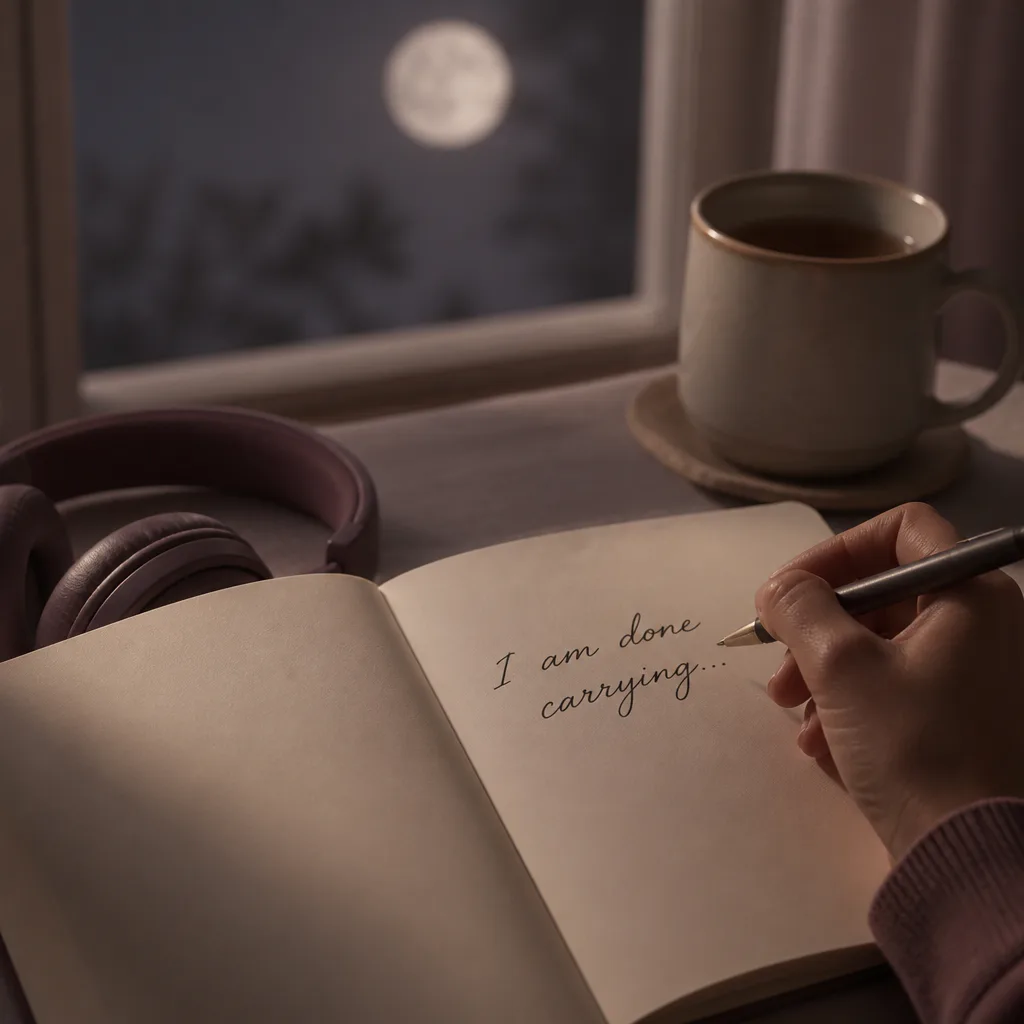
- Minute 3: release. Write one line: “I am done carrying…” Then name one specific pattern, fear, resentment, or old role.
Do not add seven more steps because you are anxious. Do not turn the sentence into a contract. A ritual can be complete before your mind believes it has done enough.
A 2019 review in Frontiers in Psychology noted that brief mindfulness practices can affect attention and emotion regulation, though results vary by person and study design. That is the right level of promise. Not magic. Not certainty. A small return.
What should you listen to during a full moon release ritual?
Listen to a voice that reminds you who you are becoming, not a voice that scolds who you have been.
This is where the AYA Method can sit quietly inside the ritual. The AYA Method is a daily audio manifestation practice. Each day you listen to a short personalized recording — your Dream-Self Moment — narrated from the version of you who has already manifested the life you intend. Listening is the practice. Repetition is the work. The audio is the method.
For a full moon release ritual, you do not need to listen to the whole recording if you only have three minutes. You can listen to the first minute, or one passage that feels true. The point is to hear your Dream-Self Moment, then notice the distance between that voice and the burden you keep carrying.
Maybe the audio says you speak clearly in your home. Then the release sentence may be: “I am done carrying the fear that peace depends on my silence.” Maybe it says you care for your body with steadiness. Then the sentence may be: “I am done carrying the idea that care has to be earned.”
Dr. Andrew Huberman has often discussed the role of auditory input and breathing in shifting state, especially when attention is deliberately placed. You do not need to make that grand. A voice, heard daily, can become a remembered room.
You can also use silence. But silence is not always neutral. Some nights, silence makes the mind louder. Audio gives you a rail to hold. That is why the practice begins with listening rather than forcing belief.
If you are new to manifestation, keep this distinction close: manifestation is not pretending the unwanted thing is gone. It is practicing attention toward the self you intend to live from, while taking honest action in the life you have.
What do you release when you do not know what is ready?
Release the smallest repeated burden you can name without arguing with yourself.
Not the whole history. Not the entire grief. One piece. One phrase. One reflex. In expressive writing research, James Pennebaker and later researchers found that putting emotional material into language can help some people organize stress, though the effects are not identical for everyone. The lesson is modest and useful: language can give shape to what was foggy.
Use this table when you are too tired to decide:
| If you notice this | Release this sentence |
|---|---|
| You keep replaying a conversation | “I am done carrying the need to win this again.” |
| You feel behind | “I am done carrying the calendar as proof of my worth.” |
| You are waiting to be chosen | “I am done carrying the role of auditioning.” |
| You are bracing for bad news | “I am done carrying tomorrow before it arrives.” |
| You keep apologizing for wanting | “I am done carrying shame around my own desire.” |
A full moon release ritual works best when the sentence is plain. Your body can understand plain. The sentence does not need to be poetic. It needs to be true enough that your shoulders know it.
Pew Research Center reported in 2018 that about 29% of U.S. adults said they believed in astrology. Belief is not the only reason people use lunar rituals. Some use them as symbolic timing. Some use them because a monthly practice is easier to remember than a vague intention. You are allowed to belong to either group.
If you also use affirmations, let the affirmation come after the release, not before. First name what you are done carrying. Then choose one clean sentence to return to. The daily affirmation is a complement. It is not the center of the method.
The truest release is often boring. It sounds like one honest sentence and a body that stops defending the old story.
How do you do the 3-minute practice step by step?
You do the practice by giving each minute one job and refusing to add more.
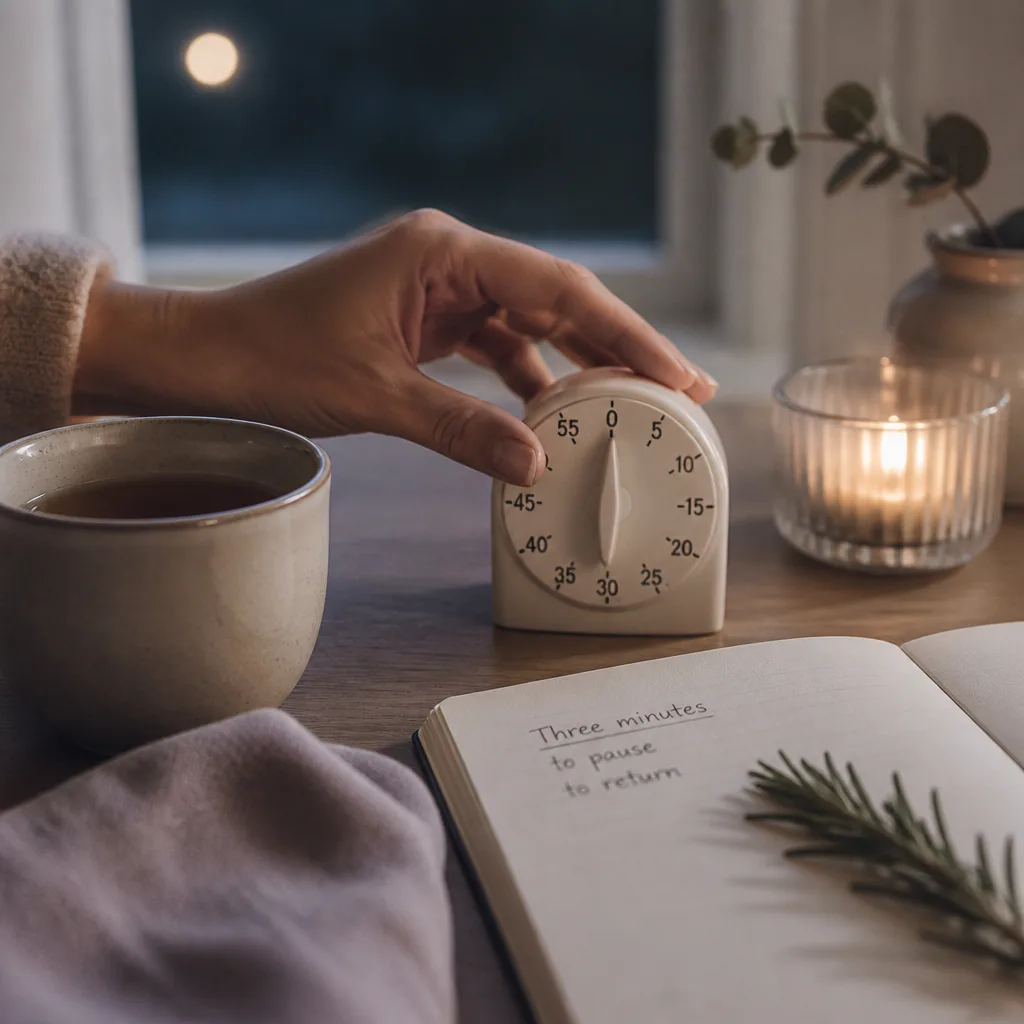
Set a timer for three minutes. If you can see the moon, fine. If clouds are covering it, fine. The full moon is still full behind weather. Astronomically, the full moon is the moment the moon is opposite the sun from Earth’s view, but the visible roundness lasts long enough that you do not need to chase the exact minute.
Before you begin, choose one object to touch. A mug. A stone. A necklace. The object is not special because it has secret force. It is special because your hand can find it. Somatic practices often use touch as an orienting cue; in trauma-informed settings, grounding through the senses is widely used because it brings attention back to present safety.
Then follow this:
- 0:00–1:00 — arrive. Put both feet down if you can. Name three things you see. Say, “I am here.”
- 1:00–2:00 — listen. Play your Dream-Self Moment from the AYA Method, or listen in silence for the sentence your future self would not rush.
- 2:00–3:00 — release. Write one line beginning, “I am done carrying…” Read it once. Fold the paper or close the note.
Do not burn the paper unless it is safe, legal, and genuinely calm. Fire can become performance quickly. A closed notebook is enough. A note deleted from your phone is enough. A hand over the cup is enough.
The Manifestation Board can help after the ritual if you want something visible to return to tomorrow. Keep it in its right place: a complement to the listening, not the main practice. The audio is the method. The board is something your eyes can rest on.
What if you feel nothing during the ritual?
Feeling nothing does not mean the ritual failed; it may mean your system is being careful.
Many people expect release to feel dramatic. Tears. Heat. A sudden new self. Sometimes it is quieter. You write the sentence and feel blank. You listen and feel distracted. You look at the moon and think about laundry. This still counts if you stayed for the three minutes.
The American Psychological Association has noted for years that stress can show up as irritability, fatigue, muscle tension, and trouble sleeping. Numbness can be part of that picture too. If your body has been carrying too much, it may not hand you a clean emotion on command.
Do not chase a feeling. Chasing makes the mind loud. Instead, ask one smaller question: what did I notice? Maybe you noticed your jaw. Maybe you noticed that you did not want to write your mother’s name. Maybe you noticed relief when the timer ended. Noticing is material.
You can finish with one of these quiet closings:
- “I heard it.”
- “That is enough for tonight.”
- “I do not need to solve this before sleep.”
- “I can return tomorrow.”
Small studies on self-compassion practices suggest that kind inner language can reduce shame and improve emotional steadiness for some people. Kristin Neff’s work on self-compassion has been especially influential here. So if nothing moves, speak gently anyway. Gentleness is not a consolation prize. It is a condition for staying.
If the ritual brings up panic, traumatic memory, or an urge to harm yourself, stop the practice and contact a trusted person or local crisis support. A moon ritual is not a substitute for care. The bravest sentence may be, “I need help tonight.”
How can this fit with your daily manifestation practice?
Let the full moon ritual be a monthly clearing around your daily listening, not a replacement for it.
Daily practice has a different texture than monthly ritual. Daily listening builds familiarity. Monthly release marks a threshold. They do not compete. The moon ritual asks, “What is complete?” The Dream-Self Moment asks, “What voice am I practicing living from?” Both can be quiet.
A useful rhythm is simple:
| Timing | Practice | Purpose |
|---|---|---|
| Daily | Listen to your Dream-Self Moment | Repetition and recognition |
| Daily, optional | Read one affirmation | A small sentence to carry |
| Weekly, optional | Look at your Manifestation Board | Visual remembering |
| Full moon | Three-minute release ritual | Name what is done |
Repetition matters because the brain learns by return. Neuroscience research on habit formation often cites wide variation in timing; one 2009 study in the European Journal of Social Psychology found an average of 66 days for a new behavior to become more automatic, with large differences between people. Do not use that number as a deadline. Use it as mercy. It takes returning.
If you practice with astrology and manifestation, the lunar cycle can become a soft calendar. New moon: choose a clear intention. Full moon: release what has become false, heavy, or complete. The daily audio remains the anchor because listening changes the room you live from.
A ritual is not stronger because it is longer. It is stronger when you can come back to it without lying.
Before you sleep, do not audit the ritual. Do not ask whether it worked. Put the note away. Wash the cup. Let the moon be older than your doubt.
Leave one small thing outside the door tonight.
Listen on Aya
