manifestation for life areas
Manifest Moving to a New City With Future-Self Audio
Manifest moving to a new city with a small future-self audio practice that helps you decide clearly, act steadily, and feel at home sooner.

The cardboard box is still flat under the bed. Manifest moving means rehearsing the life you intend before you have the keys, then taking small real actions toward it. Future-self audio helps because you hear the moved version of you speak in ordinary detail, daily, until the decision feels less far away.
What does it mean to manifest moving without pretending it is easy?
It means you let the future become specific while you stay honest about money, timing, and fear.
A move asks for many kinds of courage at once. There is the visible courage: notice to a landlord, a resignation letter, a train ticket, a lease. Then there is the quieter kind. The courage to admit that a city no longer fits. The courage to want a different street without making your current one wrong.
According to the U.S. Census Bureau, about 27.1 million people in the United States moved in 2023, and the most common reasons included housing, family, and work. That number is useful because it takes the drama down. Moving is not rare magic. It is administration, grief, hope, and cardboard tape. Manifestation belongs here only if it can sit beside the spreadsheet.
In manifestation, the cleanest question is not whether you can force a city to happen. You cannot. The better question is whether you can practice being the person who recognizes the right opening and answers it. That is where audio helps. Hearing your future self say ordinary things, again and again, gives your mind a pattern to return to when the old room feels final.
Neville Goddard wrote often about living from the end, not as a daydream but as an inner position. Joe Dispenza uses different language, but he also asks people to rehearse a future state until it becomes familiar to the nervous system. You do not need to adopt every claim from either teacher. You can take the modest part: a repeated inner scene changes what you notice and what you are willing to do.
A move starts as a sentence your body can believe.
How do you choose the city your future self is speaking from?
You choose by listening for fit, then testing that fit against facts.
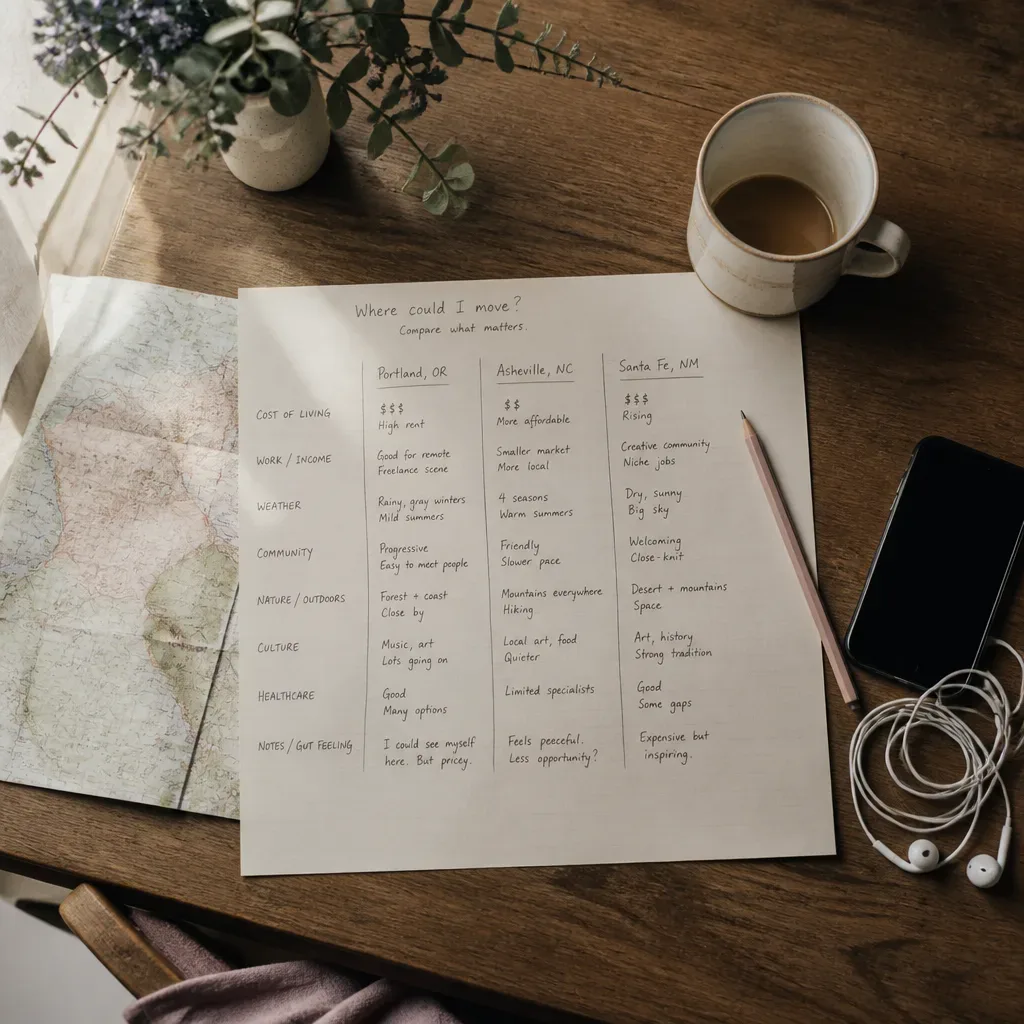
Start with a page divided into two columns. On the left, write the city names that pull at you. On the right, write the daily life each city would ask from you. Not the postcard. The Tuesday. Rent. Transit. Language. Weather. Loneliness. Work. A city is not only a skyline. It is the corner shop you can afford when you are tired.
Pew Research Center reported in 2022 that roughly 19% of U.S. adults said they had moved or knew someone who moved because of the pandemic. Many people learned that place is negotiable. But negotiable does not mean careless. If you are choosing between three cities, give each one a simple score from 1 to 5 in four areas: cost, work access, social support, and body sense. The last one counts, but it does not get to overrule rent.
Use this small table before you record the audio:
| Question | What to write | Why it matters |
|---|---|---|
| Can I afford the first 90 days? | Rent, deposit, food, transport | Moves often fail at the cash-flow edge |
| Who will know I am there? | One friend, group, colleague, cousin | Belonging needs a door, not a crowd |
| What will I do on a hard evening? | Walk route, library, café, call list | The future self must have a bad day plan |
| What feels true in my body? | Calm, closed, curious, tight | The body gives data, not orders |
Behavioral scientist Gabriele Oettingen has studied mental contrasting for decades. Her WOOP method pairs a wish with the real obstacle and a plan. In studies across health and school behavior, this pairing often works better than positive fantasy alone. For moving, that means you can want Lisbon, Berlin, Chicago, or Brussels, and still ask: what is the obstacle I will meet first?
What should your future-self audio actually say?
It should describe one lived moment after the move, in present tense, with enough detail that your next action becomes obvious.
The AYA Method is a daily audio manifestation practice. Each day you listen to a short personalized recording — your Dream-Self Moment — narrated from the version of you who has already manifested the life you intend. Listening is the practice. Repetition is the work. The audio is the method.
For manifest moving, keep the audio short. Three to seven minutes is plenty. Dr. Andrew Huberman has often pointed to repetition and attention as key parts of neuroplastic change; the exact claims can get overstated online, but the basic point is plain. What you repeatedly attend to becomes easier to access. A short daily listen beats a grand recording you play twice and forget.
Build the audio around one scene. Not your whole new life. One moment. You are unlocking the apartment door after work. You are standing in the small kitchen. You are walking to the tram. You know where the pharmacy is. Your phone has two local contacts you can call. The rent is paid. Your shoulders have dropped.
Try this structure:
- Begin with the body. I wake in my room and know where I am.
- Name the place. The city is around me, not ahead of me.
- Include the ordinary. I buy bread, answer emails, wash one cup.
- Show one brave act. I make the call, view the flat, send the application.
- Close with belonging. I am not visiting my life. I live here.
Do not make the audio glossy. Gloss breaks trust. If you know you will miss people, include one line where future you misses them and still makes dinner. A true future self does not erase your tenderness. She makes room for it.
How do you listen so the practice changes your choices?
You listen at the same small moment each day, then take one small action before the day can talk you out of it.
This is where people make the practice too large. They decide to wake at 5 a.m., journal for 40 minutes, meditate, stretch, visualize, and then become angry by Thursday. A modest practice is not less serious. It is more likely to survive you. The Journal of Behavioral Medicine has published studies linking implementation intentions, the if-then plans studied by Peter Gollwitzer, with better follow-through in health behaviors. The same logic helps a move.
Pick a cue you already have:
- after brushing your teeth
- while walking to the bus
- before opening rental listings
- after lunch, before messages
- in bed, before the last light is off
Then pair the listen with one action under ten minutes. Save one apartment. Check one salary range. Ask one person about a neighborhood. Put 20 euros, dollars, or pounds into the moving account. Read one page about visa rules. Ten minutes is not symbolic if you repeat it for 30 days. That is 300 minutes of contact with the move.
A 2009 study in the European Journal of Social Psychology found that habit formation took a median of 66 days, with wide variation. So do not worry if the audio does not feel natural on day 4. Day 4 is often just day 4. Your job is to keep the ritual small enough that doubt cannot make it dramatic.
If you also use affirmations, let them support the audio rather than replace it. One sentence after the listen is enough: I can make this move one honest step at a time. The daily affirmation is a complement. The audio is the method.
Repetition is not proof that nothing is happening. It is often how the new thing becomes safe.
What practical steps should follow each listen?
Each listen should end with a concrete move in the outer world, however small.
Manifesting a move without action can become a very pretty form of avoidance. You do not need to become harsh with yourself. You do need a list that meets the floor. The city will not be impressed by your intensity. It will ask for documents, dates, money, and names.
Use a weekly rhythm. Research from the American Psychological Association has repeatedly noted that stress rises when people feel low control. A moving plan gives you a small amount of control back, especially when the final outcome is not yet settled. The goal is not to control everything. It is to stop abandoning the parts you can touch.
A simple seven-day cycle can look like this:
| Day | After the audio, do this | Time |
|---|---|---|
| Monday | Check three rental prices | 10 minutes |
| Tuesday | Read one neighborhood forum | 10 minutes |
| Wednesday | Message one contact | 5 minutes |
| Thursday | Review work or income options | 15 minutes |
| Friday | Move money into savings | 3 minutes |
| Saturday | Walk or map a daily route | 20 minutes |
| Sunday | Rewrite the audio if needed | 10 minutes |
For some readers, the city is tied to work. For others, it is love, climate, family, study, or the need to begin again without explaining yourself to everyone from school. If your timing depends on another person, a visa office, or a job market, use the same practice but soften the deadline. Deadlines help only when they are real.
The old mystical language often says, act as if. I prefer, act in proportion. If your future self lives in another city, what is the proportionate action today? Not selling everything at midnight. Maybe measuring the desk. Maybe asking what it costs to ship eight boxes. Maybe admitting you own fourteen mugs and only like three.

How do you work with fear, signs, and timing?
You treat fear as information, signs as invitations to think, and timing as something you can prepare for but not fully command.
Fear is not a stop sign by default. It is also not always wisdom. Sometimes fear is the body remembering every previous risk. Sometimes it is telling you the plan is underfunded. Write the fear down in plain language. I am afraid I will be lonely. I am afraid I cannot afford month two. I am afraid I will leave and still be myself. That last fear is very common. It is also useful. Wherever you move, you are coming too.
The Princeton Engineering Anomalies Research lab, often called PEAR, studied intention and random event generators for nearly 30 years before closing in 2007. Its findings remain debated. I mention it carefully because many manifestation readers know the name. Even if you set aside the controversial claims, the practice of intention still has a grounded use: it organizes attention. When you name the life, you notice doors that were already there.
If you use astrology and manifestation, let timing support discernment, not replace it. A moon date may help you mark an application day. It should not override a lease clause, a safety concern, or your bank balance. The quiet test is simple: does this sign make me more honest, or does it let me avoid the next task?
You may also feel grief. That does not mean the move is wrong. You can love a street and still be done with it. You can be grateful for a city and still need another one. Gratitude is not a contract to stay.
The right move does not always feel fearless. Sometimes it feels like fear with a lamp on.
When do you know the practice is working?
You know it is working when your behavior becomes more consistent, your criteria become clearer, and the future feels less like performance.
Look for small evidence. You stop saving apartments you cannot afford. You ask better questions. You know which neighborhoods are fantasy and which ones fit your actual feet. You talk to one person who lives there. You gather numbers. You recover faster after doubt. These are not cinematic signs. They are better. They are usable.
A 2021 Gallup report on migration desire found that hundreds of millions of adults worldwide would like to move permanently to another country if they could. Wanting to leave is common. Preparing well is rarer. Your practice works when wanting becomes choosing, and choosing becomes a calendar.
Once a week, answer these five questions after listening:
- What did I do this week that the old me would have postponed?
- What fact changed my plan?
- What part of the audio felt false?
- What part felt more believable than before?
- What is the next smallest honest action?
If a line in the audio starts to feel untrue, edit it. This is not failure. It is respect. Future-self audio should stay alive to real information. If the rent in your chosen city is 30% higher than expected, your future self may need a smaller room, a different district, or six more months. The desire can remain while the route changes.
Keep returning to the wider practice of manifestation as a relationship between inner rehearsal and outer honesty. The app may also give you a Manifestation Board, which can help you see the life you are naming. But the board is a complement. The listen is where the moved self becomes familiar.
There is no need to make the move look impressive from the outside. A library card in the new city may matter more than the photograph. A paid deposit may matter more than a declaration. A Tuesday that feels livable may matter more than the story you tell about becoming new.
The key can wait; the listen is already here.