money manifestation
Manifest Unexpected Money: Listen Before Signs
A quiet 7-minute practice to manifest unexpected money: listen first, stop forcing signs, and take clean, practical action when money appears.

The kitchen is still dark. To manifest unexpected money, listen before you hunt for signs: hear the future-self audio, name the amount softly, then notice real openings without forcing meaning. The practice is not waiting. It’s listening first, then taking one clean money action today.
Why listen before you hunt for signs?
Listening first gives your attention a place to land before anxiety starts inventing evidence.
When money feels uncertain, the mind gets very busy. It counts receipts. It studies license plates. It turns 11:11 into a verdict. That doesn’t make you foolish. It makes you human. The brain is a pattern-making organ, and under stress it works overtime. A 2023 Federal Reserve report found that 37% of adults would not cover a $400 emergency expense entirely with cash or savings. No wonder a small sign can feel like oxygen.
But signs are poor leaders. They can comfort you, then confuse you ten minutes later. Listening comes first because it returns you to a steadier inner script before the world gives you anything to interpret. A sign is not a plan. A receipt is not a prophecy.
If you’re new to manifestation, keep this distinction close: manifestation is not the refusal of ordinary action. It’s the practice of living from a chosen inner assumption while still answering emails, checking balances, and making decisions. Neville Goddard wrote often about assumption. Joe Dispenza speaks about mental rehearsal. Different languages, same small requirement: repeat the state until it becomes easier to act from it.
The sign can come later. A refund email. A friend mentioning paid work. A bill adjusted down by 23 euros. You can notice these things. You don’t have to worship them.
Listen first. Then look. The order matters.
What exactly are you listening to?
You’re listening to a short personalized recording that lets your future self speak before your fear does.
The AYA Method is a daily audio manifestation practice. Each day you listen to a short personalized recording — your Dream-Self Moment — narrated from the version of you who has already manifested the life you intend. Listening is the practice. Repetition is the work. The audio is the method.
For money, this matters because the body often hears money words as threat. Rent. Debt. Tax. Due. Overdraft. Even the word “unexpected” can make you brace. A 2022 American Psychological Association survey found that money remained one of the most common sources of stress for adults in the United States, with inflation and daily costs close behind. You don’t need more noise in that state. You need a voice you can stay with.
A Dream-Self Moment for unexpected money might sound simple: you speak from the version of you who has already received the money, handled it cleanly, and stayed calm. Not grand. Not theatrical. Just true enough to enter the nervous system without argument.
The app also includes a daily affirmation and a Manifestation Board. They can help you remember. But they are complements. The audio is the method. If you only have one minute, listen.
This is why affirmations are useful but not the same as listening. Speaking an affirmation asks you to produce belief. Listening lets belief arrive by repetition, even on a morning when your hair is unwashed and your bank app is being dramatic.

How do you set up the 7-minute practice?
Keep the practice short enough that your real life can finish it.
Seven minutes is not a sacred number. It’s just kind. In library terms, it’s the small book that comes back worn out. It fits inside a kettle boiling, a tram stop, a walk to the bus. Research on habit formation by Phillippa Lally and colleagues, published in the European Journal of Social Psychology in 2009, found that a new behavior took 18 to 254 days to feel automatic, with 66 days as the average. So the first win is not perfection. The first win is repeatability.
Use this structure for 7 days:
- Minute 1: Name the amount. Choose an amount or range. “An unexpected 50 to 200 euros” is easier to believe than a number that makes your stomach laugh.
- Minutes 2 to 4: Listen. Play your Dream-Self Moment without checking messages.
- Minute 5: Write one sentence. “Money can reach me through ordinary doors.” Or write your own.
- Minute 6: Look for one practical opening. Refund, invoice, rebate, sale, request, follow-up.
- Minute 7: Do or schedule the step. Put it on the calendar if it can’t happen now.
That’s the practice. Small enough to keep. Clear enough to measure.
If you like timing, set a simple alarm. Dr. Andrew Huberman often speaks about attention and repetition as basic ingredients in nervous system change. You don’t need to become a neuroscience hobbyist to use that. Put the same cue near the same action. Headphones beside keys. Audio before bank app. Pen after listening.
The practice that gets finished is stronger than the practice that impresses you.
What signs count, and what should you leave alone?
A sign counts when it connects to real money, real action, or a clear inner shift you can name.
This is where many people lose the thread. They ask to manifest unexpected money, then spend the day collecting symbols. A coin on the pavement. A green car. A number repeated twice. Fine. Notice it. Smile if you want. But don’t make a symbol do the work of a step.
The Princeton Engineering Anomalies Research program studied intention and random physical systems from 1979 to 2007. Its findings remain debated, and they don’t prove that a repeated number makes money appear. They do show something more modest and useful: human intention has been studied seriously, even when the results are hard to interpret. Hold mystery with manners. Don’t pretend certainty where there isn’t any.
Use this table when your mind starts reaching:
| What you notice | Count it? | Why |
|---|---|---|
| A refund email arrives | Yes | Real money may be coming back |
| You remember an unpaid invoice | Yes | It points to a clear action |
| You see 777 on a receipt | Maybe | Only useful if it steadies you |
| A friend mentions paid work | Yes | It may be an opening |
| A random cloud looks like a coin | No | Let it be a cloud |
There is tenderness in this discipline. You’re not being cynical. You’re protecting the practice from becoming frantic. Astrology and manifestation can be meaningful when it helps you choose timing, reflect, and listen. It becomes unkind when every transit, number, or bird has to carry your rent.
A true sign makes you quieter, not more desperate.
How do you stay practical without closing the door?
You stay practical by treating action as one of the ways money can find you.
The phrase “unexpected money” can tempt you to wait for money that asks nothing of you. Sometimes that happens. A rebate appears. A relative sends a gift. A forgotten deposit returns. But often the unexpected part is not the source. It’s the fact that you finally saw the source clearly.
In small behavioral studies, implementation intentions, the “if this, then that” plans researched by psychologist Peter Gollwitzer, have helped people follow through on goals more reliably than vague intention alone. So give your listening a doorway. If I remember someone owes me money, then I send the message by noon. If I see a refund option, then I fill it out before tea.
Try one of these after your audio:
- Check for refunds, rebates, or fee reversals from the last 30 days.
- Send one unpaid invoice or gentle reminder.
- Return one item you don’t need.
- List one thing for sale.
- Ask one clear question about paid work.
- Cancel one charge you keep pretending is tiny.
This is not less magical. It is more honest. The clean step does not cancel the inner practice. It gives it hands.
If you want a broader map of the practice, read the manifestation guide after you listen, not before. Reading can become another form of delay. So can planning. So can making a perfect spreadsheet with twelve tabs and no sent invoice.
Money loves a channel. Sometimes the channel is your inbox.
What should you write down after listening?
Write down evidence, actions, and shifts, not every symbol that crosses your path.
A simple log protects you from two common distortions. First, the mind forgets small receipts. Second, it exaggerates vague signs. A 2021 report from the Financial Health Network found that many households move in and out of financial strain across a year, not just once. Money life is often irregular. Your log should be steady enough to hold that irregularity.
Use three lines only:
- Received: amount, source, date.
- Noticed: practical opening or clear idea.
- Did: the step you took.
For example: “Received: 18 euros from returned train ticket. Noticed: old client hasn’t replied. Did: sent follow-up.” That is enough. You don’t need a velvet notebook, though I would never stop you. Librarians have limits, but stationery is not one of them.
You can add one sentence from your audio if it stayed with you. Keep it believable. Affirmations work best when they don’t require you to lie to yourself. “I notice money I used to miss” will often enter more easily than “I am rich beyond measure,” especially when the card machine just declined your lunch.
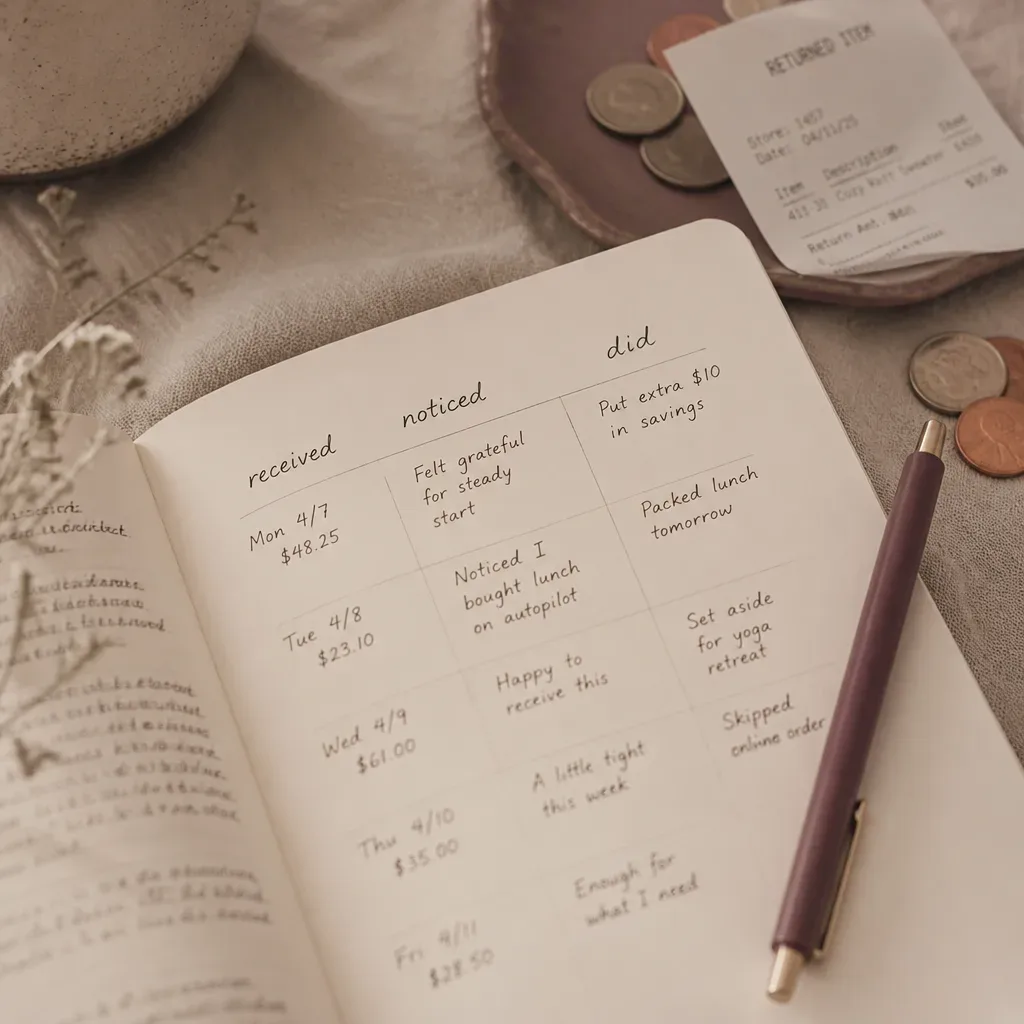
At the end of 7 days, total only what is real: money received, money saved, money requested, money made more likely. Include the 6-euro fee reversed. Include the 40-euro item returned. Small money is still money. If you can’t receive five euros with respect, a larger amount may only make you louder.
What do you do when unexpected money arrives?
You pause long enough to let the arrival register before you spend, explain, or chase the next sign.
This part is often skipped. Money comes in, and the mind immediately asks for more. That is how satisfaction keeps moving away. When unexpected money arrives, even 3 euros, stop for 20 seconds. Say what happened plainly: “Money came in through a refund.” “Money came in through work.” “Money came in through a gift.”
Then choose a simple order. In personal finance, many planners use the 50/30/20 rule as a rough teaching tool: 50% needs, 30% wants, 20% saving or debt. It won’t fit every income or country, and it may be impossible in a hard month. Still, it points to a helpful question: does this money need a job before it becomes noise?
Try this quiet order:
- Acknowledge it. Write amount and source.
- Stabilize first. Food, bill, transport, debt, buffer.
- Give it one clear purpose. Don’t split 12 euros into 9 meanings.
- Listen again tomorrow. Not to demand more, but to keep the practice clean.
Unexpected money can make you superstitious if you don’t ground it. It can also make you careless. The middle way is thankfulness with a receipt.
If timing matters to you, you can pair this with astrology and manifestation as a reflective tool. Just keep the order intact. Listen. Act. Notice. Record. The sky may be beautiful, but the refund form still needs your name.
A soft practice can still have structure.
Keep the receipt. Keep the quiet.
Listen on Aya

