manifestation 101
Manifestation Box vs Future-Self Audio: What First
A quiet comparison of a manifestation box and future-self audio, with guidance on what to choose first when your intention needs form.

A manifestation box gives your intention a visible home; future-self audio gives it a voice you can return to every day. If you’re choosing what goes in first, begin with the audio when you need repetition, and use the box when you need a quiet object to hold what you’ve already heard.
What does a manifestation box actually do?
A manifestation box turns an intention into a small, visible ritual you can touch.
It may be a wooden box, a drawer, a paper envelope, or an old tea tin. The object isn’t the point. The point is containment. You place inside it the fragments that feel true: a note, a photo, a receipt from a place you want to return to, a key, a sketch, a word written on torn paper. The box says, softly, this matters enough to have a place.
Psychology has long known that physical cues can shape attention. In a 2002 study on implementation intentions, Peter Gollwitzer found that specific cues, paired with chosen actions, can raise follow-through across many settings. A box works in that family of cues. It doesn’t force the future. It reminds the nervous system where to look.
A good manifestation box is not a shrine to wanting. It is a storage place for recognition. You aren’t proving that you deserve the thing. You’re keeping evidence of the life you’re practicing seeing. That difference matters. Wanting often tightens the body. Recognition softens it.
The box can also help when language feels thin. Clay taught me this. Before a vessel has a name, it has weight. Before glaze has color, it has a recipe. Sometimes the body understands the symbol before the mind can write the sentence. A box gives the symbol a place to rest.
A manifestation box is strongest when it stays small. Three to seven objects are often enough. Too many objects can become noise. The quieter the box, the clearer the request.
If you want the broader frame for this practice, the Manifestation pillar gives the clean foundation: manifestation is not just wishing. It’s attention, identity, repetition, and behavior meeting in one place.
The box holds the symbol. The practice has to hold you.
What does future-self audio do differently?
Future-self audio rehearses identity from the inside, not just intention from the outside.
The AYA Method is a daily audio manifestation practice. Each day you listen to a short personalized recording — your Dream-Self Moment — narrated from the version of you who has already manifested the life you intend. Listening is the practice. Repetition is the work. The audio is the method.
That distinction is important. A box sits still. Audio moves through you. It meets breath, posture, memory, and resistance. It can be heard with eyes closed, on a walk, before sleep, or with hands covered in slip while the wheel slows. The daily act is simple enough that you can do it on ordinary days, which is the only kind of day most lives are built from.
Neuroscientist Dr. Andrew Huberman has often spoken about the role of repetition and nervous-system state in learning. The details vary by context, but the basic point is steady: the brain changes through repeated signals, not occasional intensity. A 2018 review in Neuropsychologia also notes that mental imagery can recruit neural systems related to action and perception. Audio gives imagery a track to run on.
Future-self audio also lowers the burden of invention. You don’t have to create a perfect sentence each morning. You listen. The recording carries the words when you’re tired. This matters because habit research suggests friction matters; BJ Fogg’s behavior model, published in 2009, puts ability and prompts beside motivation. The easier the practice, the more likely it returns.
A manifestation box asks, “What do I want to remember?” Future-self audio asks, “Who am I practicing being?” Both are useful. They do different work.
| Practice | Best at | Risk when overused | Time needed |
|---|---|---|---|
| Manifestation box | Making intention visible | Turning desire into checking | 5–20 minutes weekly |
| Future-self audio | Rehearsing identity daily | Listening without acting | 3–8 minutes daily |
| Daily affirmation | Naming one true sentence | Repeating words you don’t believe | 30–60 seconds |
| Manifestation Board | Seeing patterns and images | Collecting too much | 10–30 minutes monthly |
The app also includes a daily affirmation and a Manifestation Board, but they are complements. If you only remember one thing, remember the listening.
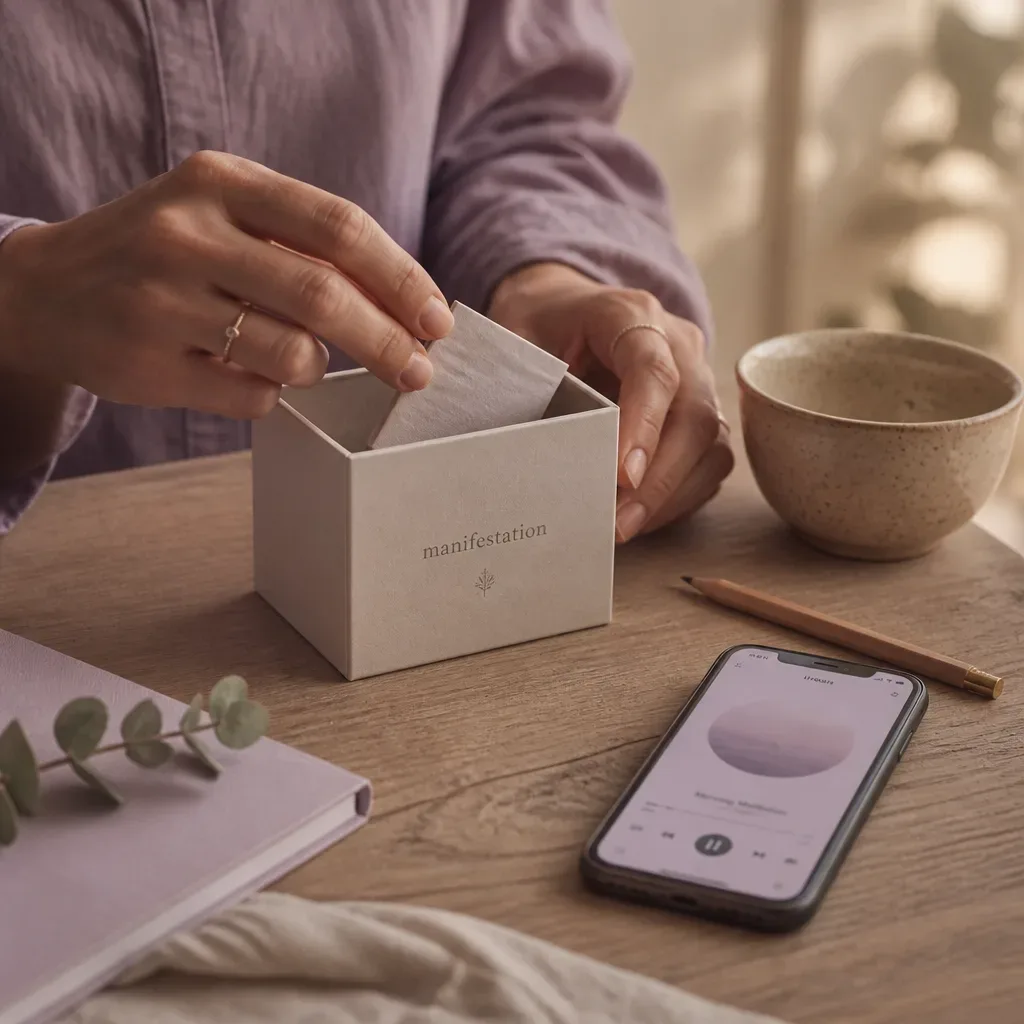
Which one should go first when the desire feels unclear?
Use future-self audio first when the desire has a feeling but no clean shape yet.
Many people reach for the box first because objects feel safer than language. I understand this. In the studio, I often place a clay test tile beside a cup before I know what glaze belongs there. Still, if the desire is unclear, the first need is not more objects. It is a voice that can steady the question.
A short audio practice can reveal what the box should later hold. After three or four listens, you may notice one phrase keeps returning. Maybe it’s “I answer slowly now.” Maybe it’s “My mornings are mine.” Maybe it’s “I don’t chase work that doesn’t fit.” Those phrases are better guides than vague images of success.
Research on self-affirmation offers a useful clue. A 2016 meta-analysis in Social Cognitive and Affective Neuroscience discussed how affirming core values can influence stress response and openness to change. The effect isn’t magic. It’s contact with self-consistency. You remember what matters, and the body has less need to defend.
If you’re working with affirming language, keep it modest. The Affirmations pillar is a good companion here, especially if you’ve ever felt false repeating sentences you don’t believe. One honest sentence beats twenty polished ones.
Try this order for unclear desire:
- Listen to your Dream-Self Moment for 3 days.
- Write down the single line that stays with you.
- Choose one object that matches that line.
- Place it in the box without adding more.
- Leave the box closed for a week.
The restraint is part of the practice. You are not building a museum. You are giving one true thing a room.
Which one should go first when you already know what you want?
Use the manifestation box first if the desire is already specific and emotionally clean.
Specific means you can say it without performing. “I want to live alone in a quieter apartment by spring” is specific. “I want my life to be perfect” is not. Emotionally clean means the desire doesn’t require someone else to lose, apologize, return, change, or finally understand you. Your box is not a place to control other people.
When the intention is clear, the box can become a beautiful first move. It gives the decision weight. You might place a floor-plan sketch, a dried leaf from the neighborhood, a small key charm, and a note with the date. Four objects. Enough. In clinical settings, symbolic acts can support commitment; acceptance and commitment therapy, developed in the 1980s and 1990s, often uses chosen values and committed action as paired movements.
Then you listen. The order matters less than the return. A box without repetition can become a forgotten object. Audio without visible cues can fade into private intention. Together, they create two doors into the same room.
You can also use timing as a guide. New moons, birthdays, first days of the month, or the first morning after a hard decision can give the box a natural opening. If that language speaks to you, Astrology and manifestation can help you use timing without giving your power away to timing. The day may mark the practice. It doesn’t do the practice for you.
Here is a simple comparison:
- If you need clarity, listen first.
- If you need commitment, place one object first.
- If you need comfort, hold the box after listening.
- If you need movement, choose one real action within 24 hours.
A clear desire doesn’t need to be loud. It needs to be lived with.
How do you use both without making the practice heavy?
Keep one method daily and the other occasional.
The mistake is trying to make every tool equally important. That turns a tender practice into administration. In AYA, the audio is the daily practice because sound returns easily. You press play. You listen. The box can stay quiet on the shelf. It doesn’t need your hands every morning to be doing its work.
The American Time Use Survey has repeatedly shown that adults spend several hours a day on work, care, chores, and movement between places. A practice that needs 45 perfect minutes will fail many ordinary people. A 5-minute audio has a better chance of surviving laundry, school runs, grief, deadlines, and bad sleep.
I like this rhythm:
| Rhythm | Audio | Box |
|---|---|---|
| Daily | Listen once | Leave it closed |
| Weekly | Listen, then read one note | Add or remove one item |
| Monthly | Notice what changed | Rewrite the main intention |
| After a setback | Listen gently | Touch the box, don’t edit it |
The quiet rule is this: don’t open the box when you’re panicking. Panic wants proof. The box cannot give proof. It can only give remembrance. If your body is urgent, listen first. Let the voice come before the sorting.
Small practices respect the nervous system. A 2020 paper in Frontiers in Psychology on habit formation notes that stable cues and repeated context make habits easier to maintain. That is why the same chair, same headphones, or same evening light can help. Not because they’re sacred. Because they’re repeatable.
You might keep the box near where you listen, but not in your hand. Let the audio speak first. Let the object answer later.
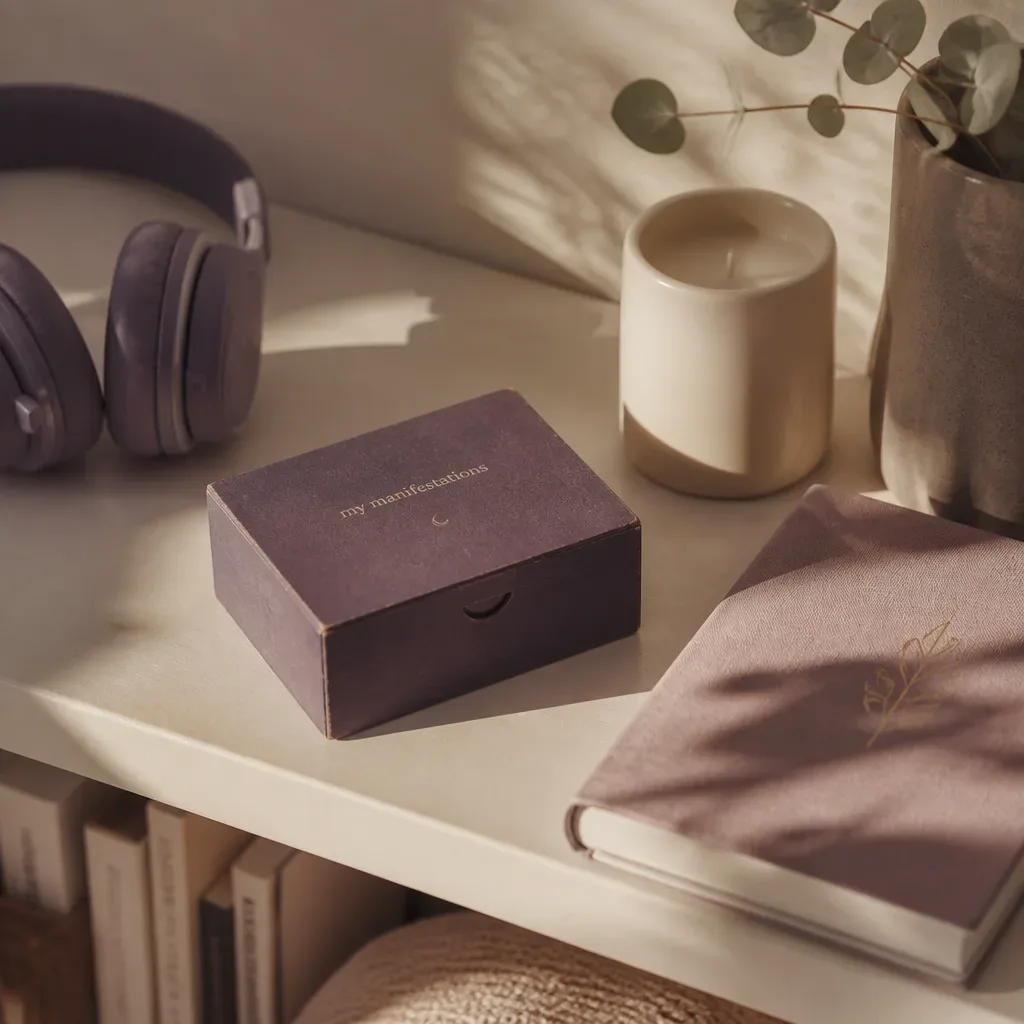
What should go inside the manifestation box after listening?
Put in only what matches the future-self voice, not everything you want.
After listening, write down one sentence from the audio that felt physically true. Not the prettiest line. The one your shoulders recognized. Then choose an object that belongs to that sentence. If the line is about steadiness, maybe a stone. If it’s about a new home, maybe a small folded floor plan. If it’s about health, maybe a recipe card or appointment note. The object should be plain enough that you don’t need to explain it to yourself.
Neville Goddard wrote often about assuming the feeling of the wish fulfilled. Whether you read him literally or psychologically, the useful piece is this: the state comes before the symbol. The symbol should not beg for the state. It should remember it.
Good objects for a manifestation box include:
- A handwritten line from your Dream-Self Moment
- One photograph that feels like the intended life
- A tiny object from a place connected to the desire
- A receipt from a first real step
- A fabric scrap, key, shell, bead, or stone
- A date written on paper, if timing is part of the intention
Leave out anything that tightens you. Don’t include screenshots of people you’re comparing yourself to. Don’t include proof that you are behind. Don’t include ten versions of the same wish because you’re afraid one won’t be enough.
A 2010 study by Oettingen and colleagues on mental contrasting suggested that positive fantasy works better when paired with present obstacles and planned action. So place one future symbol in the box, then name one present step outside the box. Call the landlord. Send the email. Rest before the meeting. Drink the water.
The box is not where action goes to sleep. It is where intention stays warm.
How do you know the practice is working?
You know it’s working when your daily choices begin to sound like the self you’ve been listening to.
This is quieter than a sudden sign. You pause before saying yes. You stop rehearsing old arguments. You notice that the job listing you once ignored now gets a careful read. You buy the notebook, book the class, clean the corner, make the call. These are not dramatic. They are real.
Behavior change often appears as reduced friction before it appears as visible result. James Clear popularized the idea of identity-based habits in Atomic Habits, but the research behind habit loops goes back decades, including Wendy Wood’s work on context and automaticity. Repeated cues shape what feels normal. Your audio is one cue. Your box is another.
There are also signs that the box has become too much:
- You open it many times a day to check whether you still believe.
- You keep adding objects because silence feels unsafe.
- You use it to avoid making one real choice.
- You feel punished when nothing changes quickly.
If that happens, close the box for 7 days. Return to listening. Read the AYA Method again if you need the order made plain: listening is the practice. The rest supports it.
For a wider map of where this fits, return to Manifestation when you need the whole field, Affirmations when words feel brittle, and Astrology and manifestation when timing is part of how you listen to your life.
In clay, I can tell a vessel is drying well because it stops demanding my hands. It holds its shape without me. A practice is similar. It begins to live in the day without being watched.
Put the voice first, then let the small box keep watch.