aya method deep dive
Manifestation for Busy People: 3-Minute Audio
Manifestation for busy people can be three minutes: learn a quiet Dream-Self audio practice that fits between meetings, meals, and sleep.
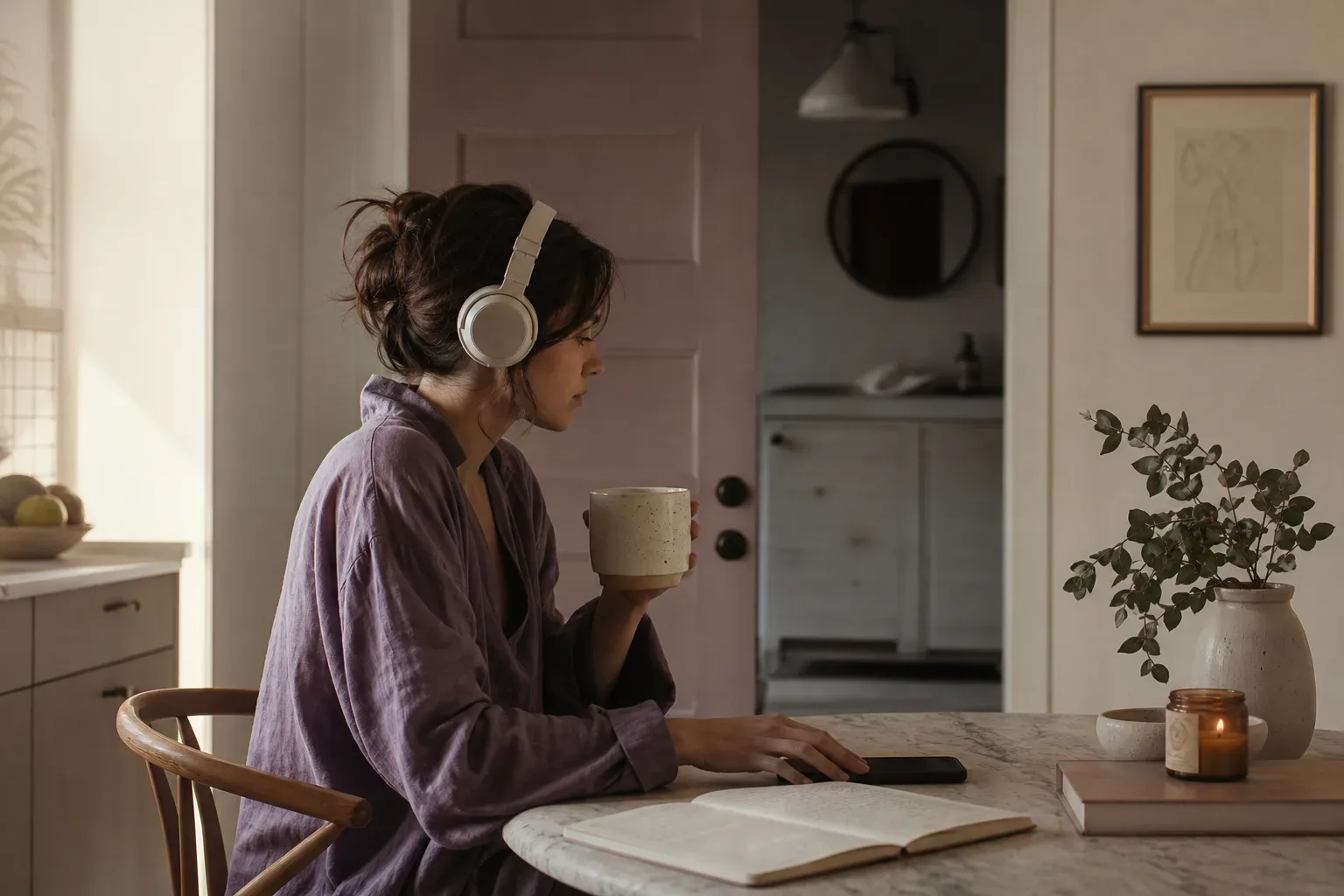
The cup is still warm. Your phone is face down. Manifestation for busy people works best as a three-minute audio practice: one Dream-Self Moment, listened to daily, with no larger routine required. You do not need more time. You need one small room you can return to.
Why can three minutes be enough?
Three minutes can be enough because the practice is not trying to fill your morning; it is trying to give your attention one clear place to stand.
A busy life often fails at long practices before it even begins. The intention is sincere. The calendar is not. The U.S. Bureau of Labor Statistics reported that full-time workers averaged about 8.5 hours of work on days they worked in 2023. Add care work, commuting, meals, messages, and the small repairs of being alive. A 45-minute ritual may be beautiful. It may also be fiction.
Three minutes is 180 seconds. That number matters because it lowers the threshold. BJ Fogg, the Stanford behavior scientist, has written for years about tiny habits: make the action so small that starting it is almost easier than avoiding it. A practice that fits before a kettle boils is not lesser. It is more likely to be repeated.
The brain also learns through rehearsal. Mental practice research in sport and rehabilitation has found that repeated imagery can support performance, especially when it is vivid and tied to action. You are not forcing life to obey a script. You are rehearsing the self who makes the next choice differently.
A small practice is not a small promise.
For a busy person, the measure is not how dramatic the practice feels. The measure is whether it survives Tuesday. If it can live inside an ordinary day, it can become part of the architecture of that day.
What is the 3-minute Dream-Self audio practice?
The 3-minute Dream-Self audio practice is a short daily listening ritual where you hear your future self speak as if the intended life is already real.
The AYA Method is a daily audio manifestation practice. Each day you listen to a short personalized recording — your Dream-Self Moment — narrated from the version of you who has already manifested the life you intend. Listening is the practice. Repetition is the work. The audio is the method.
That definition is precise for a reason. The method is not a long checklist. It is not a demand to become a different person by 6 a.m. The audio gives you one spoken scene, one felt identity, one return. The app also includes a daily affirmation and a Manifestation Board, but they support the listening practice. They are not the pillars.
Dr. Andrew Huberman often notes that the nervous system changes through repeated, state-linked practice, not through one grand decision. In his public teaching on habit and attention, he frequently points to repetition and cueing as basic tools. The Dream-Self Moment uses both: the same cue, the same audio shape, the same future-tense feeling brought into the body now.
Here is the quiet distinction:
| Practice | Time needed | What it asks of you | Best use |
|---|---|---|---|
| Dream-Self audio | 3 minutes | Listen and return | Daily identity rehearsal |
| Journaling | 10 to 20 minutes | Write and reflect | Sorting thoughts |
| Vision board review | 2 to 5 minutes | Look and remember | Visual cueing |
| Meditation | 5 to 30 minutes | Attend to breath or object | Attention training |
A three-minute audio practice does not replace every other practice. It removes the excuse that manifestation needs an empty morning. If you want the wider frame, the manifestation pillar explains how intention, attention, and repetition work together without making the practice loud.
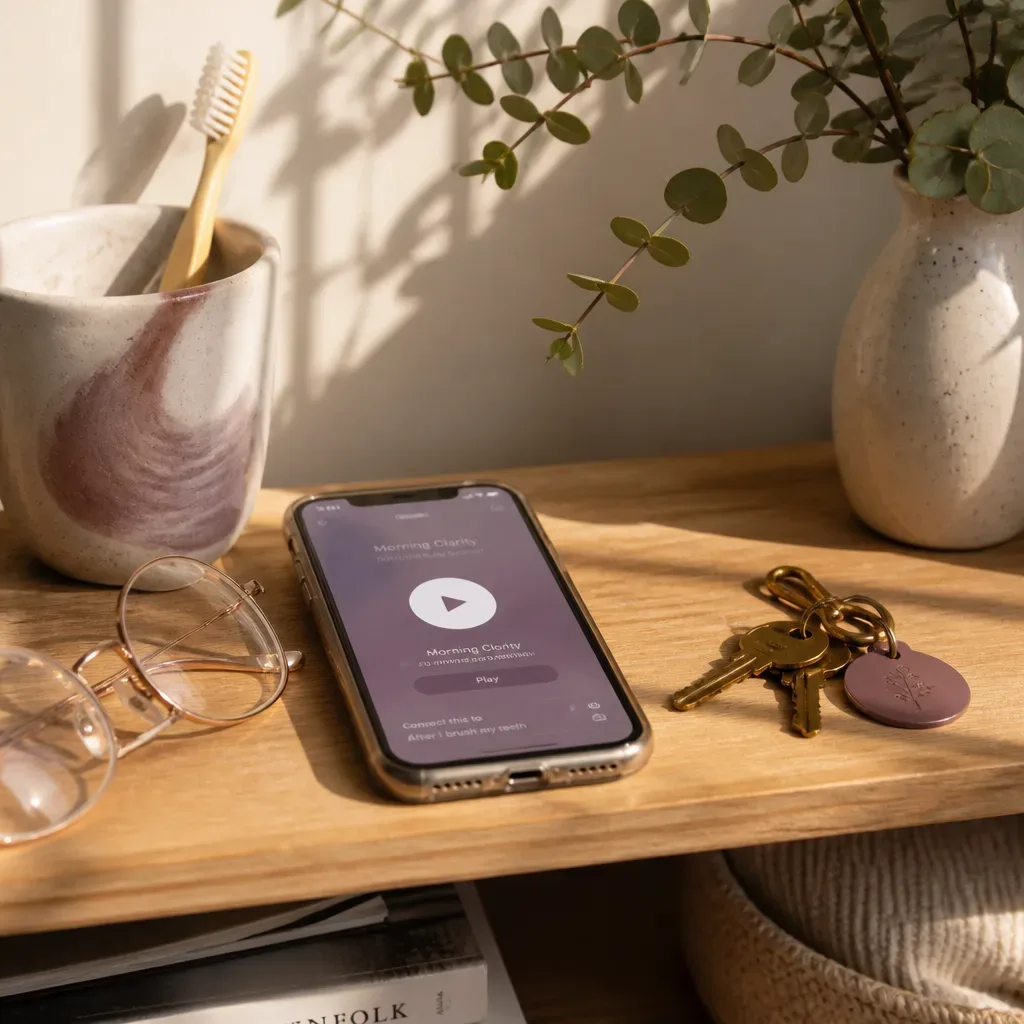
How do you set it up when your day is already full?
You set it up by attaching the audio to a cue that already exists, then protecting those 180 seconds as if they were a closed door.
Do not begin with your ideal morning. Begin with evidence. For two days, notice where your day already has hinges. Toothbrush. Shoes. Elevator. Car seat. First sip of tea. Laptop closing. According to research by Phillippa Lally and colleagues in the European Journal of Social Psychology, a new habit took a median of 66 days to become automatic, with wide variation from 18 to 254 days. The cue matters because it carries the practice while automaticity is still forming.
Use this setup:
- Choose one cue you already meet daily.
- Place headphones or speaker access near that cue.
- Start the Dream-Self audio before any other input.
- Sit, stand, or walk slowly for the full 3 minutes.
- Let one sentence stay with you after it ends.
The cue should be humble. A grand cue breaks easily. A humble cue keeps showing up.
If you have children, caregiving duties, shift work, or a schedule that changes, make a two-cue plan. One primary cue. One rescue cue. For example, listen after brushing your teeth if the morning is open, or listen in bed if the morning has already been taken. The World Health Organization has reported that depression and anxiety cost the global economy an estimated 12 billion working days each year. Busy does not always mean productive. Sometimes busy means unheld.
Design the practice like a room with one chair. Nothing extra belongs there. No inbox. No planning. No checking whether it is working while it is working.
What should you do during the three minutes?
During the three minutes, you listen, soften your attention, and let the recording be more important than your commentary.
The first 20 seconds are usually the threshold. Your mind may offer tasks. It may remind you of a message. It may produce doubt because doubt likes to arrive early. That is normal. In mindfulness studies, wandering is not treated as failure; noticing and returning is the repetition. A 2010 Harvard study by Killingsworth and Gilbert, using phone-based samples, found that people reported mind-wandering in about 47 percent of waking moments. Your wandering mind is not unusual.
Try this quiet pattern while the audio plays:
- Let your jaw unclench.
- Put both feet on the floor if you are seated.
- Breathe normally, not theatrically.
- Notice one phrase that feels slightly more true than yesterday.
- Do not argue with the rest.
If the recording says something your body resists, do not force belief. Make room for contact. Neville Goddard wrote often about assuming the feeling of the wish fulfilled. Many readers take that to mean strain. It can be softer than that. Assumption can begin as a willingness to hear the sentence without pushing it away.
Belief does not always arrive first. Sometimes it follows repetition into the room.
Joe Dispenza’s work is often associated with mentally rehearsing a future self, and while claims around manifestation vary, the behavioral point is simple: repeated inner rehearsal can influence what you notice, choose, and practice. You are listening so the next action has a different reference point.
For more language-based support, the affirmations pillar can help you understand why one sentence, repeated cleanly, may be easier to live than a page of declarations.
Where does this fit with work, care, and real pressure?
It fits by becoming smaller than the pressure, not by pretending the pressure is not there.
A working parent does not need a ritual that collapses when someone cannot find their socks. A founder does not need another productivity performance. A nurse on rotating shifts does not need advice written for someone with quiet mornings and clean counters. Microsoft 2023 Work Trend Index data found that 68 percent of surveyed workers said they did not have enough uninterrupted focus time during the workday. That is the setting. The practice has to fit inside it.
Here are four realistic placements:
| Life pattern | Cue | Three-minute placement |
|---|---|---|
| Office work | Before opening email | Listen at the desk with the screen dimmed |
| Caregiving | After the child sleeps | Listen beside the bed or in the hall |
| Commute | Parked vehicle or train seat | Listen before stepping out |
| Shift work | First drink after waking | Listen before messages |
The practice should not become another way to judge yourself. If you miss a day, you have missed one day. Return the next time the cue appears. A 2018 review in Health Psychology Review found that habit strength is supported by context stability and repetition, not by self-criticism. The room is built by returning to the same place.

There is also a useful boundary here. Manifestation for busy people is not a substitute for rest, money, care, medicine, or help. It is a way to keep your inner reference point from being written only by urgency. The astrology and manifestation guide says this in another language of timing: cycles can remind you when to begin, but the daily act still has to be done.
How do you know it is working?
You know it is working when the audio starts changing the next small choice, not when life becomes instantly tidy.
Look for modest evidence. You pause before replying. You choose the clearer meal. You send the application. You stop rehearsing the old apology. You notice the same fear, but it no longer gets the first vote. In self-affirmation research, Claude Steele’s theory and later studies by Geoffrey Cohen and David Sherman suggest that affirming valued identity can reduce defensiveness under threat. The mechanism is not magic. It is a steadier self-view.
Track the practice lightly for 14 days. Not with pressure. With kindness. A simple table is enough:
| Day | Listened? | One sentence remembered | One choice that followed |
|---|---|---|---|
| 1 | Yes | I move calmly before I am ready | Sent the email |
| 7 | Yes | I can be seen and still be safe | Spoke in the meeting |
| 14 | Yes | I keep promises in small ways | Walked after dinner |
Fourteen days is not a finish line. It is a first site visit. You are checking whether the structure is sound.
The proof of a practice is often quieter than the wish that began it.
You can also notice friction. If you keep avoiding the audio, the content may be too far from what your body can accept. Make the Dream-Self Moment nearer. Not smaller in worth. Nearer in believability. Instead of I am completely fearless, try I meet this day without abandoning myself. The second sentence may do more because you can actually live it today.
If you want the larger philosophy of how identity rehearsal sits inside manifestation, return to the AYA Method deep guide. The audio is still the center. The rest is scaffolding.
What if you only have one minute today?
If you only have one minute, listen to the first minute with full attention and come back tomorrow for the whole three.
A shortened practice is not a failed practice. It is a kept thread. In behavior design, the minimum version matters because it protects continuity. Fogg calls this making the behavior tiny. James Clear has also popularized the idea that habits compound through repeated votes for identity. The vote can be small. It still counts.
Use the one-minute version only when needed:
- Press play.
- Place a hand somewhere steady: chest, wrist, or thigh.
- Hear one line as if it were addressed to you now.
- Stop without guilt if you must.
- Return to 3 minutes at the next cue.
The danger is not a short practice. The danger is turning one short day into a story about who you are. Busy people often carry a private ledger of unfinished things. Do not add the practice to that ledger. Let it be the place where the ledger closes.
The Princeton Engineering Anomalies Research program studied intention and random systems for decades, and its conclusions remain debated. You do not need to rest your practice on contested claims. You can rest it on something more immediate: attention shapes behavior, behavior shapes evidence, and evidence teaches the self what is possible next.
Three minutes is not nothing. It is a vote cast in the language of attention.
If you are building from almost no time, begin here. Same cue. Same audio. Same return. The daily affirmation can echo the line you remember. The Manifestation Board can hold an image of where you are going. But the listening remains the method.
The room knows when you return.