money manifestation
Money Manifestation Meditation for Your Daily Walk
A quiet money manifestation meditation for walking, listening, and letting your nervous system rehearse a more steady relationship with receiving.

Your shoes are by the door. A money manifestation meditation for your daily walk is a short listening practice that pairs movement with a clear money intention. You walk, listen to your future self, repeat one grounded sentence, and end with one concrete money action you can do today.
What is a money manifestation meditation on a walk?
A money manifestation meditation on a walk is a focused way to let the body rehearse receiving, choosing, and acting with steadier attention.
It isn’t a spell against rent. It isn’t a refusal to look at numbers. It is a practice of attention. You take the subject of money, which often lives in the throat, the stomach, the jaw, and you give it rhythm. Left foot. Right foot. Breath. Sound. A sentence you can believe by one percent more than yesterday.
The word meditation can make the practice sound still. It doesn’t have to be. The CDC recommends 150 minutes of moderate movement each week, and a 14-minute walk repeated 5 days gives you 70 minutes of that. Your body already understands repeated action. Money work becomes less abstract when your feet are included.
This is where manifestation becomes less theatrical and more honest. You aren’t demanding proof by tonight. You are practicing the identity of someone who can receive, decide, save, ask, spend, and repair without leaving herself. A thought that only lives in the head is fragile. A thought walked every morning begins to have weight.
Money is easier to meet when the body is no longer bracing for impact.
For this walk, keep the focus narrow. One intention. One audio. One sentence. One small action after. The mind likes to build a cathedral. The practice asks for a cup.
Why does walking help money feel more real?
Walking helps because repeated movement gives the nervous system a steady rhythm while the mind rehearses a new money story.
A 2014 Stanford study by Marily Oppezzo and Daniel Schwartz found that walking increased creative output by an average of 60% compared with sitting. That doesn’t mean every walk will solve a money fear. It does suggest that movement can loosen fixed thought. When you’re scared about money, fixed thought is often the room you’re trapped in.
Walking also reduces the pressure to perform meditation correctly. You don’t need a cushion. You don’t need silence. You don’t need a perfect breath count. You need enough safety to hear the audio and enough attention to notice when your body tightens. Dr. Andrew Huberman has often pointed to walking and optic flow, the visual motion passing by as you move, as a cue that can help downshift stress responses. The research around movement and stress is broad, but the practical truth is simple: your body believes what you repeat while you’re regulated.
Money fear is rarely only about money. The Federal Reserve’s 2023 report on economic well-being found that 37% of adults would not cover a $400 emergency expense fully with cash or its equivalent. So if your chest tightens when you practice, you aren’t broken. You’re human in a financial system that has taught many bodies to scan for threat.
The walk gives fear a place to move. Not vanish. Move.
| Sitting money meditation | Walking money meditation |
|---|---|
| Easier to turn inward | Easier to stay embodied |
| Can intensify rumination | Can soften looping thoughts |
| Useful for stillness practice | Useful for daily repetition |
| Best in quiet spaces | Works on ordinary streets |
A walked sentence lands differently. It has footsteps under it.
How do you prepare before you step outside?
Prepare by choosing one safe route, one money intention, and one short audio before you leave.
Don’t begin by asking for everything. Begin with the thing your body can hear. A steady client. A clean invoice. A calmer grocery shop. A debt plan you don’t avoid. In the Journal of Behavioral Medicine, mindfulness-based approaches have been associated in multiple studies with improved stress regulation, though results vary by group and method. Specificity helps because the nervous system can orient toward one clear cue.
Before you walk, write one sentence on paper or in your phone. Keep it plain. If it sounds like a poster, soften it. If your body flinches, make it smaller. The practice works best when the sentence can enter without violence.
Try this preparation sequence:
- Choose a route you know well, ideally 10 to 14 minutes.
- Put your phone on Do Not Disturb.
- Name one money intention in ordinary language.
- Notice the first body response without judging it.
- Start walking before you try to believe anything.
Good money intentions sound like this:
- I receive paid work that fits my real capacity.
- I look at my accounts without disappearing.
- I let money come through clean agreements.
- I choose one careful action today.
- I can be honest and still be safe.
If you use affirmations, let them be small enough to carry. The daily affirmation can support the walk, but it isn’t the main structure. A sentence is a thread. The audio is the cloth.
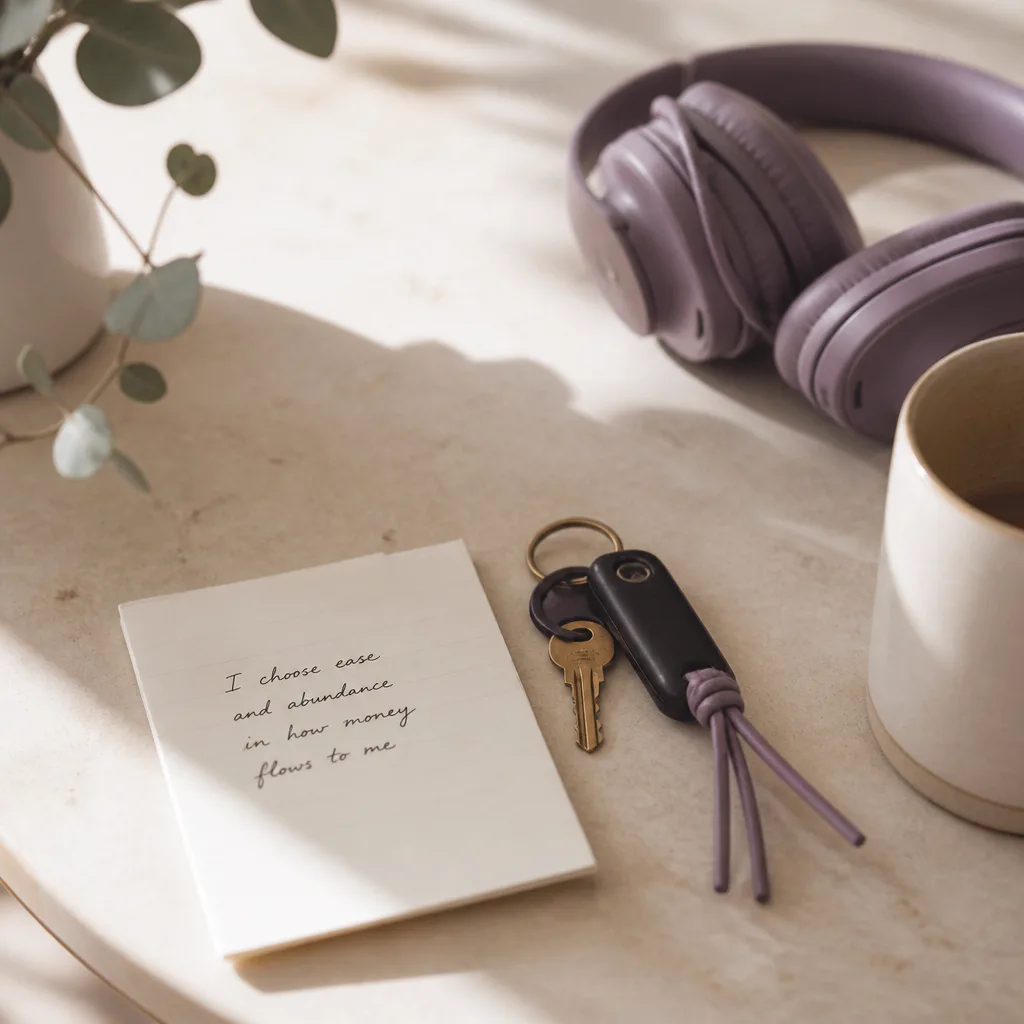
What do you listen to while you walk?
You listen to a short personalized future-self recording, then let silence or one sentence carry you home.
The AYA Method is a daily audio manifestation practice. Each day you listen to a short personalized recording — your Dream-Self Moment — narrated from the version of you who has already manifested the life you intend. Listening is the practice. Repetition is the work. The audio is the method.
That matters here. A money manifestation meditation can become too mental very quickly. You can start negotiating with the thought, testing it, doubting it, improving it, making it shiny. Audio interrupts that habit. You receive the voice. You don’t have to manufacture the whole inner climate by yourself.
In a 2014 JAMA Internal Medicine review, mindfulness meditation programs showed moderate evidence for reducing anxiety, depression, and pain, with effects often measured across 8 weeks. Your walk doesn’t need to mimic a clinical program. Still, the time frame is useful. Give the practice weeks, not hours. A nervous system that learned scarcity over years may need repetition before new cues feel safe.
Use this listening pattern:
- First 2 minutes: walk without words and feel your feet.
- Next 5 to 7 minutes: listen to your Dream-Self Moment.
- Next 3 minutes: repeat one money sentence with your steps.
- Last 1 minute: choose one concrete action for today.
The app also includes a daily affirmation and a Manifestation Board. They can help you remember and see the intention. But they are complements. They don’t replace the listening.
The audio gives the future self a voice before the present self has evidence.
How do you use attention without forcing outcomes?
Use attention by returning to the next step, the next breath, and the next honest sentence instead of demanding proof.
Forcing sounds loud inside. It says, this has to work, this has to work today, this has to fix me. The body hears that as threat. A quieter practice says, I am learning to receive without abandoning myself. It doesn’t need to shout because it isn’t trying to bully disbelief.
Neville Goddard wrote about assuming the feeling of the wish fulfilled. Taken gently, that can be useful. Taken harshly, it becomes another place to fail. Joe Dispenza speaks often about rehearsing a future self through repetition and emotion. You don’t have to accept every claim from every teacher to use the simple principle beneath it: the brain changes through repeated attention. Neuroplasticity research commonly shows that repetition and salience matter, though exact timelines differ by behavior.
Money manifestation meditation becomes more honest when it includes action. If you walk as someone who receives clean money, then later you send the invoice. If you walk as someone who chooses wisely, then later you pause before the purchase. The practice isn’t separate from behavior. It is rehearsal for behavior.
Here is the gentle rule:
- If the sentence makes you numb, make it smaller.
- If the sentence makes you frantic, slow your pace.
- If the sentence makes you cry, let the walk become care.
- If the sentence feels true for one breath, don’t demand more.
You may also bring in astrology and manifestation if timing helps you reflect, such as using a new moon to choose the intention. Let timing be a mirror, not a cage. Your daily walk is allowed to be ordinary.

What should you do when doubt or shame shows up?
When doubt or shame shows up, name it softly, stay with the body, and lower the demand until the practice feels possible again.
Money shame often speaks in old voices. You should be further along. You made the wrong choice. You can’t trust yourself. These thoughts can feel private, but they are common. The American Psychological Association has reported money as a significant source of stress for many adults across multiple Stress in America surveys, with inflation and economic concerns rising sharply in recent years.
Don’t answer shame with performance. Answer it with contact. Feel the ground. Notice the temperature on your face. Let the eyes see real things: a gate, a dog, a wet curb, a bakery window. Then say, this is shame, and I’m still walking. Naming emotion is not cosmetic. In affect labeling studies, including work associated with UCLA researcher Matthew Lieberman, putting feelings into words has been linked with reduced amygdala activity in some contexts.
The sentence may need to change. Instead of I am rich, which your body may reject, try I can take one honest money step. Instead of money always comes easily, try I am learning to receive without panic. A believable sentence is not weaker. It is kinder, and kindness repeats better.
You don’t have to defeat doubt. You have to stop letting it choose the whole room.
If shame becomes too intense, pause the manifestation language and use grounding only. Count 20 steps. Exhale longer than you inhale for 5 rounds. Look for 3 blue things. Then decide whether to continue. The practice is yours. It should not punish you.
How do you finish the walk so it changes the day?
Finish by choosing one visible money action that matches the self you just rehearsed.
A meditation that never touches the calendar can remain beautiful and vague. Choose one action small enough to do today. The BJ Fogg Behavior Model from Stanford emphasizes that behavior happens when motivation, ability, and a prompt meet at the same moment. So make the action easy. If it takes less than 5 minutes, the body is less likely to argue.
Examples:
- Send one invoice.
- Open the banking app and look, without spiraling.
- Move a small amount into savings.
- Cancel one unused subscription.
- Ask one clear question about pay.
- Put a bill date on the calendar.
- Leave one item in the cart for 24 hours.
This is where the AYA Method stays practical. You listen in the morning, then you let the listened self make one choice in the day. The Dream-Self Moment is not a fantasy to visit. It is a voice to remember when the ordinary decision arrives.
You can track the practice for 7 days without turning it into a scorecard. Use three columns only: listened, walked, acted. A check mark is enough. In habit research, consistency often improves when tracking is simple and visible; complex tracking can become its own avoidance.
If you want a wider frame for the practice, return to the manifestation guide when you need language, or the affirmations guide when you need one clean sentence. But on the walk, keep it quiet. Too many tools can become noise.
The work is not to become someone else. The work is to hear the part of you that already knows how to meet the day.
Keep walking softly toward what already feels true.
Listen on Aya

