astrology manifestation
Moon Phases Manifestation: A 4-Week Listening Ritual
Moon phases manifestation can become a quiet 4-week listening ritual: set an intention, listen daily, act gently, release, and review.

A cup sits beside the window. The moon is not full yet. Moon phases manifestation works best as a 4-week listening ritual: set one clear intention at the new moon, listen daily to your Dream-Self Moment, take small action as light grows, release friction as it wanes, and review before the next dark moon.
Why pair moon phases manifestation with audio?
Moon phases manifestation works because the moon gives you timing, while audio gives you repetition.
The lunar cycle lasts about 29.53 days, according to NASA, which is close enough to a calendar month to feel ordinary and old at the same time. That matters. A month is long enough to notice a pattern. It is short enough not to lose yourself inside it. When you pair that rhythm with daily listening, you give the mind one repeated future to hear, not a hundred competing wishes.
For this ritual, the AYA Method is the center. The AYA Method is a daily audio manifestation practice. Each day you listen to a short personalized recording — your Dream-Self Moment — narrated from the version of you who has already manifested the life you intend. Listening is the practice. Repetition is the work. The audio is the method.
This is why the moon is not the method. It is the frame. The listening is what you return to when you are tired, doubtful, distracted, or too hopeful to sit still. Research on habit formation helps here: Phillippa Lally and colleagues reported in the European Journal of Social Psychology in 2009 that new habits took a median of 66 days to feel automatic, with wide variation from 18 to 254 days. One lunar cycle will not make you automatic. It will make you honest.
The moon can mark the door, but you still have to enter by listening.
There is also a cultural reason this practice keeps calling people back. A 2018 Pew Research Center survey found that 29% of U.S. adults said they believe in astrology. You do not need to be in that 29% to use the moon. You only need to respect rhythm. If you want more context, astrology and manifestation can offer language for timing without making your life feel controlled by the sky.
What do the four moon phases ask from you?
Each moon phase asks for one simple movement: begin, build, see, and soften.
You do not need to track all eight named lunar phases unless you want to. For a listening ritual, four parts are enough. The new moon is the quiet beginning. The waxing moon is the stretch between idea and evidence. The full moon is the point where something becomes visible. The waning moon is the release, the review, the return. NASA describes the moon’s changing appearance as a result of sunlight on the moon as it orbits Earth, not as the moon changing itself. That is a useful teaching. You are not becoming a different person each week. You are seeing different light.
| Phase | Approximate days | Listening focus | Small action |
|---|---|---|---|
| New moon | Days 1-3 | Name one intention | Write one present-tense sentence |
| Waxing moon | Days 4-13 | Repeat the future self | Take one practical step |
| Full moon | Days 14-16 | Notice what is visible | Record evidence and resistance |
| Waning moon | Days 17-29 | Release what is too heavy | Remove one demand or distraction |
A lunar month is not exactly four calendar weeks, but four weeks makes the ritual usable. That matters because a practice you cannot repeat becomes decoration. The American Psychological Association reported in 2023 that 27% of adults said most days they were so stressed they could not function. A ritual should not add another impossible task to that pile. It should lower the number of choices you have to make.
Here is the quiet rule: one intention per cycle. Not five. Not a list that sounds like a second job. If you are working with manifestation, the point is not to force certainty. The point is to rehearse a true inner position until your next action can recognize it.
A clear intention is not loud. It is repeatable.
How do you set up the ritual before the new moon?
You set up the ritual by choosing one intention, one listening time, one sentence, and one place to record what changes.
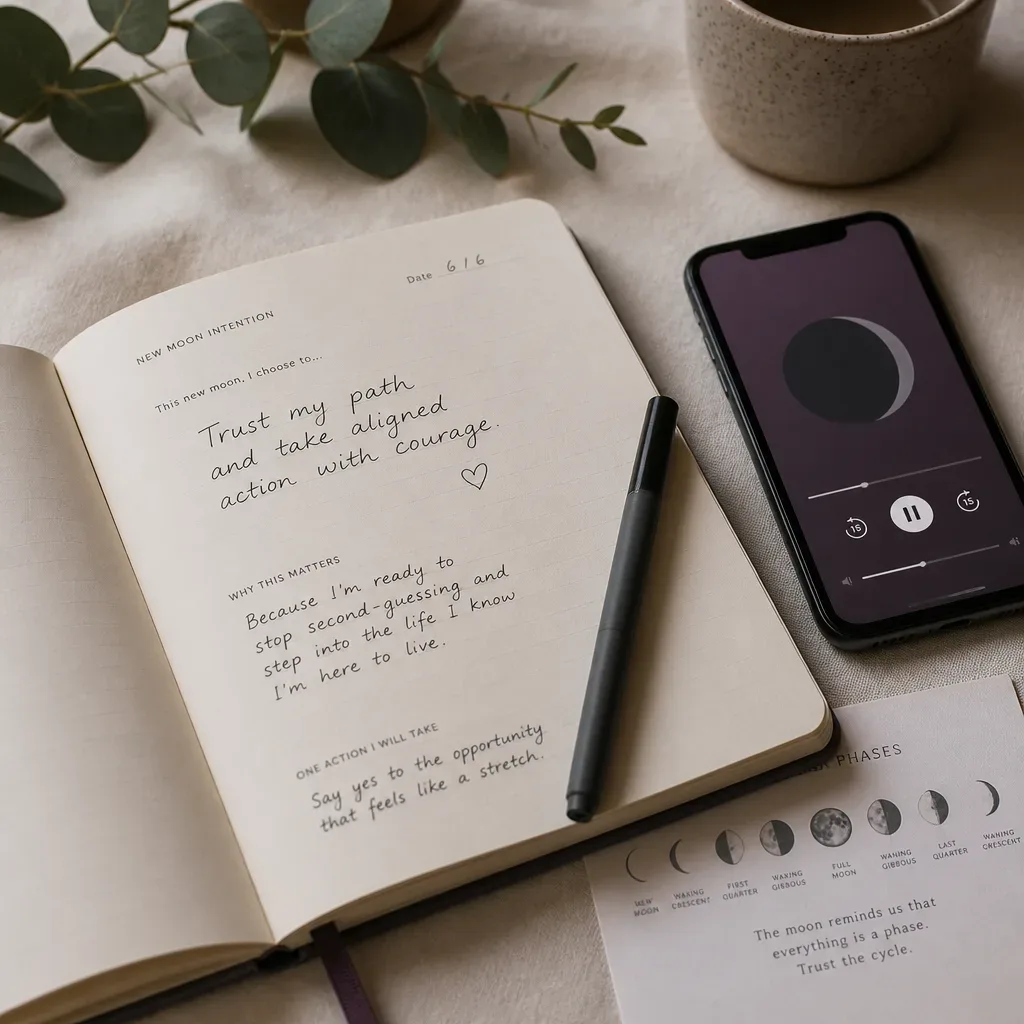
Begin before you feel ready. The day before the new moon is enough. You need a notebook, your Dream-Self Moment, and ten quiet minutes. The moon will be dark or nearly dark, and that is the mercy of it. You are not expected to show proof yet. The Old Farmer’s Almanac and NASA both list new moons by date and time, but you do not need precision down to the minute. Choose the evening that feels closest and begin.
Use this setup once at the start of the cycle:
- Write the intention in one sentence, as if it is already becoming real.
- Choose a daily listening time you can keep for 28 or 29 days.
- Listen to your Dream-Self Moment without multitasking.
- Write one line after listening: what did I hear that I can live today?
- Choose one small visible action for the waxing phase.
- Mark a review date near the next new moon.
Gollwitzer and Sheeran’s 2006 meta-analysis of implementation intentions reviewed 94 studies and found that if-then planning had a medium-to-large effect on goal achievement. That is why the listening time matters. Not someday. Not when you feel open. Try: after I brush my teeth at night, I listen. Or: after I make coffee, I listen before touching my phone.
Keep the sentence plain. If you are learning to speak to yourself more kindly, affirmations can help as a complement. One affirmation after the audio is enough. For example: I am someone who keeps one promise to herself. Say it once. Then stop. The ritual does not become stronger because you keep adding things.
How do you listen through the waxing moon without forcing it?
You listen through the waxing moon by repeating the same audio daily and taking one small action that proves attention is present.
The waxing phase is where many people start pressing too hard. The light is growing. The intention feels more visible. You may want to overhaul your schedule, your body, your work, your home, and the way you speak by Thursday. Do not. In behavior research, smaller actions tend to repeat more reliably because they create less friction. BJ Fogg’s Tiny Habits model, published by Stanford-affiliated research and in his 2019 book, rests on this simple point: make the behavior small enough to do now.
After you listen, ask one question: what is the smallest faithful action? Not the most impressive one. Not the one that would photograph well. The faithful one. If your intention is steadier work, open the document for ten minutes. If your intention is love that feels safe, send the honest message. If your intention is health, prepare the next meal rather than redesigning the whole week.
A 2022 review in Nature Reviews Psychology noted that repetition in stable contexts is central to habit formation. This is one reason daily audio matters. You are not trying to feel inspired every day. You are placing the same future-self cue into the same human life, again and again, until the next small action is easier to find.
Use these waxing moon supports:
- Keep the same listening time for at least 7 days.
- Choose actions that take 5 to 20 minutes.
- Record evidence in single lines, not essays.
- Do not change the intention because one day feels flat.
- Let missed days be data, not proof against you.
The future self becomes believable through ordinary evidence.
If you miss a day, return the next day without punishment. A 2010 study by Lally and colleagues also found that missing one opportunity did not erase habit formation. The ritual is not fragile. It is patient when you are.
What should you do at the full moon?
At the full moon, you pause long enough to see what has become visible without making everything mean too much.
The full moon is often treated as the dramatic point. It does not have to be. Astronomically, it is the phase when the moon is opposite the sun from Earth’s view and its near side appears fully lit. Emotionally, it can become a mirror because you have been listening for about two weeks. Something has usually surfaced by then: desire, resistance, evidence, boredom, grief, relief, a clean no.
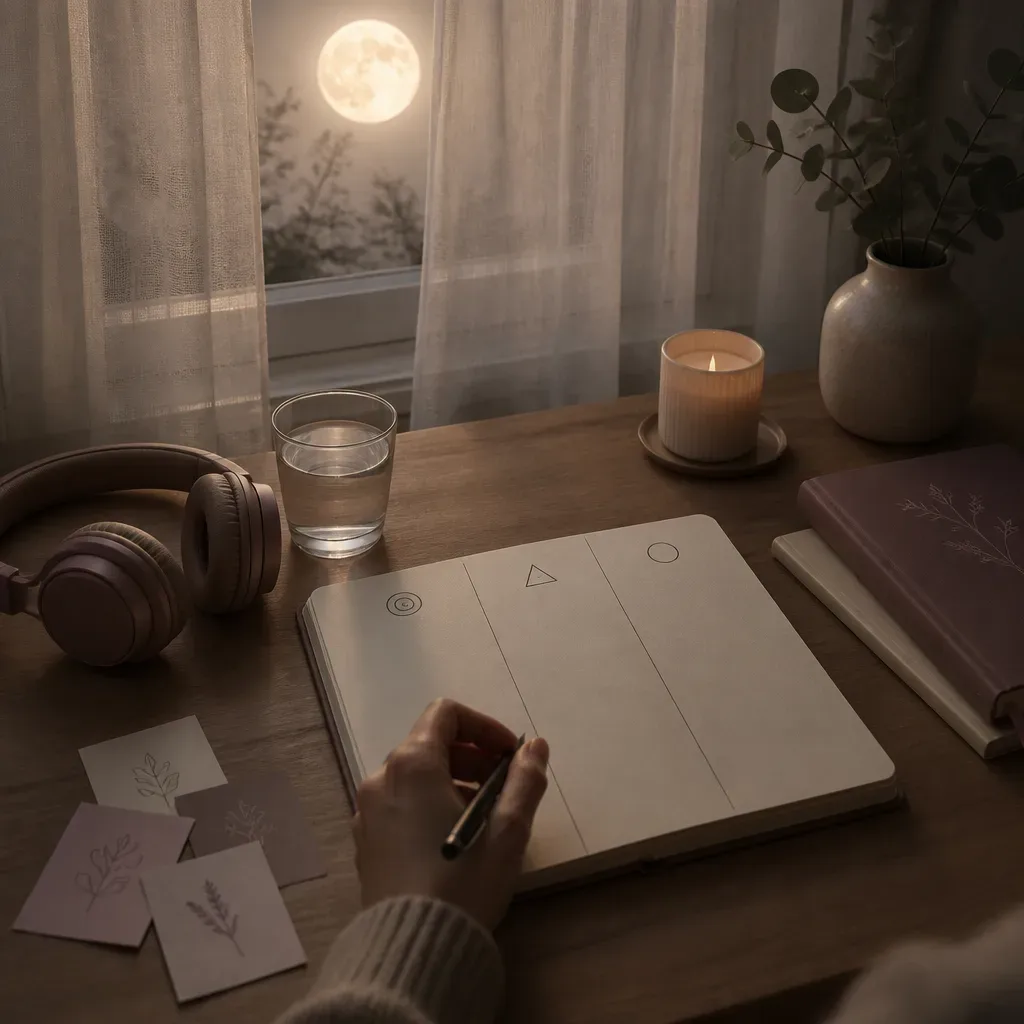
Give yourself 20 minutes. Listen first. Then write three columns: evidence, resistance, next truth. Evidence is what supports the intention, even if it is small. Resistance is the part of you that still argues, freezes, avoids, or performs. Next truth is the sentence that feels honest now. This is not a test. It is a reading of the room.
Neville Goddard wrote often about assuming the feeling of the wish fulfilled. You can take the useful part without turning it into strain. In this ritual, the Dream-Self Moment lets you hear that assumption spoken from inside the life you intend. Then the full moon asks: where did my body believe it this week, and where did it brace?
If you use a Manifestation Board inside the app, let it be visual evidence, not the center of the work. Add or remove one image if it clarifies the intention. The board can help you see. The audio remains the method. Princeton Engineering Anomalies Research, often cited in consciousness discussions, reported small statistical deviations in random event generator studies over many years, but its interpretations remain disputed. That is a useful caution: mystery can invite practice, but it should not ask you to abandon discernment.
For a broader frame on timing, signs, and ritual, return to astrology and manifestation when you want language. Then come back to the simple act: listen, write, act.
How do you use the waning moon to release what is too heavy?
You use the waning moon by removing one demand, one distraction, or one old sentence that keeps arguing with the intention.
Release is often made too grand. It can be small. Delete the note that keeps reopening an old fear. Move the app that steals the first ten minutes of morning. Stop repeating the sentence, I never finish anything. The waning moon is not a collapse. It is editing. Editors know this: a piece becomes clearer when the extra line is gone.
The lunar light appears to decrease for about two weeks after the full moon. That visible lessening can help your practice feel sane. Not every part of manifestation is addition. Sometimes the truest movement is subtraction. A 2018 paper in the Journal of Behavioral Medicine found that self-monitoring is associated with better health behavior outcomes, especially when paired with clear goals. During the waning phase, monitor what drains the intention, not to shame yourself, but to choose one less burden.
Try this release practice for 7 to 10 minutes after listening:
- Write: the sentence I am ready to stop rehearsing is…
- Name where it appears: phone, body, work, love, money, family.
- Choose one replacement action under 5 minutes.
- Repeat the replacement after the next listening session.
You might notice grief here. That is allowed. Sometimes an old identity was not only painful; it was familiar. Joe Dispenza often speaks about rehearsing a new state before the outer world confirms it. Whether or not you use his full framework, the daily audio gives you a grounded way to practice that idea. You listen before the proof is complete.
Release is not rejection. It is making room for the sentence that is more true.
Do not release your real needs. Do not release boundaries, medicine, money plans, or difficult conversations because they feel less mystical. The ritual should make you more honest with life, not less. If you want a plain foundation for this distinction, read the wider guide to manifestation and keep your practice close to action.
How do affirmations, a Manifestation Board, and astrology fit without taking over?
They fit as complements when they support daily listening instead of replacing it.
This is the place to be clear. The audio is the method. The daily affirmation and Manifestation Board are not pillars. They can help, but they should not become a second system you have to maintain perfectly. If you are tired, listen. If you only have three minutes, listen. If you are unsure what the moon is doing tonight, listen.
A daily affirmation can be useful when it is short, believable, and tied to the same intention. Research on self-affirmation, including work by Claude Steele and later health studies in social psychology, suggests that affirming valued identity can reduce defensiveness in some contexts. That does not mean every sentence works for every person. It means language can soften the threat response when it feels true enough to repeat.
The Manifestation Board is visual. It can hold images, words, or symbols that remind you of the life named in the Dream-Self Moment. Keep it spare. Three images may serve you better than thirty. In cognitive load theory, first developed by John Sweller in the late 1980s, too much information can make learning harder. Your future self does not need clutter to be real.
Astrology can give timing and texture. A new moon in Cancer may make home themes louder. A full moon in Capricorn may show work, duty, or structure. But the sign is not a verdict. If it helps, use it. If it makes you spiral, return to the visible moon. The body often understands dark, growing, full, and fading before it understands a chart.
A simple hierarchy helps:
| Tool | Role | Use it when |
|---|---|---|
| Dream-Self Moment | Core practice | Every day |
| Affirmation | Short verbal cue | After listening |
| Manifestation Board | Visual reminder | Weekly or when needed |
| Moon phase | Timing frame | Throughout the cycle |
| Astrology | Optional context | Only if it clarifies |
For method details, return to the AYA Method. For language practice, keep affirmations simple. The fewer moving parts you require, the more likely you are to return.
How do you know the 4-week ritual is working?
You know the ritual is working when your attention, choices, and self-talk begin to repeat the intention in ordinary moments.
Do not measure only outer results. Some outcomes need more than one lunar cycle. A job may take months. A relationship may need real conversations. A body may need care, diagnosis, or rest. The first signs are often quieter: you pause before the old reaction, you choose the smaller promise, you hear the cruel sentence and do not obey it.
Use a simple review before the next new moon. Give yourself 15 minutes. Read the first intention. Listen once. Then answer five questions:
- What did I repeat most often?
- What evidence appeared, even in small form?
- What resistance kept returning?
- What action helped more than I expected?
- What intention wants to continue into the next cycle?
The number matters less than the pattern, but numbers can help you see. Count how many days you listened out of 29. Count how many small actions you took. Count how many times you returned after missing a day. In habit research, consistency is rarely perfect. It is usually a pattern of return.
If you listened 18 days, that is not failure. It is 18 contacts with the future self you are practicing. If you listened 29 days, do not make it a trophy. Let it become trust. A 2020 study in Frontiers in Psychology on goal progress and well-being found that perceived progress can support positive affect, especially when goals feel self-concordant. In plain terms: it helps when the goal feels like yours.
You may begin again at the next new moon with the same intention or a cleaner one. This is the mercy of cycles. They do not ask you to become finished. They ask you to return with more truth than last time.
Listen, then let the night be enough.