aya method deep dive
Personalized Manifestation App for Dream-Self Audio
Use a personalized manifestation app to turn goals into Dream-Self audio, listen daily, and make manifestation quiet, specific, and repeatable.
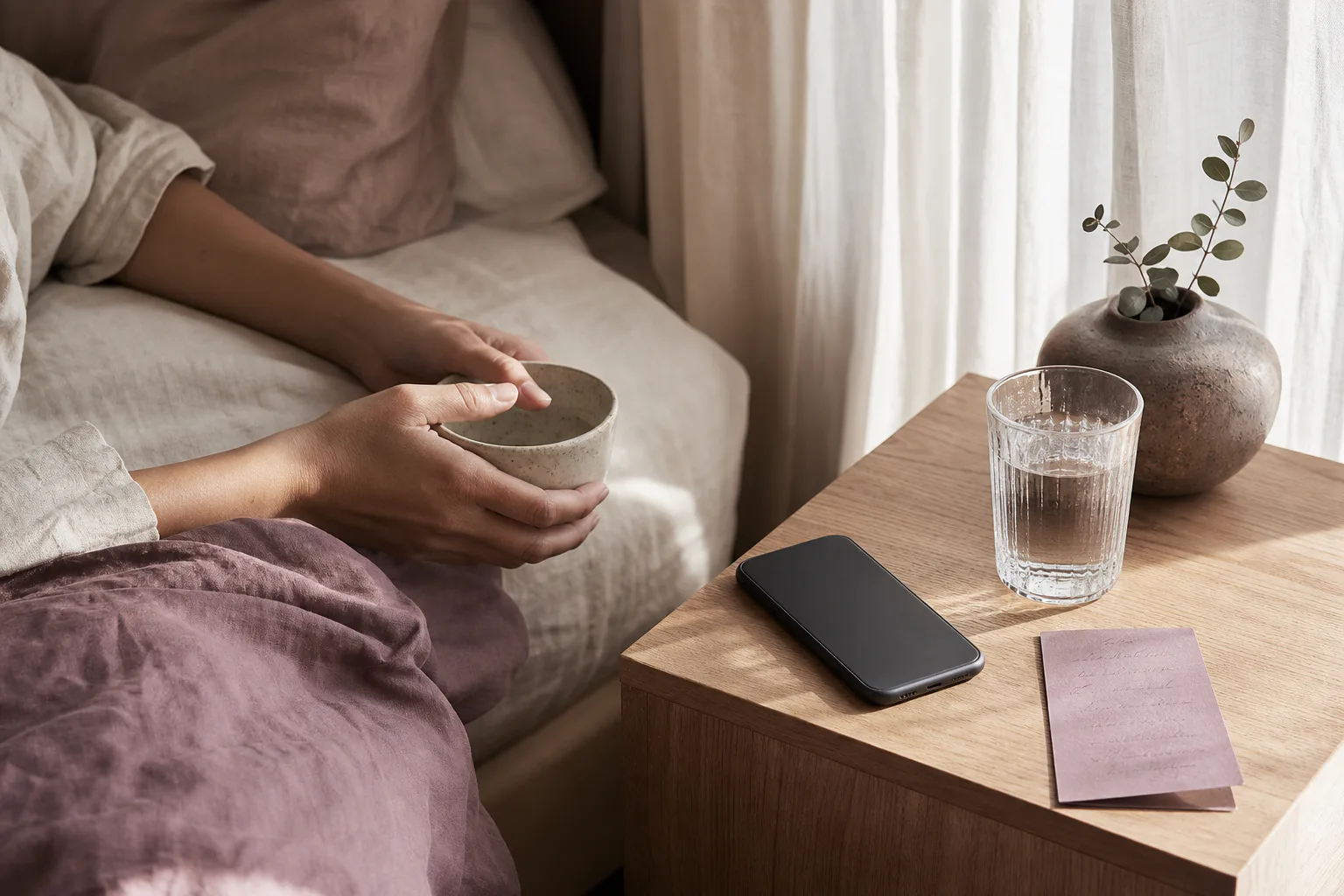
The phone is face down beside a glass of water. A personalized manifestation app should take your real goal, turn it into a short Dream-Self audio, and help you listen daily. The point is not more effort. It is a repeatable way to hear the self you’re already practicing becoming.
What should a personalized manifestation app actually do?
A personalized manifestation app should make your goal specific, audible, and easy to repeat.
Most people don’t need another place to store wishes. They need a place where one wish becomes clear enough to return to tomorrow. Pew Research Center reported in 2024 that 91% of U.S. adults own a smartphone, which means the phone has become the small object we carry into nearly every private hour. A good app uses that closeness carefully. It should not shout at you. It should help you remember.
The center of Aya is the AYA Method: The AYA Method is a daily audio manifestation practice. Each day you listen to a short personalized recording — your Dream-Self Moment — narrated from the version of you who has already manifested the life you intend. Listening is the practice. Repetition is the work. The audio is the method.
That last sentence matters. The daily affirmation and Manifestation Board can support you, but they are not the center. They are complements. If you can do only one thing, listen to the Dream-Self Moment. A goal becomes easier to meet when you can recognize the person who would keep it.
Personalization is not decoration. It is evidence that the practice knows your real life. Your language should include the work you do, the room you wake in, the fear you keep meeting, the small action that counts. In Cohen and Sherman’s 2014 review in the Annual Review of Psychology, self-affirmation was described as most useful when it connects people back to personally important values, not vague praise. The words need to belong to you.
How do you turn a goal into Dream-Self audio?
You turn a goal into Dream-Self audio by translating the outcome into the voice, choices, and daily evidence of the person who already lives it.
Start with one goal. Not ten. One. Research on implementation intentions by Peter Gollwitzer has been tested across more than 90 studies, and a 2006 meta-analysis found a medium-to-large effect on goal achievement when people used specific if-then plans. Specificity helps because it gives the mind a place to stand.
Use this simple order:
- Write the goal in one plain sentence.
- Name why it matters now.
- Describe one ordinary scene from the life where it is already true.
- Name the behavior you repeat in that life.
- Let the app shape those details into your Dream-Self Moment.
Here is the difference between a goal and audio-ready material:
| Written goal | Dream-Self audio detail |
|---|---|
| I want to be healthier. | I choose the walk after lunch because my body is not an afterthought. |
| I want more money stability. | I check my account without flinching and make one calm decision. |
| I want to write my book. | I sit for 25 minutes before messages and keep the page open. |
| I want love that feels safe. | I speak honestly before I disappear into politeness. |
A personalized manifestation app is useful when it helps you move from fog to evidence. You don’t need a louder goal. You need a truer sentence. In mental imagery research, including work by Stephen Kosslyn and colleagues in the early 2000s, the brain has been shown to use overlapping systems when imagining and perceiving visual scenes. That doesn’t make imagination magic. It makes rehearsal meaningful.
If you’re new to the wider practice, the Manifestation pillar gives the larger frame. But here, stay close. The audio is not a speech you perform. It is a room you enter each day.
What details make the audio feel like yours?
The audio feels like yours when it includes your real language, your body cues, and proof you would notice on an ordinary day.
I trained as a clinical psychologist before clay took my hands elsewhere. In the therapy room, I learned that people often reject sentences that are technically kind but not true. In the studio, I learned the same thing from vessels. A cup made too quickly slumps. A sentence made too generally does too.
Use details from the senses, but keep them honest:
- the time of day you can actually listen
- the phrase you would say to yourself without cringing
- the first small action that proves the goal is alive
- the place your body softens
- the old pattern you no longer feed as quickly
Habit research gives this quiet work a backbone. In a 2010 European Journal of Social Psychology study, Phillippa Lally and colleagues found that new habits took a median of 66 days to become automatic, with a range from 18 to 254 days. That range is a relief. It says you are not late. You are practicing.
There is also a difference between fantasy and rehearsal. Gabriele Oettingen’s research on mental contrasting, summarized in her 2014 book Rethinking Positive Thinking, found that positive fantasy alone can reduce effort if it is not paired with the obstacle and the next step. So your Dream-Self Moment should not float above your life. It should include the moment where you choose differently.
The softest practice is often the one you actually repeat. If your audio says, I never doubt myself, and you do doubt yourself, the sentence may break trust. Try: I feel doubt, and I still send the message. That is smaller. It is also more usable.
How should you choose the right app before you pay?
Choose the app that centers personalized audio, respects repetition, and does not confuse stimulation with practice.
A transactional choice can still be tender. You are deciding what will speak to you when you are half-awake, discouraged, or almost ready to quit. App stores are full of bright promises, but the useful question is simple: what will I actually return to on day 37? Lally’s 66-day median is a reminder that the middle matters more than the first week.
Before you subscribe, check for these things:
| What to check | Why it matters |
|---|---|
| Personalized Dream-Self audio | The app should speak from your actual goal, not a generic script. |
| Short daily listening | A practice under 5 minutes is easier to keep than a long ritual. |
| Clear method | You should know what the center is. In Aya, the audio is the method. |
| Gentle complements | Affirmations and boards can help, but they should not bury the practice. |
| Privacy cues | Personal goals are intimate. Read how your data is handled. |
| No pressure language | Fear-based streaks can make practice feel unsafe. |
There is no prize for choosing the noisiest tool. The audio should make your next action easier to see. Dr. Andrew Huberman has often spoken about the role of cue, routine, and reward in habit loops, drawing on behavioral science rather than wishful thinking. A daily app should make the cue obvious and the routine brief.
You may also want to compare it with related practices. Affirmations can be useful when a single sentence is enough. Astrology and manifestation may help some people time reflection or notice recurring themes. But if your question is, which app helps me become familiar with my future self, choose the one that lets you listen.
What does a daily listening rhythm look like?
A daily listening rhythm works best when it attaches to something you already do.
Do not build a new morning around the app. Put the app inside a morning that already exists. Listen while your coffee cools. Listen after brushing your teeth. Listen in the parked car before opening the door. The cue matters. A 2012 review in the British Journal of General Practice described habit as behavior repeated in a stable context; the stable context is what lets effort drop.
Try this 12-minute setup once, then keep the daily part short:
- Minute 1: choose one goal.
- Minutes 2–4: add the ordinary scene where it is already true.
- Minutes 5–7: name the obstacle you meet most often.
- Minutes 8–9: choose the next small behavior.
- Minutes 10–12: generate or refine your Dream-Self Moment, then listen once.
After that, listening can take 2 to 5 minutes a day. That is not a lesser practice. It is the practice made possible. Princeton Engineering Anomalies Research, active from 1979 to 2007, is often mentioned in manifestation spaces, but its findings remain debated and should not be used as proof that intention controls events. Your sturdier ground is repetition, attention, and behavior.
The app also includes the daily affirmation and Manifestation Board for moments when seeing or naming helps. Use them when they support the listening. Do not let them become a way to avoid the audio. The audio is where the future self gets a voice.

How do you know the practice is working?
You know the practice is working when your choices begin to match the self you hear, even before the outer result is complete.
Look for small evidence. You pause before the old answer. You choose the walk. You open the document. You stop rehearsing the same apology for wanting what you want. In clinical behavior change, small measurable behaviors are often more reliable than mood as a signal. Mood changes. Behavior leaves tracks.
Use a weekly check, not a daily trial. Daily measurement can make a tender practice feel like a courtroom. Once a week, ask:
- Did I listen at least 4 days?
- Did one sentence stay with me?
- Did I take one action that matched the audio?
- Did the wording still feel true?
- What needs to be made more specific?
A 2020 survey from the American Psychological Association reported that stress affects sleep, eating, and decision-making for many adults, which means your practice has to be kind enough to survive stressful weeks. Missing a day is not evidence against you. Returning is the point.
This is where the AYA Method stays merciful. It does not ask you to become a person who never forgets. It asks you to listen again. If you want the broader context for how manifestation works inside Aya, return to the Manifestation guide. If the wording itself is the place you need help, the Affirmations guide can give you a quieter way to edit the sentence.
The audio is the room where the future becomes familiar. Not forced. Familiar.
Stay close to the voice that feels like yours.