sleep hypnosis affirmations
Affirmations Before Bed: Listen in the Drowsy Window
Affirmations before bed work best when you listen in the drowsy window, keep them believable, and let sleep carry the words quietly.
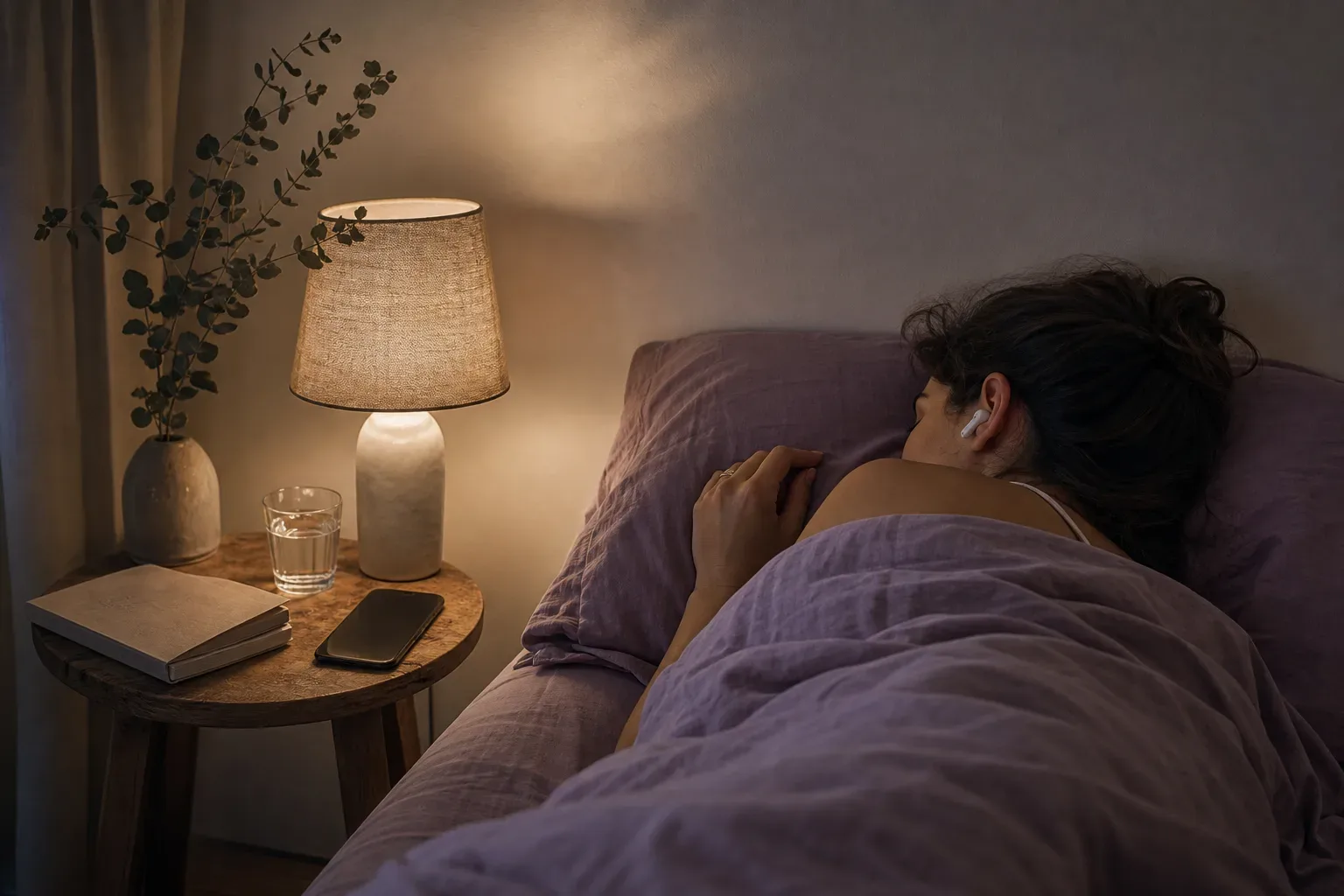
The lamp is low. Your phone is face down. Affirmations before bed work best when you listen during the drowsy window, the few minutes when you’re awake but already softening toward sleep. Keep the words brief, believable, and repeated. Let the body rest while the mind hears one clear direction.
Why are affirmations before bed different from morning affirmations?
Affirmations before bed meet the mind when it is less defended and more ready to repeat what it hears.
Morning has a certain brightness to it. Messages arrive. Teeth need brushing. Someone may need you before you’ve heard yourself. Bedtime is quieter. The prefrontal cortex, the part of the brain often linked with planning and control, is tired by then. The National Sleep Foundation has long recommended 7 to 9 hours of sleep for most adults, yet the last 10 minutes before sleep are often given to scrolling, worry, or half-finished arguments in the mind.
That matters because the brain does not treat the edge of sleep as empty time. Sleep researchers describe the transition into sleep as stage N1, a light, brief stage where thoughts can become image-like and loose. According to the American Academy of Sleep Medicine scoring system, N1 is usually only a small part of total sleep, often around 5 percent in healthy adults. Small does not mean unimportant. A doorway is small too.
Morning affirmations can set tone. Night affirmations can set residue. What you repeat before sleep may not decide your life, but it can decide what your mind rehearses while the room is dark. A 2016 paper in Social Cognitive and Affective Neuroscience found that self-affirmation activated brain regions tied to self-processing and valuation. That does not mean every sentence works. It means the self listens differently when the sentence feels connected to what you care about.
A quiet rule helps: do not use bedtime to convince yourself of something your whole body rejects. Use it to remember what is already partly true. If the sentence is too large, the mind argues. If the sentence is small and true, the mind can rest beside it.
The last thought of the day does not need to be grand. It needs to be kind enough to repeat.
What is the drowsy window, and how do you find it?
The drowsy window is the short span when you’re still aware, but your body has begun to release the day.
You know it by texture. Your limbs feel heavier. The room seems less sharp. You may lose the thread of a sentence and then find it again. Sleep medicine calls the earliest sleep transition N1, and the National Institute of Neurological Disorders and Stroke notes that a full sleep cycle usually lasts about 90 minutes, moving through lighter sleep, deeper sleep, and REM. Your drowsy window comes before that larger cycle takes over.
You do not need a device to find it. You need attention. Begin too early and the affirmation becomes another task. Begin too late and you sleep through the first words. The right time is often after the light is off, after your last sip of water, after the phone has been placed where your hand cannot reach it. For many people, that means the final 5 to 10 minutes before sleep.
There is a reason so many older contemplative practices cared about thresholds: waking, sleeping, eating, leaving, returning. A threshold is when the usual guard relaxes. Dr. Andrew Huberman has often spoken about nervous system states in practical terms, including the value of downshifting before sleep through light, breath, and reduced stimulation. You do not need to make the night dramatic. You only need to stop asking the body to be alert while asking the mind to be calm.
Try this simple timing test for 3 nights:
- Start the audio when you’re fully awake and notice if it feels like work.
- Start it when your eyelids are heavy and notice if you can still hear it.
- Start it when you’re nearly asleep and notice if you miss most of it.
The middle point is yours. Not perfect. Yours.
How do you choose affirmations your sleeping mind can accept?
Choose affirmations that feel true enough to enter the body without starting a debate.
This is where many bedtime practices become too bright. A person lies in bed with unpaid bills, a sore neck, a tender heart, and repeats a sentence that feels miles away from the life in the room. The mind does not soften. It cross-examines. Psychologist Joanne Wood and colleagues reported in a 2009 study in Psychological Science that very positive self-statements could make some people with low self-esteem feel worse. The lesson is not to avoid affirmations. The lesson is to make them honest.
A good night affirmation has three qualities: it is brief, it is present-tense, and it does not require proof tonight. If your nervous system can say, “Maybe,” the sentence is close enough. If it says, “No,” make the sentence smaller. In the Affirmations pillar, the practice is treated as repetition with care, not as decoration. Words matter because they become familiar. Familiar things feel safer to return to.
Use this table before bed:
| If the sentence feels like this | Try this instead |
|---|---|
| ”Everything is perfect." | "I can rest without solving everything tonight." |
| "I never feel afraid." | "Fear can be here, and I can still soften." |
| "My whole life is fixed." | "One part of me already knows the next small step." |
| "I am always confident." | "I can meet tomorrow with a little more steadiness.” |
The body believes tone before it believes grammar. Say less. Mean more.
You can also borrow the future-self frame used in the Manifestation pillar: speak from the version of you who has already learned the steadiness you’re practicing. Not a fantasy self. A remembered self. Neville Goddard wrote often about assuming the feeling of the wish fulfilled; the useful part at bedtime is not force, but felt nearness. The image should be simple enough to sleep inside.
An affirmation that makes you strain is too loud for night.
How do you practice affirmations before bed in 10 minutes?
Practice by lowering stimulation, listening softly, and ending before the mind starts measuring the result.
Here is the version I use when I am in Brussels in winter, when the window glass turns black by late afternoon and the city sounds closer than it is. It takes 10 minutes. No candle is required. No perfect room. The American Academy of Sleep Medicine recommends keeping a regular bedtime and reducing stimulating activity before sleep; this practice respects that by staying small.
- Minutes 0 to 2: lower the room. Dim the light. Put the phone on do not disturb. If you use your phone for audio, place it screen-down. The goal is not mood. The goal is fewer signals.
- Minutes 2 to 3: choose one direction. Pick one sentence or one short recording. Do not browse. Choice wakes the mind.
- Minutes 3 to 8: listen. Let the volume sit just above silence. If your attention wanders, return to the next word you hear.
- Minutes 8 to 9: breathe normally. Do not perform a special breath unless it already helps you. Count 6 easy exhales if you need an anchor.
- Minute 10: stop. Let the audio end. Do not check the time again.
The AYA Method is a daily audio manifestation practice. Each day you listen to a short personalized recording — your Dream-Self Moment — narrated from the version of you who has already manifested the life you intend. Listening is the practice. Repetition is the work. The audio is the method.
That definition matters most at night. You are not trying to decorate the mind with better slogans. You are letting a known voice return, day after day, until the nervous system recognizes it. Research on habit formation from Phillippa Lally and colleagues at University College London found that automaticity took a median of 66 days, with wide variation. Bedtime listening asks for that kind of patience. Not intensity. Return.
A daily affirmation can sit beside the audio. A Manifestation Board can help you see what you’re practicing. But the audio is the method. The complements should not make the night crowded. If the board stirs comparison or planning, leave it for morning. Bed is for hearing, not arranging.
What should you avoid when listening at night?
Avoid anything that makes bedtime feel like a performance you can pass or fail.
The first thing to avoid is volume, in every sense. Loud audio can keep the brain alert. Loud claims can do the same. The World Health Organization has warned that environmental noise can disturb sleep even when a person does not fully wake. Your affirmation practice should not become another form of noise. Keep the sound low enough that you could drift away from it without effort.
Avoid scrolling for the right sentence. A 2019 Pew Research Center report found that 28 percent of American adults said they were online “almost constantly,” and younger adults reported even higher rates. Bedtime browsing can stretch from 2 minutes to 40 without asking permission. If you need a sentence, choose it before you get into bed. Better yet, use the same one for 7 nights and let repetition do its plain work.
Avoid arguing with intrusive thoughts. The mind may offer a list of reasons the affirmation is not true. Thank it for trying to protect you, then return to the sound. In cognitive behavioral therapy for insomnia, stimulus control often asks people to protect the bed as a place for sleep rather than rumination. You can borrow that respect here. The bed is not a courtroom.
A few quiet boundaries help:
- Do not use affirmations to deny grief, anger, or fear.
- Do not chase a special feeling.
- Do not restart the audio again and again.
- Do not measure the practice by whether you fell asleep quickly.
- Do not turn the Manifestation Board into a bedtime checklist.
If you want to work with timing, moon cycles, or symbolic calendars, keep them gentle. Astrology and manifestation can offer language for reflection, but it should not take authority over your body. Your body is allowed to be tired on a new moon. Your body is allowed to be awake on a full one.
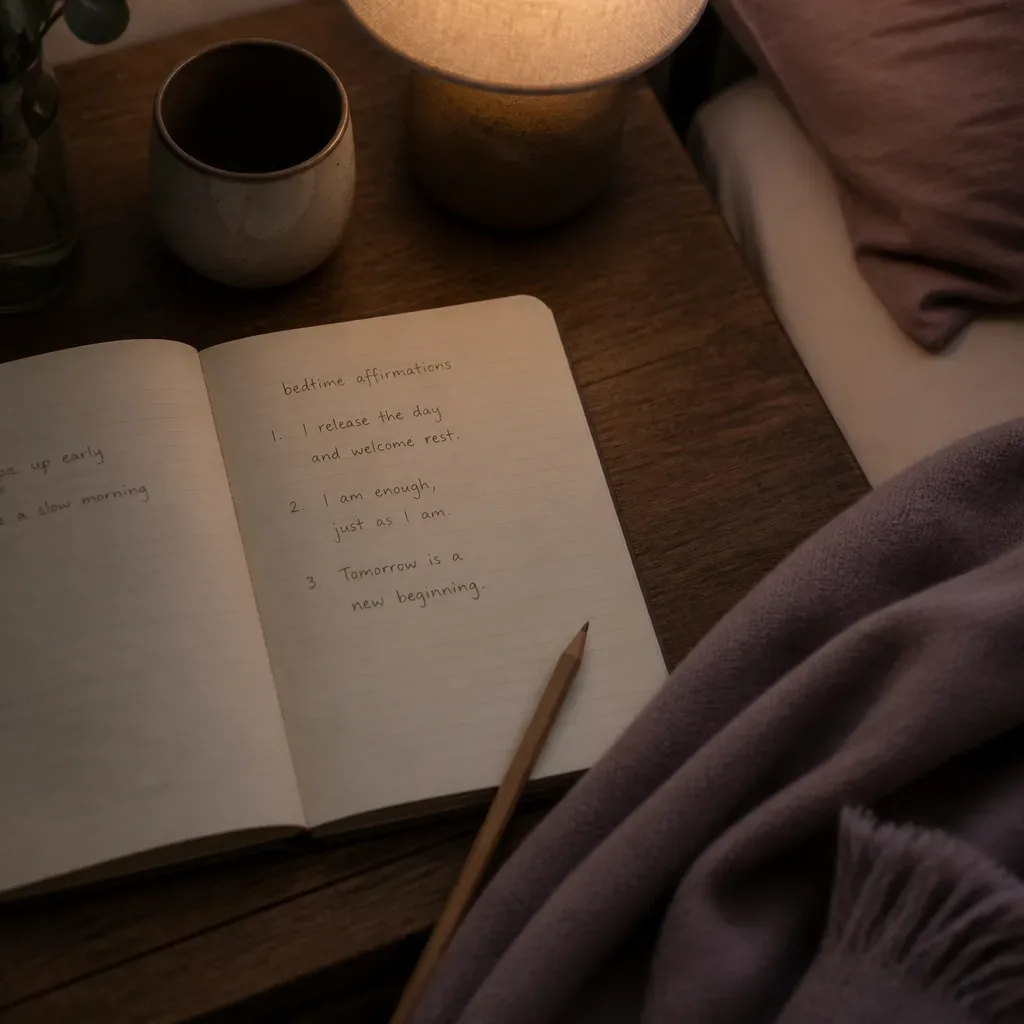
Can bedtime affirmations help with sleep anxiety?
Bedtime affirmations can support sleep anxiety when they reduce pressure rather than promise instant sleep.
Sleep anxiety often begins before the head reaches the pillow. You remember last night. You calculate tomorrow. You watch the clock as if it were a judge. The Sleep Foundation notes that insomnia symptoms affect a large share of adults at least sometimes, and chronic insomnia is commonly estimated around 10 percent of adults. If sleeplessness is persistent, painful, or tied to panic, medical or therapeutic support matters. Affirmations are a support practice, not a substitute for care.
For anxious nights, the best affirmations are not about sleeping perfectly. They are about safety, permission, and enoughness. Try: “I do not have to force sleep.” Or: “Rest counts, even before sleep comes.” Or: “My body knows more than my worry knows.” These sentences reduce the struggle. They do not demand a result within 5 minutes.
There is also value in pairing words with sensation. Feel the sheet under your fingers. Notice the weight of the blanket. Name 3 sounds without judging them. Grounding techniques are often used in anxiety care because they bring attention back to present sensory data. For a photographer, this feels familiar. Before I make an image, I stop hunting. I let the light tell me where to stand. At night, the body can do the same.
Rest is not a prize you earn by becoming calm enough.
If you use the AYA Method during a season of sleep anxiety, keep the Dream-Self Moment short and steady. Listen before the anxious spiral gathers speed. The app also includes a daily affirmation and a Manifestation Board, but at night, less is usually kinder. Choose the audio. Let the other pieces wait.
How do you know if your bedtime affirmation practice is working?
You know it is working when the night feels less like a fight, even before your life looks different.
Do not look for fireworks. Look for smaller evidence. You stop reaching for the phone after the audio ends. You notice the first harsh thought and do not follow it all the way down. You fall asleep 12 minutes sooner one night, then not the next, and you do not call yourself broken. This is real progress. Sleep and behavior both change unevenly.
Track lightly for 14 nights if you need data. The number is long enough to show a pattern and short enough not to become a second job. Sleep diaries are commonly used in insomnia treatment because perception can shift when it is written down. Keep yours plain: bedtime, audio listened or not, anxiety level from 1 to 5, and one sentence about the morning. No analysis after lights out.
You can also watch daytime residue. A good bedtime practice often shows itself at noon. You may speak to yourself with less violence after a mistake. You may remember the affirmation while waiting in line. You may make one cleaner choice. In the AYA Method, repetition is not there to impress the night. It is there to make a future self familiar enough to recognize in daylight.
Here is a simple 14-night note format:
| Night | Listened? | Anxiety 1–5 | Morning note |
|---|---|---|---|
| 1 | Yes | 4 | Woke once, returned gently |
| 2 | Yes | 3 | Less phone checking |
| 3 | No | 5 | Scrolled late, felt wired |
If the practice makes you tense, simplify it. If it makes you sad, choose truer words. If it brings up old pain, seek support. The aim is not to overpower the mind. The aim is to give it a safer place to land.
Leave one true sentence by the bed, and let the dark keep it.
Listen on Aya

