affirmations
Affirmations for Anxiety: 3-Minute Audio Reset
Affirmations for anxiety work best when they feel believable. Try this quiet 3-minute future-self audio reset when your body needs a steadier cue.

Your phone is face down. The room is not silent, but it’s close. Affirmations for anxiety work best when they’re short, believable, and heard while the body is settling. A 3-minute future-self audio reset gives your mind one steady sentence, one slower breath, and one next step.
What do affirmations for anxiety actually do?
Affirmations for anxiety give your attention a safer sentence to rehearse when the mind is repeating threat.
An anxious brain is not trying to ruin your day. It’s trying to predict danger. The National Institute of Mental Health reports that about 19.1% of U.S. adults had an anxiety disorder in the past year, and anxiety often shows up as thought loops, muscle tension, sleep changes, or avoidance. A sentence will not erase all of that. But a sentence can interrupt the loop long enough for the body to notice another cue.
The key is believability. In a well-known 2009 study in Psychological Science, Joanne Wood and colleagues found that very positive self-statements could make some people with low self-esteem feel worse. The problem wasn’t language itself. The problem was the gap. If your body is saying, I am not safe, and your affirmation says, Everything is perfect, the nervous system may push back.
A better affirmation is close enough to touch. It doesn’t deny the anxiety. It tells the truth with a little more room around it. For example: I can feel anxious and still take the next small step. Or: My body is sounding an alarm; I don’t have to obey every alarm.
A good anxiety affirmation does not shout over fear. It gives fear a smaller chair.
Self-affirmation research also points toward values. In a 2014 review, Cohen and Sherman described self-affirmation as a way to reduce defensiveness under threat by reconnecting people with what matters to them. That means your line may work better when it sounds like your life, not a poster. Try your own words. Try fewer words. Keep the sentence low to the ground.
If you want the wider practice context, the Affirmations pillar holds the larger map. For this reset, stay close. Three minutes. One line. One breath you can finish.
Why use a 3-minute future-self audio reset?
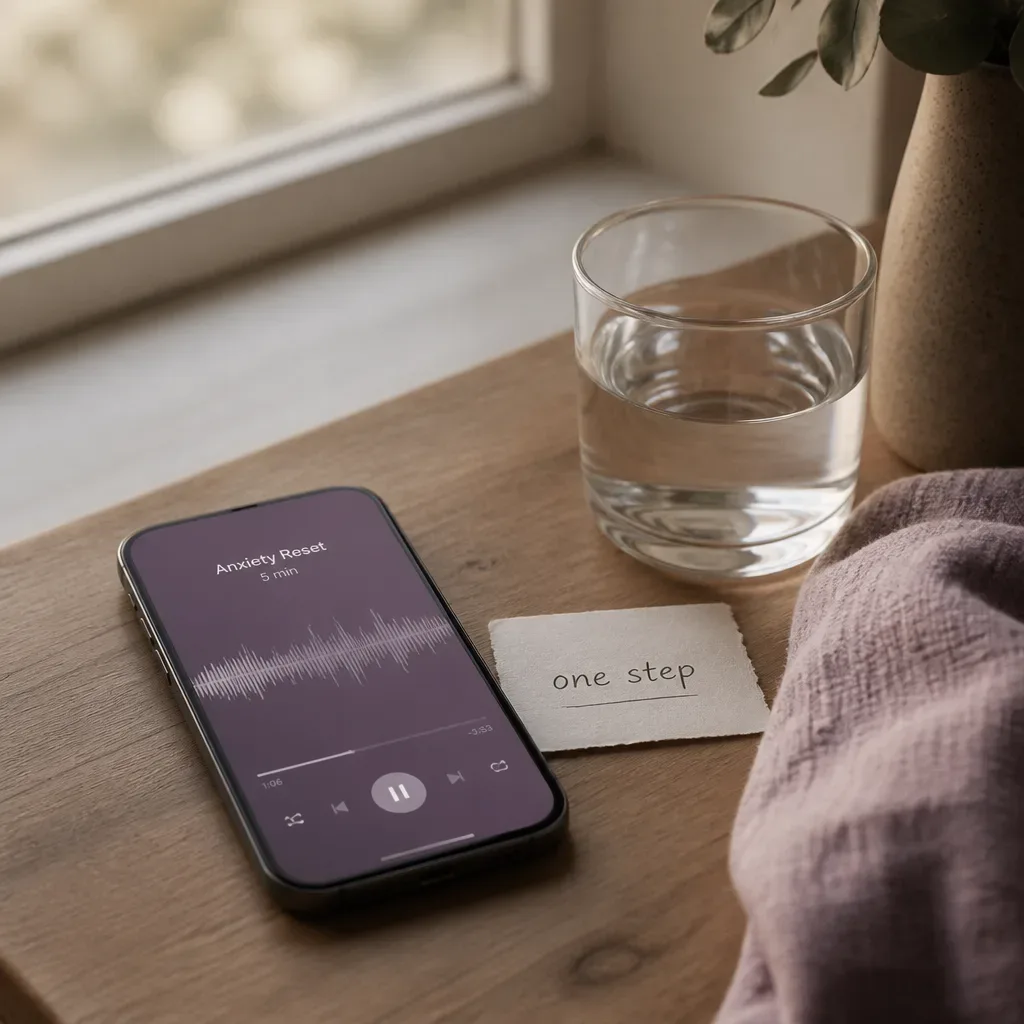
A 3-minute audio reset works because listening asks less from you than reading, deciding, or trying to think your way calm.
When anxiety is high, choice becomes heavy. The American Psychological Association’s 2023 Stress in America report found that 27% of adults said most days they were so stressed they couldn’t function. In that state, a long practice can feel like another demand. A short recording removes several decisions. You press play. You listen. The voice carries the words for you.
Audio also uses time differently. Three minutes is long enough to slow breathing, repeat one phrase, and return with a single action. It’s short enough to use before a call, in a parked car, or after waking at 3:12 a.m. The point is not to create a perfect state. The point is to create a repeatable return.
A future-self frame matters because anxiety often narrows time. It makes the next hour feel like the whole future. A future-self line gently lengthens the view: I have lived through mornings like this. I know what to do next. That kind of sentence doesn’t pretend the worry is silly. It lets another version of you speak from a steadier place.
Here is the simple difference:
| Format | When it helps | Watch for |
|---|---|---|
| Reading a list | Low anxiety, morning planning | Too many choices |
| Writing by hand | Reflection, therapy homework, evening review | Can become analysis |
| Spoken audio | High anxiety, transition moments | Needs a calm pace |
| Future-self audio | Repeated worries, self-doubt, fear of the next step | Must stay believable |
Breath research gives this small practice a stronger base. In a 2023 Cell Reports Medicine study, Balban and colleagues found that 5 minutes of daily cyclic sighing improved mood and reduced respiratory rate more than mindfulness meditation in their sample. Your reset is only 3 minutes, but the principle is similar: the body needs a cue it can feel.
The body believes repetition before it believes intensity.
How do you make anxious affirmations believable?
You make anxious affirmations believable by lowering the claim until your body stops arguing with it.
Start with the sentence your anxiety is already saying. Not because it’s true, but because it shows you where the charge is. Maybe it says, I can’t handle this meeting. Maybe it says, Something bad will happen if I rest. Write that down if you can. Then shift it by one honest degree.
The 7-item GAD-7 screening tool, often used in primary care, asks how often symptoms like uncontrollable worry and trouble relaxing appear over the past 2 weeks. That frame is useful here. Anxiety is not always a single spike. Sometimes it’s a pattern. A believable affirmation should meet the pattern, not just the spike.
Try this 3-part test:
- Does my body reject it? If yes, soften it.
- Does it name one truth? If no, make it more specific.
- Does it point to one next step? If no, bring it closer to action.
For example, I am completely calm may fail the first test. I am learning to calm down may still feel too broad. I can unclench my jaw and answer one email is easier for the body to verify. Specificity is kind. It gives the nervous system evidence.
You can also borrow the language of implementation intentions, a behavior-change method studied by psychologist Peter Gollwitzer. The format is simple: If X happens, then I will do Y. Studies across health behaviors have found that this kind of planning can improve follow-through, especially when the cue is clear. For anxiety, it might sound like: If my chest tightens before the call, then I will listen for 3 minutes before replying.
Good affirmations for anxiety often include these qualities:
- They use present-tense language without pretending.
- They name the body gently.
- They are 6 to 14 words long.
- They include permission, not pressure.
- They point to one small action.
Your mind doesn’t need a bigger promise. It needs a sentence it can stand on.
For a broader view of intention and practice, you can read the Manifestation pillar. Here, keep it very small. Anxiety tends to forecast a whole life. Your affirmation only needs to hold the next minute.
What is the 3-minute reset, step by step?
The 3-minute reset is a short sequence of naming, breathing, listening, and returning.
Set a timer if that helps. Or let the recording be the timer. The exact minute count is not sacred. It is useful. In clinical settings, even brief grounding practices are often taught in 1-to-5-minute formats because they are easier to remember under stress. You are not building a ceremony. You are building a cue.
Minute 0:00 to 0:20: name the moment
Say one plain sentence: This is anticipatory anxiety. Or: This is my body reacting to uncertainty. Labeling emotion has some support in affective neuroscience. In a 2007 UCLA study led by Matthew Lieberman, affect labeling was associated with reduced amygdala response and increased right ventrolateral prefrontal activity. Translation: naming can help create space.
Minute 0:20 to 1:00: slow the exhale
Take 2 or 3 breaths with longer exhales. You don’t need a special count. If counting helps, inhale for 4 and exhale for 6. The exhale is a signal. It tells the body there is time.
Minute 1:00 to 2:40: listen to the future-self line
Play your recording. Keep the pace slow enough that every sentence lands. A simple script might be: You are here. This is anxiety, not prophecy. You have handled hard moments before. Drink water. Send one reply. Come back to now.
Minute 2:40 to 3:00: choose one action
Pick one visible action. Stand up. Open the document. Put both feet on the floor. Text someone safe. One action matters because anxiety often asks for total certainty before movement. You are allowed to move with partial certainty.
Here is the full reset in compact form:
- Name what is happening.
- Lengthen 2 or 3 exhales.
- Listen to one future-self recording.
- Repeat one believable affirmation.
- Take one small action.
The app can make this simpler, but the principle stays the same. Listening is the part you repeat. The sentence becomes familiar by meeting you in the same shape each time.
Which affirmations can you record when anxiety is loud?
The best affirmations to record when anxiety is loud are honest, sensory, and close to one doable action.
Use fewer lines than you think. A 3-minute recording can hold silence. It can hold repetition. It does not need 30 different statements. In fact, cognitive load theory, developed by John Sweller in the late 1980s, reminds us that working memory is limited. Under stress, it is even more limited. One clear phrase may be kinder than a page of beautiful ones.
Record in your ordinary voice. Softer than usual. Slower than usual. You can use your name if that feels grounding. You can speak as your future self, the one who has already crossed this hour and knows you did not need to solve your whole life to survive it.
Try these lines and change any word that feels false:
- I can be anxious and still be safe enough right now.
- This feeling is intense, and it is moving through.
- I don’t need to answer every thought.
- My body is asking for care, not punishment.
- I can take one step before I feel certain.
- I have felt this before, and I returned.
- I can soften my jaw and let the next breath arrive.
- This is a moment, not a verdict.
- I do not have to rush to be okay.
- The next small thing is enough.
For social anxiety, make the line relational: I can be seen and still stay with myself. For health anxiety, make it careful: I can notice my body without checking again right now. For work anxiety, make it concrete: I can open the file and write the first sentence.
A 2020 Pew Research Center report found that many adults turn to digital tools for health information, but information can become another loop when worry is high. This is why the recording should not educate you for 3 minutes. It should cue you.
A reset is not a lecture. It is a hand on the doorframe.
If you are drawn to timing, cycles, or symbolic prompts, Astrology and manifestation can be a reflective companion. Still, when anxiety is loud, the body comes first. Keep the words plain. Keep the sound steady.

How should you use this with the AYA Method?
Use this reset as a small doorway into the audio practice, not as a replacement for care or as another performance to perfect.
The AYA Method is a daily audio manifestation practice. Each day you listen to a short personalized recording — your Dream-Self Moment — narrated from the version of you who has already manifested the life you intend. Listening is the practice. Repetition is the work. The audio is the method.
That definition matters here because anxious people are often given too many tasks. Track this. Write that. Think better. Be grateful. The AYA Method begins with listening. The daily affirmation and Manifestation Board can support the practice inside the app, but they are complements. The audio is where the method lives.
For anxiety, your Dream-Self Moment should not sound like a flawless person speaking from far away. It should sound like you, steadier. Someone who knows the meeting ended. Someone who knows the message was sent. Someone who remembers that the body can be loud and still not be in charge.
The recording can include a future scene, but keep it close. A 2019 review in Clinical Psychology Review noted that imagery-based techniques are used across several therapeutic approaches, including work with anxiety, because mental images can intensify emotion. That means images should be chosen with care. Use a simple scene: your hand on a warm cup after the hard thing is done. Your shoes by the door after you came home. Your shoulders lower.
You might structure your Dream-Self Moment like this:
- Arrival: You name where you are now.
- Memory: Future you recalls surviving this kind of moment.
- Cue: You repeat one believable sentence.
- Return: You choose one small action.
If you need more background on the method itself, return to the AYA Method. If you need language for your sentence, the Affirmations pillar can help you refine it. The point is not to collect practices. The point is to repeat the one you will actually use.
What should you track after 7 days?
Track one body signal, one thought pattern, and one action after 7 days, so you can see what is real.
Do not track everything. Anxiety loves a dashboard. Keep the record small. The goal is not to prove that you’re fixed. The goal is to notice whether the reset gives you more choice. In many behavioral interventions, 7 days is enough to see whether a practice is repeatable, even if it is not long enough to judge long-term change.
Use a simple note like this:
| Day | Before listening, 1 to 10 | After listening, 1 to 10 | One action taken |
|---|---|---|---|
| 1 | 8 | 6 | Opened email |
| 2 | 7 | 5 | Made tea |
| 3 | 6 | 6 | Sat by window |
The number is not a moral score. It is weather. If your anxiety stays at 8 but you still send the message, that matters. If your body softens from 7 to 5, that matters too. The practice is working if it creates a little more space between feeling and reaction.
Also track when it does not help. This is important. If the recording feels irritating, too bright, or too far from the truth, edit it. If anxiety escalates into panic, or if you feel unsafe, reach for clinical support or emergency help in your area. A 3-minute reset is a support tool. It is not a substitute for a therapist, physician, medication plan, or crisis line.
After 7 days, ask 3 questions:
- Which sentence did my body believe most?
- Which moment needed the reset most often?
- What is the smallest edit that would make the audio kinder?
Then record again. Not because the first version failed. Because you are listening more closely now. This is how a practice becomes yours: not through force, but through return.
Leave one steady sentence where your future self can find it.
Listen on Aya
