affirmations
Imposter Syndrome Affirmations: Listen First
Imposter syndrome affirmations work best when you listen before overpreparing. A quiet audio-first guide for meetings, work, and real confidence.

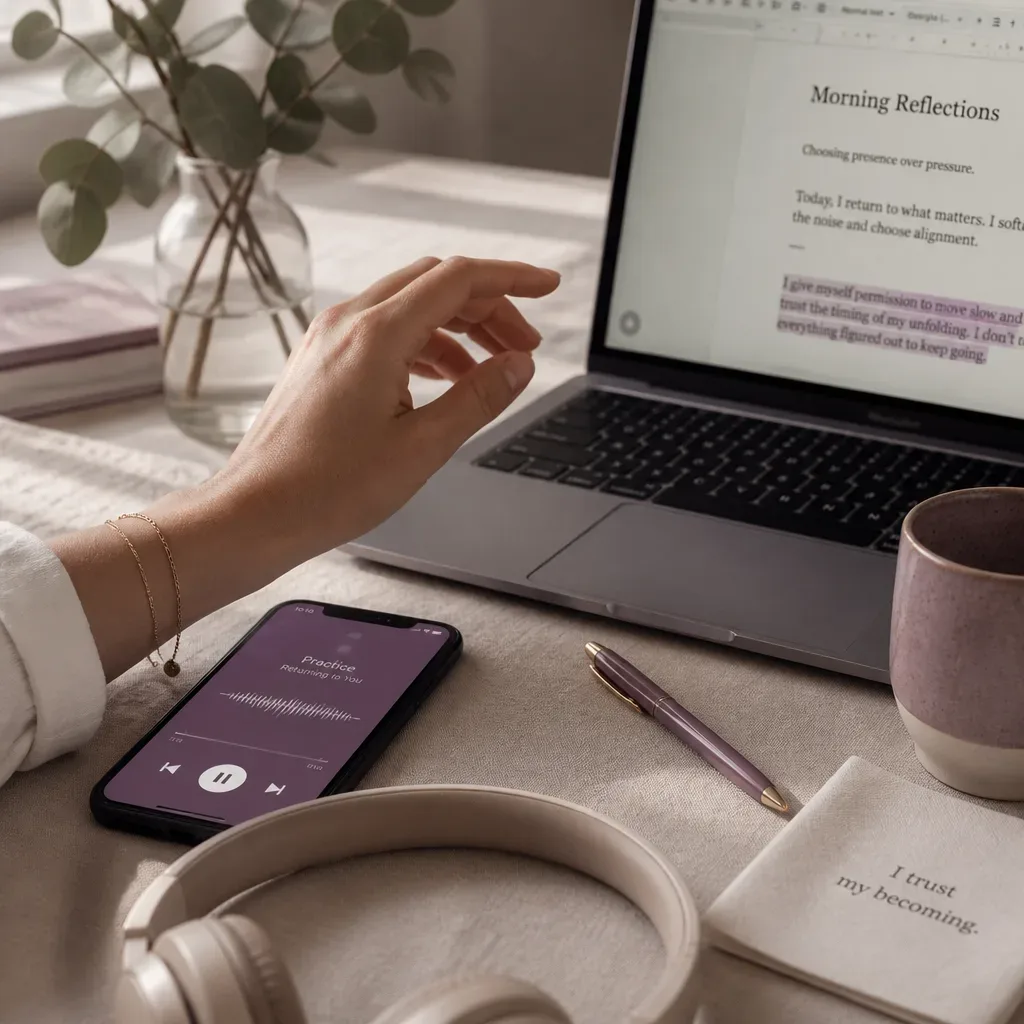
Your laptop is open. The same paragraph has been edited 9 times. Imposter syndrome affirmations help most when you listen before you overprepare, because the practice interrupts fear-driven checking and gives your mind one steadier sentence to follow. The point isn’t to feel certain. It’s to begin without betraying yourself.
Why do imposter syndrome affirmations help before overpreparing?
They help because they give your nervous system a practiced sentence before fear turns preparation into proof-seeking.
Imposter syndrome has a long name, but the room it creates is small. Pauline Clance and Suzanne Imes named the imposter phenomenon in 1978 after studying high-achieving women who kept doubting their competence despite clear evidence. Later reviews have found it across genders, professions, and ages. In one 2019 review in the Journal of General Internal Medicine, prevalence estimates ranged from 9% to 82%, depending on the group and measure used.
That range matters. It tells you this isn’t a rare private flaw. It’s a pattern many people recognize, especially when they’re being evaluated. You prepare. Then you prepare again. Then you keep preparing because the work no longer feels like work. It feels like shelter.
An affirmation won’t make your résumé more true. It already is. What it can do is place a true sentence between you and the old reflex. A sentence like: I can be learning and still be useful. Or: I don’t need perfect certainty to offer one honest contribution.
Self-affirmation theory, developed by Claude Steele in 1988, suggests that reflecting on valued parts of the self can reduce defensiveness under threat. A 2006 study by Cohen and colleagues found that brief values-affirmation writing improved academic outcomes for some students under stereotype threat. The mechanism wasn’t magic. It was identity remembered under pressure.
A good affirmation doesn’t inflate you. It returns you.
If you’re new to this, start with the broader practice of affirmations, then make the words more specific to the moment that scares you. Imposter syndrome loves vague danger. Specific language gives it less room.
What should you listen to before you overprepare?
Listen to a short, personal audio that speaks from the self who already knows how to enter the room.
This is where the AYA Method belongs. The AYA Method is a daily audio manifestation practice. Each day you listen to a short personalized recording — your Dream-Self Moment — narrated from the version of you who has already manifested the life you intend. Listening is the practice. Repetition is the work. The audio is the method.
For imposter syndrome, audio helps because the mind that’s spiraling is often not the best writer in the room. It wants another draft, another tab, another reassurance. Listening asks less. You put on headphones. You receive the sentence. You don’t have to generate faith from a tight chest.
Dr. Andrew Huberman has often spoken about the nervous system using behavioral entry points: breath, posture, visual focus, and repeated cues. You don’t need to make a huge ceremony of it. A 2-minute audio before a meeting can become a cue. Your body learns: when I hear this, I stop proving and start arriving.
Use this order when you feel yourself slipping into overwork:
- Pause the checking. Don’t close the document yet. Just take your hands off the keys for 20 seconds.
- Listen once. Choose a short recording, not a long teaching.
- Name the next real action. Send the file, join the call, ask the question, or make one final edit.
- Stop at the boundary. If you said one more pass, make it one.
Audio is not an escape from action. It is the doorway back to action.
If you also keep a visual cue, the app’s Manifestation Board can be a complement, not the center. For the heart of the practice, return to the sound. The voice reaches you when the page has started arguing.
Which affirmations are believable enough to use at work?
The best affirmations for work are plain, specific, and close enough to the truth that your body doesn’t reject them.
A sentence like I am the best person in every room may sound strong, but for many people with imposter syndrome, it creates inner debate. The mind starts gathering evidence against it. That wastes more attention. In clinical settings, this is sometimes discussed as cognitive dissonance: when a statement feels too far from current belief, the mind pushes back.
Choose an affirmation that stands on evidence. Not fantasy. Evidence. In a 2020 systematic review on workplace imposter feelings, researchers noted links with burnout, anxiety, and reduced job satisfaction. That means the goal isn’t to decorate fear. The goal is to reduce the extra load fear adds to work you already know how to do.
Try these before a meeting, presentation, client call, review, or first day:
- I can be nervous and still be prepared.
- I don’t need to perform certainty to tell the truth.
- I was invited here for a reason I don’t have to prove every minute.
- One useful sentence is enough to begin.
- I can ask a clear question without apologizing for existing.
- I have prepared enough to be present.
- I can learn in public and still belong in the room.
- My work can be reviewed without my whole self being judged.
The sentence should fit in your mouth on a hard morning.
Here’s a simple way to choose:
| If your fear says | Use this affirmation |
|---|---|
| They’ll find out I don’t know enough | I don’t need to know everything to contribute one true thing |
| I should check it again | I have done the agreed amount of preparation |
| Everyone else is ahead | I can learn without disappearing |
| I shouldn’t speak until I’m certain | Clarity can arrive while I speak carefully |
| I don’t deserve this role | I can grow into a role I was trusted to hold |
If you want a wider frame, read the manifestation pillar as a companion. The quiet part of manifestation isn’t pretending. It’s practicing the future self until your daily behavior can recognize her.
How do you write imposter syndrome affirmations that don’t feel fake?
Write them from the smallest true edge, not from a fantasy version of confidence.
Start with what your fear is trying to prevent. Usually it wants to protect you from exposure. That protection may have helped once. Now it costs too much. A 2022 KPMG study of executive women reported that 75% had experienced imposter syndrome at some point in their careers. Many were not underqualified. They were over-questioning their right to be seen.
Use this 5-step writing method:
- Name the exact scene. Not work in general. The Monday call. The pitch. The email. The viva. The interview.
- Write the fear sentence. Say it plainly: They’ll think I’m too junior.
- Find one piece of evidence. A completed task. A recommendation. A skill. A prior hard day survived.
- Write a bridge sentence. It should sit between fear and steadiness.
- Make it audible. Read it slowly, or record it in your own voice.
Examples:
- Fear: I don’t know enough to lead this meeting.
- Evidence: I built the agenda and spoke with each team lead.
- Affirmation: I know enough to guide the next 30 minutes.
Or:
- Fear: My work will be judged and I’ll vanish.
- Evidence: I’ve revised it twice and answered the brief.
- Affirmation: Feedback can meet the work without erasing me.
A useful affirmation contains friction. Not too much. Just enough that it asks you to stand a little straighter. Neville Goddard wrote about assuming the feeling of the wish fulfilled; in this practice, keep that assumption quiet and embodied. Ask: what would I do next if I already trusted my place here by 5% more?
For more sentence craft, the affirmations pillar can help you understand why repetition, present-tense wording, and personal relevance matter. Keep the language close to your real day. Your future self does not need a costume.
What is the 12-minute listening practice?
It’s a short sequence that uses audio, breath, one affirmation, and one clear stopping point.
Set a timer for 12 minutes. This matters because imposter syndrome often feeds on the absence of a boundary. Parkinson’s law, first named by C. Northcote Parkinson in 1955, says work expands to fill the time available for its completion. Fear does this too. Give it an open afternoon and it will ask for the whole afternoon.
Use the practice when you catch yourself opening another tab, rewriting an already clear paragraph, rehearsing one sentence for the 17th time, or asking for reassurance you don’t truly need.
The practice
- Minute 0 to 1: put the work down. Leave the document visible if you need to. Just remove your hands from it.
- Minute 1 to 3: breathe slowly. Try a longer exhale. For example, inhale for 4, exhale for 6. In small studies, slower breathing has been associated with increased heart rate variability, a marker often linked with regulation.
- Minute 3 to 7: listen. Play your Dream-Self Moment or another short personal recording. Don’t multitask.
- Minute 7 to 9: repeat one affirmation. Whisper it if you can. If not, say it internally.
- Minute 9 to 11: choose the boundary. One edit. One send. One question. One slide.
- Minute 11 to 12: act. Do the next small thing before the fear negotiates.
Confidence is not always a feeling first. Sometimes it’s a completed small act.
You can pair this with a daily affirmation in the app, but remember the order. The audio is the method. The daily affirmation supports it. The Manifestation Board may steady your eyes. The listening steadies your direction.
If your timing is shaped by the moon, cycles, or personal ritual, astrology and manifestation can offer a softer calendar. Still, don’t let timing become another way to delay the call.

How do you know whether you’re preparing or hiding?
You know by asking whether the next action improves the work or only postpones being seen.
Preparation has a clean feeling, even when it’s hard. It produces something specific: a clearer argument, a checked number, a rehearsal, a corrected typo. Hiding has a foggier feel. It repeats without changing much. You read the same slide again and call it diligence.
Use this small test:
- Useful preparation has a defined task and end point.
- Fear preparation keeps moving the end point.
- Useful preparation makes the work clearer.
- Fear preparation makes you more dependent on certainty.
- Useful preparation respects the audience.
- Fear preparation tries to control their reaction.
A 2021 report from Asana found that workers spent a large share of time on what it called work about work: coordination, searching, and status tasks rather than skilled output. Different companies measure this differently, but the pattern is familiar. Not all busyness is care. Some busyness is a locked door.
Ask 3 questions before doing more:
- What will this next pass improve?
- How will I know it’s done?
- Would I ask a friend to keep preparing this way?
If you can’t answer, listen first. Then decide. This is not laziness. It is discernment. My grandmother used to stop stirring tea when the leaves had given what they had. More heat would only make it bitter.
For a wider map of practice, you can return to the AYA Method and notice how repetition works without force. The recording meets you daily. It doesn’t shout. It doesn’t demand that you become someone else before breakfast.
What should you do after the meeting, send, or presentation?
Afterward, record evidence before your mind rewrites the event as failure.
Imposter syndrome often edits memory. You remember the pause, not the useful answer. The missed phrase, not the clear opening. Psychologists call this negativity bias: negative information often receives more attention than neutral or positive information. Roy Baumeister and colleagues wrote in 2001 that bad can be stronger than good in attention and memory. This is not a moral flaw. It’s a known human tilt.
Make a 3-line evidence note within 10 minutes:
- What I did: I asked the question. I sent the draft. I presented the finding.
- What was real: Two people nodded. The client asked for the next step. The editor only changed 4 lines.
- What I’ll practice next: Slower opening. Clearer number. Less apology.
Then choose one closing affirmation:
- I can review my work without attacking myself.
- I did one brave thing in a real room.
- I am allowed to learn from evidence, not panic.
- My next attempt does not need my self-punishment.
If you use a journal, keep this section small. Five minutes is enough. If you make it too elaborate, reflection becomes another job. Pew Research Center has reported for years that workplace stress and mental load remain common concerns among adults, but your daily repair doesn’t need to be large to be meaningful.
When your evidence accumulates, your affirmations get less theoretical. They have receipts. One day the sentence I belong in the room may still make you tender, but it won’t feel invented.
Close the laptop when the water boils.
Listen on Aya
