affirmations
Affirmations Not Working? Try Future-Self Audio
If affirmations not working is your honest place, try a 3-minute future-self audio that helps belief feel close, repeatable, and real.

The kettle clicks, and the old sentence still feels false. If affirmations not working is the honest place you are, stop forcing belief. Record three minutes from the voice of your future self, then listen daily. Sound can carry identity more gently than typed words can.
Why do affirmations stop landing?
Affirmations stop landing when the words ask your system to accept too much too fast.
You may be saying the correct sentence. You may even like it. Still, the body hears a gap. In a 2009 study in Psychological Science, Joanne Wood, W. Q. Elaine Perunovic, and John Lee found that repeating very positive self-statements could leave some people with low self-esteem feeling worse, not better. The phrase used was only 4 words. That is how little language can press on a bruise.
This does not mean affirmations are useless. It means a sentence has a nervous system context. A line like I am confident can feel like a door. It can also feel like a locked room. Belief forced through the teeth often hardens into resistance.
There are 3 common reasons a written affirmation fails:
- It is too general, so the mind has nothing to recognize.
- It is too far away, so the body treats it as a threat.
- It is repeated without feeling, so it becomes noise.
Claude Steele introduced self-affirmation theory in 1988, and later reviews by Geoffrey Cohen and David Sherman noted that affirming core values can reduce defensiveness. But many studies use values, memories, or writing for 5 to 15 minutes. They are not simply asking someone to repeat a shiny sentence into the air.
A better question is not, Why can I not believe this? It is, What form would make this truth easier to hear?
What changes when you hear your future self?
Hearing your future self changes the affirmation from a claim into a remembered scene.
A written affirmation is flat by design. It sits on the page. Audio has breath, timing, and texture. In one 2017 review in Frontiers in Psychology, researchers described how auditory imagery and inner speech involve brain systems tied to perception and memory. You do not need to make a grand claim from that. You only need the small fact: the heard voice can feel closer than the read word.
This is why the AYA Method begins with audio: The AYA Method is a daily audio manifestation practice. Each day you listen to a short personalized recording — your Dream-Self Moment — narrated from the version of you who has already manifested the life you intend. Listening is the practice. Repetition is the work. The audio is the method.
The daily affirmation and Manifestation Board can support the practice. They give you a sentence and an image to return to. But they are complements. The audio is where the new self gets a voice.
Think of the difference this way:
| Practice | What it gives you | Where it can fail | Best use |
|---|---|---|---|
| Written affirmation | A clear sentence | It can feel false | Naming the desire |
| Vision image | A visible cue | It can become decoration | Remembering direction |
| Future-self audio | Voice, pacing, scene | It needs repetition | Rehearsing identity |
In memory research, repetition matters. Hermann Ebbinghaus described forgetting curves in the 1880s, and modern learning science still finds that spaced repetition improves recall. Your future-self audio uses the same humble law. What returns often becomes easier to find.
Sound gives the nervous system a place to rest while the mind catches up.
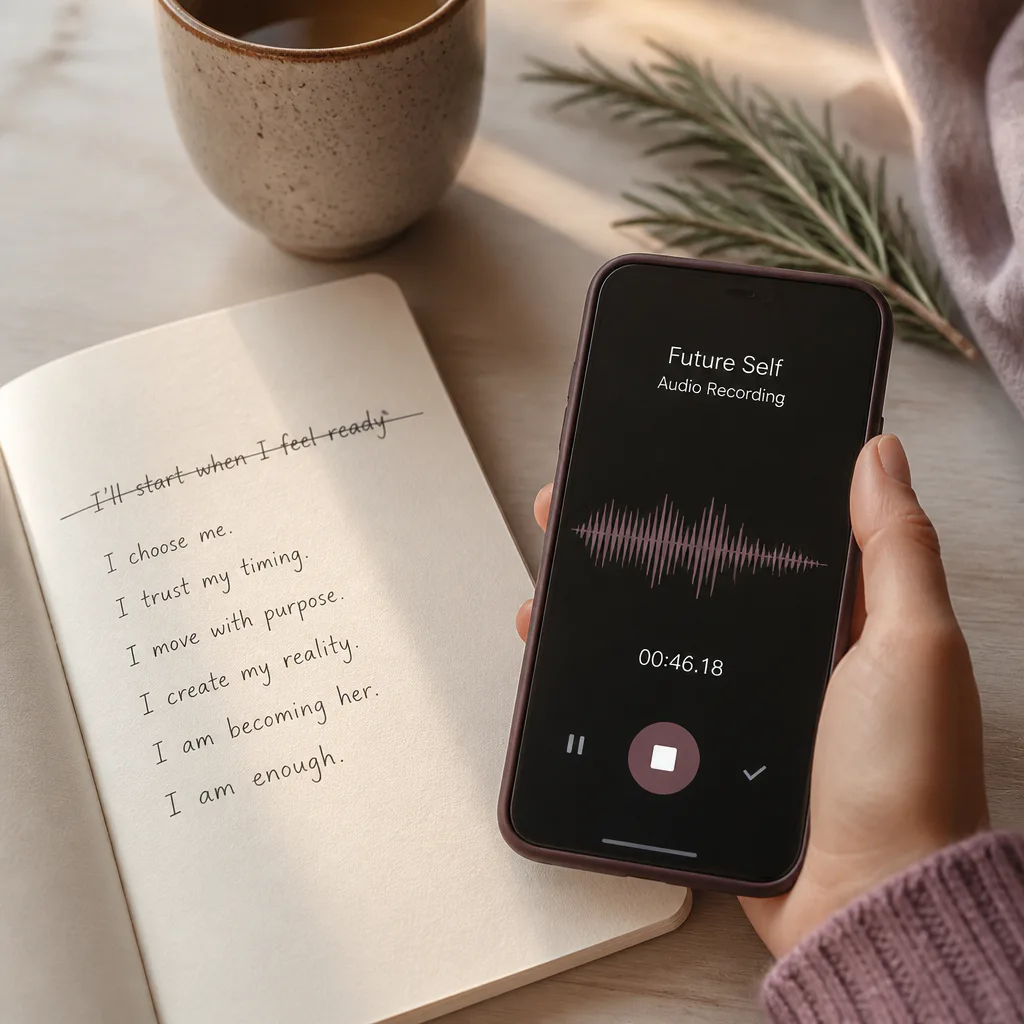
How do you make a 3-minute future-self audio that feels true?
You make it true by recording a near scene, not a perfect life.
Start with the affirmation that is not working. Do not throw it away. Put it under a lamp. If the line is I trust myself, ask where you would see that trust by next Tuesday. Maybe you answer one message without apologizing 3 times. Maybe you ask for the fee you know is fair. Maybe you eat breakfast before the second coffee. Specificity is kindness.
Behavior design researcher B. J. Fogg has written that tiny behaviors work because they are small enough to repeat. A 3-minute audio follows that logic. It does not try to remake your whole morning. It asks for one clean repetition. In habit studies, consistency is often more predictive than intensity; a 2010 study by Phillippa Lally and colleagues found habit formation averaged 66 days, with wide variation from 18 to 254 days.
Use this 6-line structure:
- Name the ordinary setting: It is morning, and my feet are on the floor.
- Name the old pattern softly: I used to rush to prove I was safe.
- Name the new action: Now I pause before I answer.
- Name the felt evidence: My chest stays open for one breath longer.
- Name the outer proof: I choose the next right message, call, or step.
- Close with belonging: This steadiness is already becoming mine.
Keep the words plain. A good future-self audio does not flatter you. It recognizes you.
If you use the Manifestation pillar as a wider map, let this audio be the daily path under your feet. If you use the Affirmations pillar to refine language, let it help you choose one sentence that does not bruise.
Record on your phone. Speak 25 to 35 percent slower than usual. Leave 2 or 3 seconds of quiet between lines. Three minutes is not a test of eloquence. It is a small room where your future self can sit down and be heard.
What exact steps should you follow today?
You can make and use the recording in 12 minutes, then listen for 3 minutes each morning.
The first recording does not need studio sound. It needs honesty. The American Time Use Survey has often shown that people spend several hours a day on phone-based media, but a practice fails if it feels like one more demand. Three minutes matters because it is hard to resent. It can fit beside the kettle, the train platform, the bathroom mirror.
Here is the full 12-minute process:
- Minute 1: Write the failed affirmation. Put down the exact sentence. Circle the word that feels untrue.
- Minutes 2 to 3: Choose a near proof. Pick one scene from the next 7 days where the sentence would show up.
- Minutes 4 to 7: Write 6 lines. Use the structure above. Keep each line under 12 words if you can.
- Minutes 8 to 10: Record once. Speak gently. If you stumble, keep going. Real voices breathe.
- Minutes 11 to 12: Save and name it. Use a simple title, such as Future self, steady morning.
Then use the 3-minute listening practice:
- Listen before messages, news, or work apps.
- Sit or stand still for the first 30 seconds.
- Let one hand rest on your chest or the table.
- Do not repeat the words out loud unless it feels natural.
- After listening, write one sentence: Today I will practice this by…
Dr. Andrew Huberman often discusses the role of attention and repetition in learning, and that is enough of a frame here. What you attend to daily becomes easier to access. Repetition is not glamour. It is repair done on a schedule.
If you like timing, try 7 mornings first. Seven is not magic. It is just long enough to notice whether your body argues less by day 4 or 5.
What if your mind argues with every line?
If your mind argues, make the audio smaller until it can nod once.
Doubt is not failure. It is information. If your recording says, I am fully safe, and your body answers no, change the line. Say, I can feel one safe surface under my hand. The nervous system often accepts evidence before it accepts identity. Somatic therapies use this principle in many forms: orient to the room, name 5 things you see, feel the chair. Simple cues can lower alarm.
The future self does not have to sound grand. She can sound like someone who slept enough. He can sound like someone who no longer checks the same thread 12 times. They can sound like you after one honest choice.
Use these edits when a line feels false:
| If the line says | Try this instead |
|---|---|
| I never doubt myself | I recover from doubt more quickly |
| Money always comes easily | I make one clear choice with money today |
| I love my body completely | I speak to my body with less cruelty |
| I am fearless | I can act with fear in the room |
Neville Goddard taught the idea of living from the end, and Joe Dispenza often speaks about rehearsing a future self before the outer proof arrives. You do not have to accept every claim from either teacher to use one practical piece: the mind learns by rehearsal. Athletes have used mental rehearsal for decades; a 1994 review by Driskell, Copper, and Moran found mental practice improved performance across tasks, with stronger effects when paired with physical practice.
That pairing matters. Listen, then do one small thing. Send the email. Drink the water. Close the tab. Walk for 10 minutes. Your doubt is not an enemy. It is a witness asking for better evidence.
How does this fit with daily affirmations, astrology, or a vision board?
It fits best when the audio stays central and the other tools stay simple.
A daily affirmation can become the title of your recording. A Manifestation Board can hold one image from the scene. If you work with astrology and manifestation, you might choose a timing cue, such as a new moon, a birthday month, or a weekly reset. But the daily listening is what keeps the practice from becoming only symbolic.
The Princeton Engineering Anomalies Research program, often called PEAR, studied intention and random systems for nearly 28 years. Its findings are debated, and they should be held carefully. Still, the wider lesson is useful: intention becomes more interesting when it is measured, repeated, and observed. Your 3-minute audio gives you a way to observe your own participation without pretending certainty.
Keep the support tools light:
- One written affirmation, no more than 10 words.
- One image that feels ordinary enough to believe.
- One listening time, preferably attached to an existing cue.
- One small action after the audio.
- One note at night, written in 30 seconds.
If you are already using the AYA Method, this will feel familiar. The Dream-Self Moment is not a lecture. It is not a mood trick. It is a short return to the self you are practicing being.
You can keep your herbs, your candle, your chart, your page. I am an herbalist; I understand the comfort of objects. But do not ask objects to do the listening for you. The recording meets you where language, breath, and choice touch.
How will you know the future-self audio is working?
You will know it is working when your choices begin to match the recording before your mood does.
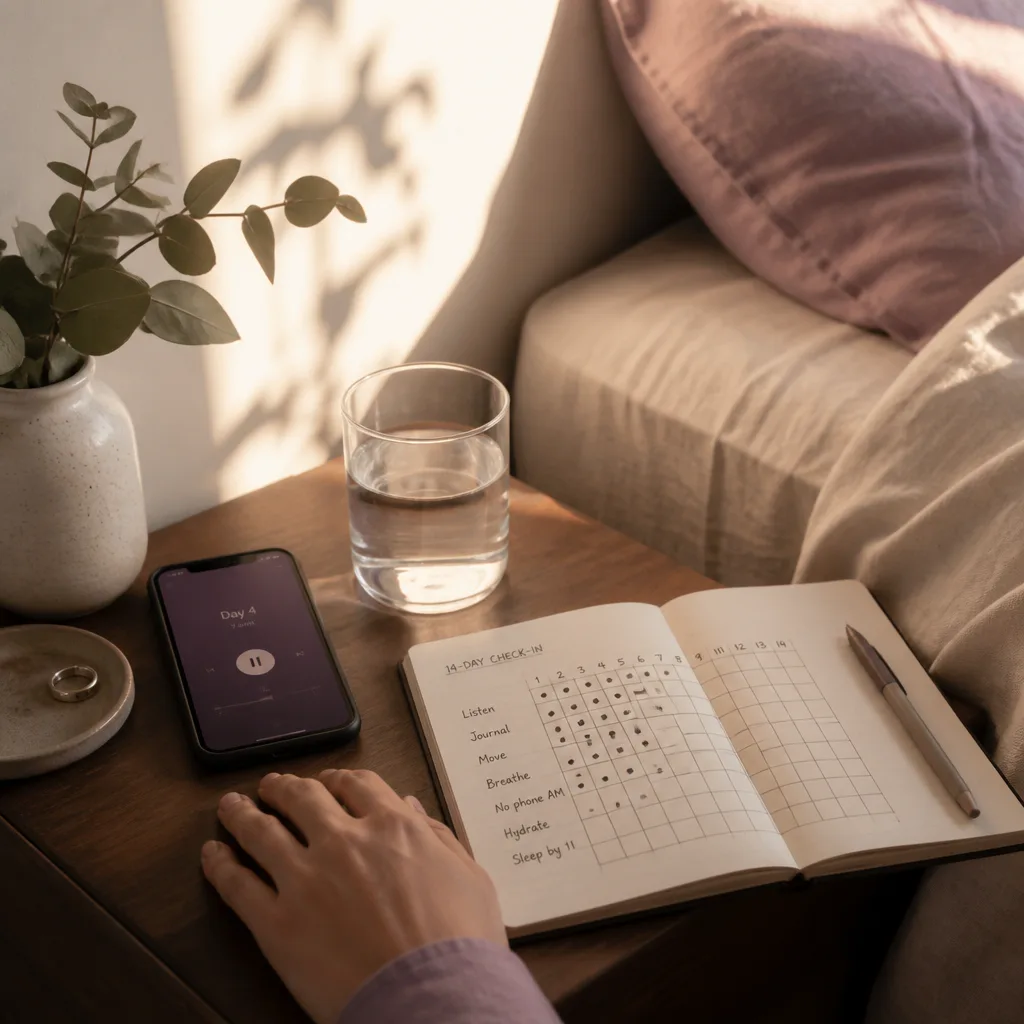
Do not wait for a dramatic feeling. In many clinical and behavioral studies, change is tracked through repeat measures because one session can be misleading. Use 14 days. That gives you 14 listens, 14 small actions, and 14 notes. It is enough to see a pattern without turning the practice into a burden.
Track 3 signs:
- Friction: Does the recording feel less false by day 5 or 6?
- Recovery: Do you return faster after doubt?
- Behavior: Did you take one action your old self avoided?
You can rate each sign from 0 to 2 at night. Zero means not today. One means a little. Two means clearly. After 14 days, your highest possible score is 84 across the 3 signs. You do not need a perfect score. You need evidence that something is becoming more available.
There is also a quieter sign. You may stop needing the sentence to dazzle you. It becomes familiar. Like the path from the bed to the kitchen. Like the cup you reach for without thinking.
If nothing changes after 14 days, do not shame yourself. Rewrite the audio smaller. Move the scene closer. Try a different voice: warmer, older, plainer. Some people respond better to second person, as in you are learning to pause. Others need first person, as in I am learning to pause. Test 2 versions for one week each.
The Affirmations pillar can help you refine the sentence. The audio helps you live near it long enough for the sentence to become less strange.
Put the recording on, and let the room stay soft.