audio manifestation
Audio Manifestation Meditation When Stillness Feels Hard
Audio manifestation meditation can work when sitting still feels hard. Learn a quiet, body-friendly way to listen, walk, repeat, and return.

The kettle clicks off. Your foot is already tapping. Audio manifestation meditation can still work if you hate sitting still, because the practice is listening, not posing as a calmer person. Use a short recording, pair it with gentle movement, and repeat it daily until your body knows the sound.
What is audio manifestation meditation if sitting still feels impossible?
Audio manifestation meditation is a listening practice that lets your attention return through sound, even when your body needs to move.
There is a quiet misunderstanding around meditation. Many people think it means sitting cross-legged, motionless, with a blank mind for 20 minutes. That picture can be useful for some bodies. For other bodies, it becomes one more place to fail. A 2019 report from the National Center for Health Statistics found that 14.2% of U.S. adults had practiced meditation in the previous year, but the word covers many forms: breath, mantra, body scan, prayer, movement, and guided audio.
If you’re restless, sound gives you a rail to hold. A voice can carry the next sentence when your mind wants to sprint ahead. Music can soften the edge of waiting. A short recording can make the practice specific enough to repeat tomorrow.
This is where the AYA Method sits, very simply. The AYA Method is a daily audio manifestation practice. Each day you listen to a short personalized recording — your Dream-Self Moment — narrated from the version of you who has already manifested the life you intend. Listening is the practice. Repetition is the work. The audio is the method.
The body doesn’t need a perfect room to remember a true sentence. It needs contact, repetition, and enough safety to stay.
For manifestation as a broader practice, the old question is not only, “What do I want?” It is also, “Can my nervous system recognize this as familiar?” If you want more context, the Manifestation pillar names the wider practice without asking you to become theatrical about it.
Why does restlessness show up when you try to meditate?
Restlessness often appears because stillness removes your usual distractions and lets the body speak first.
When the phone is down, the dishes are done, and nothing is asking for you, the nervous system may not feel peaceful. It may feel exposed. Dr. Andrew Huberman has often described attention as something trained through repeated return, not forced blankness. In laboratory terms, attention is unstable by design. A widely cited 2010 Harvard study by Killingsworth and Gilbert found that people reported mind-wandering in 46.9% of sampled moments.
So if your mind leaves the audio, that is not evidence against you. It is ordinary brain weather. The practice is the return. One return. Then another. Then another.
Restlessness can also be a memory of over-effort. Some people meet meditation the way they met school: sit still, be good, don’t disturb anyone. The body hears the instruction and braces. In my old clinical training, I saw this often. The person was not resisting care. They were resisting being controlled.
Try making the container smaller. You do not need 30 minutes. You may need 6. Research on habit formation from Phillippa Lally and colleagues at University College London found an average of 66 days for a new behavior to feel automatic, with wide variation from 18 to 254 days. The number matters because it lowers drama. A practice is not proven in one morning.
Restlessness is not the opposite of readiness. Sometimes it is the doorway your body uses.
How do you practice audio manifestation meditation without sitting still?
You practice by choosing one simple movement, pressing play, and letting the audio stay more important than the movement.
Start with a shape your body can trust. Not an ideal shape. A real one. I like clay because it tells the truth quickly. If I grip too hard, the wall collapses. If I go too fast, the rim warps. Attention is similar. Too much force makes it brittle.
Use this 12-minute version if you’re beginning:
- Minute 0 to 1: Put in headphones or place the phone nearby. Feel both feet, even if you’re walking.
- Minute 1 to 4: Listen to the first part of the audio without correcting your thoughts.
- Minute 4 to 8: Pair one sentence with one slow movement, such as stepping, folding, or stretching.
- Minute 8 to 10: Let the body soften somewhere small: tongue, hands, shoulders, belly.
- Minute 10 to 12: Name one ordinary action that fits the future-self recording today.
A specific number helps. If 12 minutes is too much, use 5. If 5 is too much, use 3. In small adherence studies, brief practices often perform better because they meet the actual day. The American Psychological Association has also noted that stress management tools work best when they are practical enough to repeat.
Here are movement options that usually keep the practice clean:
- Walk the same hallway or block, without adding errands.
- Stretch calves, neck, or wrists slowly.
- Wash one cup by hand.
- Sit on the floor and change position when needed.
- Lie down with eyes open and one hand on the ribs.
The point is not to make movement decorative. It is to let the body stay in the room.

What should the audio actually say?
The audio should speak from the already-real version of you, in language plain enough for your body to believe.
A good audio manifestation meditation is not a pep talk. It is not a list of glittering claims. It should sound like something you could hear on a quiet Tuesday and still respect. Neville Goddard taught the “feeling of the wish fulfilled,” but the useful part here is not performance. It is inhabiting a state with enough detail that the nervous system can rehearse it.
The Dream-Self Moment matters because it gives the mind a scene. Not a fantasy scene with 40 impossible details. A lived scene. Your hand on the door. Your name in the email. Your breath before the call. Your kitchen light at 7:10 a.m. Specificity makes the future less vague.
Use this table to keep the audio grounded:
| Instead of saying | Try hearing |
|---|---|
| “Everything is perfect now.” | “I wake and know the next right action.” |
| “I never doubt myself.” | “Doubt comes, and I don’t hand it the keys.” |
| “My life is completely different.” | “My days now contain the work, care, and rhythm I once kept postponing.” |
| “I have everything I want.” | “I can feel how enough changes the way I choose.” |
One sentence can be more honest than a hundred declarations. If you’re working with affirmations too, keep them as a small companion. The Affirmations pillar can help you choose words that don’t fight your own belief system.
There is also a research reason to care about language. Cognitive reappraisal studies, including work discussed in the Journal of Behavioral Medicine, suggest that the way people name an event can shape emotional response and coping. Words are not magic tricks. Words are instructions the body may slowly test.
When is the best time to listen if mornings feel crowded?
The best time is the one attached to a cue you already do almost every day.
Morning is beautiful if it is yours. But many mornings belong to children, pain, alarms, medication, buses, inboxes, or the kind of sleep that did not repair you. Do not make the practice depend on a fantasy version of your schedule. A 2023 Pew Research Center report found that 62% of U.S. adults say they sometimes feel too busy to enjoy life. If the practice needs a perfect morning, it may never get touched.
Choose one existing cue. Behavioral scientist BJ Fogg calls this anchoring: placing a new tiny behavior after something already stable. You do not have to borrow his whole model to use the simple truth. The body remembers sequences.
Try these cue pairs:
- After brushing your teeth, listen for 3 minutes while standing.
- After closing your laptop, walk once around the block with the audio.
- After making tea, sit near the cup and press play.
- After putting a child to bed, listen while folding one blanket.
- Before sleep, lie down and listen once, without checking messages after.
If you like symbolic timing, you might also bring in the sky as a soft calendar, not a command. New moons, birthdays, and seasonal shifts can hold intention gently. The piece on Astrology and manifestation treats timing as a mirror, not a rulebook.
The time is right when it can happen again. Repetition is kinder than intensity.
How do you know whether it’s working?
You know it is working when your choices become slightly more consistent with the self you keep hearing.
Do not measure only by emotion. Some days the audio will feel close. Some days it will feel flat. Some days you’ll be irritated by the narrator, the music, your own hopes, the fact that the tea went cold. This is all data. It is not a verdict.
Look for behavioral evidence over 7 to 14 days. Did you send the email sooner? Did you pause before answering from fear? Did you keep one promise to your body? Did you choose the smaller, truer action instead of the dramatic one? Joe Dispenza often speaks about rehearsal and identity, and while some claims around manifestation should be held with care, mental rehearsal itself has a long history in sports psychology and clinical preparation.
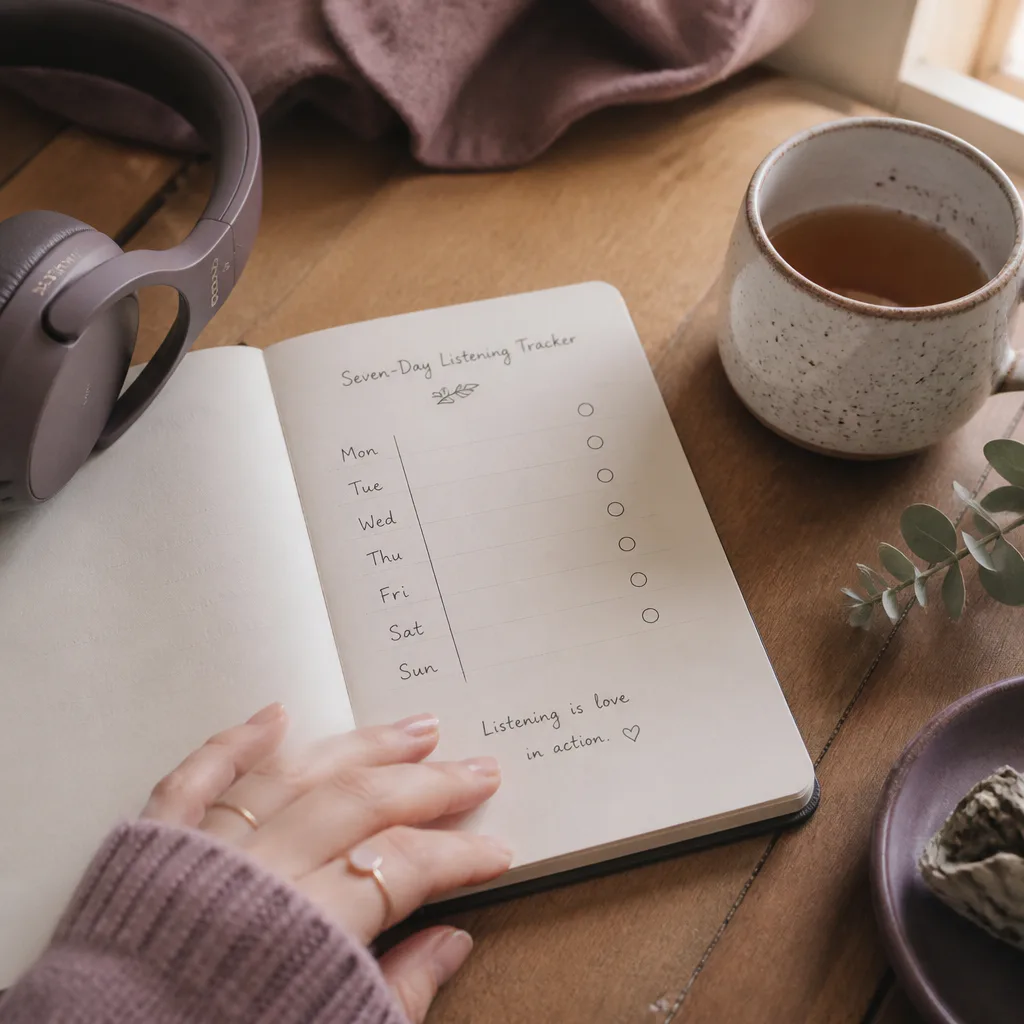
Use this simple tracker for one week:
| Day | Did I listen? | Body shape | One action after |
|---|---|---|---|
| 1 | Yes / No | Walk / sit / stretch | 1 sentence |
| 2 | Yes / No | Walk / sit / stretch | 1 sentence |
| 3 | Yes / No | Walk / sit / stretch | 1 sentence |
| 4 | Yes / No | Walk / sit / stretch | 1 sentence |
| 5 | Yes / No | Walk / sit / stretch | 1 sentence |
| 6 | Yes / No | Walk / sit / stretch | 1 sentence |
| 7 | Yes / No | Walk / sit / stretch | 1 sentence |
In behavior change research, self-monitoring is one of the more reliable tools. A 2012 review in Psychological Bulletin linked self-monitoring with stronger goal progress across many interventions. You are not tracking to punish yourself. You are tracking so the mind cannot erase the small returns.
What should you do on the days you resist the practice?
On resistance days, make the practice smaller instead of making yourself wrong.
There will be days when pressing play feels strangely difficult. This can happen even when you want the life named in the audio. Especially then. Desire can stir grief. A future self can remind you of old disappointment. The recording may touch the place that stopped expecting good things.
Use the “minimum true dose.” It is not a clinical term. It is a mercy. For one day, lower the practice until it becomes honest.
Try this:
- Put the headphones on.
- Play 60 seconds of the recording.
- Keep one hand on a surface: table, wall, sink, thigh.
- Say, “This still counts.”
- Stop, or continue if the body says yes.
One minute is not nothing. In mindfulness-based programs, formal practices are often longer, but many teachers still use brief grounding because the nervous system can re-enter through one sensory cue. Trauma-sensitive meditation teachers, including David Treleaven, have also warned that forcing closed-eye stillness can be unhelpful for some people.
If your resistance carries panic, dissociation, or memories that flood you, please involve a qualified mental health professional. Audio manifestation meditation can support attention and intention. It is not a replacement for therapy, medication, or crisis care.
On ordinary hard days, the practice can become very plain. You listen while rinsing a bowl. You listen with your eyes open. You listen badly and return once. That is enough for the day to remain connected.
Your future self does not need you to perform belief. She needs you to keep showing up where you can.
How can you make this a daily practice without forcing it?
You make it daily by keeping it short, attached, and kind enough that your body does not revolt.
Here is the cleanest version:
- Pick one audio manifestation meditation.
- Pick one cue.
- Pick one body shape.
- Repeat for 7 days without editing the whole system.
- After 7 days, adjust only one thing.
This matters because changing too many variables hides the lesson. If you change the time, the recording, the location, and the length every day, you won’t know what helped. In clinical work, and in clay, the container teaches. The walls of a cup rise because the wheel repeats its turning.
You may also use visual complements if they help you remember. A Manifestation Board can hold images or words that match the audio, but it is not the core. The daily affirmation can echo one line from the recording, but it is not the core. The audio is the method. The rest are small lamps around it.
If you want a wider map of the practice, return to audio manifestation inside the AYA Method, then read the manifestation guide when you want language for desire, action, and patience. If words are your doorway, the affirmations guide can keep them clean and believable.
Keep the promise small enough to keep. That is not lowering the standard. That is giving the practice a life.
Put one hand on the cup. Listen.