noise colors
Brown Noise vs White Noise: Play Dream-Self Audio First
Brown noise vs white noise for manifestation listening: know when to use each sound, and why your Dream-Self audio comes first.
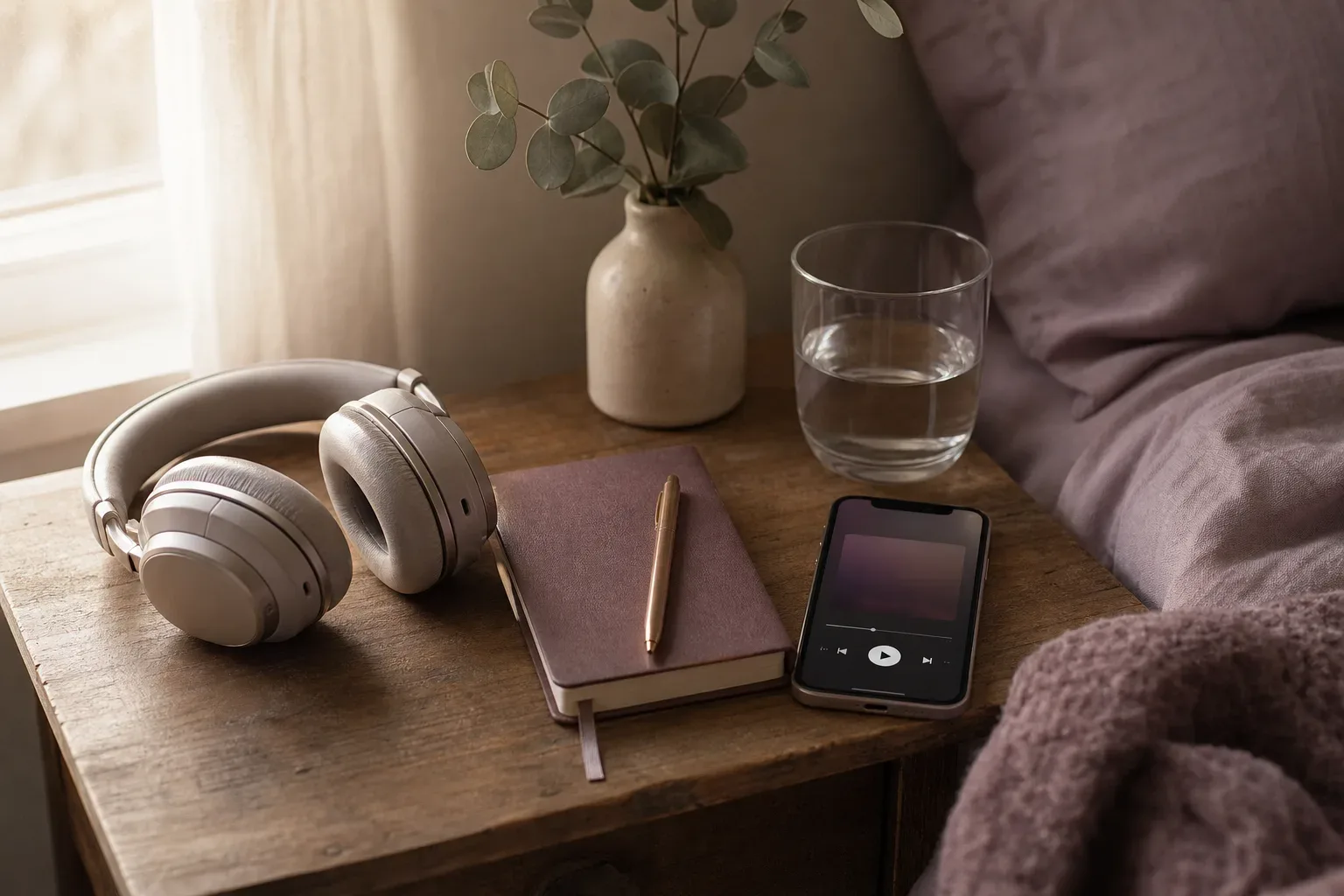
Brown noise vs white noise is not a contest for your manifestation practice. Play your Dream-Self audio first, while the words can reach you clearly. Then use brown noise for softer settling, or white noise for sharper masking, depending on what your room is doing.
What is the real difference between brown noise and white noise?
Brown noise is deeper and lower; white noise is brighter and spread evenly across audible frequencies.
White noise contains equal sound intensity across frequencies, which is why it can sound like radio static or a fan turned toward your ear. Brown noise drops in intensity as frequency rises, often described as about 6 decibels per octave, so it feels rounder and lower. Pink noise sits between them, with about 3 decibels per octave. These are acoustic descriptions, not moral rankings.
Your body may know the difference before your mind names it. White noise can cover a wide range of interruptions: a door click, a distant voice, a dog in the hall. Brown noise can feel less sharp, especially when you’re trying to read, rest, or come down from a day that had too many tabs open. In a 2021 review in Sleep Medicine Reviews, researchers noted that sound masking studies vary widely in method, which is a quiet way of saying: the right sound is personal, and the setup matters.
Here is the simple comparison:
| Sound color | What it emphasizes | Often feels like | Best used for |
|---|---|---|---|
| White noise | Equal intensity across frequencies | Static, air, hiss | Masking uneven sound |
| Brown noise | Lower frequencies | Low rain, distant river | Settling, reading, sleep prep |
| Pink noise | Balanced slope | Softer rain, steady wind | Gentle masking and rest |
A sound can be scientifically neat and personally wrong. If white noise makes your jaw tighten after 10 minutes, that is data. If brown noise makes the room feel more private, that is data too. The practice begins when you stop asking which one is best and start noticing which one lets you stay with yourself.
Why should Dream-Self audio come before any noise color?
Dream-Self audio comes first because the voice is the practice, and background noise is only support.
The AYA Method is a daily audio manifestation practice. Each day you listen to a short personalized recording — your Dream-Self Moment — narrated from the version of you who has already manifested the life you intend. Listening is the practice. Repetition is the work. The audio is the method.
That order matters. A voice carries pace, memory, and emotional detail. If you bury it under static, you ask your attention to split itself. Dr. Andrew Huberman has often described attention as a limited biological resource, tied to arousal and sensory load. You don’t need a lab coat to test this. Try hearing your name in a busy café. The signal has to be clear enough to find you.
Manifestation can become too elaborate. Too many tabs. Too many candles. Too many rules. The quieter version is harder to sell but easier to keep: sit, walk, or lie still for a few minutes and listen. If you want the broader frame, the manifestation pillar gives you the plain architecture without asking you to become theatrical about it.
Noise color belongs after that first listening. It can soften the room once the words have landed. Think of it like turning down the house lights after the sentence has been read. Not before. The voice gets the front seat because your future self should not have to shout over a fan.
A practice is not stronger because it has more parts. It is stronger when the important part is unmistakable.
When does brown noise work better than white noise?
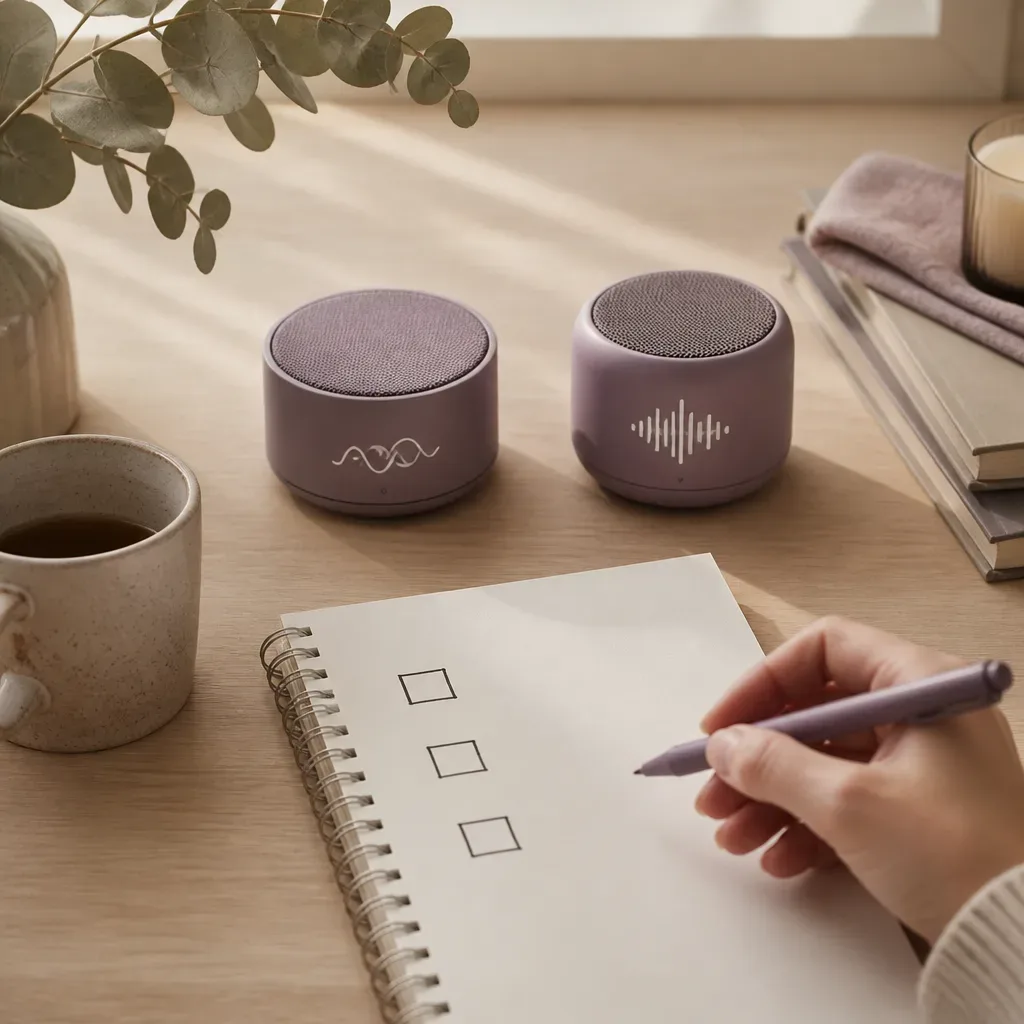
Brown noise works better when you want a lower, less hissy sound that helps the body settle after listening.
Many people reach for brown noise at night because it has fewer bright edges. The low-frequency tilt can make it feel close to heavy rain, a train heard from far away, or water behind a wall. There is not a large clinical literature proving brown noise as a sleep tool by itself. Still, in small studies of steady background sound, participants sometimes report fewer awakenings when sudden noises are masked. The World Health Organization’s night noise guidelines name 40 dB outside as a level that protects public health; most bedrooms are less ideal than the guideline imagines.
Use brown noise after your Dream-Self Moment when the room feels too awake. Not loud. Just present. Let it be a floor, not a ceiling. If you journal after listening, brown noise can keep the room from grabbing at you with every refrigerator click. If you use the app’s Manifestation Board after the audio, let the sound stay low enough that your images and words still feel like yours.
Brown noise may help when:
- your room has low, constant hums already
- white noise feels sharp or tiring
- you’re listening at night or before sleep
- you want to read one page, not start a project
- you tend to feel startled by small sounds after quiet practice
There is a library version of this. Some readers need silence. Others need the low murmur of people turning pages. Seven years at a Brussels desk taught me that the right background is the one that lets a person finish the page. The impressive method is not always the finished method.
When does white noise make more sense?
White noise makes more sense when the problem is interruption, not restlessness.
Because white noise spreads intensity across the audible range, it can mask more kinds of sound. That is why machines for offices, clinics, and nurseries often use white or near-white noise. A 2017 study in Scientific Reports found that moderate white noise improved learning in some children with attention difficulties, while it harmed performance for others. That mixed result is useful. It reminds you that sound is medicine only when the dose and person fit.
Use white noise when the world keeps poking through. A neighbor’s chair. A bus stop below the window. Someone opening cupboards like they are making a legal argument. Brown noise may feel nicer, but white noise may cover the edges better. The question is not which sound is prettier. The question is which sound lets you stop bracing.
For manifestation listening, white noise still comes second. Play the Dream-Self audio cleanly first. Then, if you’re writing an affirmation or staying with one sentence, you can add white noise at low volume. If affirmations are part of your day, the affirmations pillar is a good place to keep them simple and precise.
A useful volume test is ordinary: can you hear a soft knock? Can you hear your own breath? If not, turn it down. The U.S. National Institute for Occupational Safety and Health recommends limiting exposure at 85 dBA over 8 hours, with risk increasing as sound rises. Your ritual does not need heroic volume. It needs room to be heard.
White noise is not there to erase your life. It is there to make one small practice possible inside it.
How do I choose without making it another rule?
Choose by the problem in the room, then keep the choice for seven days before changing it.
A new sound every night can become another way to avoid the practice. The mind loves equipment. It loves settings, names, and tiny adjustments that feel like action. Start with a small test instead. Listen to your Dream-Self Moment with no added sound. Notice what interrupts you. Then choose the lowest-support sound that answers that interruption.
Try this seven-day comparison:
- Days 1 and 2: Play Dream-Self audio alone. Write down what distracted you.
- Days 3 and 4: Play Dream-Self audio first, then brown noise for 10 minutes.
- Days 5 and 6: Play Dream-Self audio first, then white noise for 10 minutes.
- Day 7: Choose the one that made you more likely to return.
Keep the notes painfully simple. Use a 1 to 5 scale for ease, steadiness, and whether you actually finished. Behavioral researchers often use adherence as a key measure because a beautiful intervention that nobody repeats is mostly decoration. In habit research, BJ Fogg’s Tiny Habits model emphasizes making the action small enough to complete. That is not a compromise. It is engineering for a real morning.
This is also where astrology and manifestation can be kept in its proper size. Timing can be meaningful. Moon notes can be tender. But the audio still comes first. A calendar can point to the door. It cannot walk through for you.
If your test is messy, that is allowed. One night you will forget. One morning you will listen while brushing your teeth and think you have done it wrong. You have not. You are learning the size your practice can actually wear.
Can noise color change manifestation results?
Noise color does not manifest for you, but it can protect the attention your practice needs.
The claim needs to stay clean. Brown noise and white noise are not magic switches. They are sound tools. They may reduce distraction, support focus, or make a room feel less jagged. The manifestation work remains the repeated listening, the inner recognition, and the small behavior that follows. Neville Goddard wrote often about assuming the feeling of the wish fulfilled. Joe Dispenza writes about rehearsing a future self until the body learns a new emotional pattern. You do not have to accept every claim from either teacher to see the shared point: repetition matters.
The Princeton Engineering Anomalies Research program, often called PEAR, ran intention-related experiments for 28 years before closing in 2007. Its findings remain debated. That debate is healthy. A quiet practice does not need exaggerated certainty. It needs honest contact. You listen, you remember, you act a little more like the self you keep hearing.
Sound can help with the remembering. If brown noise makes you less likely to pick up your phone after the audio, it has served the practice. If white noise keeps hallway sound from pulling you out of a sentence, it has served the practice. If either one becomes the main event, turn it down.
You can keep this hierarchy:
- First: Dream-Self Moment, clear and audible
- Second: one written line, if useful
- Third: brown noise or white noise, only as support
- Fourth: any visual complement, such as a board or note
The AYA Method page says the plain thing: the audio is the method. Everything else should behave like a good librarian. Present when needed. Quiet when not.
What is the simplest setup for tonight?
The simplest setup is a clean listen first, then one low background sound if the room needs help.
Use headphones if they make the voice easier to receive, but do not make them a ceremony. Use a speaker if your body relaxes more without something in your ears. The American Speech-Language-Hearing Association notes that long exposure through personal listening devices can contribute to hearing risk when volume is high. That is enough reason to be gentle. Your future self does not need to be loud to be believed.
Here is the smallest version:
- Put your phone where you will not scroll.
- Play your Dream-Self Moment once.
- Let the last sentence finish before touching anything.
- If the room is sharp, play white noise softly.
- If the room is restless, play brown noise softly.
- Stop after 10 to 20 minutes, or set a timer before sleep.
If you want a wider explanation of manifestation without spectacle, return to the manifestation guide. If your next step is language, not sound, keep one phrase from the affirmations guide and repeat it after the audio. One sentence is often enough. One true sentence is better than twelve decorative ones.
There is no prize for the most optimized ritual. The room can be ordinary. The socks can be on the floor. The bus can be coming in 14 minutes. Play the voice first. Then choose the sound that helps you stay.
Softly is still a way of being serious.