manifestation 101
Cinnamon Manifestation: Listen Before You Sprinkle
A quiet cinnamon manifestation ritual that begins with listening, then uses scent, touch, and one small action to make your intention feel real.
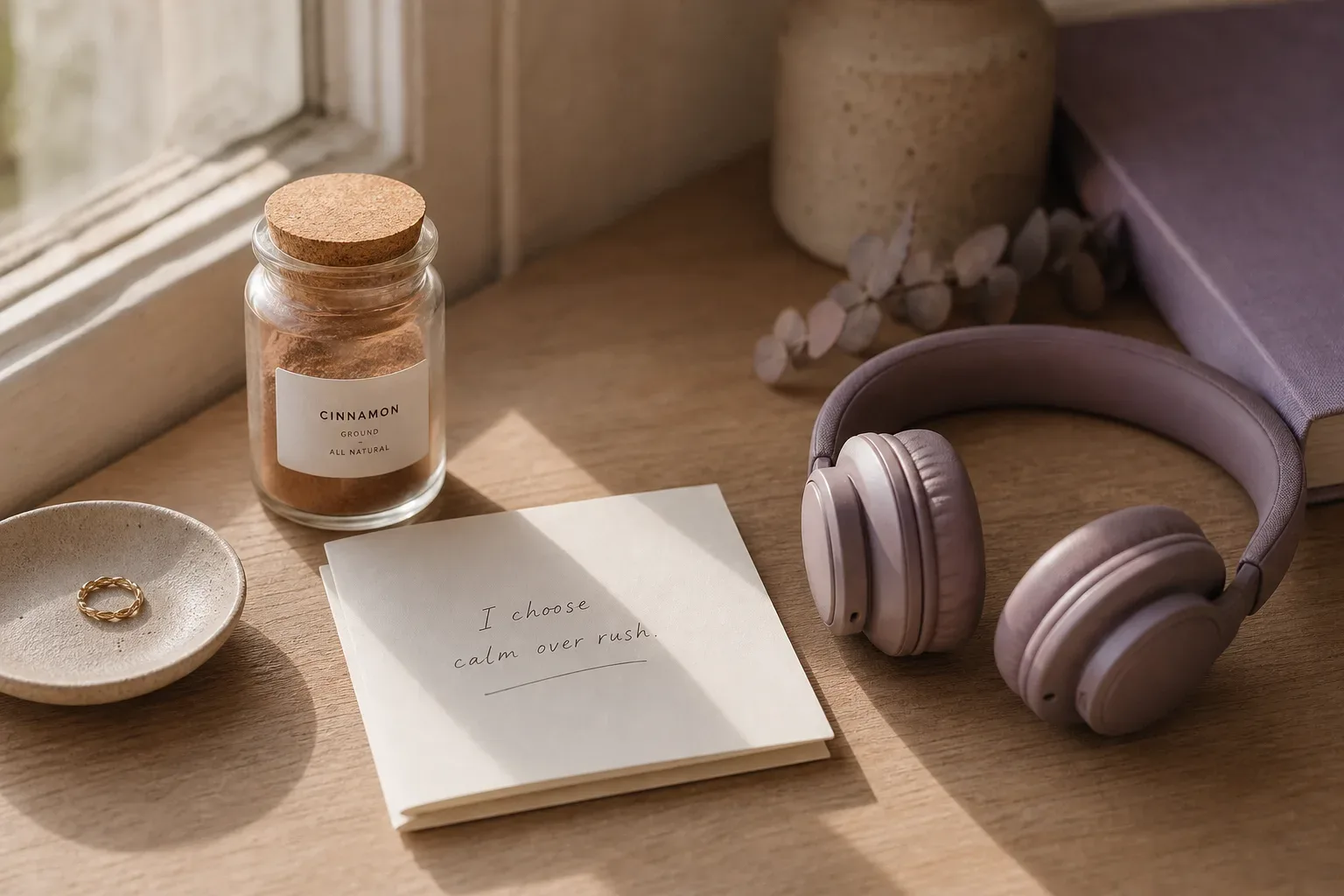
The jar is small. The scent arrives before the thought. Cinnamon manifestation is a sensory ritual for naming an intention, but it works best when you listen first, then sprinkle. Begin with audio, let the body hear the future, use cinnamon as a cue, and take one real action.
What is cinnamon manifestation really doing?
Cinnamon manifestation is a symbolic ritual that turns an intention into something your body can smell, touch, and remember.
The common version is simple: on the first day of a month, you sprinkle cinnamon at the front door while naming what you are calling into your life. Some people blow it inward. Some place it in a bowl. Some write an intention and dust the page. The details vary, but the structure is the same. A desire becomes physical for 30 seconds.
That matters because the mind is not the only place intention lives. In somatic work, I often see a person speak a clear sentence while the jaw tightens or the breath lifts high into the chest. The mouth says yes. The body says not yet. One small sensory ritual can make that split visible.
Smell is especially tied to memory. A 2004 review in Chemical Senses by Rachel Herz noted that odor-evoked memories are often more emotional than memories called up by words or images. That does not mean cinnamon has a special force. It means scent is a strong doorway into recall.
A ritual is not proof. It is a place to practice attention. Cinnamon does not replace money work, a difficult conversation, a budget, a job application, rest, skill, or repair. It gives the nervous system a marker. This is the moment I remembered what I said I wanted.
If you are new to manifestation, start with the larger frame in manifestation. Then come back to the jar. A symbol works better when it belongs to a practice, not when it is asked to carry the whole wish by itself.
The cinnamon is not the promise. The cinnamon is the reminder.
Why should you listen before you sprinkle?
You listen first because the audio teaches the body the shape of the intention before the hand performs the ritual.
The AYA Method is a daily audio manifestation practice. Each day you listen to a short personalized recording — your Dream-Self Moment — narrated from the version of you who has already manifested the life you intend. Listening is the practice. Repetition is the work. The audio is the method.
This is why I would not begin a cinnamon manifestation ritual with the spice. I would begin with the voice. Not a loud voice. Not a demanding one. A voice that lets the body hear a future as if it is familiar. The daily affirmation and Manifestation Board can support the practice, but they are complements. The listening is the center.
There is good behavioral reason for this order. Research on mental rehearsal has often shown that the brain and body respond to vividly imagined action in measurable ways. In sports psychology, imagery practice has been studied for decades, including a 1994 meta-analysis in the Journal of Applied Sport Psychology that found mental practice improved performance across many tasks, especially when paired with physical practice.
The same principle stays humble here. You are not pretending cinnamon will do the work. You are letting the body rehearse receiving, choosing, asking, or beginning. Then the cinnamon marks it. Then one action proves you were listening.
A quiet order helps:
- Listen to the Dream-Self Moment.
- Notice what the body believes or resists.
- Touch or sprinkle the cinnamon.
- Speak one grounded sentence.
- Take one matching action within 24 hours.
The action can be tiny. Tiny is often better. A 2010 review in Health Psychology found that small, repeated cues support habit formation more reliably than intensity alone. The body trusts what returns.
How do you do the cinnamon manifestation ritual step by step?
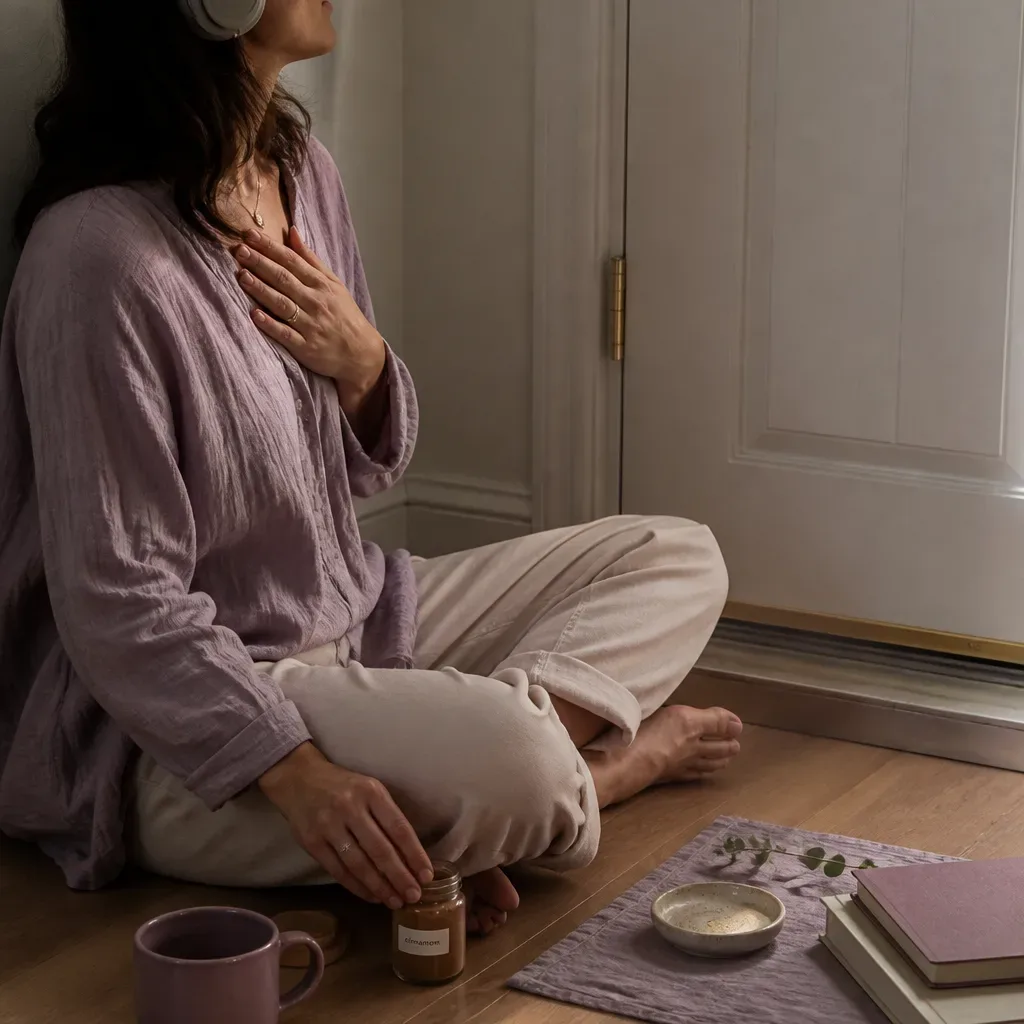
You do the ritual by choosing one intention, listening first, using a small amount of cinnamon, and closing with one action that belongs to the desire.
Set aside 7 minutes. That is enough. The ritual should fit inside a normal day, not ask you to become someone theatrical. If you have pets, babies, asthma, allergies, or shared floors, do not scatter spice where it can irritate bodies. A closed jar, a small dish, or a folded paper can carry the symbol without mess.
Here is the quiet version I teach:
- Choose one intention. Make it specific. Not more money, but I receive the paid work that respects my time. Not love, but I practice being available to steady love.
- Listen for 2 minutes. Use your Dream-Self Moment if you practice with Aya. If not, record your own short note in the present tense.
- Pause for 30 seconds. Ask: where did my body brace?
- Touch the cinnamon. Use one pinch. Place it at a threshold, in a dish, or on a written sentence.
- Speak one line. Keep it simple enough that your body does not flinch.
- Act within 24 hours. Send, ask, apply, save, rest, tidy, prepare.
Peter Gollwitzer’s work on implementation intentions, first widely cited in the late 1990s, found that if-then plans can increase the likelihood of follow-through. The ritual becomes stronger when it ends with that kind of plan. If the client replies, then I will send the proposal by 3 p.m. If I feel scared, then I will put one hand on my sternum and send the message anyway.
Use this table to choose the safest form:
| Situation | Cinnamon form | Best closing action |
|---|---|---|
| Shared home | Cinnamon in a small bowl | Clean the space after 10 minutes |
| Pets nearby | Closed jar only | Wash hands and store it high |
| Money intention | Pinch on folded paper | Review one account or invoice |
| Love intention | Scent from the jar | Send one honest message |
| Career intention | Paper on desk | Open the file for 15 minutes |
A ritual that harms your actual home is not sacred. It is just avoidance in costume.
What should you say during cinnamon manifestation?
Say one sentence your body can tolerate as true enough to practice.
This is where many people push too hard. They choose a sentence so shiny that the nervous system rejects it. You can feel it happen. The throat tightens. The belly pulls back. The face performs belief. That performance is not failure, but it is information.
If you use spoken intention often, the affirmations guide can help you shape language that does not bully the body. A good sentence is not always grand. Often it is plain. I am available for work that pays clearly. I let support be real when it arrives. I tell the truth sooner. I can receive without leaving myself.
In expressive writing research, James Pennebaker’s 1988 work in the Journal of Consulting and Clinical Psychology linked short writing practices with later health-related outcomes in some groups. The point is not that one sentence fixes a life. The point is that language becomes more useful when it is honest enough to stay close to the body.
Try these sentence shapes:
- I am practicing receiving ______ without abandoning myself.
- I am ready to notice the next true step toward ______.
- I let ______ become normal in my daily life.
- I can move slowly and still be faithful to ______.
- I welcome ______ in a way my body can hold.
Notice the difference between forcing and permitting. Forcing says, I must believe this now. Permitting says, I can let this become more familiar. The second one usually lands lower in the body. Lower is good. The belly is often more honest than the forehead.
A sentence is ready when your breath can stay with it.
If nothing feels true, say less. One word can be enough. Steady. Paid. Chosen. Safe. Home. In ritual, accuracy matters more than decoration.
What if you feel skeptical or silly?
Skepticism is allowed, and it can keep the ritual honest.
You do not have to believe cinnamon changes events in order to use cinnamon well. You only have to let it become a cue. Behavioral science is full of cues. A running shoe by the door. A glass of water by the bed. A note on a mirror. The cue does not do the behavior for you. It helps you remember the behavior you chose.
A 2012 study by Phillippa Lally and colleagues in the European Journal of Social Psychology found that habit formation varied widely, with a median of 66 days for a behavior to become more automatic. One ritual will not carry a whole life. Repetition changes the feel of a choice.
If you feel silly, make the ritual smaller. Do not perform for an invisible audience. Do not film it. Do not make your home look like a stage. Stand at the door with the jar in your hand. Listen. Breathe. Touch the lid. Speak softly. That counts.
Here are signs the ritual is staying grounded:
- You still take practical action afterward.
- You can name what you want in ordinary words.
- You do not use the ritual to avoid a hard email.
- You respect health, pets, and shared space.
- You feel more present, not more frantic.
Cinnamon manifestation becomes unhelpful when it asks you to bypass grief, debt, conflict, fatigue, or time. Wanting something is not a command to the world. It is an invitation to become more available to the choices that match it.
How does this fit with astrology, timing, and first-of-month rituals?
Timing can make the ritual feel marked, but the date is a container, not a rule.
Many people use cinnamon on the first day of the month because beginnings help the mind organize attention. This is not strange. The fresh-start effect, studied by Hengchen Dai, Katherine Milkman, and Jason Riis in 2014, showed that temporal landmarks like Mondays, birthdays, and new years can increase aspirational behavior. A first-of-month ritual works in the same family of meaning.
If you follow lunar or seasonal timing, you can pair the ritual with a new moon, a birthday, or a personal date that matters to you. If you are curious about that symbolic layer, astrology and manifestation can give you a wider map. Still, the map is not the method. Listening comes first. The calendar supports the listening.
You might choose timing like this:
| Timing | Use it for | Keep it quiet by |
|---|---|---|
| First day of month | Fresh commitments | Choosing one intention only |
| New moon | Beginning privately | Writing before speaking |
| Full moon | Seeing what is complete | Releasing one old sentence |
| Birthday | Personal threshold | Listening longer than usual |
| Before a meeting | Courage and clarity | Taking 3 slow breaths |
Dr. Andrew Huberman often speaks about how light, timing, and repetition shape nervous system state, especially around sleep and daily rhythms. You do not need to make that complicated. Bodies like rhythm. A monthly cinnamon ritual can be one quiet rhythm among many.
The risk with timing is waiting for the perfect day. Do not do that. If the first of the month passed, begin on the third. If the moon is not right, begin anyway. The body learns from what you repeat, not from what you postpone.
A missed date is not a sign. It is just a missed date.
What should you do after the cinnamon is sprinkled?
After the ritual, take one small action that makes the intention more believable to your daily life.
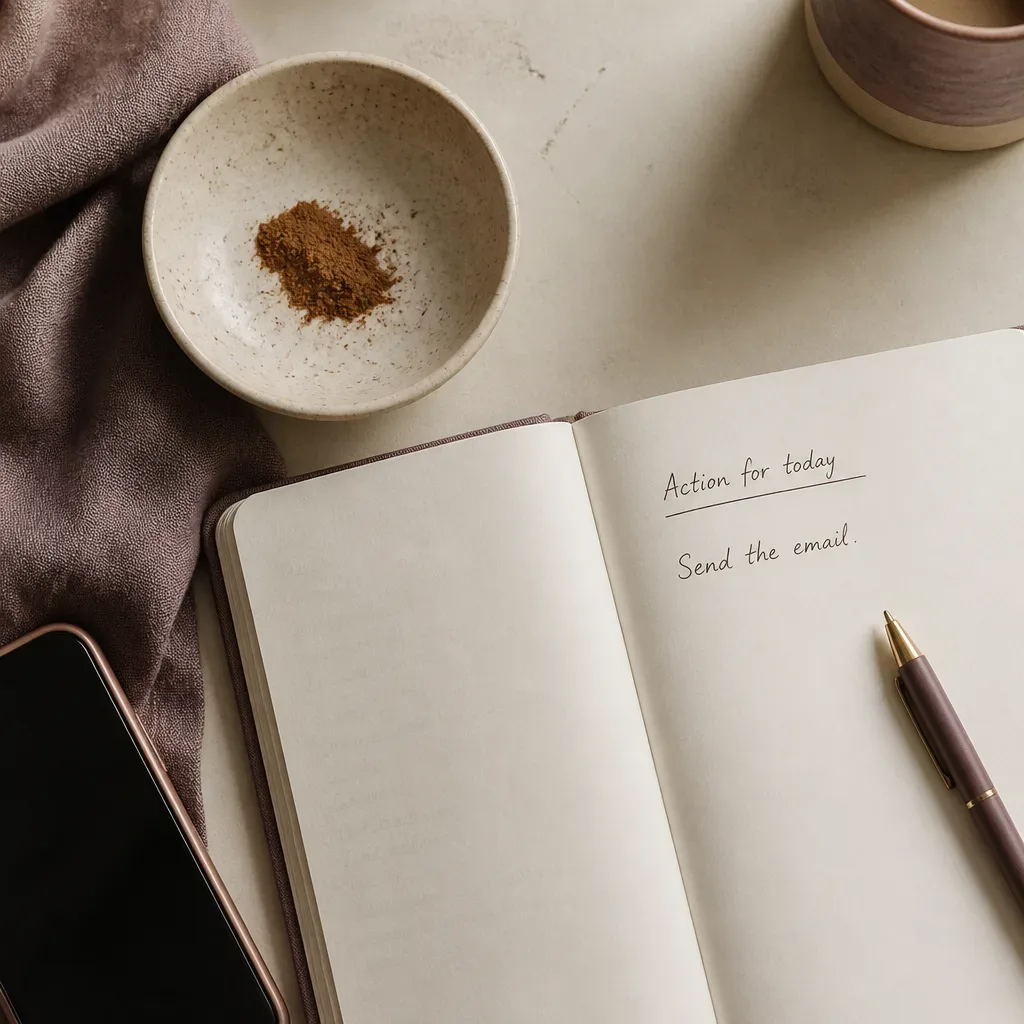
This is the part people skip because it is less pretty. It is also the part that matters. If your intention is paid work, send the invoice. If it is steadier love, answer the kind message without testing it. If it is health, book the appointment or lay out the shoes. If it is creative work, open the document for 15 minutes.
Action does not have to be large. In fact, the nervous system may trust small actions more. BJ Fogg’s Tiny Habits model, published widely after 2019, emphasizes that behavior change often works best when the action is small, anchored, and followed by a sense of completion. Cinnamon can be the anchor. The action is the practice entering the day.
If you use the AYA Method each morning, let the cinnamon ritual be occasional. The daily audio keeps the future close through repetition. The app also includes a daily affirmation and Manifestation Board, but those support the listening. They are not the center of the method.
You can use this aftercare checklist:
- Wash your hands.
- Clean any spice that could bother animals or people.
- Write the action you will take in one sentence.
- Do it within 24 hours.
- Return to listening tomorrow.
There is a tenderness in this order. First the voice. Then the scent. Then the step. It asks less drama from you and more honesty. That is often the better bargain.
If you want a wider foundation, read the manifestation pillar and keep your ritual simple for 30 days. Notice what changes when desire becomes something you hear, smell, say, and do.
Leave the jar where your hand can find it, and let the next true step be small.