mindset
Comparison Trap Manifestation: Listen Before You Scroll
The comparison trap gets louder when scrolling comes first. Use a 7-minute audio manifestation reset before social media sets the tone.

The phone is beside the cup. It knows your thumb. The comparison trap begins when someone else’s life gets the first word, so the practice is simple: listen before you scroll. Give your own desire seven quiet minutes before the feed teaches you what to want, fear, or measure.
What is the comparison trap doing to your manifestation practice?
The comparison trap pulls your attention away from your own desired life and trains it on someone else’s visible proof.
Leon Festinger named social comparison theory in 1954: people evaluate themselves by looking sideways when clear measures are missing. Manifestation can be full of unclear measures. You’re listening, writing, hoping, trying to feel the future as real. Then a stranger posts the apartment, the ring, the business, the body, the calm breakfast. Your mind makes a private spreadsheet in under 10 seconds.
That spreadsheet is usually wrong. Pew Research Center reported in 2024 that a large majority of U.S. adults use at least one social media site, and younger adults often use several. You’re not comparing yourself to one neighbor anymore. You’re comparing your morning hair and sink dishes to 200 edited windows.
A manifestation practice asks for one tender skill: to know what’s yours before the room gets loud. Manifestation isn’t helped by panic. It’s helped by repetition, attention, and a felt sense that your inner image is allowed to exist before it has proof.
Comparison makes a stranger’s timing look like a verdict on your own.
The trap isn’t that you saw someone succeed. The trap is that you made their success the clock. Once that happens, your practice can shift from desire to defense. You stop asking, “What am I here to remember?” and start asking, “Why not me yet?”
Why listen before you scroll?
Listening first gives your mind a chosen image before social media gives it a borrowed one.
This is where the AYA Method comes in quietly, like a coat over your shoulders. The AYA Method is a daily audio manifestation practice. Each day you listen to a short personalized recording — your Dream-Self Moment — narrated from the version of you who has already manifested the life you intend. Listening is the practice. Repetition is the work. The audio is the method.
Audio matters because it doesn’t ask you to perform. You don’t need a perfect sentence. You don’t need a beautiful notebook. You listen. Dr. Andrew Huberman has often described attention as a limited resource shaped by salience, stress, and repetition. Whether you follow his protocols or not, the practical point is ordinary: what you attend to first can color what you notice next.
Neuroscientists often speak of the brain’s negativity bias, a term popularized in work by Rick Hanson and others. Some estimates suggest the mind registers threat faster than neutral information, often within fractions of a second. A feed can become a little threat machine when you arrive unheld.
Listening before scrolling doesn’t make you immune to envy. It gives envy less authority. Your Dream-Self Moment says, “Here is the life I’m practicing.” The feed says, “Here are many lives to inspect.” Order matters.
A simple rule helps: no input before the first listen. Not messages. Not weather. Not the person from school who now owns ceramic plates that look expensive. Seven minutes is not dramatic. It’s keepable.
How do you do the seven-minute listen-before-scroll reset?
You do it by placing one small ritual between waking and the feed, then repeating it until your hand learns the new order.
Use this when you wake, or before the first scroll of the day if your mornings are already claimed by children, shifts, buses, or a dog with strong opinions. In behavior design, BJ Fogg’s 2019 work at Stanford has made one thing clear: tiny habits stay because they fit existing life. A seven-minute reset works because it asks for less than the average coffee queue.
| Minute | What you do | Why it helps |
|---|---|---|
| 0–1 | Put the phone face down or across the room | You interrupt the reach before it becomes a scroll |
| 1–5 | Listen to your Dream-Self Moment | Your own inner image gets first place |
| 5–6 | Write the comparison sentence if it appears | The thought becomes visible, not total |
| 6–7 | Choose one small proof for today | Desire becomes a finished action |
Here is the reset in numbered form, because a tired mind likes steps:
- Touch the phone once, only to start the audio.
- Listen with your eyes closed, or while brushing your teeth.
- If comparison appears, name it gently: “I’m measuring again.”
- Write one line: “Today I return to my own timing by doing ____.”
- Open social media only after the line is written.
The daily affirmation can help here, if it stays small. Affirmations work best when they feel like a handrail, not a costume. “I’m allowed to be early in private” is often more useful than a sentence your body refuses.

What should you do when envy shows up anyway?
You should treat envy as information, not as a command.
Envy is not proof that you’re failing. It often points to a desire you haven’t admitted cleanly. The Journal of Social and Clinical Psychology published a 2018 study by Melissa Hunt and colleagues in which limiting social media use to about 30 minutes per day was linked with reduced loneliness and depressive symptoms among undergraduates. It was a small group, 143 students, not all of humanity. Still, the finding matches what many people know in the body: less comparison input can soften the day.
When envy appears, don’t rush to become noble. Try being accurate. What exactly hurt? Was it the house, the ease, the public praise, the partner, the money, the body, the apparent certainty? Specificity returns you to yourself.
Use this small list:
- If you envy someone’s rest, your desire may be for safety, not laziness.
- If you envy someone’s visibility, your desire may be for permission to be seen.
- If you envy someone’s money, your desire may be for room to breathe.
- If you envy someone’s love, your desire may be for steadiness, not a photo.
Envy becomes kinder when you ask what it’s trying to protect.
Then listen again later, even for two minutes. The point is not to erase the feeling. The point is to stop letting the feed write your inner script. Neville Goddard taught that imagination rehearses identity. You don’t have to accept every part of his language to use the plain lesson: what you repeatedly assume begins to feel more available.
How can you keep manifestation from becoming another way to measure yourself?
You keep it honest by making the practice smaller than your need to prove you’re good at it.
This matters. A manifestation routine can quietly become another comparison board: who woke at 5, who journaled 12 pages, who meditated for 40 minutes, who never doubts. That is not a practice. That is a contest wearing soft clothes.
Researchers Phillippa Lally and colleagues found in a 2009 European Journal of Social Psychology study that habit formation took a median of 66 days, with wide variation from 18 to 254 days. The number is often flattened online, but the real finding is kinder: people vary. Your rhythm may not look like someone else’s rhythm. It can still become real.
So keep the audio central. The app may also include a daily affirmation and a Manifestation Board, and both can support the practice. They are complements. They are not the pillars. The listening is the thing you return to when you don’t have a better self available.
This is also why astrology can be used gently or not at all. If you read about astrology and manifestation, let it be a mirror, not a prison. A moon phase can remind you to pause. It should not become one more reason to believe you’re late.
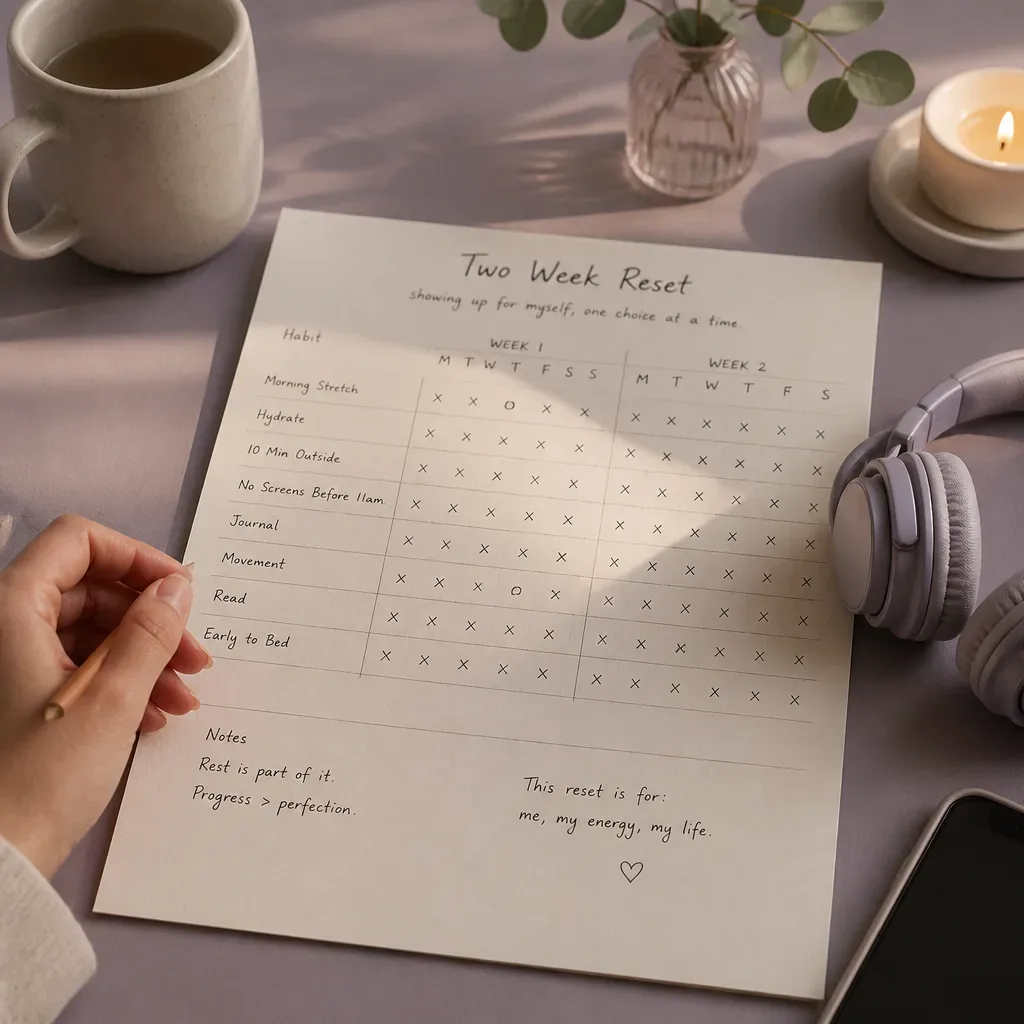
Try these boundaries for 14 days:
- No social feed before your first listen.
- No checking someone you compare yourself to before noon.
- No saving posts that make you feel smaller.
- No changing your desire because someone else made theirs look prettier.
- No punishing yourself for missing a day; return the next morning.
What if you’ve already scrolled and feel behind?
You can begin again from the exact minute you notice you’ve left yourself.
This is the part I like, perhaps because I work in a library and have seen people renew the same book three times, then finally read it on the fourth. A practice that cannot survive interruption is too fragile for a human life. The question is not whether you touched the phone. The question is how soon you come home.
A 2010 meta-analysis in Clinical Psychology Review found that mindfulness-based practices can reduce anxiety symptoms across varied groups, though effects differ by study quality and setting. You don’t need to call this mindfulness if the word feels too large. You can call it noticing. You can call it the moment you stop reading other people’s proof and return to your own breath.
Do this after a comparison spiral:
- Close the app without making a speech to yourself.
- Put one hand on your chest or the table.
- Say, “I compared. I’m here now.”
- Play your Dream-Self Moment from the beginning.
- Choose one action that takes 10 minutes or less.
That last step matters. Pennebaker’s expressive writing research, developed across decades, often used brief sessions of 15 to 20 minutes. Small timed containers can change what feels manageable. Your 10-minute action might be sending one email, washing the cup, walking outside, opening the document, or making the appointment.
You don’t need to win the morning. You need to return before the day hardens.
If you want to study the wider frame, read the Manifestation pillar when you’re steady, not when you’re bleeding from comparison. If words help, choose one sentence from the Affirmations pillar and make it plain enough to believe.
How do you know the reset is working?
You know it’s working when comparison still appears, but it no longer gets to lead.
Look for quiet evidence over 2 weeks. Not fireworks. Not a personality transplant. Just small signs: you scroll later, stop sooner, recover faster, and choose actions that belong to your life. In habit research, consistency is often more predictive than intensity. Five minutes repeated 10 times usually teaches more than 50 minutes performed once for a private medal.
Keep a small record. Very small. A library due-date slip would be enough. Mark three things each day:
| Day | Listened before scrolling? | One small proof |
|---|---|---|
| Monday | Yes / No | Sent the email |
| Tuesday | Yes / No | Took the walk |
| Wednesday | Yes / No | Wrote 5 lines |
After 14 days, read the slips. Do not grade your soul. Count returns. If you listened before scrolling on 8 of 14 days, that is 8 mornings where your desire spoke first. If you recovered after scrolling on 4 more, that is also practice.
Joe Dispenza often speaks about rehearsing a future state until the body begins to recognize it. You don’t have to adopt every claim to see the useful discipline inside it: repetition teaches familiarity. The AYA app’s Dream-Self Moment uses that ordinary human fact. A voice, heard again and again, can become easier to believe than the feed.
For deeper structure, return to the AYA Method and let the audio stay first. Let the Manifestation Board be something you see after you’ve listened. Let the affirmation be a line you carry, not a test you pass.
The phone can wait by the lamp.