manifestation 101
Lucky Girl Syndrome vs Future-Self Audio
Lucky girl syndrome can soothe the mind, but future-self audio gives the body a daily place to rehearse what is already becoming real.
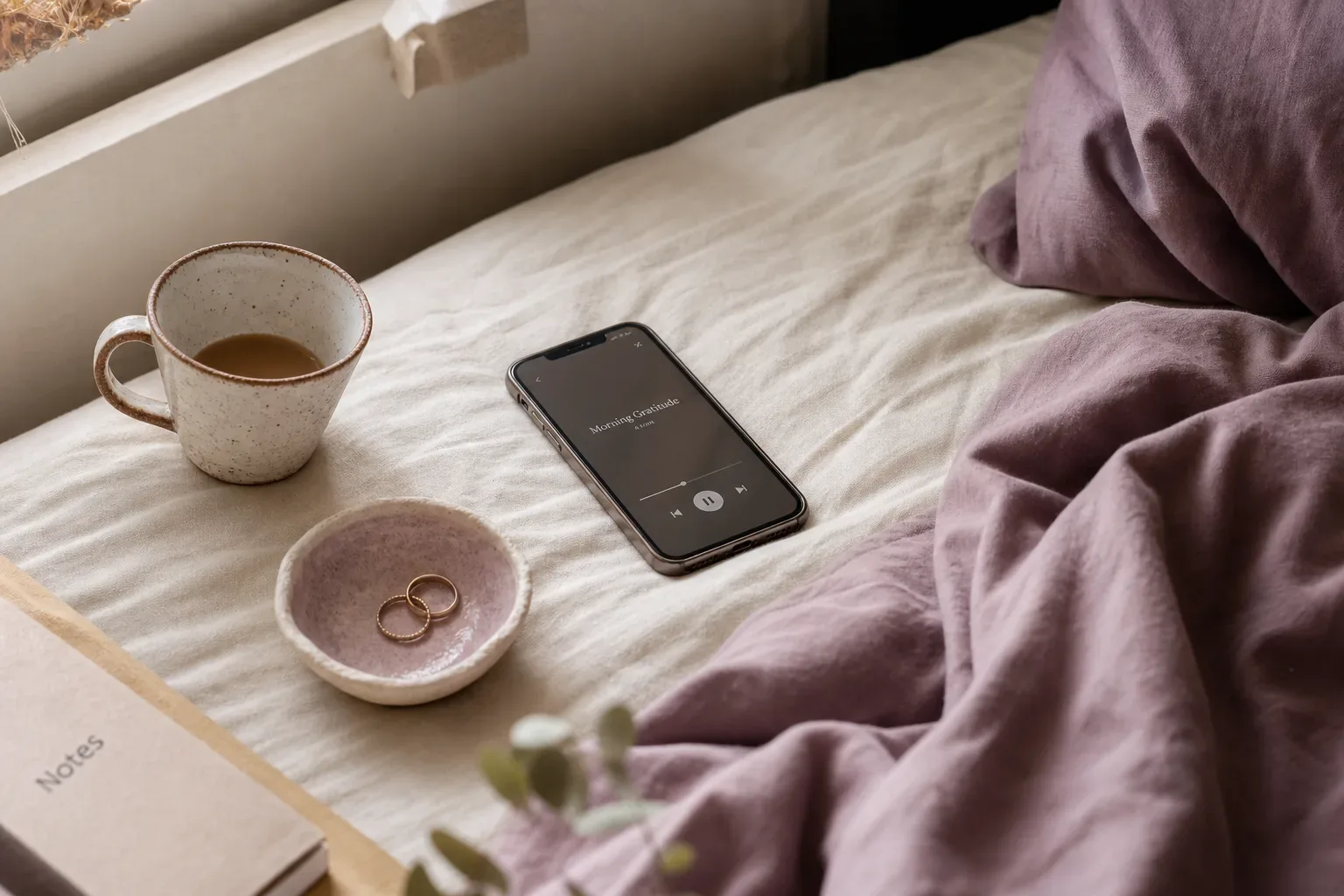
A phone glows on the edge of the bed. Lucky girl syndrome says, softly or loudly, that things work out for you. Future-self audio asks something slower: can you hear the version of yourself who already lives that truth, and return to her daily without forcing belief?
What is lucky girl syndrome, really?
Lucky girl syndrome is a repetition practice built around the idea that life tends to meet you kindly.
The phrase became visible on TikTok in early 2023, when reporters at outlets including The Guardian and NBC News described videos with hundreds of millions of views attached to the idea. The common sentence was simple: I’m so lucky, everything works out for me. It spread because it was small enough to remember. One line. One breath. One way to interrupt the mind when it starts making a list of everything that could go wrong.
There is a reason that kind of sentence can feel relieving. Cognitive reappraisal, the act of changing the frame around a situation, has been studied for decades. A 2010 meta-analysis in Psychological Bulletin found that reappraisal is generally linked with healthier emotion regulation than suppression. Lucky girl syndrome is not clinical reappraisal, but it borrows the same doorway: you change the frame, and your body may soften by one degree.
Still, a doorway is not a house. If you use the sentence to avoid looking at money, health, grief, work, or repair, the practice becomes brittle. The nervous system knows when it is being lied to. It may accept hope, but it rarely accepts denial for long.
Luck is a doorway. Practice is the room you can live in.
This is where manifestation needs to be named with care. Manifestation is not a performance of cheerfulness. It is the repeated act of becoming available to the life you intend, in thought, attention, choice, and body. A sentence can begin that act. It usually cannot hold the whole thing.
How is future-self audio different from a lucky phrase?
Future-self audio gives the mind a specific voice to return to, instead of asking one phrase to carry the whole future.
The difference is texture. Lucky girl syndrome often works like a sticker on a mirror. Future-self audio works more like a small room you enter each day. You hear pacing. You hear tone. You hear the ordinary details of the life you are practicing toward. The future is not shouted at you. It is narrated from inside you.
Here is the canonical shape of the practice: the AYA Method is a daily audio manifestation practice. Each day you listen to a short personalized recording — your Dream-Self Moment — narrated from the version of you who has already manifested the life you intend. Listening is the practice. Repetition is the work. The audio is the method.
That matters because hearing is intimate. In a 2014 study in the Journal of Personality and Social Psychology, Ethan Kross and colleagues found that distanced self-talk can help people regulate stress before difficult tasks. The words were simple. The shift was in perspective. Future-self audio uses a related principle, but it adds a felt sense: not just what you tell yourself, but who you hear yourself becoming.
A phrase can be true and still be too thin for a hard morning. Audio lets the truth have weight.
| Practice | What it asks of you | What it gives back |
|---|---|---|
| Lucky girl syndrome | Repeat a broad belief about things working out | Quick relief, a brighter frame, a simple cue |
| Future-self audio | Listen daily to a specific future-self narration | Repetition, imagery, tone, embodied rehearsal |
| Daily affirmation | Hold one sentence for the day | A clean focus point beside the audio |
| Manifestation Board | See visual reminders of what matters | A visible complement, not the center |
In affirmations, the sentence is the tool. In future-self audio, the voice is the tool. That is a quiet but real difference.
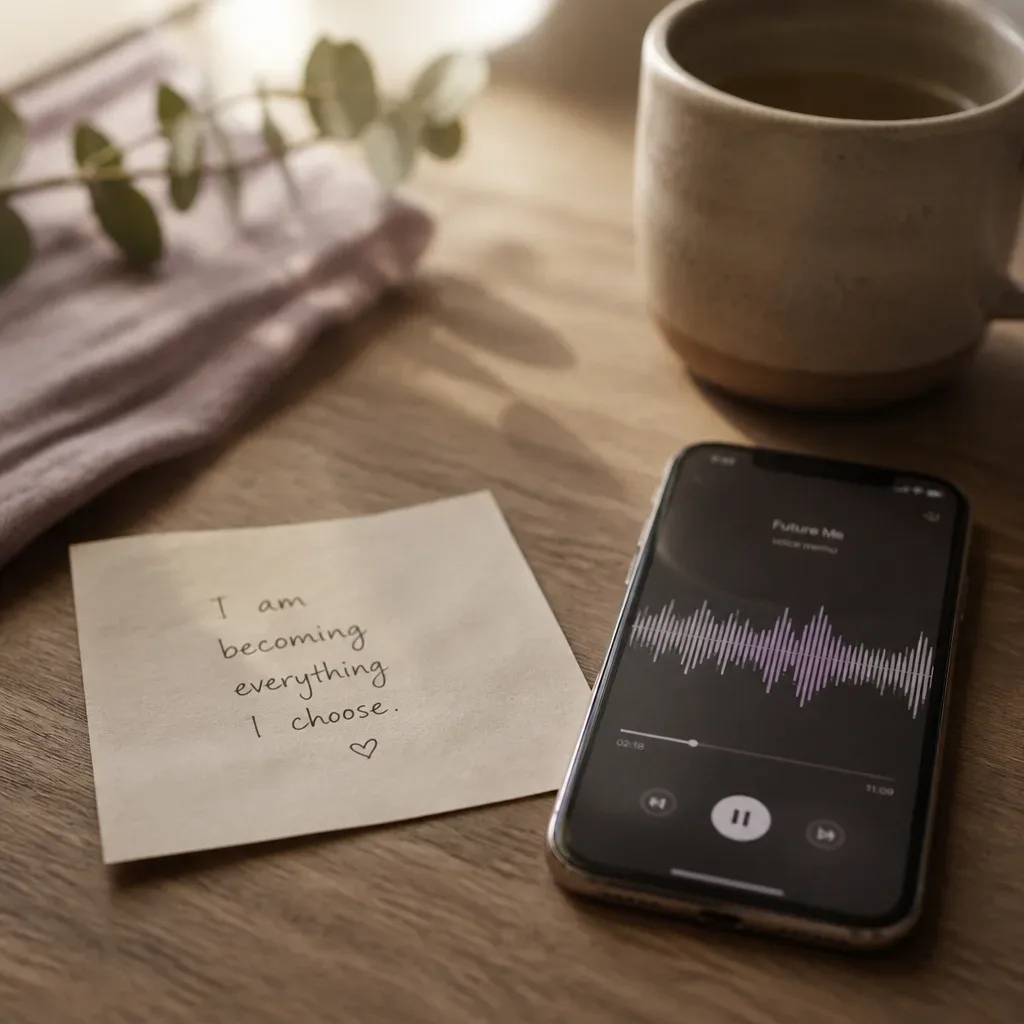
Where does the science give each practice support?
The strongest support is not for magical luck, but for repetition, mental rehearsal, self-affirmation, and attention.
Self-affirmation research is more careful than social media language. In a 2014 review in the Annual Review of Psychology, Geoffrey Cohen and David Sherman described how affirming core values can help reduce defensiveness under threat. That does not mean repeating I am lucky will change every outcome. It means the self can become less rigid when it remembers what it stands on.
Mental rehearsal has its own evidence base. Sports psychology has used imagery for decades, and a 2013 review in Frontiers in Human Neuroscience noted that motor imagery activates overlapping neural networks with action, though not identically. This is important. The brain does not need the future to be physically present in order to begin practicing parts of it. It needs enough repetition, enough sensory detail, and enough emotional safety to stay with the image.
Habit research adds another quiet number. Phillippa Lally and colleagues, writing in the European Journal of Social Psychology in 2010, found that habit automaticity took an average of 66 days, with a range from 18 to 254 days. That range is merciful. It means becoming steady is not a 7-day test of character. It is a repeated return.
Future-self audio fits this better than a viral phrase because it is built for recurrence. You do not have to invent the sentence every morning. You listen. Your body learns the path back. The app may also offer a daily affirmation or a Manifestation Board, but those sit beside the audio. They are not the pillars. The listening is the practice.
There is also a caution from motivation science. Gabriele Oettingen’s work on mental contrasting, summarized in her 2014 book Rethinking Positive Thinking, suggests that positive fantasy alone can reduce effort when it becomes detached from present obstacles. A softer practice does not skip the obstacle. It lets the future self speak while your real life stays in the room.
When can lucky girl syndrome help, and when can it harm?
Lucky girl syndrome helps when it interrupts panic, and harms when it asks you to abandon what is true.
There are mornings when a phrase is enough. You are about to send the email. You are waiting for a result. Your chest has gone tight. A simple sentence can keep you from rehearsing failure for the 14th time. The National Science Foundation did not prove the popular claim about 60,000 thoughts a day, so I will not repeat it as fact. But daily cognition is repetitive. Anyone who has worried at 3:17 a.m. knows this without a lab coat.
The problem begins when luck becomes moral pressure. If the rent is late, if your body is ill, if your relationship is tender, the phrase everything works out can start to feel like another demand. A 2022 American Psychological Association survey found that 27 percent of U.S. adults reported being so stressed they could not function on most days. In that kind of body, forced brightness can feel like noise.
A useful practice does not humiliate the part of you that is afraid.
Here is a simple way to tell whether the phrase is serving you:
- Does it soften your body? If your jaw releases or your breath slows, the sentence may be helping.
- Does it make you avoid a needed action? If yes, pause. A practice should not replace the call, the apology, the budget, or the rest.
- Does it leave room for grief? If it cannot sit beside sadness, it is too small.
- Does it return you to choice? The right sentence gives you one next step, not a fantasy of being rescued.
This is why a practice like astrology and manifestation needs tenderness too. Symbols can help you see timing and pattern. They should not be used to disappear your agency. A sign, a phrase, a ritual, a recording: each one should bring you closer to your own hands.

Why does audio feel softer to the body?
Audio feels softer because it asks you to receive before it asks you to perform.
Many manifestation practices ask you to write, repeat, visualize, script, plan, and track. There is nothing wrong with these. But some days the self is tired of producing. Listening changes the posture. You do not have to make the practice impressive. You only have to be present enough to hear it.
There is a clinical echo here. Stephen Porges’ polyvagal theory is debated in parts, but one widely accepted point remains: vocal tone can influence perceived safety. Separate from that theory, infant research has long shown that prosody, the music of speech, matters before meaning is fully understood. A 2017 review in Neuroscience & Biobehavioral Reviews described how voice cues are processed quickly and socially. Your body hears more than words.
That is why future-self audio can reach places a typed affirmation may not. The sentence says, I am safe to become. The voice says it with timing. The pause matters. The breath matters. The ordinary detail matters.
When I make a cup on the wheel, I cannot argue the clay into center. I have to touch it steadily until it remembers the middle. Future-self audio feels similar. You listen again. Not to force the future. To become less strange to it.
The AYA Method keeps the practice small on purpose. A short Dream-Self Moment can be repeated daily because it does not ask you to clear your whole morning or become a new person by breakfast. In behavior design, BJ Fogg has often argued for tiny habits because small actions are easier to repeat. The exact time matters less than the return.
A voice can become a home when you meet it at the same door each day.
How should you choose between lucky girl syndrome and future-self audio?
Choose lucky girl syndrome for a quick cue, and choose future-self audio when you want a daily practice with depth, specificity, and return.
This is not a fight between right and wrong. It is a question of use. A phrase can be a match. Audio can be the candle that stays lit longer. If you only need a moment of interruption before a meeting, a lucky sentence may be enough. If you are changing how you see yourself over weeks and months, you will likely need something with more shape.
Use this small guide:
- Use lucky girl syndrome when you need one clean thought, low friction, and immediate emotional steadiness.
- Use future-self audio when you are practicing a new identity, a new rhythm, or a future that still feels far away.
- Use a daily affirmation when one sentence helps you remember the day’s center.
- Use a Manifestation Board when seeing images helps you stay close to what is yours.
- Use action when the next honest step is plain.
A 2006 meta-analysis by Peter Gollwitzer and Paschal Sheeran reviewed 94 studies and found that implementation intentions had a medium-to-large effect on goal achievement. The sentence If situation X happens, I will do Y works because it ties intention to behavior. Future-self audio should do something similar in a quieter register. It should make the next self feel specific enough to meet.
If you want the broader frame, begin with the manifestation guide. If your mind keeps returning to one sentence, spend time with affirmation practice. If timing and symbolism matter to you, read about astrology and manifestation. And if you are ready to listen rather than perform, return to the AYA Method.
The softer practice is the one you can repeat without leaving yourself behind.
Put the cup down. Listen softly.