manifestation 101
Two Cup Method vs Future-Self Audio
The two cup method is a simple water ritual. Future-self audio is a daily listening practice. Here is how they differ, and when each fits.
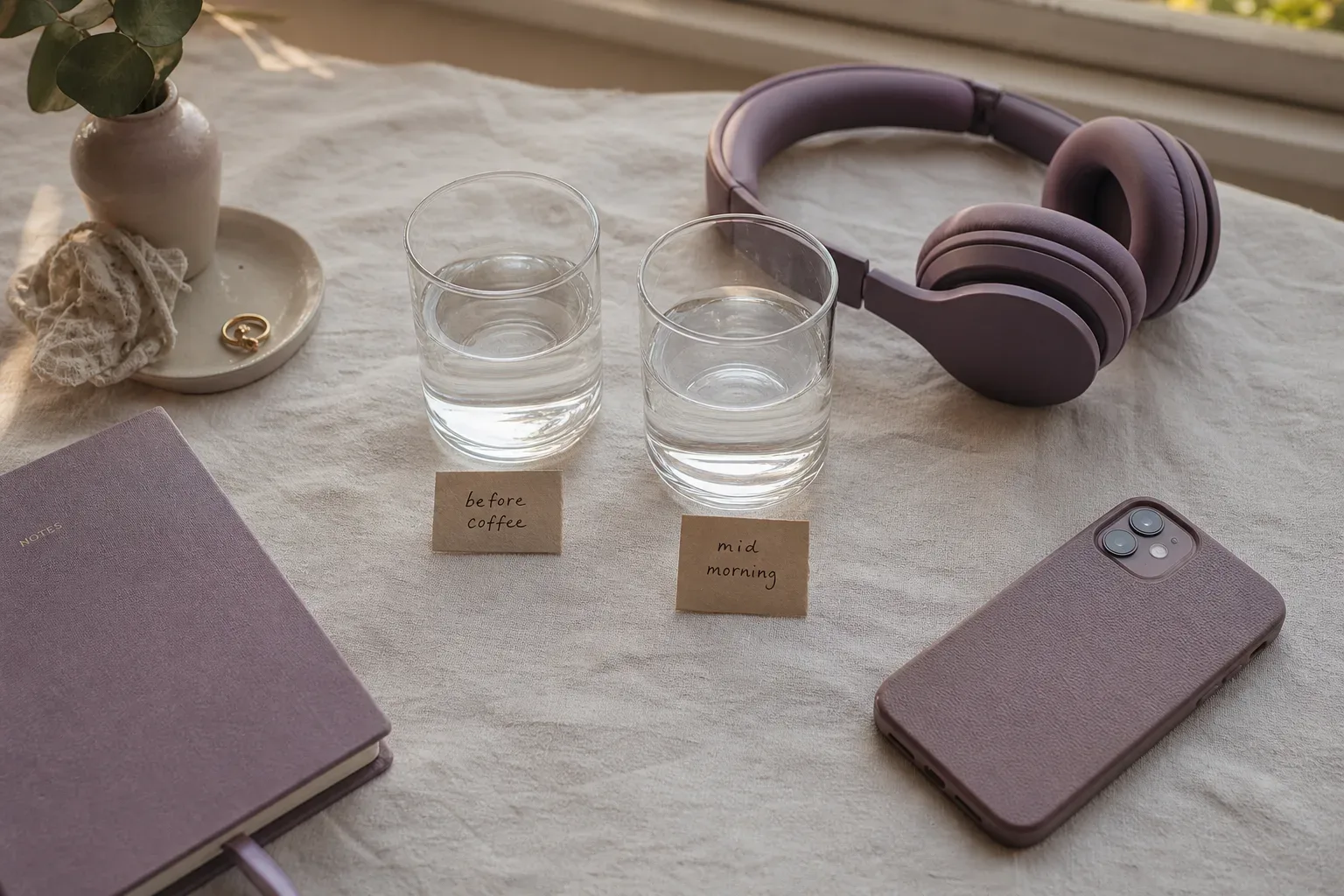
Two glasses sit on the table. One is marked now. One is marked already. The two cup method gives you a clear symbolic act; future-self audio gives you repetition. If you need a threshold, use the cups. If you need a daily way back, listen.
What is the two cup method actually doing?
The two cup method is a short ritual that uses water, labels, and attention to mark a chosen inner shift.
You take two cups. You label one with your current state, such as anxious about money or unsure what to choose. You label the other with the state you want to inhabit, such as steady with money or clear enough to act. Then you pour water from the first cup into the second. You drink it slowly. The whole practice often takes 5 to 10 minutes, which is part of why it moves so easily through TikTok, Reddit threads, and small private notebooks.
Its force is not in the water itself. It is in the way the body remembers a clear action. Psychologist Peter Gollwitzer’s 1999 work on implementation intentions showed that specific if-then plans can improve follow-through because they give the mind a cue and a response. The cup ritual does something related, though less formal: it makes an invisible intention visible for a few minutes.
The ritual also works with what researchers call embodied cognition. In one review of embodied cognition, Lawrence Barsalou noted that thought is often tied to sensory and motor systems, not held only as abstract language. You touch the glass. You see the label. You swallow the water. It is small, but it is not vague.
A ritual can make a decision feel held by the body before the calendar has proof.
The two cup method belongs inside the wider language of manifestation, but it is not a complete practice for everyone. It is a moment. A threshold. A line drawn in condensation on a kitchen table.
How does future-self audio work differently?
Future-self audio works by repeated listening to a narrated identity until the chosen future feels familiar enough to live from.
The AYA Method is a daily audio manifestation practice. Each day you listen to a short personalized recording — your Dream-Self Moment — narrated from the version of you who has already manifested the life you intend. Listening is the practice. Repetition is the work. The audio is the method. You can read the full definition of the AYA Method at its home.
That difference matters. The two cup method asks you to perform a symbolic transfer. Future-self audio asks you to return, again and again, to the felt tone of who you are becoming. In habit research, repetition is not decorative. A 2009 study by Phillippa Lally and colleagues at University College London found that habit formation took 66 days on average, with a wide range from 18 to 254 days. The nervous system learns through many returns, not one perfect ceremony.
Audio also asks less of the eyes. This is not small. Many manifestation tools require writing, arranging, typing, or looking. A listening practice can meet you in bed, on a walk, or before sleep. Dr. Andrew Huberman has often pointed to the value of repeated mental rehearsal for changing perception and behavior, especially when the practice is specific and emotionally believable. Future-self audio gives that rehearsal a voice.
A cup ritual says: cross this line. A future-self recording says: come back here tomorrow.
This is why audio can be especially kind when life is ordinary and full. You do not need a candle. You do not need the right pen. You do not need to be impressive to yourself. You only need to listen.

Which one is easier to repeat when your life is full?
Future-self audio is usually easier to repeat because it removes setup, cleanup, and the need to create fresh words every time.
The two cup method is simple, but it still asks for a small scene. Two cups. Labels. Water. A flat surface. A moment when no one needs the sink. That can be beautiful. It can also be enough friction to make you postpone it. Behavioral scientist BJ Fogg writes that tiny habits survive when they are easy to do after an existing prompt. A 30-second behavior attached to a daily cue has better odds than a meaningful ritual that requires staging.
Future-self audio lowers the threshold. You press play. If the recording is already there, the mind has fewer exits. Research on decision fatigue is often debated, but one practical point holds: fewer choices can protect follow-through. A 2010 meta-analysis by Hagger and colleagues found evidence for ego depletion effects, while later replication work questioned the size of the effect. Still, in daily practice, reducing steps remains useful.
Here is the quiet comparison:
| Question | Two cup method | Future-self audio |
|---|---|---|
| Time needed | Usually 5 to 10 minutes | Often 2 to 5 minutes |
| Main action | Pour and drink water | Listen to your Dream-Self Moment |
| Best use | Marking a threshold | Building daily familiarity |
| Friction | Needs objects and labels | Needs headphones or quiet sound |
| Memory cue | Visual and physical | Auditory and emotional |
If you are drawn to water, the two cup method may feel intimate. If you are tired, future-self audio may be kinder. The right practice is the one you can return to without having to become a different person first.
I like tools that do not punish the life you actually have. A practice that depends on a perfect morning will often disappear by Thursday.
Which practice has more support from psychology?
Future-self audio has closer support from habit, visualization, and self-narrative research, while the two cup method is better understood as symbolic ritual.
There is no large clinical trial proving the two cup method itself. That does not make it useless. It means the honest category is ritual, not tested protocol. Rituals can still change behavior. In a 2016 review in the Annual Review of Psychology, researchers noted that rituals can reduce grief, increase perceived control, and shape attention, even when people do not believe the ritual has direct causal force. The cup method may help because it focuses your attention, not because water obeys a label.
Future-self audio stands nearer to several studied areas. Mental imagery has a long evidence base. In a 1998 study by Shelley Taylor and colleagues, students who visualized the process of studying tended to perform better than those who visualized only the desired outcome. The lesson is tender but firm: the mind needs scenes it can enter, not just prizes it can admire.
Self-affirmation research is more mixed. Claude Steele’s self-affirmation theory began in the 1980s, and later studies found that values-based reflection can help people stay open under threat. But a 2009 study by Joanne Wood and colleagues found that repeating very positive self-statements could make some people with low self-esteem feel worse. This matters for affirmations. Words need to feel reachable. Otherwise, the body argues.
Future-self audio can make identity more believable because it is not only a sentence. It is tone, timing, scene, breath. It can hold a future that sounds lived-in.
A practice is not stronger because it is dramatic. It is stronger when your body stops bracing against it.
When should you choose the two cup method?
Choose the two cup method when you need a simple ritual to mark a clear before and after.
The cup method is well suited to beginnings. The first day after a breakup. The night before sending a difficult email. The morning you decide to stop negotiating with an old pattern. You are not asking the water to do your life for you. You are using the water to say, I have crossed a line. Anthropologists have studied rites of passage for more than 100 years; Arnold van Gennep’s 1909 work described the pattern of separation, threshold, and return. The two cup method fits that threshold shape.
Use it when the contrast is clear. If the first cup says confused and the second says calm enough to choose, the body can understand that. If the second cup says perfect life by Friday, the ritual may become fantasy theater. Keep the desired state close enough to be real.
A good two cup ritual has 4 parts:
- Name the present state in plain language.
- Name the chosen state without exaggeration.
- Pour slowly and watch the transfer.
- Drink, then take one ordinary action within 24 hours.
That last part matters. A 2002 review by Charles Carver and Michael Scheier on self-regulation emphasized feedback loops: you compare where you are with where you want to be, then adjust behavior. The cup is not the adjustment. It is the signal.
You might also choose it if you work visually. As a photographer, I know the mercy of seeing something with my hands. A label on glass can be more honest than a page of beautiful sentences.
When should you choose future-self audio instead?
Choose future-self audio when you want a practice that can repeat daily and shape the felt identity behind your actions.
A future-self recording is not a speech about goals. It is a short return to a version of you who already knows how this life feels from the inside. This matters because identity guides behavior quietly. In 2018, Pew Research Center reported that 77% of Americans owned smartphones; by 2024, Pew reported smartphone ownership around 91%. The tool already lives beside most beds. That can be troubling, yes. It can also make a listening practice easy to place where your day already begins.
Use future-self audio when your intention needs consistency more than ceremony. Money steadiness. Creative discipline. A softer way of speaking to yourself. A body that trusts your promises. These are not crossed once. They are rehearsed. The AYA Method names this clearly: the Dream-Self Moment is the center, and the app also includes complements such as a daily affirmation and Manifestation Board.
Future-self audio may also serve you if written affirmations feel dry. Some people need voice before words settle. A 2010 paper in Psychological Science by Ethan Kross and colleagues found that self-distanced reflection can help people regulate emotion more effectively. Hearing a future-self narration can create a gentle distance from the current storm: not denial, just another place to stand.
Choose audio when you need:
- a practice that works with closed eyes
- a daily cue you can repeat without preparation
- language that feels personal, not pasted on
- a way to rehearse action before the day asks for it
- privacy, especially if your rituals are yours alone

Can the two practices work together without becoming too much?
Yes, the two practices can work together if the cup method marks the threshold and future-self audio carries the repetition.
Too many tools can scatter attention. This is why I would not stack five rituals and call it devotion. Choose roles. Let the two cup method be occasional. Let the audio be daily. If astrology helps you choose timing, you might use a new moon or personal transit as a symbolic date, then keep the practice grounded with listening. For that thread, astrology and manifestation can be a quiet companion, not a command.
A simple pairing could look like this:
- On Sunday night, do the two cup method for one clear state.
- Write down one ordinary action that proves the new state is not only an idea.
- Listen to future-self audio each morning for the next 7 days.
- At the end of the week, note what felt easier, what felt false, and what changed in your choices.
Seven days is short, but it is enough to notice friction. In behavior design, a week gives you 7 repetitions and 7 chances to see where the practice fails. That is useful information, not a moral verdict.
You can also keep the language consistent. If the second cup says steady with my work, your Dream-Self Moment should not suddenly reach for ten other lives. One intention. One thread. Manifestation basics become easier when the mind is not asked to chase every possible self at once.
The ritual is not the result. The result is the way you begin to choose when no one is watching.
Your table is quiet now. The glass is empty. The voice is still here.