vision boards
Make a Vision Board That Works With Future-Self Audio
Learn how to make a vision board that works by pairing true images with future-self audio, repetition, and a quiet daily practice.

A vision board works when it becomes a daily cue, not a pretty collage. To make a vision board that works, choose images that feel true, give them specific words, and pair the board with future-self audio you hear each day. The image shows the direction. The audio teaches you to return.
What makes a vision board work at all?
A vision board works when it gives your attention one clear place to land every day.
The board is not magic paper. It is a design tool for attention. In architecture, a plan is never the building. Still, the plan changes what the builders notice. A door is drawn, so someone leaves space for it. A window is marked, so the wall makes room for light. A vision board can do the same for inner space.
Psychologist Gail Matthews, then at Dominican University of California, found in a widely cited goals study that people who wrote goals down and shared progress were more likely to report completion than people who only thought about goals. The exact numbers are often repeated too neatly online, but the core finding is steady: written and reviewed intentions behave differently than private wishes.
A good board also reduces noise. Cognitive load theory, first described by John Sweller in 1988, is simple enough to feel in your body: too many competing signals make it harder to learn and act. This is why a board with 80 images can feel loud. It asks your mind to want everything at once.
Use this small rule before you cut, pin, save, or print anything:
- If the image feels like performance, leave it out.
- If the image makes your breath soften, keep it.
- If the image belongs to someone else’s idea of success, return it.
- If the image shows a daily reality, not only an outcome, it may be useful.
A vision board should not impress you. It should recognize you.
You can read the wider practice through manifestation, but keep it plain here. You are not trying to force life. You are teaching attention what is worth noticing, repeating, and choosing.
How do you choose images that feel true?
Choose images by asking whether they show a life you would actually live on an ordinary Tuesday.
Start with fewer images than you think you need. Ten to 20 is enough for most boards. In visual design, negative space is not empty. It tells the eye where to rest. The same is true here. If every corner shouts, nothing speaks.
Look for scenes with texture. A mug beside a notebook. A studio corner with one lamp. A train ticket. A body walking after lunch. A clean invoice. A calm kitchen. These images may seem too small, but small is where behavior lives. In habit research, BJ Fogg has often taught that tiny behaviors are easier to repeat because they ask less from the nervous system at the start.
Avoid images that create distance. A mansion you do not want to maintain. A body edited beyond recognition. A desk so perfect it could never hold your real work. If the image makes you feel late to your own life, it is not instruction. It is pressure.
Here is a simple sorting table:
| Image type | Keep it if | Release it if |
|---|---|---|
| Place | You can feel yourself moving through it | It only looks expensive |
| Body | It suggests care, strength, rest, or ease | It makes you compare yourself |
| Work | It shows a rhythm you want to practice | It only signals status |
| Love | It feels mutual and ordinary | It feels like being chosen to prove worth |
| Money | It shows safety, choice, or repair | It makes you chase a number with no context |
Research on mental imagery, including work discussed in Frontiers in Psychology, has shown that imagined sensory detail can influence emotion and later behavior. You do not need to make this dramatic. You only need enough detail that your mind knows where to place the future.
A board becomes stronger when it looks less like a fantasy and more like evidence.
What words should you add to the board?
Add words that sound like you already know how this future feels.
Use present-tense sentences, but keep them believable. Not grand. Not stiff. A line such as, “I keep my promises in small ways,” often lands better than a line that tries to sound enormous. The affirmations practice can support this, but the board itself needs only a few phrases.
A 2016 review in Social Cognitive and Affective Neuroscience described self-affirmation as a practice that can affect brain systems related to self-processing and valuation. That does not mean every sentence works. It means language matters when it is tied to identity, safety, and action.
Try 3 kinds of board language:
- Identity lines: “I am the kind of person who finishes what she begins.”
- Rhythm lines: “I return to the work for 25 minutes each morning.”
- Receiving lines: “I let care be normal, not rare.”
Place words near images, not in a separate corner. A phrase beside a bedroom image might say, “I sleep before midnight three nights a week.” A phrase beside a money image might say, “I know what comes in and what goes out.” Specific numbers help. One 25-minute work block. Three calls a month. Two evenings with no screen after dinner.
Do not cover the whole board with language. Leave quiet. A board needs silence the way a room needs air.
Why does future-self audio change the practice?
Future-self audio changes the practice because it lets you hear the life your board is pointing toward.
A board is visual. That is its strength and its limit. You can look at a picture of a calm morning and still speak to yourself like someone who will fail by noon. Audio reaches a different door. It gives the image a voice.
The AYA Method is a daily audio manifestation practice. Each day you listen to a short personalized recording — your Dream-Self Moment — narrated from the version of you who has already manifested the life you intend. Listening is the practice. Repetition is the work. The audio is the method.
That matters because repetition is how a cue becomes familiar. Neuroscientist Dr. Andrew Huberman often explains learning through repeated attention, emotion, and behavior rather than one perfect insight. You do not need to listen for an hour. A short recording, heard daily, can become a hinge in the day.
The board says, “Here.” The audio says, “This is how you sound when you live here.”
Small studies on guided imagery and mental rehearsal, including research in sports psychology going back several decades, suggest that repeated internal rehearsal can support performance when paired with action. The point is not to replace work. The point is to make the work feel less foreign.
If your board has an image of a studio, your audio might describe you entering it at 8:10 a.m., touching the edge of the table, opening the file, and staying for one honest hour. If your board has an image of a healthier body, the audio might speak from the future self who keeps water by the bed and walks after dinner.
This is why the daily affirmation and Manifestation Board inside Aya are complements. They help you see and name the practice. But the audio is the method. The Dream-Self Moment is the part you return to.
How do you make the board step by step?
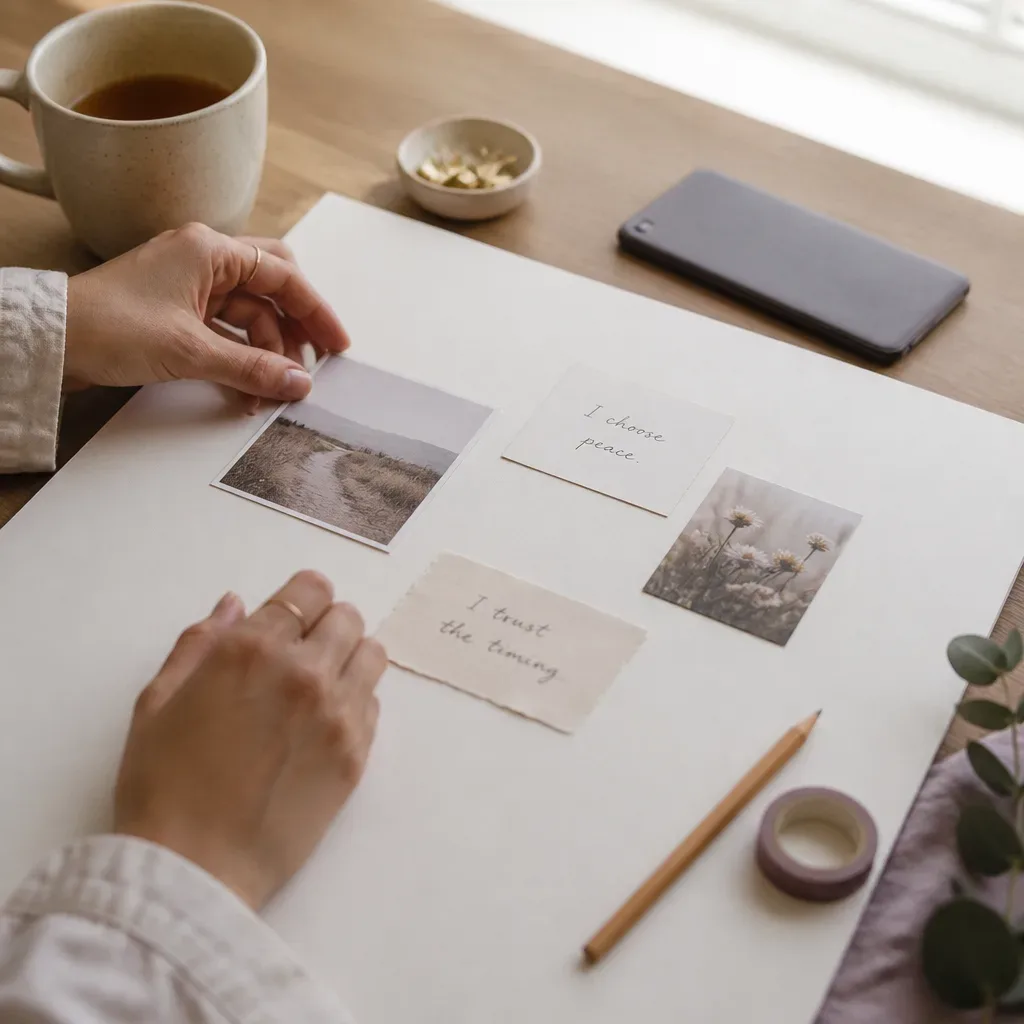
Make the board by moving from intention, to image, to words, to audio, to placement.
Set aside 35 minutes. Not a whole weekend. A shorter container keeps the board honest. Time-boxing is used in design sprints for a reason: limits reduce perfectionism. The Nielsen Norman Group has noted for years that constraint often improves usability because people make clearer choices.
Use this sequence:
- Write 3 to 5 intentions. Choose areas such as health, work, love, money, home, creativity, or spiritual practice. Keep each one under 12 words.
- Choose 10 to 20 images. Print them, cut them, or save them digitally. Do not exceed 25.
- Add 5 to 8 short lines. Use present tense. Use your own speech.
- Create one future-self audio. Make it 2 to 5 minutes. Speak from the self who is already living the board.
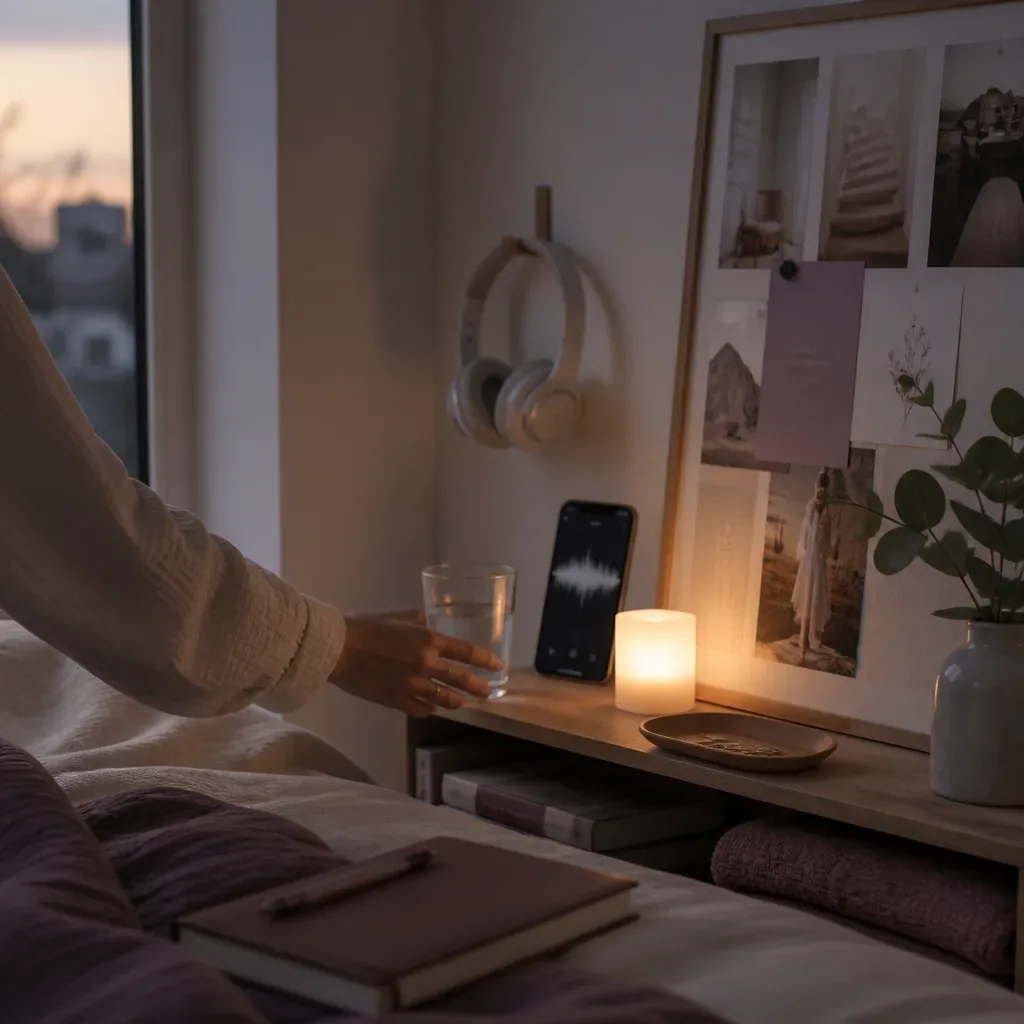
- Place the board near the listening place. Bedside, desk, mirror, altar shelf, or phone wallpaper.
- Listen once daily for 7 days. Then adjust what feels false.
If you use Aya, the board can sit beside the AYA Method as a visual companion. You listen to the Dream-Self Moment first. Then you look at the board for 30 to 60 seconds. This order matters. The voice gives the board warmth before the eyes begin to scan.
A 2022 review in Behavior Research and Therapy noted that imagery-based techniques can affect emotion more strongly when the scene is vivid and personally meaningful. So keep your audio concrete. Say the room. Say the time. Say what your hand touches. Say what you choose next.
One future sentence is better than twenty borrowed slogans.
Where should the board live after you make it?
Place the board where it can be seen without becoming background noise.
A board hidden in a folder may be too easy to forget. A board placed where you stare all day may become invisible after a week. Psychologists call this habituation: repeated exposure to the same stimulus can reduce response over time. The fix is not more intensity. The fix is ritual.
Choose one daily meeting place. A small board beside headphones. A digital board that appears only during your morning practice. A notebook spread you open before bed. The place should say, quietly, “Return now.”
You can also bring timing into it. In a 2009 study in the European Journal of Social Psychology, Phillippa Lally and colleagues found that habit formation varied widely, with an average of 66 days for a behavior to become more automatic. That number is not a promise. It is a reminder to give repetition a real runway.
Try this rhythm for the first month:
| Week | Practice | What to notice |
|---|---|---|
| 1 | Listen daily and look for 30 seconds | Which images feel alive |
| 2 | Add one tiny action after listening | What you resist |
| 3 | Remove one false image | What feels quieter afterward |
| 4 | Rewrite one line in your real voice | What becomes easier to repeat |
You can pair this with astrology and manifestation if lunar timing helps you notice cycles. Just do not let timing become avoidance. The board does not need a perfect day. It needs a repeated one.
How do you know when to revise the board?
Revise the board when it starts describing who you used to perform, not who you are becoming.
Once a month is enough. Put 15 minutes on the calendar. Look at each image and ask, “Is this still true?” Not exciting. Not impressive. True. If your body tightens every time you see one image, listen. The board may be holding an old idea of approval.
This is where many people mistake consistency for rigidity. You are allowed to edit. Architects revise drawings dozens of times before a building stands. The revision is not failure. It is contact with reality. In design practice, a drawing that cannot change is usually not finished. It is just defended.
Use 4 checks:
- Truth: Does this image still belong to me?
- Clarity: Do I know what action it points to?
- Scale: Is this desire sized for my real life now?
- Tenderness: Does this future include care for my current self?
The Princeton Engineering Anomalies Research lab and later Global Consciousness Project work are often mentioned in manifestation circles, but the evidence remains debated. You do not need disputed science to make a careful board. You need attention, repetition, emotional honesty, and action that can be practiced this week.
Keep what still opens. Remove what asks you to abandon yourself. Add what your life has quietly begun to prove.
For a fuller frame, keep the board connected to manifestation, and let affirmations stay simple when words help. If the sky has meaning for you, astrology and manifestation can offer timing. Still, return to the sound. Return to the Dream-Self Moment.
Let the room hear who you’re becoming.
Listen on Aya
