love manifestation
Manifest Love After Breakup With Future-Self Audio
Learn how to manifest love after breakup with a 3-minute future-self audio practice that steadies your nervous system and keeps desire honest.

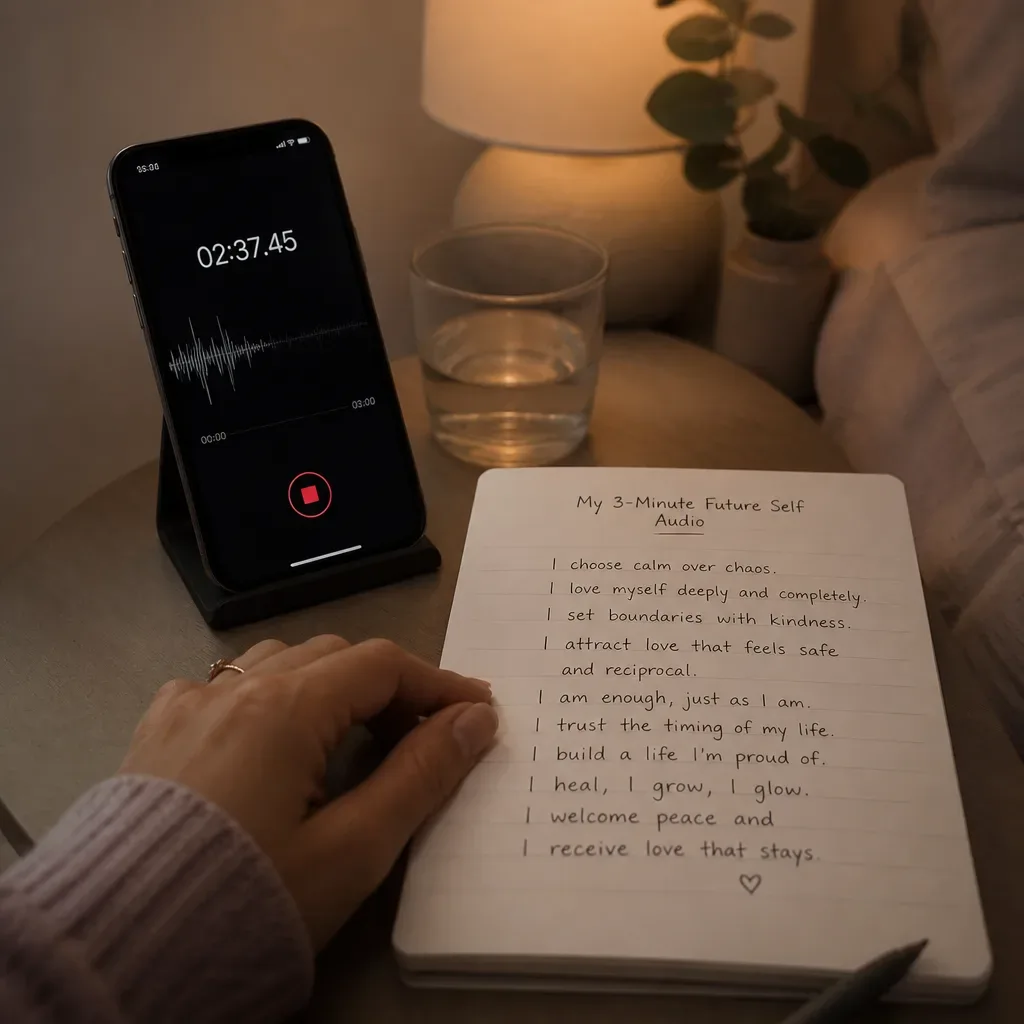
The phone is face down. Your chest still knows the old name. To manifest love after breakup, use a 3-minute future-self audio that rehearses being loved safely, not being chosen by someone at any cost. The practice is small: listen daily, soften the story, then act from the love you are becoming.
Can you manifest love after a breakup without losing yourself?
Yes, you can manifest love after a breakup by making love the focus, not panic.
Breakup pain is not proof that you chose wrong, or that you are hard to love. It is proof that attachment leaves traces in the body. In a 2010 fMRI study led by Helen Fisher, people who had been recently rejected showed brain activity in reward and craving circuits when they viewed an ex-partner’s photo. That is why longing can feel like instruction. It is not always instruction. Sometimes it is a nervous system asking for a familiar door.
Manifestation after heartbreak has to be cleaner than fantasy. It cannot be a way to stalk the past in prettier language. If you are using the practice to count signs, decode silence, or keep yourself suspended, the practice has become another version of waiting. Love does not ask you to disappear while you hope someone returns.
The quiet shift is this: manifest the conditions of love before you manifest the face. Mutual care. Clear speech. A body that can rest. A relationship that is visible in daylight. A 2021 Pew Research Center report found that 3 in 10 U.S. adults had used a dating site or app, which means many people meet love through choice, timing, and repeated social contact, not fate alone. Your practice should help you make better choices inside that real world.
The love you manifest after a breakup has to include you, or it is only longing with candles around it.
If you need a broader base for the practice, read the Manifestation pillar slowly. Then come back here. This page is narrower. It is about the first tender weeks when desire is loud and dignity needs a chair beside it.
Why does a 3-minute future-self audio work better than overthinking?
A 3-minute future-self audio works because it gives your attention one steady place to return.
Overthinking after a breakup often pretends to be healing. You replay the last message. You review the last dinner. You build 12 alternate endings before breakfast. Rumination has been studied for decades; psychologist Susan Nolen-Hoeksema linked repetitive negative thinking with longer depressive episodes in work published across the 1990s and 2000s. Your mind is trying to solve pain by touching it again and again. But touch is not always repair.
Audio is different because it moves through time. You do not stare at one sentence until it hardens. You listen, receive, and let the voice carry you forward. Three minutes is long enough to create a scene and short enough not to become another task. In Stanford behavior researcher BJ Fogg’s model, tiny actions work because they reduce friction. A practice that can be completed in 180 seconds has a better chance of surviving a hard week.
The future-self frame matters too. You are not begging the present to prove you are lovable. You are borrowing the tone of the self who already knows. Mental rehearsal is common in sports psychology, and meta-analyses have found imagery can improve performance when paired with action. Love is not a performance, of course. Still, the nervous system learns through repeated inner scenes.
Here is the distinction:
| Breakup rumination | Future-self audio |
|---|---|
| Replays what happened | Rehearses how you are loved now |
| Searches for blame | Names safety and choice |
| Keeps the ex as the center | Returns you to your own body |
| Often lasts 20 minutes or more | Ends in 3 minutes |
The AYA Method is a daily audio manifestation practice. Each day you listen to a short personalized recording — your Dream-Self Moment — narrated from the version of you who has already manifested the life you intend. Listening is the practice. Repetition is the work. The audio is the method. You can learn the full practice through the AYA Method, but the center is simple: you listen to the self who remembers what is already yours.
What should your future-self audio say after heartbreak?
Your future-self audio should say what real love feels like in your body, your day, and your choices.
Do not begin with a person’s name. Begin with a state of being that would still be true if the person changed. This keeps the practice ethical and steadier. A useful 3-minute script has 5 parts, and each part can be only 2 or 3 sentences. Research on implementation intentions by Peter Gollwitzer, first widely cited in 1999, shows that specific if-then plans can increase follow-through. Specificity matters. It gives desire a place to live.
Try this structure:
- Name the present without drama. I am healing. I am not late. My heart is sore, and I am here.
- Enter the future self. I wake in a life where love is mutual, calm, and spoken clearly.
- Show one ordinary scene. There is coffee on the counter. A kind message waits. I do not check for proof.
- Name one boundary. I do not chase silence. I do not shrink to be chosen.
- Close with one matched action. Today I eat, rest, answer slowly, and let love meet me where I am.
You can add a daily affirmation after the audio if you want. Keep it as a complement, not the center. If you want help choosing language that does not feel false, the Affirmations pillar gives a quieter way to write sentences your body can believe. One true sentence is better than 20 polished ones you secretly reject.
A future-self audio is not a spell against loneliness. It is a rehearsal for not abandoning yourself inside loneliness.
If saying I am loved feels too far away, soften it. Say, I am learning to receive love that is calm. Say, I am no longer training my body to call uncertainty romance. In small studies of self-affirmation, including work summarized by Cohen and Sherman in the Annual Review of Psychology in 2014, values-based statements helped people respond with less defensiveness under stress. The words do not need to be grand. They need to be usable.
How do you make the 3-minute practice feel safe in the body?
You make it safe by pairing the audio with breath, posture, and a clear ending.
Heartbreak can put the body on watch. Sleep changes. Appetite changes. Your thumb moves toward the phone before thought arrives. The American Psychological Association has reported that social rejection can activate pain-related brain regions, and Naomi Eisenberger’s work at UCLA is often cited in this area. That does not mean heartbreak is only in your head. It means your body deserves a method gentle enough to repeat.
Before you press play, place one hand on your chest or your lower ribs. Take 3 slower exhales. Dr. Andrew Huberman often teaches the physiological sigh, a double inhale followed by a long exhale, as a fast way to reduce arousal; a 2023 Cell Reports Medicine study from Stanford researchers found cyclic sighing improved mood and reduced respiratory rate more than mindfulness meditation in a short daily protocol. You do not have to perform calm. Just give the body a signal.
Use a closed container:
- Same place, when possible
- Same length, 3 minutes
- Same opening breath
- Same ending phrase
- One small action after listening
The ending matters. After the audio, say: This is complete for today. Then do something physical. Wash a cup. Step outside for 2 minutes. Put both feet on the floor. A 2020 review in Frontiers in Psychology noted that grounding techniques are commonly used to reduce distress, though evidence quality varies. The point is not perfection. It is contact.
Do not listen while scrolling through old photos. Do not listen while waiting for a message. Do not listen as a test. The practice loses tenderness when it becomes surveillance.
If grief comes up, let it. Crying does not mean the audio failed. It may mean the body finally believed it was safe enough to stop holding its breath.
What should you do after listening so manifestation becomes real behavior?
After listening, take one small action that matches the love your future self described.
Manifestation becomes clearer when it changes your next ordinary choice. This is where many people get lost. They listen, feel soft for a moment, then return to the same loop: checking, comparing, bargaining, disappearing. The audio opens the door. Your behavior walks through it. In habit research published in the European Journal of Social Psychology in 2009, Phillippa Lally and colleagues found that habit formation took 66 days on average, with wide variation. Repetition is not decorative. It is the work.
Choose one matched action from the list below:
- Drink water before checking your phone.
- Wait 10 minutes before replying to a triggering message.
- Write one sentence about what you actually need.
- Delete one screenshot that keeps reopening the wound.
- Text a friend instead of asking the past for comfort.
- Go outside for 5 minutes without music.
- Eat something with protein.
- Put your phone in another room for the length of one song.
None of these actions looks dramatic. That is the point. Love after breakup often returns first as self-respect in a very small outfit.
You may also keep a Manifestation Board in the app as a visual complement. Let it hold images of mutuality: two cups, clean sheets, a street you like, a table with room for another person. The board is not the method. The audio is. The board simply gives your eyes something true to remember.

If you are drawn to timing, moon phases, or birth-chart language, keep it light and choice-based. Astrology and manifestation can be a mirror, not a command. No chart should tell you to wait where your body is asking for care.
The sign you are healing is not that you stop wanting love. It is that you stop using longing as a reason to leave yourself.
How long should you practice before you look for signs of change?
Practice for 21 days before you judge the audio, and watch behavior more than signs.
Twenty-one days is not a magic number. The often-repeated 21-day habit claim is older and too simple; Lally’s 2009 study found many habits took longer. But 21 days is long enough to gather evidence without making the practice feel endless. It gives you 63 minutes of listening. Just over one hour. That is small enough to begin and large enough to notice a pattern.
Track only 3 things:
- Did I listen today?
- Did my body soften by even 5 percent?
- Did I take one matched action?
Do not track whether someone viewed your story. Do not track angel numbers if they make you more anxious. Do not turn the practice into court evidence for whether love is coming. If you want a wider language for desire, how manifestation works is a useful place to return. But here, after heartbreak, the measure is quieter. Are you choosing less from fear? Are you telling the truth sooner? Are you able to imagine being loved without immediately picturing loss?
A 2018 study by Sandra Langeslag and Michelle Sanchez found that cognitive strategies could reduce feelings of love after a breakup in the short term, though negative mood sometimes increased. That makes sense. Healing can hurt while it helps. Your audio should not erase grief. It should make grief less likely to drive the car.
If you miss a day, do not restart with punishment. Listen the next day. That is all. A practice that cannot survive being human will not help a human heart.
When is manifesting love after a breakup not enough on its own?
Manifesting love after a breakup is not enough when you are unsafe, unable to function, or caught in repeated harm.
There are moments when a 3-minute audio is a support, not a substitute. If the relationship involved coercion, threats, stalking, physical harm, or chronic emotional cruelty, bring in real help. In the United States, the National Domestic Violence Hotline reports that more than 12 million people are affected by intimate partner violence each year. If that is close to your story, manifestation should not ask you to stay mystical about danger. Safety comes first.
Support can look ordinary. A therapist. A trusted friend. A doctor. A local hotline. A written plan for no contact. If you are not sleeping for several nights, cannot eat, feel at risk of hurting yourself, or feel unable to work or care for children, please tell someone real and trained. The practice can sit beside care. It should never replace it.
There is also the quieter case: you are not in danger, but you are addicted to checking. If the audio becomes another way to keep the bond alive, pause and simplify. Listen only to words about your body, your home, your next day. Leave romance out for a week. A 2014 paper in the Journal of Behavioral Addictions discussed how compulsive online checking can share features with behavioral addiction, though the field uses careful language. Your thumb may need boundaries before your heart can hear anything new.
For love-specific practice beyond this breakup moment, keep reading through love manifestation and return to the AYA Method when you want the audio to hold the center. One recording. One day. One self you do not abandon.
Let the next three minutes be kind.
Listen on Aya

