love manifestation
Manifesting a Soulmate with 3-Minute Audio
Manifesting a soulmate can begin with a 3-minute audio that helps you rehearse new standards, calmer choices, and real love daily.

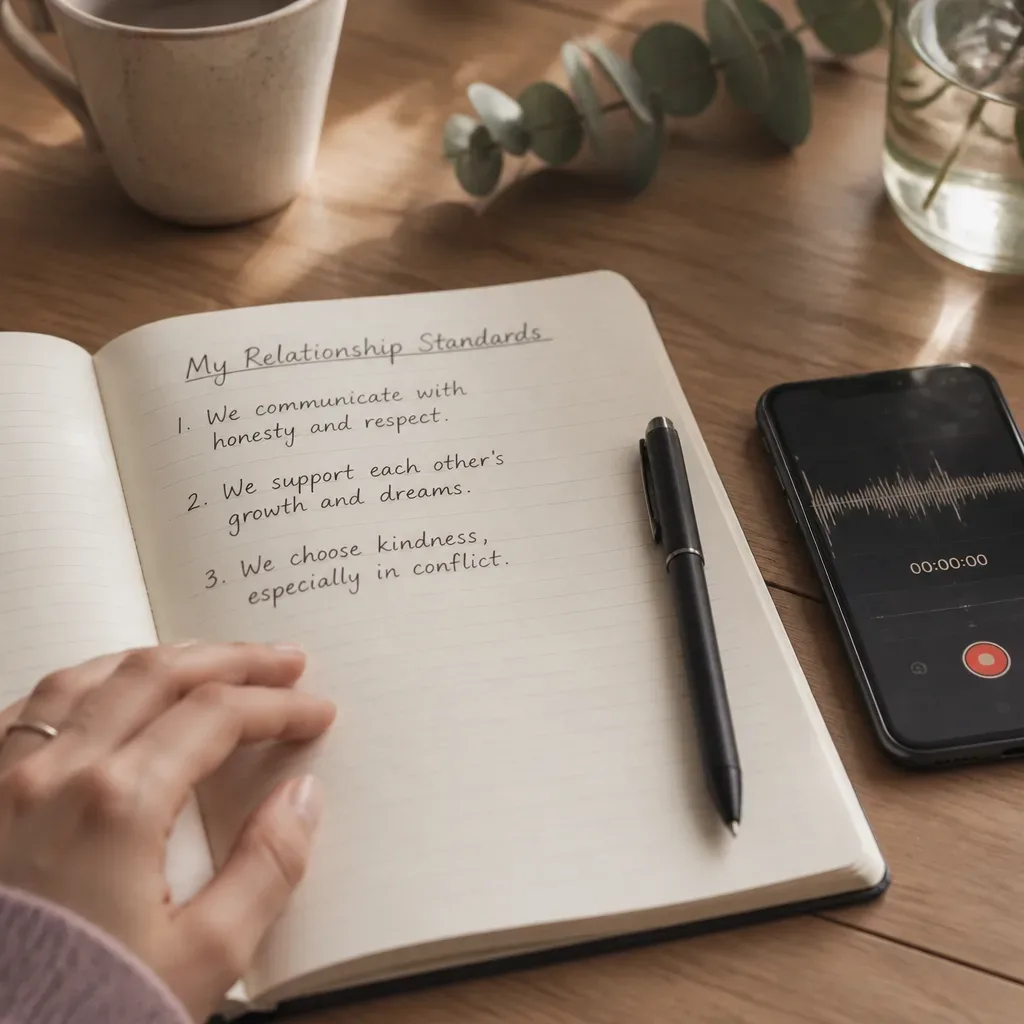
The phone is face down. Your tea is cooling. Manifesting a soulmate starts with three minutes of audio that rehearses better standards, not with chasing signs. You listen to your future self speak as someone already loved well. Then you make one small choice that agrees with what you heard.
What does manifesting a soulmate really ask of you?
Manifesting a soulmate asks you to become honest about the love you can receive and the treatment you won’t normalize anymore.
The word soulmate can get loud. It can make you picture one perfect person, one fated message, one door opening at exactly 8:08. Quiet it down. For this practice, soulmate means a relationship that meets you with mutual care, real desire, respect, and staying power. Not fantasy. Not guessing. Not the ache of being almost chosen.
Psychologist John Gottman has studied couples for more than 40 years, and his research often returns to small repeated behaviors: turning toward, repairing, listening, and showing respect. Love is not only a lightning feeling. It is a pattern. If you want a different pattern, you need a daily rehearsal that is short enough to repeat when life is ordinary.
This is where the AYA Method enters quietly. The AYA Method is a daily audio manifestation practice. Each day you listen to a short personalized recording — your Dream-Self Moment — narrated from the version of you who has already manifested the life you intend. Listening is the practice. Repetition is the work. The audio is the method.
Manifesting a soulmate, then, isn’t a way to override another person’s will. It’s a way to stop overriding your own knowing. A three-minute recording gives your mind a place to return. Neuroscientist Dr. Andrew Huberman has often noted that attention and repetition are central to neuroplasticity; the brain changes through repeated signals, not rare dramatic declarations.
The love you keep rehearsing becomes the love you can recognize.
Why use only three minutes of audio?
Three minutes is enough because the practice works through repetition, emotional specificity, and daily return, not through length.
A long practice can be beautiful. It can also become another thing you postpone. Three minutes is the size of a song, a kettle boil, a short walk to the corner. It asks less from your schedule and more from your sincerity. That matters. In a 2009 University College London study, Phillippa Lally and colleagues found that habits took 18 to 254 days to become automatic, with 66 days as the average. The daily repeat mattered more than the heroic start.
Your audio should not be a lecture. It should sound like someone who knows you well and isn’t impressed by your old panic. It might say: “You don’t prove your worth by waiting for unclear love. You choose the person who meets you in daylight. You answer warmth with warmth. You leave confusion alone.”
If you’ve used manifestation as a wish list before, this will feel smaller and more exact. Good. The smaller the practice, the harder it is to hide from it. A vague wish can stay pretty for years. A daily recording asks what you’ll do after you listen.
Use this simple structure:
| Minute | What to include | Example |
|---|---|---|
| 0:00–1:00 | Name the old pattern gently | “You don’t chase silence anymore.” |
| 1:00–2:00 | Speak from the new standard | “Love is clear, mutual, and kind.” |
| 2:00–3:00 | Give one today-sized instruction | “Today, choose the calm reply.” |
Three minutes is not less serious. It is more repeatable.
How do you write the soulmate audio script?
Write the script as a message from your future self, using present-tense standards that feel true enough for your body to believe.
Start with paper if you can. The body slows down when the hand moves. A 2014 study by Mueller and Oppenheimer found that longhand note-taking can support deeper processing than typing, partly because you can’t write every word. You have to choose. That is useful here. You are choosing the emotional laws of your love life.
Don’t begin with the other person. Begin with you. Not because you are the only person who matters, but because you are the only person you can practice being. Neville Goddard taught from the idea of living from the fulfilled state. In plain language: don’t beg from the doorway. Speak from inside the home.
A good soulmate script has three parts:
- Recognition. Name the old habit without shame. “You used to confuse intensity with intimacy.”
- Standard. Say what is now normal. “You are loved with consistency, humor, honesty, and touch that feels safe.”
- Instruction. Give today’s one action. “You don’t text from fear. You answer when you’re clear.”
Keep the words concrete. “Emotionally available” is useful, but give it a face. It means they call when they say they will. It means you can ask a hard question without being punished. It means attraction doesn’t cost you your peace.
You can add one daily affirmation after the audio, but remember the order. The audio is the method. The affirmation is a complement. If you want a fuller primer, affirmations can help you make the lines believable without turning them into a performance.
What should you avoid saying in soulmate manifestation?
Avoid scripting control, obsession, revenge, or a specific person’s surrender; those lines usually keep you attached to the wound.
There is a difference between devotion and fixation. Devotion makes you cleaner. Fixation makes you smaller. If your audio is full of one person’s name, one outcome, or one imagined apology, pause. You may be rehearsing the old bond, not the new standard.
Pew Research Center reported in 2023 that about 3 in 10 U.S. adults have used a dating site or app, and younger adults use them at higher rates. That means modern love often happens inside quick judgments, open tabs, and many half-conversations. Your practice has to protect your attention. It has to remind you that access is not intimacy.
Here are lines to leave out:
- “They can’t stop thinking about me.”
- “They regret losing me every day.”
- “My soulmate has to look exactly like this.”
- “I need proof by Friday.”
- “I am chosen only when someone else finally changes.”
Here are lines that tend to hold better:
- “I choose reciprocal love.”
- “I trust consistency more than intensity.”
- “My body is allowed to feel calm in love.”
- “I don’t audition for closeness.”
- “I recognize devotion by its behavior.”
Joe Dispenza often writes about mentally rehearsing a future state until the body starts to know it as familiar. You don’t have to borrow every part of his framework to use the practical piece: what you rehearse repeatedly becomes easier to access. In small studies on mental imagery, including sport psychology research across several decades, rehearsal has been linked with improved performance when paired with action.
A standard is not a wall. It is a door with a clear handle.
How do you listen so the practice changes your choices?
Listen at the same cue each day, then take one small action that matches the standard you just heard.
The cue matters. Don’t wait until you feel romantic, lonely, or unusually brave. Attach the audio to something boring and stable: brushing your teeth, making coffee, walking to the tram, sitting in the parked car for 180 seconds. BJ Fogg’s behavior model at Stanford emphasizes making new behaviors tiny and tying them to existing prompts. Tiny is not childish. Tiny is how the nervous system learns safety.
When you press play, don’t multitask with dating apps open. Close the other tabs. Put one hand somewhere simple: chest, thigh, mug, steering wheel. Let your future-self voice be the only voice for three minutes. Then ask, “What is the matching action?” Not the grand action. The matching one.
It may be one of these:
- Don’t answer the message that only appears at midnight.
- Tell the kind person you’d like to see them again.
- Stop rereading the thread for hidden meaning.
- Update one line in your dating profile so it sounds like you.
- Go to bed instead of negotiating with absence.
If you track anything, track behavior. A simple seven-day note is enough: “Listened. Chose honesty. Didn’t chase.” In cognitive behavioral therapy, self-monitoring is often used because noticing behavior can change behavior. You don’t need a perfect record. You need evidence that you’re returning.
This is also where the Manifestation Board can be useful as a complement. Add images or words that point to the standard: a kitchen with two cups, a train platform reunion, a handwritten note, two calendars making room. Keep it quiet. The board should remind you, not seduce you away from the practice.
For a wider map of how timing and symbols can support reflection without replacing action, astrology and manifestation may help. The stars can be a mirror. The listening still belongs to you.

How long before you notice a shift?
You may notice a shift in days, but the deeper change usually comes from several weeks of repeated listening and matching behavior.
The first shift is often not romantic. It is quieter. You don’t send the paragraph. You don’t explain your softness to someone careless with it. You feel bored by the familiar ache. That boredom is not failure. It may be the first sign that your body is done confusing anxiety with love.
Give the practice 21 days if you need a beginning, and 66 days if you want a fair test. The 21-day number is popular, but the stronger habit research is more nuanced. Lally’s 2009 study found wide variation, which is comforting. Some nervous systems need more repeats. Some standards take time because they ask you to grieve what you once accepted.
Use a simple review every Sunday:
| Question | What to look for |
|---|---|
| Did I listen at least 5 days? | Repetition, not perfection |
| Did I choose one clearer action? | A behavior, not a mood |
| Did I feel less pulled by old chaos? | Even 5 percent counts |
| Did I meet life halfway? | Messages, invitations, honesty |
Be careful with signs. A song, a number, or a dream can feel tender, but it should not outrank behavior. If someone is inconsistent for 6 weeks, your audio should make that easier to see, not harder. Real love becomes more real when it can survive daylight.
The sign is not that they appeared. The sign is that you stopped abandoning yourself while you waited.
If you want more grounding around the wider practice, return to the manifestation guide when your mind starts making the process huge. Big claims can make you freeze. Small daily listening gives you somewhere to stand.
What if you feel silly, doubtful, or tender while doing it?
Feeling silly doesn’t mean the practice is false; it often means you’re speaking to a part of you that has been underfed.
Most new practices feel theatrical for the first few days. You are hearing your own recorded voice, or a personalized narration, speak with certainty about something that has hurt. Of course part of you may roll its eyes. Let it. Doubt can sit in the room. It doesn’t get to hold the script.
In compassion-focused therapy, developed by Paul Gilbert, the tone of the inner voice matters. A harsh inner voice can keep threat systems active; a warmer voice can help the body feel safer. That is one reason audio matters here. You are not only reading a sentence. You are hearing tone, pacing, and care. The voice gets under the argument.
Try this when resistance rises:
- Lower the claim until it feels believable.
- Replace “I have my soulmate now” with “I am practicing the standards of real love now.”
- Keep one hand on the body while listening.
- Repeat the same audio for 7 days before editing.
- After listening, do one ordinary thing slowly.
You don’t have to feel certain. You have to stay honest. There is a difference. Certainty can become another costume. Honesty can whisper, “I want love that doesn’t make me disappear,” and that may be enough for today.
The AYA Method is built for this kind of return: short personalized audio, heard daily, from the self who already knows how life can feel when the intended thing is real. For soulmate work, the Dream-Self Moment becomes a rehearsal of clean love. The app also includes a daily affirmation and Manifestation Board, but those support the listening. They do not replace it.
You don’t need to become magnetic. You need to become less available for what erases you.
Here is a plain 3-minute script you can record tonight:
“I’m here. I know what love used to feel like when I had to earn it. That is not the home now. I am loved with consistency, warmth, honesty, and ease. I choose the person who shows up in words and behavior. I don’t shrink to keep attention. I don’t confuse longing with truth. Today I answer what is clear. I leave what is cloudy alone. I am already becoming someone who can receive steady love.”
Listen tomorrow. Same cup. Same chair. Same three minutes.
The quiet knows where to find you.
Listen on Aya

