manifestation for life areas
Manifesting Friends with 3-Minute Future-Self Audio
Manifesting friends can be quiet: listen to a 3-minute future-self audio, settle your body, then reach out with one clear, true message.

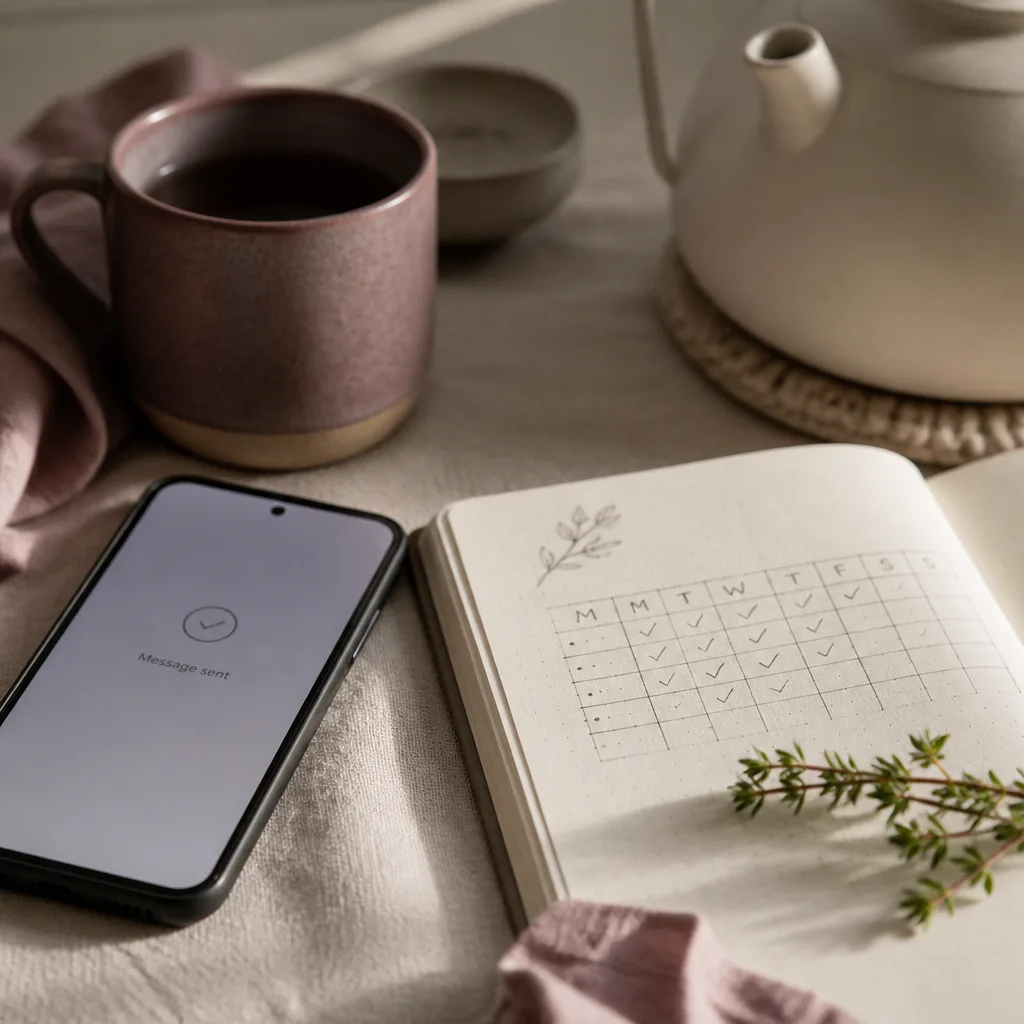
The phone is face down beside your tea. Manifesting friends starts there: you listen to a 3-minute future-self audio, let your body remember belonging, then send one small, specific message. The practice is not to force closeness. It is to reach out as someone who is already welcome.
Why listen before you reach out?
You listen first because your message changes when your body no longer believes it has to audition.
Friendship is not made by one perfect text. It is made by repeated, ordinary signals of safety. Robin Dunbar’s social brain research often names about 150 as the rough number of stable social relationships a person can maintain, with smaller inner circles nested inside that number. That means friendship has shape. It has limits. It also has room.
When you are lonely, even a kind message can come out tightened. The U.S. Surgeon General’s 2023 advisory reported that social disconnection is associated with a 29% increased risk of heart disease and a 32% increased risk of stroke. Those numbers are not here to frighten you. They are here to tell the truth: the body treats belonging as real medicine.
A future-self audio gives you a brief place to stand before you act. You hear yourself already in a life where friendship is not a performance. Then you send the message from that steadier room.
The audio is not a spell. It is a rehearsal for being real.
This is also where manifestation becomes practical. Not grand. Not glittered. You are not commanding life to bring you people. You are becoming the kind of reachable person who can notice a thread and gently hold it.
What is the 3-minute future-self audio practice?
The practice is a short listening ritual where your future self speaks as if warm friendship is already normal in your life.
The AYA Method is a daily audio manifestation practice. Each day you listen to a short personalized recording — your Dream-Self Moment — narrated from the version of you who has already manifested the life you intend. Listening is the practice. Repetition is the work. The audio is the method.
For manifesting friends, the Dream-Self Moment might be simple. You hear yourself describe a Saturday market walk with someone who knows how you take your coffee. Or a Tuesday voice note that does not feel like a test. Or the quiet ease of being included without having to become louder.
Keep it to 3 minutes before a reach-out. In 2023, Balban and colleagues published a Cell Reports Medicine study showing that 5 minutes a day of cyclic sighing improved mood and reduced breathing rate more than mindfulness meditation in that small trial. Your audio is not the same intervention, but the principle is useful: a short, repeated practice can shift the state you bring into the next act.
A future-self scene works best when it is ordinary. Not a crowd. Not being adored. Just this: someone texts back because you have been kind and clear enough to be known.
You do not manifest friends by becoming more impressive; you become easier to meet.
How do you prepare the scene without making it fake?
You prepare the scene by choosing one believable moment of connection, not a whole new personality.
Start small. Friendship grows through contact, time, and mutual care. Communication researcher Jeffrey Hall estimated in 2019 that it may take around 50 hours for someone to move from acquaintance to casual friend, about 90 hours toward friendship, and more than 200 hours toward close friendship. These numbers are not a rule. They are a mercy. They remind you that closeness usually arrives by accumulation.
Before the audio, choose one scene your body can believe today. If you choose a scene too polished, your nervous system may reject it. If you choose one too empty, it will not give you anything to practice. Aim for a scene that is 5% beyond your current normal.
Use this table as a quiet test:
| If you feel | Choose this future-self scene | Reach out with |
|---|---|---|
| Nervous | A calm walk with one person | A low-pressure check-in |
| Forgotten | Being remembered by name | A message naming a shared memory |
| Too intense | Sitting near others without performing | A simple invitation with an easy exit |
| New in a place | Becoming a familiar face | A repeated small hello |
Neville Goddard wrote in Feeling Is the Secret in 1944 about assuming the feeling of the wish fulfilled. You do not have to accept every claim to use the psychological usefulness of rehearsal. You are letting the body taste a possible normal before you ask it to act.

What exactly should you do in the 3 minutes?
In the 3 minutes, listen, soften, and let one future friendship scene become specific enough to guide your next message.
Set a timer if you need edges. The mind is less dramatic when it knows the container is small. Dr. Andrew Huberman often teaches that breath can alter arousal quickly; one accessible version is the physiological sigh, a double inhale followed by a long exhale. You can do three of those before pressing play.
Then listen without correcting the audio. If a sentence feels too tender, let it pass through. If you feel resistance, that is not failure. Resistance is often just the old social self checking whether it is safe to be seen.
Use this simple sequence:
- Put the phone down, screen away, for 10 seconds.
- Take three slow breaths, longer out than in.
- Play the 3-minute Dream-Self Moment.
- Notice one detail: a table, a laugh, a name, a doorway.
- Send one reach-out within 2 minutes of finishing.
That last part matters. A 2018 paper in Nature Communications on habit formation and behavior change noted that context cues help actions repeat. The cue here is the end of the audio. When the audio ends, the reaching begins.
Do not wait until you feel fearless. Fearlessness is not the doorway. Sincerity is.
The future self does not shout over the shy self. She sits beside her until the message can be sent.
What kind of message should you send after listening?
Send one message that is specific, warm, and easy for the other person to answer.
Most friendship messages fail when they ask for too much too soon or hide the real ask under fog. Pew Research Center reported in 2021 that 31% of U.S. adults said they were online almost constantly. People are reachable, but they are also tired. Clarity is kindness.
Try this shape: name, thread, invitation, softness. Name the person. Name the reason they came to mind. Offer one concrete next step. Leave room. This is not a script for control. It is a script for dignity.
Examples:
- Maya, I thought of you when I saw the jasmine tea at the shop. Would you like to get a cup next week?
- I liked talking with you after class. If you ever want to walk after Wednesday sessions, I would be glad.
- Your comment about old films stayed with me. Want to trade one recommendation each?
- I am trying to be better at not letting good people stay strangers. Would coffee feel nice sometime?
A true invitation does not beg. It opens a door and leaves the handle warm.
If you use affirmations, keep them as a complement after the audio, not the main practice. One line is enough: I can be honest and still be easy to answer. Self-affirmation research reviewed by Cohen and Sherman in 2014 suggests that affirming valued identity can reduce defensiveness under stress. For reaching out, that means you may not need the reply to carry all your worth.
The app also includes a Manifestation Board, which can help you keep visual reminders of the friendships you are tending. But remember the order. Listening first. Seeing and wording after.
How do you keep manifesting friends from becoming pressure?
You keep it gentle by measuring your practice, not another person’s response.
A reply is lovely. No reply is information. Neither one is a verdict on your lovability. Gallup’s 2023 global reporting found that about 1 in 4 adults worldwide felt very or fairly lonely. Many people are carrying quiet social hunger. Some still cannot answer quickly. Some want connection and are bad at tending it.
So track what belongs to you. Did you listen? Did you send one clear message? Did you leave the person free? Did you speak from the self you are practicing, rather than the panic you inherited?
Here is a small weekly record:
| Day | Audio listened? | Reach-out sent? | What felt true? |
|---|---|---|---|
| Monday | Yes | Yes | I was less apologetic |
| Wednesday | Yes | No | I noticed fear without obeying it |
| Friday | Yes | Yes | The message was simple |
Joe Dispenza writes often about mental rehearsal, and many athletes and performers use rehearsal to prepare behavior. That does not prove every metaphysical claim. It does show something grounded: the brain and body practice before the visible act. Friendship can be practiced too.
If you like timing practices, you may also enjoy reading astrology and manifestation as a symbolic way to notice seasons, moods, and thresholds. Use it lightly. The message still has to be sent by your hands.
What should you do after the message is sent?
After the message is sent, return to your own life and let friendship have time to breathe.
Do not stare at the phone as if watching a seed split. Put water on for tea. Walk to the window. Touch something green. In my greenhouse, I do not pull thyme upward to prove it is rooting. I water, I prune, I return the next morning. Social life asks for the same patience.
The American Time Use Survey has repeatedly shown that adults spend only a small part of the day in social and leisure activities compared with work, care, and household tasks. Time is real. If someone replies in 2 days, that can still be care. If someone cannot meet this week, they may still be available later.
Use a 3-part aftercare practice:
- Write one sentence about your own courage.
- Do one grounding act for 60 seconds.
- Do not send a second message for at least 24 hours unless there is a practical reason.
For more structure around visible reminders, you can pair the audio with a simple Manifestation Board. Add images that feel like friendship as lived reality: two mugs, a shared bench, a message thread that feels calm. Keep it honest. The board is a complement. The listening is the method.
If you want a wider frame for life areas, return to the manifestation pillar and read slowly. Manifesting friends is not separate from how you speak, rest, and make room. It is a relational practice with a phone in your hand.
Send the message, then come back to the kettle.