manifestation for life areas
Job Interview Manifestation: Listen Before You Answer
Job interview manifestation can steady your mind before a high-stakes meeting. Learn a quiet audio practice that helps you listen first.

The chair is colder than you expected. Your name may be called in 4 minutes. Job interview manifestation means using a short, repeated inner rehearsal so your body remembers calm before your mouth has to answer. It works best when it sits beside real preparation, not instead of it.
What does job interview manifestation actually do?
Job interview manifestation gives your attention a place to return before fear starts writing the interview for you.
An interview is not only a test of skill. It is also a test of retrieval. You have to remember your work, your examples, your judgment, and your voice while being watched. Cognitive psychologist Sian Beilock has written for years about choking under pressure; one core finding is simple: when attention turns inward in a frightened way, well-practiced skills can become harder to use. That is why your preparation can disappear at the exact moment you need it.
Manifestation, used carefully, is not pretending the job is already yours. It is rehearsing the inner posture of someone who can answer from memory instead of panic. The practice says: I know this room. I know this question. I know how to pause. In a 2009 meta-analysis in Perspectives on Psychological Science, implementation intentions, the small if-then plans people make before a task, showed reliable effects across 94 studies. A cue matters.
For an interview, the cue can be sound. A recording. A remembered sentence. A slow breath before the second question. The brain likes repetition; Dr. Andrew Huberman often describes how repeated attention and emotion help mark neural pathways for future use. You do not need to make it dramatic. You need to make it available.
A good manifestation practice does not make you less honest. It makes you less absent. The room still matters. The hiring manager still asks what they ask. But you arrive with a rehearsed way of meeting it.
The interview is not the first place you answer. It is the first place someone else hears it.
How should you use audio before an interview?
Use audio as a short rehearsal of the self who can listen, pause, and answer without rushing.
The AYA Method is a daily audio manifestation practice. Each day you listen to a short personalized recording — your Dream-Self Moment — narrated from the version of you who has already manifested the life you intend. Listening is the practice. Repetition is the work. The audio is the method.
For a job interview, this matters because sound reaches the body differently than a written note. A 2014 review in Frontiers in Psychology discussed how auditory cues can shape attention and emotion; anyone who has heard an old song and remembered a whole room knows this in ordinary life. The point is not that audio is magic. The point is that audio is intimate. It can become familiar.
Your Dream-Self Moment might speak from after the interview, not before it. She is not boasting. She is describing. She says how you sat down. How you took the first question. How you did not fill every silence. How you told the truth about the project that failed and what you changed after it. One study from the University of Chicago found that students who wrote about test anxiety before an exam improved scores compared with controls; naming pressure can reduce its grip.
If you want the wider frame for this practice, read the manifestation pillar. For this room, keep the frame smaller. Five minutes is enough. Listen the night before. Listen while dressed. Listen once more, if you can, before the call opens.
You are not trying to become someone else. You are remembering the self who can stay in the chair.
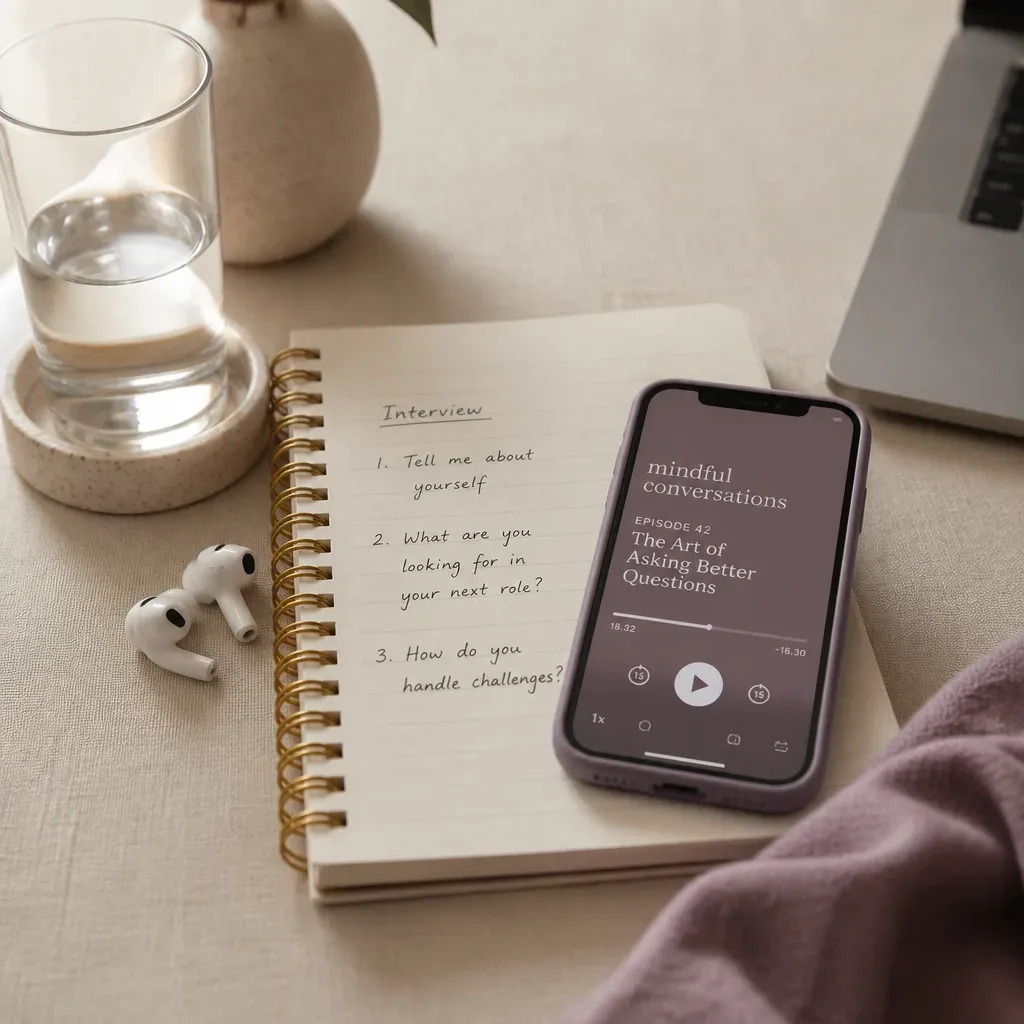
What should you prepare before you listen?
Prepare the facts first, then let manifestation give those facts a calmer home.
The quiet mistake is using inner work to avoid outer work. Do not do that. The U.S. Bureau of Labor Statistics reported that job openings and hires can shift by hundreds of thousands month to month; hiring is real, uneven, and often slow. You meet it better when you know the role, the company, and your own proof.
Before you listen, make a small page. Not a script. A page. Include the 3 things you most want them to know, the 2 questions you want to ask, and the 1 story you can tell if your mind goes blank. This is enough structure for many interviews, especially first rounds that last 30 to 45 minutes.
Try this 6-step preparation sequence:
- Read the job description and underline the repeated words.
- Choose 3 work stories that match those words.
- Write each story in situation, action, result, lesson.
- Name the question that scares you most.
- Write one honest first sentence for that question.
- Listen to your audio after the page is made.
This order matters. Your audio should not be a cloud. It should have architecture. I say that as someone who spent 12 years drawing buildings: a room holds you because someone decided where the walls go. Your mind needs a few walls too.
Use affirmations only where they stay true. I am fully qualified may feel false if you are changing fields. I can speak clearly about what I have done may land better. The nervous system often accepts a modest sentence before it accepts a grand one.
Truth is stronger when your body can believe it.
How do you answer with more calm in the room?
You answer with more calm by listening to the full question before choosing your first sentence.
Most people answer too early. They hear the first half of the question and start building a response while the interviewer is still speaking. That habit feels efficient, but it often creates a thin answer. Research on active listening in workplace communication has long shown that paraphrasing and pausing improve perceived understanding; even a 2-second pause can change the pace of a conversation.
Use a simple interview rhythm:
| Moment | Quiet action | Why it helps |
|---|---|---|
| Question begins | Look at the speaker and listen to the end | You stop guessing too soon |
| Question ends | Breathe once | You give working memory a second |
| First sentence | Answer the actual question | You build trust quickly |
| Example | Give one clean story | You make the claim visible |
| Close | Name the lesson or result | You show judgment |
This is not theatrical. It is respectful. If the interviewer asks, Tell me about a time you handled conflict, do not begin with your entire philosophy of teamwork. Begin with the room. One sentence. In my last role, I had to reset expectations with a senior designer after a missed deadline. Then give the structure.
The STAR method is useful because it reduces strain: situation, task, action, result. But add one more piece: what you know now. A 2022 LinkedIn report found that recruiters continue to rank communication among the most in-demand skills. Communication is not smoothness. It is making your thinking easy to follow.
You may also say, I want to answer that carefully. Give me a second. That sentence is allowed. Silence is not failure. Silence is a door handle.
What if the interview triggers old fear?
If the interview triggers old fear, treat the fear as a signal to slow down rather than as proof you are not ready.
Interviews wake old rooms. The teacher who interrupted you. The parent who asked why the score was not higher. The manager who made every mistake feel final. Your body may not know that this is a new Tuesday with a new person on a screen. The American Psychological Association has reported that stress can narrow attention and increase physical symptoms like a faster heart rate. A job interview can become a body event before it becomes a career event.
This is where job interview manifestation has to be gentle. Do not command yourself to be confident. Start smaller. Say: I can feel fear and still hear the question. I can pause. I can ask for the question to be repeated. These lines are not glamorous. They are usable.
You can also borrow timing from breathing research. Slow breathing around 6 breaths per minute has been studied for heart-rate variability, including in a 2017 review in Frontiers in Human Neuroscience. You do not need a perfect protocol. Before the interview, take 5 slower breaths. Let the exhale be a little longer than the inhale. Then listen to your cue sentence once.
A few grounded phrases that often work:
- I do not have to rush to be taken seriously.
- I can answer the question that was asked.
- My work history is still mine under pressure.
- I am allowed to need one breath.
- I can be honest without shrinking.
If you use astrology and manifestation as reflective language, keep it supportive, not fatal. A difficult transit is not a verdict. A chart is not an interviewer. Use any symbolic system to notice timing and temperament, then return to preparation.

What should you do in the last 10 minutes before the interview?
In the last 10 minutes, stop adding information and start reducing noise.
The mind will ask for one more tab, one more company review, one more salary forum. Usually, that is fear wearing glasses. A 2018 Pew Research Center report found that many adults feel overloaded by information in digital life; before an interview, overload can make you less clear, not more ready. Close the tabs.
Use this last 10-minute ritual:
- Ten minutes out: read only your 3 main points.
- Seven minutes out: listen to your Dream-Self Moment or a short audio cue.
- Four minutes out: place both feet on the floor and soften your jaw.
- Two minutes out: say your first sentence for the most likely opening question.
- Thirty seconds out: stop rehearsing. Let the room be quiet.
If it is a video interview, check the practical things earlier. Camera. Battery. Link. Water. The final minutes are not for troubleshooting unless something truly breaks. The average first-round interview often runs 30 minutes, and the opening 3 minutes can set tone fast. You want to meet those minutes with attention, not frantic clicking.
This is also a good place to use a single affirmation if you like one. Keep it plain. I can listen before I answer. The app may also include a daily affirmation and a Manifestation Board, but they are complements. The audio is the practice here. The listening is what trains the return.
Calm is not the absence of stakes. It is the presence of a return.
How do you keep the practice honest after the interview?
After the interview, keep the practice honest by reviewing what happened without turning every silence into a prophecy.
Write notes within 15 minutes if you can. Memory fades quickly; Hermann Ebbinghaus first described the forgetting curve in the 1880s, and later research keeps confirming the basic truth that recall changes with time. Write what they asked. Write where you were clear. Write where you wandered. Write the follow-up you promised.
Then separate three things:
- What you controlled: preparation, listening, examples, follow-up.
- What you influenced: rapport, clarity, pacing.
- What you did not control: internal hiring priorities, budgets, other candidates.
This separation protects the practice from superstition. Manifestation is not a way to claim control over every outcome. It is a way to practice the self you want to bring to the outcome. If the answer is no, you still get data. If the answer is yes, you still stay human.
You can return to the manifestation pillar when you need a larger explanation of the practice, and to the AYA Method when you want the daily audio form. For interviews, the instruction stays small: listen before you answer.
One more thing. Do not rewrite the whole meeting from fear. If you stumbled once, let it be once. If you needed water, let it be water. A 2020 paper in Nature Human Behaviour noted that people often mispredict how others judge them in social settings. The interviewer may remember your clear example, not the sentence you keep replaying.
Send the thank-you note. Eat something. Return to your day.
Listen. Then let the next room find you here.
Listen on Aya
