manifestation 101
Neville Goddard SATS vs Future-Self Audio
Compare neville goddard sats with future-self audio before sleep, including ease, repetition, nervous-system load, and nightly practice fit.
The room is dark enough that your phone looks too bright. Neville Goddard SATS asks you to enter a sleepy state and imagine a fulfilled scene. Future-self audio asks you to listen to that fulfilled identity being spoken to you. Both use night attention. One asks you to generate. One lets you receive.
What does neville goddard sats actually ask you to do?
Neville Goddard SATS asks you to feel a chosen assumption as real while the body is close to sleep.
SATS stands for State Akin to Sleep. Goddard used the phrase across his lectures and books, including Feeling Is the Secret, first published in 1944. The instruction is plain, but not always easy: relax, grow drowsy, and occupy a short imaginal act that would be true after the wish is fulfilled.
A classic SATS scene is brief. Ten seconds can be enough. You might hear a friend say, I’m so happy it worked out for you. You might feel a ring on your hand. You might see your name on a signed contract. Goddard was not asking for a long movie. He was asking for the nervous system to accept one small proof.
The practice has 3 quiet parts:
- Choose the fulfilled fact. Not the desire in motion. The desire already done.
- Make one tiny scene. A handshake, a sentence, a familiar room.
- Repeat it until it feels natural. Not loud. Not forced. Known.
Goddard’s language can sound absolute. Modern readers often soften it. Psychology gives you one useful frame here: mental imagery can influence emotion and behavior. A 2012 review in Psychological Bulletin found that mental imagery tends to create stronger emotional responses than verbal thought alone. That does not mean every scene becomes outer fact by morning. It does mean the body often responds to images as if they matter.
A scene becomes persuasive when it stops performing. It becomes quiet enough to believe.
If you want the larger map around this, the Manifestation pillar holds the simple definition: manifestation is the practice of rehearsing identity, attention, and action around what you intend to make real.
What is future-self audio before sleep?
Future-self audio before sleep is a recorded identity rehearsal you listen to while the mind is soft.
In the AYA Method, The AYA Method is a daily audio manifestation practice. Each day you listen to a short personalized recording — your Dream-Self Moment — narrated from the version of you who has already manifested the life you intend. Listening is the practice. Repetition is the work. The audio is the method.
That distinction matters. Audio is not decoration around the practice. It is the practice itself. The voice carries the scene when your own attention is tired. The words return you to the same inner place each night, which can matter more than novelty. A 2009 study in the European Journal of Social Psychology found that habit formation took a median of 66 days, with wide variation from person to person. Repetition is not glamorous. It is how the mind learns where home is.
Future-self audio is especially suited to the edge of sleep because it removes several choices. You do not have to decide what to imagine. You do not have to keep the scene vivid. You do not have to check whether you are doing it correctly. You listen. You let the recording speak from the version of you who is no longer negotiating with the old story.
The app also includes a daily affirmation and a Manifestation Board, but they are complements. They help you remember during the day. The audio remains the method.
Here is the simplest difference: SATS asks you to hold the candle. Future-self audio lets a small lamp stay on beside you.
How are SATS and future-self audio different in practice?
They differ most in where the effort lives: SATS asks for inner construction, while future-self audio gives you a guided structure.
A comparison helps because both practices can look similar from the outside. You are lying down. The room is quiet. You are thinking about a life that is not yet fully visible. But the mechanics are not the same.
| Question | Neville Goddard SATS | Future-self audio before sleep |
|---|---|---|
| Main action | You imagine a fulfilled scene | You listen to your fulfilled identity |
| Best for | People who like inner imagery | People who relax with voice and rhythm |
| Difficulty | Can be hard when tired | Often easier when tired |
| Repetition | You replay the same scene | The recording repeats for you |
| Risk | Forcing, checking, overthinking | Passive listening without feeling |
| Night fit | Strong if you can stay lightly aware | Strong if you need support |
SATS is beautiful when you can enter it simply. Some people have strong visual imagery. Others do not. Research on aphantasia, first named in modern terms by Adam Zeman and colleagues in 2015, suggests that a small percentage of people report little or no voluntary visual imagery. If that is you, SATS can still work through sound, touch, or knowing. But it may feel less natural than audio.
Future-self audio supports people who think in language, voice, mood, or memory. It can also help when the day has been full. The American Psychological Association’s 2023 stress reporting noted that many adults describe stress affecting sleep. On nights like that, asking the mind to craft a perfect imaginal scene may be too much.
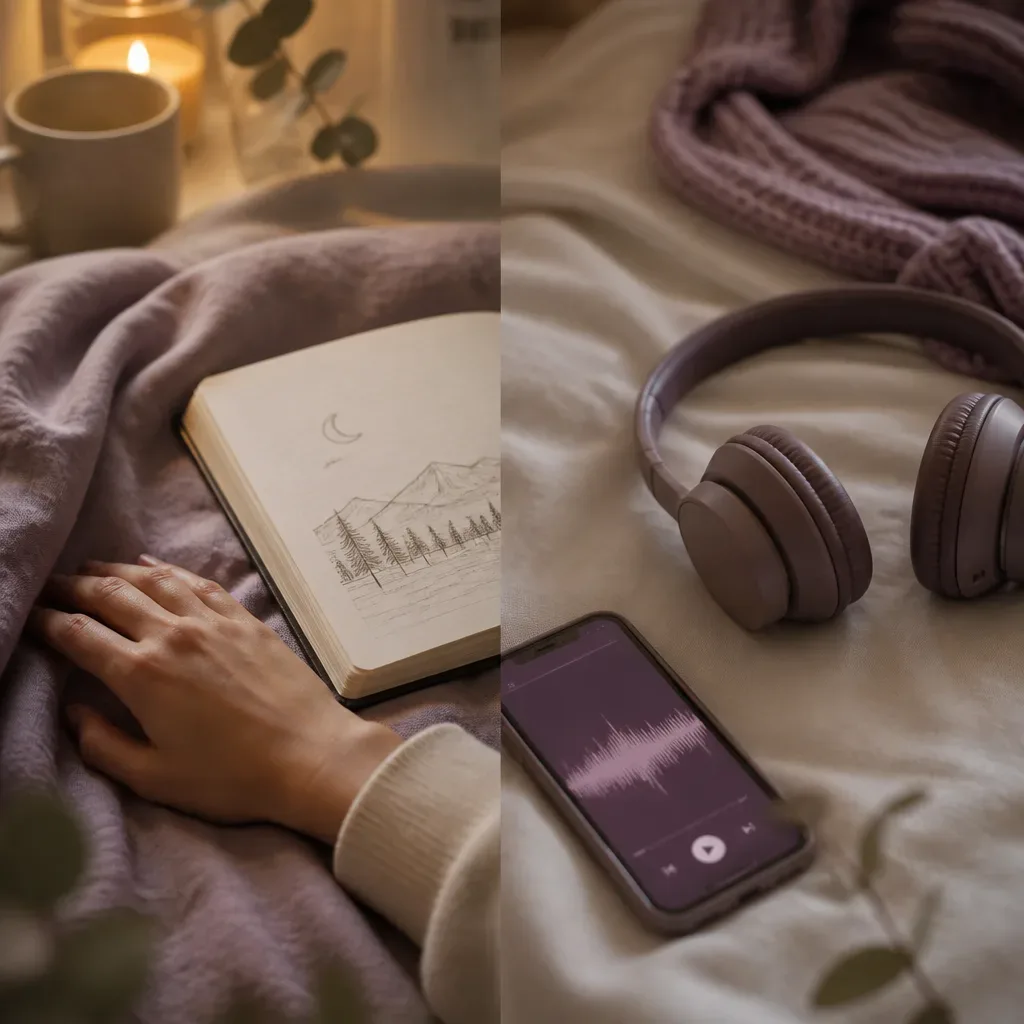
Neither method is superior in every body. The better practice is the one you can return to without becoming another person to manage.
For related language practice, see the Affirmations pillar. Affirmations can steady the sentence. Audio can carry the whole remembered self.
Which one works better when your mind is tired?
Future-self audio usually works better when the mind is tired because it asks less from working memory.
Working memory is small. Cognitive psychologist George Miller famously proposed in 1956 that people can hold about 7 items, plus or minus 2, in immediate memory. Later research suggests the number may be closer to 4 chunks. Either way, bedtime is not the mind at its sharpest. By night, you may not want another task.
SATS can become effortful if you are trying to get it right. You might ask: Is the scene short enough? Do I feel it? Am I sleepy enough? Did I just ruin it by thinking about tomorrow’s email? The question behind all those questions is fear. Fear makes the practice noisy.
Future-self audio reduces that noise by giving you a track to follow. The recording holds the sequence. You can drift and return. If you miss one sentence, the next one arrives. This is not laziness. It is design. A practice that survives tiredness has a better chance of becoming daily.
Still, SATS has one gift audio cannot replace: authorship. You choose the scene from inside your own symbolic life. A hand on your shoulder. A particular kitchen. A message from one person. That specificity can be deeply convincing. Neville Goddard’s students often repeated one scene until it felt like memory. The scene did not need to be cinematic. It needed to imply the end.
A tired mind does not need more instructions. It needs fewer doors.
If you use Astrology and manifestation as timing support, keep it in its place. The moon phase may help you mark a ritual. The nightly listening is still what trains attention.
What does sleep research say about practicing before bed?
Sleep research supports the timing of pre-sleep repetition, but it does not prove every metaphysical claim.
That sentence matters. You can honor mystery without pretending the lab has measured all of it. Sleep is tied to memory, emotion, and learning. A 2013 review in Physiological Reviews described sleep as active in memory consolidation, not merely rest. The brain sorts, strengthens, and loosens material while you are unavailable to ordinary control.
Pre-sleep suggestion also has a long history. Hypnagogia, the threshold between waking and sleep, is known for vivid images and reduced critical filtering. Goddard built SATS around that threshold. Modern meditation and hypnosis studies often use similar relaxation states, though with different claims and methods.
There is also evidence that auditory cues can influence memory during sleep when paired with prior learning. Targeted memory reactivation studies, including work published in Science in 2007 by Rasch and colleagues, found that scent cues during sleep could strengthen memory linked to earlier learning. Later studies tested sound cues too. This does not mean a recording heard at night controls reality. It means cues near sleep can become part of what the brain rehearses.
The Princeton Engineering Anomalies Research program and later Global Consciousness Project are often mentioned in manifestation circles. Their findings remain debated and should be held carefully. They are not a simple proof that thought makes events happen. They are a reminder that attention, intention, and measurement have a complicated history.
For a grounded starting point, return to the core practice described in the AYA Method. Listen daily. Repeat gently. Let the self you are becoming become familiar before you ask life to confirm it.
How do you choose between SATS and future-self audio tonight?
Choose the practice that lets you feel the fulfilled state with the least strain tonight.
This is not a personality test. It is a nightly fit. Some evenings, you may want the clean precision of SATS. Other evenings, you may need to be held by a voice that already knows where you are going. Both can be honest. Both can be misused if you turn them into pressure.
Use this simple check before bed:
- If your mind is clear, try SATS with one 10-second scene.
- If your mind is crowded, use future-self audio and let it lead.
- If you cannot visualize, use sound, touch, or spoken identity.
- If you keep checking results, shorten the practice.
- If you fall asleep, do not punish yourself. Sleep was already near.
You can also combine them in a clean order. First, listen to your Dream-Self Moment. Then, when one phrase or image stays with you, let it become your SATS scene. This keeps SATS from becoming a blank page. It also keeps audio from becoming background sound. One feeds the other without making the night crowded.
Behavior change research keeps returning to the same plain truth: consistency beats intensity. In the 66-day habit study, some people took 18 days and others took 254 days for a behavior to feel automatic. Your pace is not a verdict. It is information.
For more on the larger practice, move between Manifestation, Affirmations, and Astrology and manifestation without making any of them a rulebook. The practice has to stay livable.
The fulfilled self is not louder than the old self. She is simply more repeated.
Tonight, speak softly to the part of you that already knows.
Listen on Aya

