mindset
Shadow Work Manifestation: Let Your Future Self Speak
Shadow work manifestation helps you meet hidden fears without letting them lead. Learn a quiet future-self practice for daily audio work.

The notebook is open beside the cup you forgot to drink. Shadow work manifestation means meeting the hidden fear behind a desire, then letting your future self speak before the fear starts giving orders. You are not digging for pain. You are making room for a truer instruction.
What is shadow work manifestation, really?
Shadow work manifestation is the practice of naming the unseen part of you that resists what you are trying to receive.
The phrase “shadow” comes through Carl Jung’s psychology, where the shadow names the disowned material in the psyche, often built from what we learned was unsafe, unacceptable, or too much. Jung wrote about this in the 20th century, and the language has since moved far beyond clinical rooms. Still, the useful part is simple. Something in you learned to hide. Something in you still acts from that hiding.
In manifestation, the hidden thing matters because your desire is not only a sentence. It becomes habits, choices, posture, timing, tone, and attention. A 2009 paper in the European Journal of Social Psychology found that habit formation took a median of 66 days, with wide variation from 18 to 254 days. That range is humbling. The body takes time to believe a new pattern is ordinary.
Shadow work does not ask you to be endlessly positive. It asks you to be honest without handing the wheel to the oldest wound. You might want visibility and still flinch when someone reads your work. You might want partnership and still scan tenderness for danger. You might want money and still feel loyal to scarcity because it once kept you close to your family.
The shadow is not the enemy of the desire. It is the part of you asking whether the desire is safe.
For this practice, you do not need a perfect theory. You need one desire, one honest fear, and one steadier voice. That voice is your future self. Not fantasy. Rehearsal. Research on mental simulation, including work by psychologist Shelley Taylor in the 1990s, suggests that imagining concrete processes can support action more reliably than only picturing outcomes. So you let the future self speak in usable details.
Why should your future self speak first?
Your future self should speak first because the old protective voice is usually faster than the new one.
The brain is built to detect threat quickly. Joseph LeDoux’s research on fear circuits helped popularize the idea that the amygdala can respond to threat cues before the slower, more reflective cortex has finished making meaning. That does not mean your amygdala is bad. It means the frightened part may arrive early, loud, and certain.
If you begin shadow work by asking, “What is wrong with me?” you may get a full report from the oldest file. Try asking, “What does the version of me who is already safe here know?” The question changes the room. It gives the nervous system another reference point before the familiar story takes the microphone.
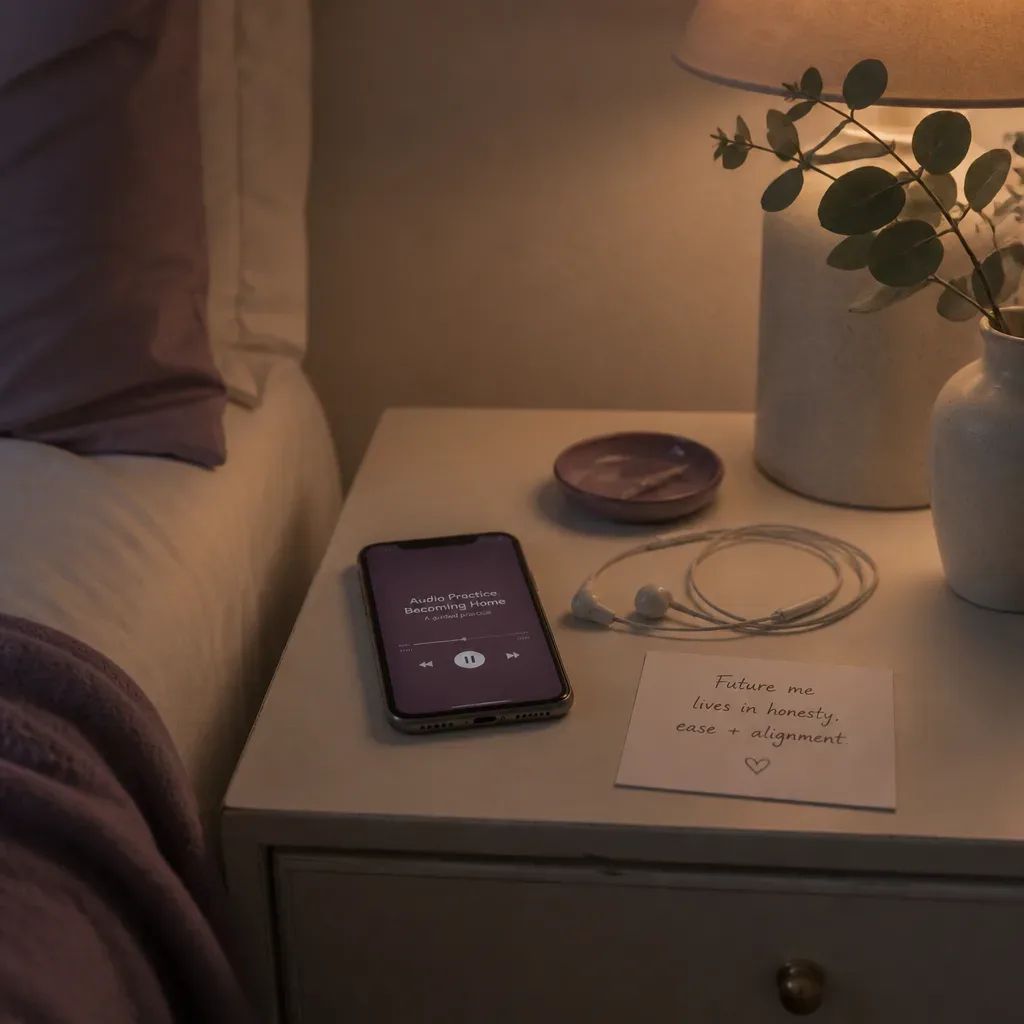
This is where the AYA Method belongs quietly. The AYA Method is a daily audio manifestation practice. Each day you listen to a short personalized recording, your Dream-Self Moment, narrated from the version of you who has already manifested the life you intend. Listening is the practice. Repetition is the work. The audio is the method.
That matters for shadow work because sound reaches you differently than a list on paper. A 2014 review in Frontiers in Psychology described how voice, rhythm, and auditory cues can affect emotional processing and memory. You already know this. One sentence from the right person can change your breathing. One tone can return you to a room you left 12 years ago.
Letting the future self speak first is not pretending fear has no wisdom. It is refusing to let fear be the only elder in the house.

How do you do shadow work without spiraling?
You do shadow work safely by keeping the container small, timed, and oriented toward return.
Set a timer for 12 minutes. Not 2 hours. Not the whole Sunday. The American Psychological Association has noted that expressive writing studies often use short sessions, commonly 15 to 20 minutes, across several days. James Pennebaker’s early research used this kind of timed writing to study emotional disclosure. The point is not endless excavation. The point is contact, language, and integration.
Use this order:
- Name the desire in one sentence. “I want to be paid well for work that feels true.”
- Name the body response. Tight throat. Warm face. Heavy chest. No poetry needed.
- Let the shadow speak for three sentences. “If I earn more, people will expect more. I’ll be judged. I’ll leave someone behind.”
- Pause for one breath longer than feels natural. Count 6 seconds out if that helps.
- Ask the future self to answer first. Write the response as if it is already lived.
- Choose one small repair action. Send the invoice. Drink water. Close the tab. Tell the truth.
A spiral often begins when you mistake intensity for depth. It feels serious, so you keep going. But the nervous system learns through manageable doses. In trauma therapy, the term “titration” is often used for working with small amounts of difficult material at a time, especially in somatic approaches associated with Peter Levine. You do not need the whole cave. You need one stone you can carry.
Use these boundaries when the writing gets sharp:
- Stop if you feel numb, unreal, or unable to come back to the room.
- Put both feet on the floor and name 5 visible objects.
- Do not do shadow work right before a hard conversation.
- If a memory feels too large, write “not alone” and bring it to a therapist or trusted clinician.
You are allowed to meet yourself in small rooms.
What prompts help the shadow speak clearly?
The best prompts are plain enough that the hidden belief cannot hide behind style.
A beautiful prompt can become a hiding place. I say this as a librarian who loves a sentence with a lamp in it. For shadow work manifestation, better questions are often almost rude in their clarity. A 2020 review in Behavior Research and Therapy noted that cognitive restructuring often begins by identifying automatic thoughts. That is the work here too. You are catching the sentence that runs before the choice.
Try this table when you do not know where to begin:
| Desire | Shadow sentence | Future-self reply |
|---|---|---|
| I want to be seen. | If I’m seen, I’ll be criticized. | I can be visible and still choose whose opinion enters. |
| I want steady love. | Love always costs me my freedom. | Real love has room for my morning, my work, my no. |
| I want more money. | Wanting money makes me selfish. | Money can be a clean tool when I tell the truth about it. |
| I want rest. | Rest means I’m falling behind. | Rest is part of how I keep my promise. |
You can also use direct prompts:
- What do I fear would happen if this desire arrived this month?
- Who would I disappoint by becoming steadier?
- What identity would I have to retire?
- What praise do I secretly distrust?
- What would my future self stop apologizing for today?
Neville Goddard often wrote about assuming the feeling of the wish fulfilled. The useful reading is not forced cheer. It is practice in inhabiting a state until behavior begins to answer it. Joe Dispenza uses different language around rehearsing future states, and some of his claims are debated, but the practical instruction is clear enough: repetition changes what feels familiar.
If you use affirmations, let them be specific after the shadow has spoken. “I am worthy” may be true, but “I can receive payment without shrinking” may meet the exact place where you leave yourself.
How does audio make shadow work gentler?
Audio makes shadow work gentler by giving the future-self voice a felt form you can return to daily.
Writing is useful because it slows thought. Audio is useful because it can hold tone. A 2019 report from Edison Research found that weekly online audio listening in the United States had reached 67 percent of people age 12 and older; by 2024, the number was reported at 75 percent. People return to audio because sound can travel with the body. It meets you while your hands are still busy.
In the AYA practice, the Dream-Self Moment is not background sound. It is the center. You listen to a short personalized recording from the self who already knows the shape of the life you intend. The app also includes a daily affirmation and a Manifestation Board, but they are complements. The audio is where the practice begins and returns.
For shadow work, this matters because the old belief may not soften from logic alone. You can write, “I am safe to be seen,” and still feel your shoulders climb toward your ears. Then you hear the future-self voice say it in a way that feels slower, closer, less like homework. Repetition does not bully the shadow. It gives it new evidence.
Try this 18-minute rhythm:
- 2 minutes: breathe and name one desire.
- 4 minutes: let the shadow write three to five sentences.
- 5 minutes: listen to your Dream-Self Moment.
- 4 minutes: write what the future self knows.
- 3 minutes: take one small action or schedule it.
In behavior change research, implementation intentions, studied widely by Peter Gollwitzer, use simple if-then plans to link intention with action. “If I hear the old sentence, then I play my Dream-Self Moment before deciding.” Small. Repeatable. Yours.
What should you do after the hidden belief appears?
After the hidden belief appears, thank it for protecting you and ask what present-day proof would help it stand down.
This is the part people skip. They find the belief, feel the sting, and close the notebook like it bit them. But a named belief is only the middle of the practice. The next step is repair. Not grand repair. One proof. In dialectical behavior therapy, developed by Marsha Linehan, skills often pair acceptance with change. That pairing is useful here. “This fear makes sense” and “this fear does not get to run my calendar” can both be true.
Use the belief as a map. If the shadow says, “If I ask for more, I’ll be rejected,” the repair action is not to demand a whole new life by Friday. It might be to ask one clear question. If the shadow says, “If I rest, I’ll become lazy,” the repair action might be a 20-minute rest with no apology attached. The old part needs evidence in the language it understands: repeated, concrete, survivable.
You can borrow from astrology and manifestation if symbolic timing helps you listen. A new moon can mark a beginning. A Saturn transit can name a boundary. But the symbol is not the practice. Your practice is the moment you tell the truth, hear the future-self voice, and do the next small thing.
Here are clean repair actions:
- Send the message you keep rewriting.
- Put the price in writing.
- Leave 30 minutes empty and do not explain it.
- Save the compliment instead of dismissing it.
- Say, “I need one day to answer.”
The future self becomes believable through receipts, not speeches.
A 2021 Pew Research Center survey found that 31 percent of U.S. adults reported being online “almost constantly.” That matters because your old belief has endless chances to compare, scan, and react. Repair actions need to be close enough to real life to interrupt the scroll.
How do you know the practice is working?
You know the practice is working when your reaction time changes before your whole life looks different.
Look for small evidence first. You notice the old sentence sooner. You pause before sending the defensive text. You listen to the audio before checking whether someone approved of you. You still feel fear, but it no longer gets the first and last word. In mindfulness research, a 2014 meta-analysis in JAMA Internal Medicine found moderate evidence that meditation programs can improve anxiety, depression, and pain. The change was not magic. It was practice repeated over time.
Track 3 signs for 14 days:
- Speed: How quickly did I notice the shadow sentence?
- Softness: Did my body return sooner after activation?
- Action: Did I take one future-self action, even if small?
Do not track 17 things. A practice with too many measurements becomes another room where shame can sit down. Three signs are enough. At the library, I have seen people return a book 9 months late and whisper as if they have committed a public crime. Usually, I scan it, smile, and tell them the system is fine. Some parts of us need that same simple mercy.
If you want a steadier frame, pair this work with the broader manifestation practice you already keep. Let the future self speak. Let the shadow answer. Let the audio return you. If you use an affirmation afterward, keep it close to the wound you actually found.
There is no prize for becoming a person with no shadow. There is only the quiet relief of not letting the hidden part steer alone.
The room is still here, and so are you.
Listen on Aya

