mindset
Stop Self Sabotage With a 3-Minute Audio
Stop self sabotage with a 3-minute future-self audio. Learn a quiet daily practice that interrupts old patterns, steadies the body, and makes the next choice feel real.

Your thumb hovers over the same message again. You know the pattern. To stop self sabotage, use a 3-minute future-self audio as a daily cue: name the old move, hear your future self choose differently, then take one small action before the pattern gathers speed.
What counts as self-sabotage, really?
Self-sabotage is any repeated choice that protects you from discomfort now while costing you the life you say you want.
It often looks quiet. You delay the email. You pick the fight. You scroll until the window closes. You say yes when your body has already said no. Psychologists often discuss this through avoidance, emotion regulation, and self-handicapping. In a classic 1978 paper, Steven Berglas and Edward Jones described self-handicapping as creating obstacles that protect self-worth if you fail.
The key word is repeated. One late night is just one late night. A pattern is different. It has a doorway, a feeling, a thought, and a payoff. You avoid the proposal because not trying keeps the dream untested. You return to the old relationship because loneliness feels sharper than confusion. The behavior is not random. It is trying to keep you safe.
A 2022 American Psychological Association stress survey found that 27% of adults reported being so stressed they could not function on some days. Under that kind of load, the mind reaches for familiar moves. Not true moves. Familiar ones.
Self-sabotage is not proof that you do not want the new life. It is proof that part of you still thinks the old protection is necessary.
This is why shame does not work. Shame adds heat to the same system that is already bracing. A softer method begins with seeing the pattern exactly, without turning it into your name.
Why does future-self audio help interrupt the old move?
Future-self audio helps because it gives your nervous system a rehearsed identity cue before the automatic choice completes.
The future self is not fantasy here. It is a practical design tool. Hal Hershfield at UCLA has studied future-self continuity for more than a decade. In one well-known 2011 study, people who saw age-progressed images of themselves allocated more money toward retirement than those who did not. The closer the future self feels, the more real future care becomes.
Audio adds something visual tools do not. It enters through listening. It can be used with closed eyes, on a walk, or before the moment you usually fold. Voice has timing. Breath. Pause. A sentence can land in the body before you have argued with it.
In the AYA Method, The AYA Method is a daily audio manifestation practice. Each day you listen to a short personalized recording — your Dream-Self Moment — narrated from the version of you who has already manifested the life you intend. Listening is the practice. Repetition is the work. The audio is the method.
That definition matters. The app may also include a daily affirmation and a Manifestation Board, but they are complements. The audio is the practice. If you are working with manifestation, this keeps it grounded in one repeated act, not a mood you have to maintain all day.
A 2015 Health Psychology meta-analysis by Epton and colleagues looked at 41 self-affirmation studies and found small but meaningful effects on health behavior change. Small is not nothing. Small is often the size of the door.
How do you set up the 3-minute practice?
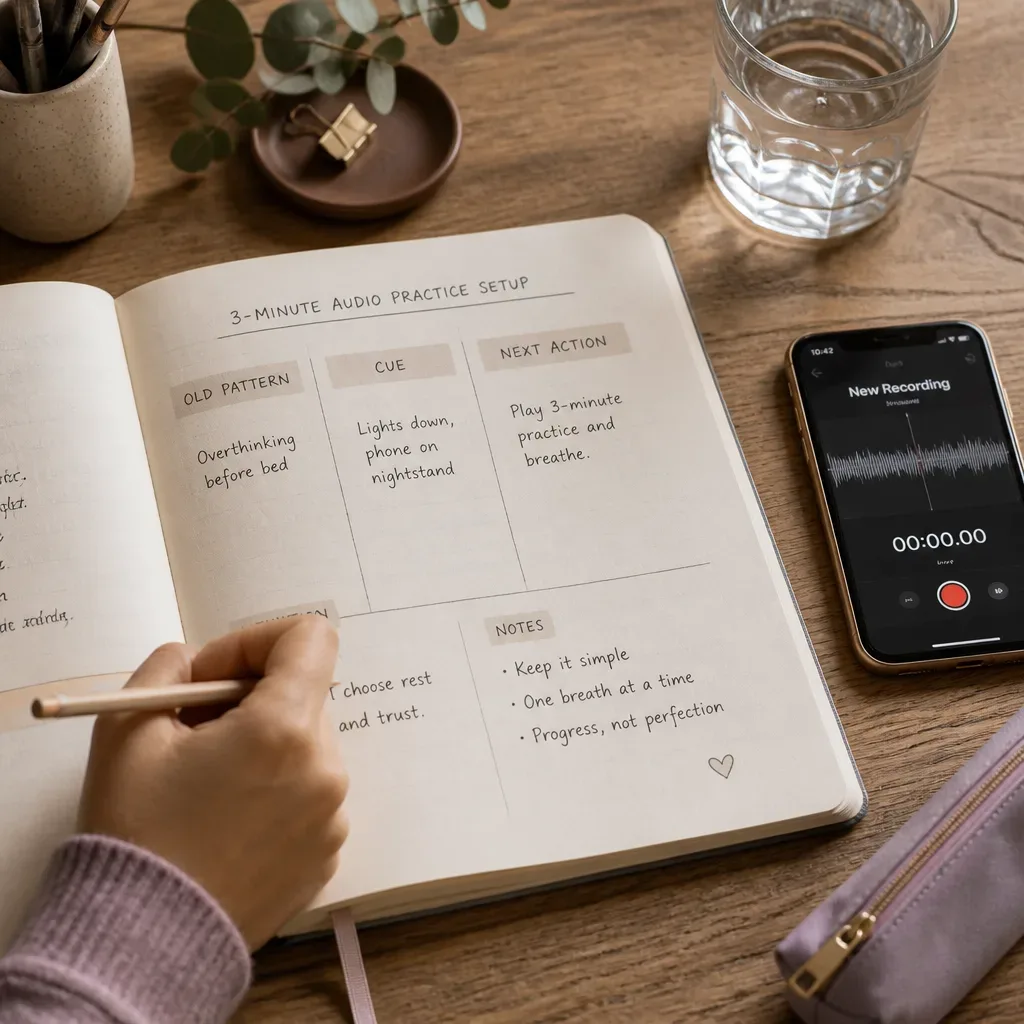
Set it up by choosing one pattern, one cue, one future-self sentence, and one action you can do immediately after listening.
Do not begin with your whole life. Begin with the moment before the old pattern wins. If you sabotage writing, the cue might be opening your laptop. If you sabotage intimacy, the cue might be the first urge to explain yourself too much. If you sabotage money, the cue might be avoiding the account balance. Specificity is mercy.
Use this 5-part setup once. It takes about 12 minutes the first time, then 3 minutes a day after that.
- Name the pattern in one plain sentence.
- Name the trigger time or place.
- Choose the smallest opposite action.
- Write 8 to 12 lines from your future self.
- Record slowly, leaving silence between lines.
Peter Gollwitzer and Paschal Sheeran reviewed 94 tests of implementation intentions in 2006 and found that if-then plans had a reliable effect on goal achievement. The structure matters because it removes one decision from the heated moment. If this happens, I do that.
Here is the difference between a vague wish and a usable cue:
| Old pattern | Clear cue | 3-minute next action |
|---|---|---|
| I avoid hard work | When I open the laptop | I write the title and one sentence |
| I overtext when anxious | When I reach for the phone after 9 p.m. | I place the phone across the room |
| I quit after one mistake | When I feel the first flush of shame | I do one imperfect repeat |
| I spend to soothe | When I open the shopping app | I open my notes and name the feeling |
A practice becomes kind when it becomes exact. You are not trying to become a different person by force. You are making a new path easier to find.
What should the future-self audio actually say?
The audio should say what your future self knows, in simple present-tense language, with one behavior you can do today.
Keep the script close to the ground. Not grand. Not polished. Three minutes is usually 300 to 420 spoken words, depending on pace. For this practice, slower is better. Try 120 words per minute or less. The silence is part of the message.
You can borrow from affirmations, but do not make the whole recording a string of ideal statements. The strongest audio names the moment of friction. It says: I notice the urge to disappear. I stay for 3 minutes. I breathe once. I send the draft. It is future-self language with present-day handles.
Use this frame:
- I know this moment.
- I know what I used to do.
- I do not need to punish that part of me.
- I choose one small true action now.
- I let the next 3 minutes count.
In a 2013 PLOS ONE study, Creswell and colleagues found that self-affirmation improved problem-solving performance under stress in a sample of 73 participants. The point is not magic wording. The point is reducing threat enough that the thinking mind comes back online.
Sample script:
I am here. I know this doorway. This is the moment where I used to delay, explain, or leave myself. I do not need to make a speech about it. I choose the next small true thing. I open the document. I write one sentence. I let it be imperfect. I can feel discomfort and still keep my promise. Three minutes is enough to return.
Your future self should not sound like a coach shouting from a stage. It should sound like you, after you have stopped negotiating with fear.
When should you listen so it actually changes behavior?
Listen at the edge of the pattern, not after the pattern has already carried you away.
Timing is the quiet architecture of this practice. I learned this as an architect before I learned it as a teacher: a doorway changes how a body moves. Place the audio at the doorway. Before the meeting. Before the app opens. Before the first drink. Before the message. Before the hour you usually lose.
Lally and colleagues tracked habit formation in 96 people in 2009 and found it took 66 days on average for a behavior to feel automatic, with a range from 18 to 254 days. That range is kind. It means you are not broken if day 9 still feels manual.
Use the same cue for 14 days before changing it. Repetition gives the mind less to debate. If you keep moving the practice around, the practice has to find you every day. If you keep it still, you learn where to return.
A simple daily rhythm can look like this:
- Put headphones in.
- Stand or sit where the pattern usually begins.
- Listen once without multitasking.
- Do the 3-minute next action immediately.
- Mark it with one small check.
The check matters. BJ Fogg at Stanford has written for years about tiny behaviors and immediate celebration. You do not need a dramatic reward. You need a trace. A small mark tells the brain: this happened. I did not abandon myself here.
If your practice includes timing with moon phases or personal cycles, keep it practical. Astrology and manifestation can offer symbolic timing, but the behavior still needs a cue you can touch on an ordinary Tuesday.
What do you do when resistance gets loud?
When resistance gets loud, make the action smaller and make the listening non-negotiable.
Resistance usually argues in extremes. It says this is pointless. It says 3 minutes cannot matter. It says you have already ruined the day. Notice the tone. Urgency is often the old pattern wearing a new coat.
This is where the practice must become almost embarrassingly small. If the planned action was write 200 words, write one sentence. If it was go to the gym, put on the shoes. If it was tell the truth, write the truth in a private note first. The nervous system learns from completed promises, not impressive plans.
A 2014 study by Ethan Kross and colleagues found that using distanced self-talk, such as speaking to yourself by name or as you, helped people regulate stress before a difficult task. Your future-self audio uses a related principle. It lets you hear guidance without being swallowed by the immediate feeling.
You can also update the recording when it becomes too shiny. If you no longer believe the script, lower the claim. Change I never avoid this to I notice avoidance sooner. Change I am fully confident to I can act while unsure. Truth is more useful than polish.
Use these repairs:
- If you missed a day, listen the next day without repayment.
- If the script feels false, make it 20% more believable.
- If the action is too large, cut it in half twice.
- If shame rises, name it as sensation before story.
- If you need clinical care, let this practice sit beside it, not instead of it.
Joe Dispenza often speaks about rehearsing a future state. Neville Goddard called it living from the end. In this practice, the end must meet the calendar. Otherwise it stays beautiful and unused.

How will you know the practice is working?
You will know it is working when the pause appears sooner and the next small action happens more often.
Do not measure only the big outcome. Measure the hinge. Did you notice the urge 10 seconds earlier? Did you listen before opening the app? Did you send the imperfect draft once this week? These are not tiny in the life of a pattern. They are the place where a future begins to become normal.
Track 3 numbers for 21 days:
| Measure | What to write | Why it matters |
|---|---|---|
| Listened | Yes or no | Repetition is the work |
| Pause appeared | Before, during, or after | Earlier noticing means more choice |
| Next action done | Yes, partial, or no | Behavior anchors identity |
Twenty-one days is not a magic number. It is a clean observation window. Habit research does not support the old claim that all habits form in 21 days. Lally’s 2009 study gives a wider and more honest range. Still, 21 days is enough to see whether the cue is placed well.
You may also notice subtler signs. Less bargaining. Less drama around beginning. A smaller crash after mistakes. A quieter relationship with effort. In the broader practice of manifestation, this is where desire stops being only something you picture and becomes something you rehearse with your nervous system.
If you use a Manifestation Board, let it remind you what the practice serves. If you use a daily affirmation, let it give you one sentence to carry. But return to the audio. Listening is the method. Repetition is the work.
The future self is not waiting at the finish line. She is the voice that teaches your hand what to do next.
Three minutes. Then the room can stay quiet.