reality shifting
Shifting Script Template: Future Self Before Bed
Use this shifting script template to write a short future-self audio for bedtime, listen with care, and make reality shifting feel quieter and easier.

The lamp is low, your phone is face down, and the day has finally stopped asking. A shifting script template gives you a short bedtime script written as your future self, then recorded and listened to before sleep. It turns scripting into audio, so the last thing you hear is the life you’re practicing.
What is a shifting script template for bedtime?
A bedtime shifting script template is a simple structure for writing the future self you want to rehearse before sleep.
It is not a long document. It is not a test of belief. It is closer to a room plan. You decide what belongs inside the room: the identity, the feeling tone, the ordinary proof, the small details that make it real. The National Sleep Foundation has long advised a consistent wind-down period before bed, often 30 to 60 minutes, because repeated cues teach the body what comes next.
A useful shifting script has three parts. First, it names the self you are practicing. Second, it gives that self a present-tense voice. Third, it includes sensory proof. If you write, I am calm, the mind may argue. If you write, I place my glass on the left side of the sink and answer one message with ease, the body has something to locate.
A script is not a spell. It is a room you prepare for attention.
Reality shifting language can become too crowded. Keep the page quieter than the desire. The manifestation pillar goes wider on intention and repetition, but this practice stays narrow on purpose. One script. One voice. One night at a time.
| Script part | What it does | Keep it this small |
|---|---|---|
| Identity | Names who is speaking | One future self |
| Setting | Gives the self a place | One room or moment |
| Sensory proof | Makes it believable | Three details |
| Closing line | Lets sleep take over | One sentence |
The American Academy of Sleep Medicine says adults generally need at least 7 hours of sleep per night. Your script should respect that. It should not keep you awake with more doing. It should hand the mind a clean line, then step back.
Why should you listen to your future self before bed?
Listening before bed works because the mind is more receptive to repeated cues when the day is closing.
Bedtime has a softness other hours do not. You are not negotiating traffic, email, or breakfast. You are already crossing from effort into rest. In habit research, this matters. A 2006 meta-analysis by Peter Gollwitzer and Paschal Sheeran found that implementation intentions, the if-then plans that connect a cue to an action, had a medium-to-large effect across 94 studies. Bed can become that cue.
Audio also changes the posture of the practice. Reading asks you to manage the page. Listening lets you receive. That is why The AYA Method is a daily audio manifestation practice. Each day you listen to a short personalized recording — your Dream-Self Moment — narrated from the version of you who has already manifested the life you intend. Listening is the practice. Repetition is the work. The audio is the method.
Your shifting script can borrow that same intelligence. The daily affirmation and Manifestation Board in the app can support the practice, but they are complements. The audio is the center. If you only have two minutes, listen.
Researchers Matthew Killingsworth and Daniel Gilbert reported in Science in 2010 that people’s minds wandered about 46.9% of the time in their sample. A bedtime recording gives the wandering mind a place to return. Not by force. By familiarity.
The last voice you hear at night should not always be worry.
How do you write the shifting script template?
You write it by making the future self specific enough to feel known and short enough to repeat.
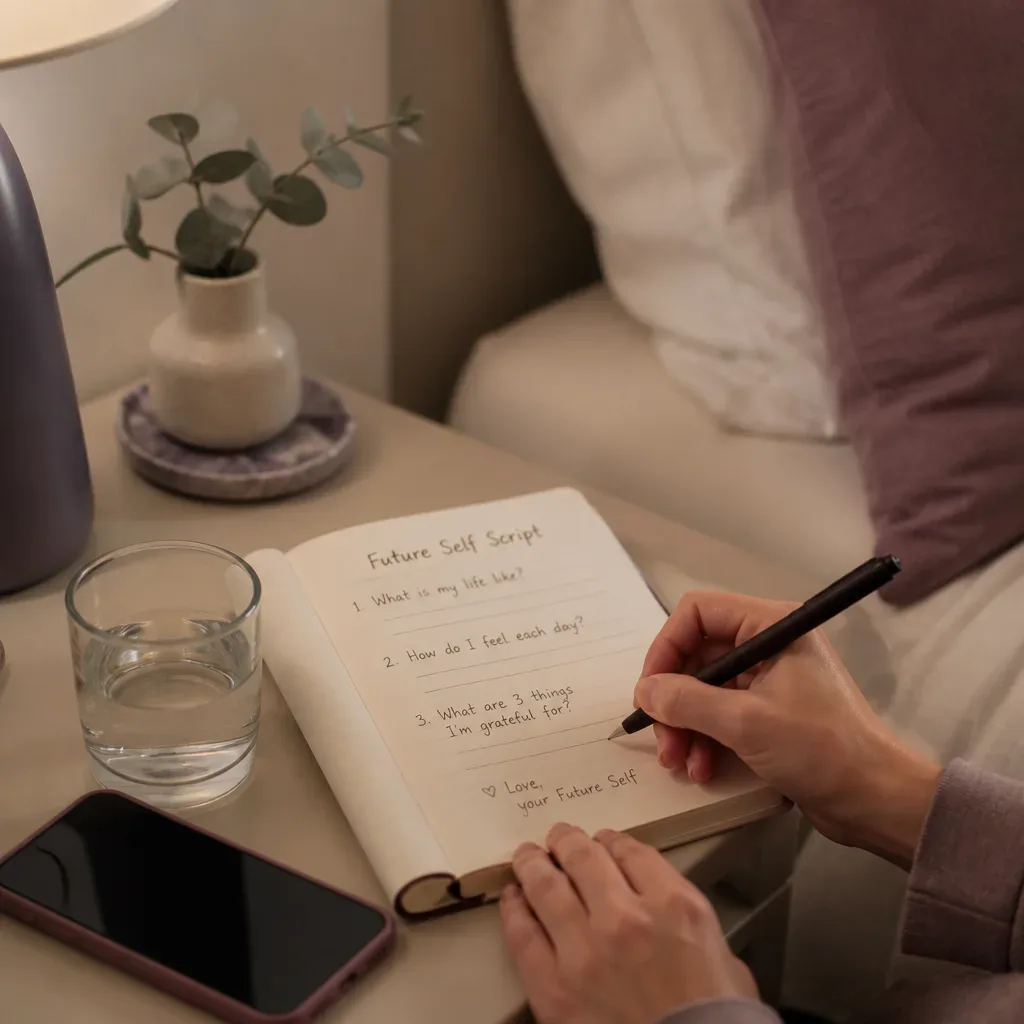
Use this template as a quiet draft. Fill it once by hand if you can. A 2014 study by Pam Mueller and Daniel Oppenheimer found that students who took longhand notes often processed concepts more deeply than those who typed verbatim notes. This is not proof that handwriting changes reality. It is a reminder that slowness can help attention choose.
- Name the self. I am the version of me who ____.
- Place the scene. It is ____ and I am ____.
- Describe the body. My shoulders feel ____. My breath is ____.
- Add ordinary proof. I notice ____, ____, and ____.
- Name the new normal. It is normal for me to ____.
- Close the loop. I sleep knowing ____ is already being practiced.
Here is a filled version, kept short:
I am the version of me who speaks clearly and rests without guilt. It is late evening, and my room is dim. My shoulders are low. My breath is even. I notice the blue cup beside the bed, the clean edge of the sheet, and the quiet space where worry used to sit. It is normal for me to answer life from steadiness. I sleep knowing this self is already here.
If you want to add belief language, keep it plain. The affirmations pillar can help you choose sentences that do not feel fake in the mouth. The best line is not always the grandest line. Often it is the one your nervous system does not reject.
Psychologist James Pennebaker’s expressive writing research, beginning in the 1980s and 1990s, found that structured writing about emotional material could be linked with health markers in some groups. Your script is different, but it shares one small principle: words organize inner material. Organized material is easier to revisit.
How do you make the script sound like your future self?
You make it sound like your future self by removing performance and leaving recognition.
Most scripts fail because they speak in a voice you would never use. They sound like a poster, not a person. Your future self does not need to announce greatness. She can say, I rinsed the cup. I sent the email. I left when I said I would. The ordinary detail is what lets the mind believe you.
Neville Goddard often taught the feeling of the wish fulfilled, and Joe Dispenza speaks about rehearsing a new self before the outer evidence is fixed. You do not have to accept every claim to use the gentle part: practice the state, then return to daily life with a slightly different instruction set. In small meditation and mental rehearsal studies, repeated imagery has been linked with changes in performance and stress response, though results depend on method and sample size.
Try these edits before you record:
- Replace huge claims with lived details.
- Use first person, present tense.
- Remove any sentence you would be embarrassed to hear.
- Add one line about safety in the body.
- End before the mind starts bargaining.
The future self sounds less like a speech and more like coming home.
There is also a design rule here. In architecture, an entryway tells the body what to do next. A narrow foyer slows you. A bright kitchen calls you forward. Your audio is the entryway to sleep. Give it one instruction, not ten.
If you use timing systems, keep them secondary. You might pair your script with a new moon, a Sunday evening, or a personal date. The guide to astrology and manifestation can help if symbols calm you. Still, the practice does not depend on a chart. It depends on returning.
How should you record and listen to it at night?
Record the script in your own slow voice, then listen once before sleep with no editing afterward.
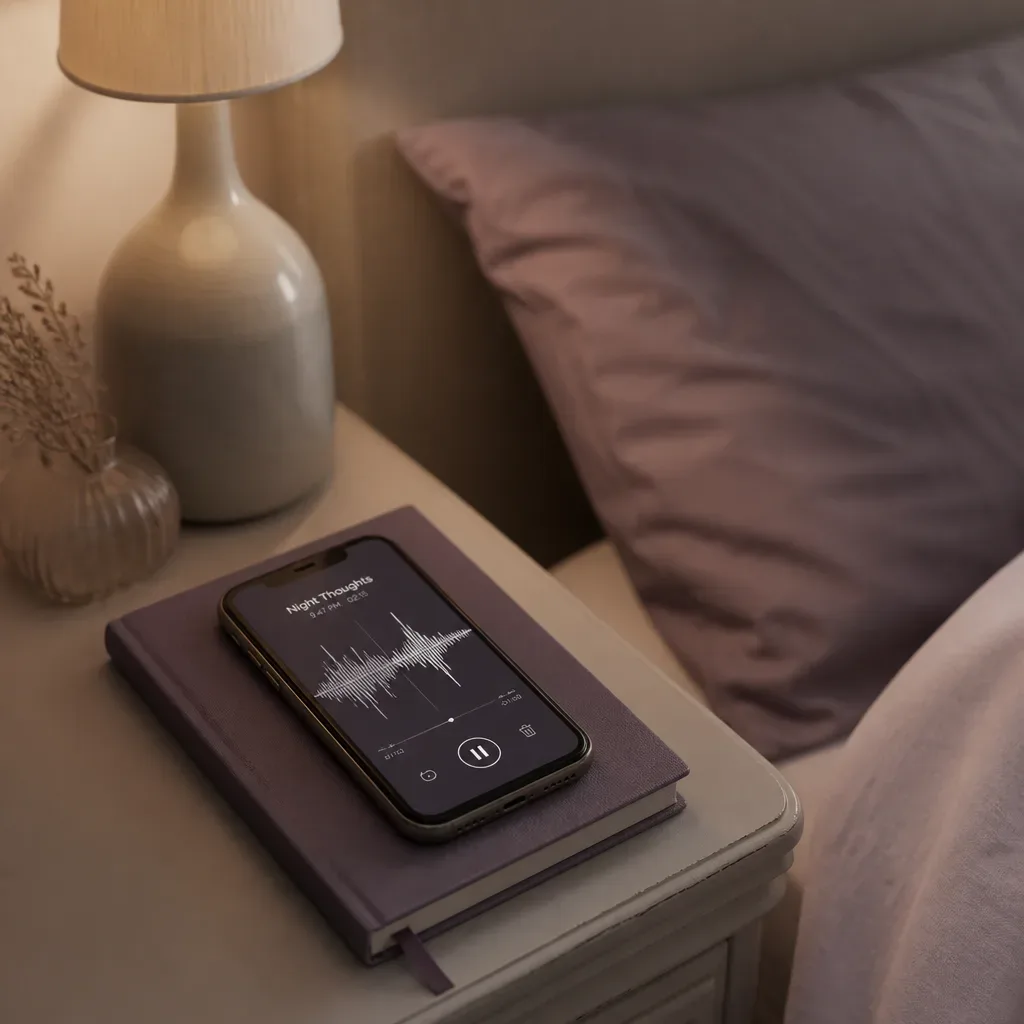
Your recording does not need studio quality. It needs intimacy. Sit where you will not perform. Hold the phone 6 to 10 inches from your mouth. Read at about 120 to 140 words per minute, slower than normal conversation. Many audiobook narrators sit near 150 to 160 words per minute, but bedtime wants more space.
Before you press record, take one breath and lower your volume. You are not convincing a crowd. You are speaking to the part of you that is tired and still listening. If your voice shakes, keep it. If a small pause happens, keep that too. Clean audio is useful. True audio is better.
A simple recording ritual:
- Put the phone on airplane mode.
- Open the voice memo app.
- Read the script once without stopping.
- Save it with a date, such as Future Self, Night 1.
- Play it once after the light is low.
- Stop there.
The Pew Research Center reported in 2024 that smartphone ownership in the United States is near universal among adults, with 97% owning a cellphone and 90% owning a smartphone. That means the tool is already beside you. The boundary matters more than the device. No scrolling after the recording.
If you use reality shifting practices with detailed desired-reality notes, keep those notes away from the bed. The bed script is the distilled version. It is the part your sleeping mind can hold without effort.
What should you do after seven nights?
After seven nights, keep what feels true, revise what feels false, and record one cleaner version.
Seven nights is not magic. It is enough time to notice friction. In habit studies, automaticity varies widely. A 2009 study by Phillippa Lally and colleagues found that new habits took a median of 66 days to become automatic, with a broad range across participants. That means one week is only a first drawing, not the building.
At the end of the week, ask three questions. Did I resist any line every night? Did one detail begin to feel familiar? Did listening make sleep softer or more active? If the script made you tense, shorten it by half. If it felt flat, add one sensory detail. If it felt true, do not decorate it.
Use this small review table:
| What you noticed | What to change |
|---|---|
| A line felt fake | Make it smaller and more physical |
| You got sleepy before the end | Shorten the recording |
| You wanted to replay it many times | Listen once, then rest |
| The scene became clear | Keep the same version another week |
Princeton’s PEAR and Global Consciousness Project research is often mentioned in intention circles, but it remains debated and is not a guarantee of personal outcomes. Let that keep you honest. The practice does not need certainty to be useful. Repetition, attention, and behavior can still be real without turning every claim into proof.
A good script does not make you chase the future. It lets you recognize the next honest action.
How do you keep the practice quiet enough to last?
You keep it quiet by making listening the non-negotiable part and letting everything else stay optional.
A bedtime practice fails when it grows too many doors. One night you write three pages. The next night you choose music. Then you check comments, compare methods, and lose the thread. Keep the thread. The audio is the thread. The daily affirmation can be read earlier. The Manifestation Board can be seen in the morning. At night, listen.
If you want a stable plan, use this rhythm for 14 days. Write on day 1. Record on day 1. Listen days 1 through 7. Review on day 8. Record a cleaner version only if needed. Listen days 8 through 14. The structure is plain enough to remember when you are tired.
The Journal of Behavioral Medicine has published many studies linking regular mind-body practices with stress measures, though effects vary by practice and person. What matters here is regularity. A two-minute recording heard 14 times may teach more than a perfect script abandoned after one night.
You can also pair the script with one physical cue:
- Put the phone on the same side of the bed.
- Lower the same lamp.
- Place one glass of water nearby.
- Touch the sheet before pressing play.
- Let the recording end without checking anything.
The room learns with you. That is not mystical language. It is design. A chair placed by a window invites reading. A phone placed under the pillow invites checking. A small audio played at the same hour invites return.
Leave the phone face down, and let the room teach quiet.
Listen on Aya

