reality shifting
Raven Method Shifting: Listen to Future-Self Audio First
Raven method shifting can feel less strained when you listen to future-self audio first, then count, affirm, and let the body stay safe through the night.

The room is dark. Your phone is face down. Raven method shifting is a reality shifting practice where you lie still, count, and affirm your intended reality; listening to future-self audio first gives the body a clearer place to land before the counting begins.
What is raven method shifting, really?
Raven method shifting is a bedtime-style reality shifting practice built around stillness, counting, and repeated intention.
Most versions ask you to lie on your back in a starfish shape, arms and legs slightly away from the body, then count from 1 to 100 while repeating affirmations. The number 100 matters less than the rhythm. Counting gives the mind a rail to hold. The still body gives the imagery less competition. In online shifting spaces, the method became popular because it is simple, repeatable, and doesn’t require tools beyond a quiet place.
The Raven Method sits inside the wider language of reality shifting, which often means entering, rehearsing, or deeply identifying with a desired reality. Some people describe this as sleep-adjacent visualization. Some use it as a symbolic practice. Some hold a more literal belief. You don’t need to settle the metaphysics before you begin. You only need to know what your body does when you ask it to believe.
The body keeps score in small ways. A 2018 review in Frontiers in Psychology notes that mental imagery can recruit perceptual and emotional systems in the brain, which is one reason imagined scenes can change heart rate, muscle tone, and feeling. That doesn’t prove shifting in the dramatic sense. It does mean inner rehearsal is not nothing.
A practice is not more real because it strains you. It is often more real when you can stay with it softly.
In this version, you don’t begin by forcing affirmations into a tense nervous system. You begin by listening. Future-self audio gives the method a voice before you add counting. It says: here is where we are going. Then the Raven Method becomes less of a test and more of a return.
Why listen to future-self audio before lying still?
You listen first because the nervous system receives tone before it argues with words.
A written script can be useful. A vision board can help. But audio enters differently. The ears stay open in the dark. The jaw doesn’t have to move. The eyes don’t have to track a page. This matters at night, when the body is already crossing from task to rest. The National Sleep Foundation has long described the pre-sleep period as sensitive to cues: light, sound, temperature, and routine all tell the brain what kind of night it is.
Future-self audio also reduces the burden on your imagination. Instead of trying to construct a whole desired reality while lying still, you hear one small scene. A hallway. A hand on a door. A message already received. A body that knows it’s safe there. Specificity is kinder than vague longing. One clear scene can do more than 20 anxious wishes.
This is where the AYA Method comes in quietly: The AYA Method is a daily audio manifestation practice. Each day you listen to a short personalized recording — your Dream-Self Moment — narrated from the version of you who has already manifested the life you intend. Listening is the practice. Repetition is the work. The audio is the method.
That definition matters here because the Raven Method can become too mental. Count. Affirm. Check. Wonder. Doubt. Restart. Audio interrupts that loop. It lets you receive before you try to produce. In somatic work, I see this often: the body softens faster when it is addressed, not commanded.
If you know manifestation as only wanting hard enough, this will feel different. It is not louder wanting. It is closer listening. The future self is not a distant prize. It is a tone you practice recognizing.
How do you practice raven method shifting tonight?
You practice by setting one scene, listening to it, lying down, counting slowly, and letting the body stay safe.
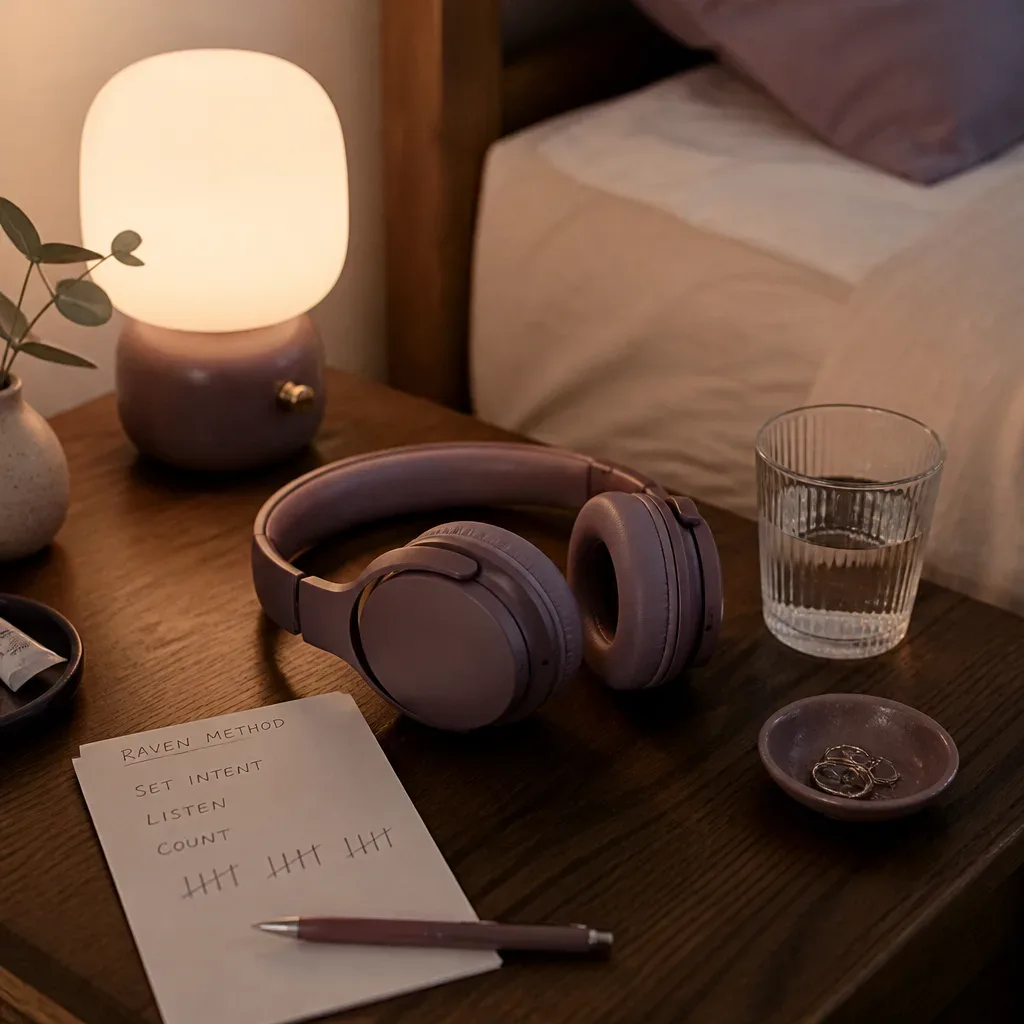
Here is the simple sequence. It takes about 18 minutes, though you can shorten it to 10. The CDC says adults generally need at least 7 hours of sleep each night, so this practice should not steal from rest. It should lead toward it.
- Choose one intended reality scene. Keep it small. Waking in a certain room. Receiving a certain name. Standing beside someone familiar. One scene is enough.
- Listen to your future-self audio for 2 to 4 minutes. Use a Dream-Self Moment if you have one. Let the voice describe the scene as already true.
- Lie on your back. Let the arms and legs rest apart, but not so wide that the position becomes uncomfortable.
- Count from 1 to 100. Move slowly. If you lose count, return to the last number you remember.
- Add affirmations every 5 or 10 numbers. Keep them plain. “I know this room.” “I am safe here.” “This is familiar.”
- Let the ending be soft. If you sleep, sleep. If you don’t, place a hand on the sternum and come back to the room.
A small table may help you remember what each part is doing:
| Part of practice | Time | What it gives the body |
|---|---|---|
| Room preparation | 2 minutes | Fewer alerts and less visual demand |
| Future-self audio | 2–4 minutes | A clear felt reference |
| Raven position | 1 minute | Stillness without performance |
| Counting and affirming | 8–10 minutes | Repetition and focus |
| Gentle close | 1 minute | Orientation back to now |
Keep the language simple. The best affirmation is one your body doesn’t reject. If “I have shifted” makes your throat tighten, try “I can listen for what feels familiar.” Affirmations work best when they have somewhere to land.
What should your body do while you count?
Your body should be allowed to be comfortable enough to stay, not frozen enough to prove devotion.
Many Raven Method instructions say not to move. I understand why. Stillness can deepen focus. But the nervous system is not a statue. If your foot goes numb at number 23, if your lower back grips at 41, if swallowing feels forbidden, the practice has become a small punishment. Adjust once. Then return. A body that feels trapped will not easily imagine safety.
Start with three physical checks. First, the jaw. Let there be a little space between the teeth. Second, the tongue. Let it rest low or wide, not pressed to the roof of the mouth as if holding a secret. Third, the hands. If starfish arms feel exposed, bring the hands closer. In trauma-informed somatic practice, choice is not decoration. It is the condition that lets attention stay present.
Dr. Andrew Huberman often speaks about longer exhales as a way to support downshifting arousal, and the basic physiology is widely taught: exhalation relates to parasympathetic activity through the vagus nerve. You don’t need a complex breath pattern here. Try a 4-count inhale and a 6-count exhale for 5 rounds before you begin counting. That is less than 1 minute.
Then count with the whole body listening. Notice where each number lands. Some numbers may feel like forehead. Some like chest. Some like nothing at all. Nothing is allowed. The practice is not failing because you are not sparkling with signs.
The body believes repetition when repetition feels safe enough to repeat.
If you sense floating, tingling, warmth, or a gentle change in scale, you can let it be. If you sense panic, open your eyes. Name 5 things you see. Press your heels into the bed. The room you are in is not the enemy of the room you intend.
How do affirmations fit without becoming pressure?
Affirmations fit best when they are brief, believable, and timed to the count instead of fired at the mind nonstop.
There is a difference between repeating a sentence and demanding that the body obey it. The first can soothe. The second often tightens the ribs. In a 2009 study in Psychological Science, researchers found that very positive self-statements could make some people with low self-esteem feel worse. That finding is often misunderstood, but it offers a useful caution: words need to meet the body where it is.
For Raven Method shifting, use affirmations like small stones across water. Place one every 5 or 10 numbers. Let silence exist between them. You might say:
- “I remember this place.”
- “My body can rest while I listen.”
- “The scene is already known to me.”
- “I don’t have to force the door.”
- “I can return to now whenever I need.”
Notice that these sentences do not shout. They also do not argue with fear. They give the body options. If you practice with the app, the daily affirmation can support the tone of the day, and the Manifestation Board can give your eyes something true to return to later. But the audio comes first. The audio is the method; the affirmation and board are complements.
Neville Goddard wrote often about entering the feeling of the wish fulfilled. You don’t have to inherit every claim he made to use that phrase carefully. Feeling is not hysteria. Feeling is the small internal evidence that a scene has become thinkable.
You can also pair affirmations with astrology and manifestation if timing helps you soften into practice. Just keep the order clean: listen, lie down, count, affirm gently, rest. The stars may mark a night. They do not need to carry the whole practice for you.
What if nothing happens during the Raven Method?
If nothing happens, you still practiced attention, imagery, and nervous system pacing.
This is the part people rarely say kindly. Many nights will be quiet. You may count to 100 and feel only your left shoulder. You may fall asleep at 37. You may spend 8 minutes wondering whether you are doing it wrong. That does not make the practice useless. Repetition teaches the body what matters by returning to it, not by producing a spectacle every time.
In meditation research, change is usually measured across weeks, not one session. The 2017 National Health Interview Survey reported that 14.2% of U.S. adults had practiced meditation in the previous year, and many studies on attention or stress use 4-week or 8-week programs. A single night can matter, but it does not have to carry the whole wish.
Try keeping a tiny log for 7 nights. Not a dramatic record. Just 3 lines:
- Audio scene: What did your future self show you?
- Body signal: What changed, even slightly?
- Afterward: Did you sleep, dream, soften, resist, or feel clearer?
Seven nights is long enough to notice patterns and short enough not to become a second job. If your body relaxes faster by night 4, that counts. If one affirmation starts feeling more true by night 6, that counts. The first sign is often not a portal. It is less bracing.

There is another reason to log. Memory edits itself. You may forget the small shifts because the mind prefers dramatic proof. Writing one sentence after practice protects the quiet data. It lets you see what your body already knew before your doubt got dressed for the day.
How do you keep raven method shifting grounded and safe?
You keep it safe by treating shifting as a practice you can enter and leave, not a place you must escape into.
Grounding is not the opposite of mystery. It is what lets mystery touch you without taking you away from your life. Before you begin, decide on an exit cue. It can be a hand on the chest, the phrase “I am here now,” or the simple act of touching the bedsheet with your thumb and forefinger. Use the same cue every time. The brain learns through repetition; that is basic learning theory, not glamour.
Use the 3-2-1 close if you feel spaced out after counting: name 3 things you see, 2 things you feel against the skin, and 1 thing you can do next. Drink water. Turn on a dim light. Write the date. These ordinary acts tell the body that practice has edges. Edges make return possible.
Small studies on dissociation and grounding vary, but clinicians commonly use sensory orientation because it brings attention back to present input. If you have a history of dissociation, psychosis, severe panic, or sleep paralysis that frightens you, keep the practice brief and consider speaking with a licensed mental health professional. Care is not doubt. Care is how the practice stays yours.
You may also want a boundary around frequency. Try 3 to 7 nights, then pause for one night. Notice your sleep, mood, and daily functioning. If the practice makes you kinder, steadier, and more honest, it is probably being held well. If it makes you frantic, secretive, or unable to care for your day, make it smaller.
A desired reality that costs you your present body is asking too much.
What should you remember before you begin again tomorrow?
Remember that the Raven Method is not a contest of belief; it is a ritual of listening, repetition, and safe return.
Begin with the audio because it lets your future self speak before your doubt starts arranging evidence. Lie down because the body learns in positions, not only in thoughts. Count because rhythm steadies attention. Affirm because language can become a handrail. Return because every good practice lets you come back.
There is no need to make the method bigger than tonight. One Dream-Self Moment. One count. One scene. One soft close. In Princeton’s Global Consciousness Project, researchers explored whether collective attention might correlate with random event generators; the interpretations remain debated, and that debate is fair. What stays useful here is humbler: attention changes how a moment is lived.
If you want to keep working with this, let the AYA Method be the first sound, not the reward at the end. The future-self audio sets the felt direction. The Raven Method gives you the night path. You don’t have to climb toward the self you intend. You can listen until she sounds familiar.
Tonight, let the voice arrive before the effort.