vision boards
Vision Board Wallpaper: Listen Before You Look
Use a vision board wallpaper as a gentle cue, not the whole practice. Learn why listening first makes the image feel specific, steady, and real.
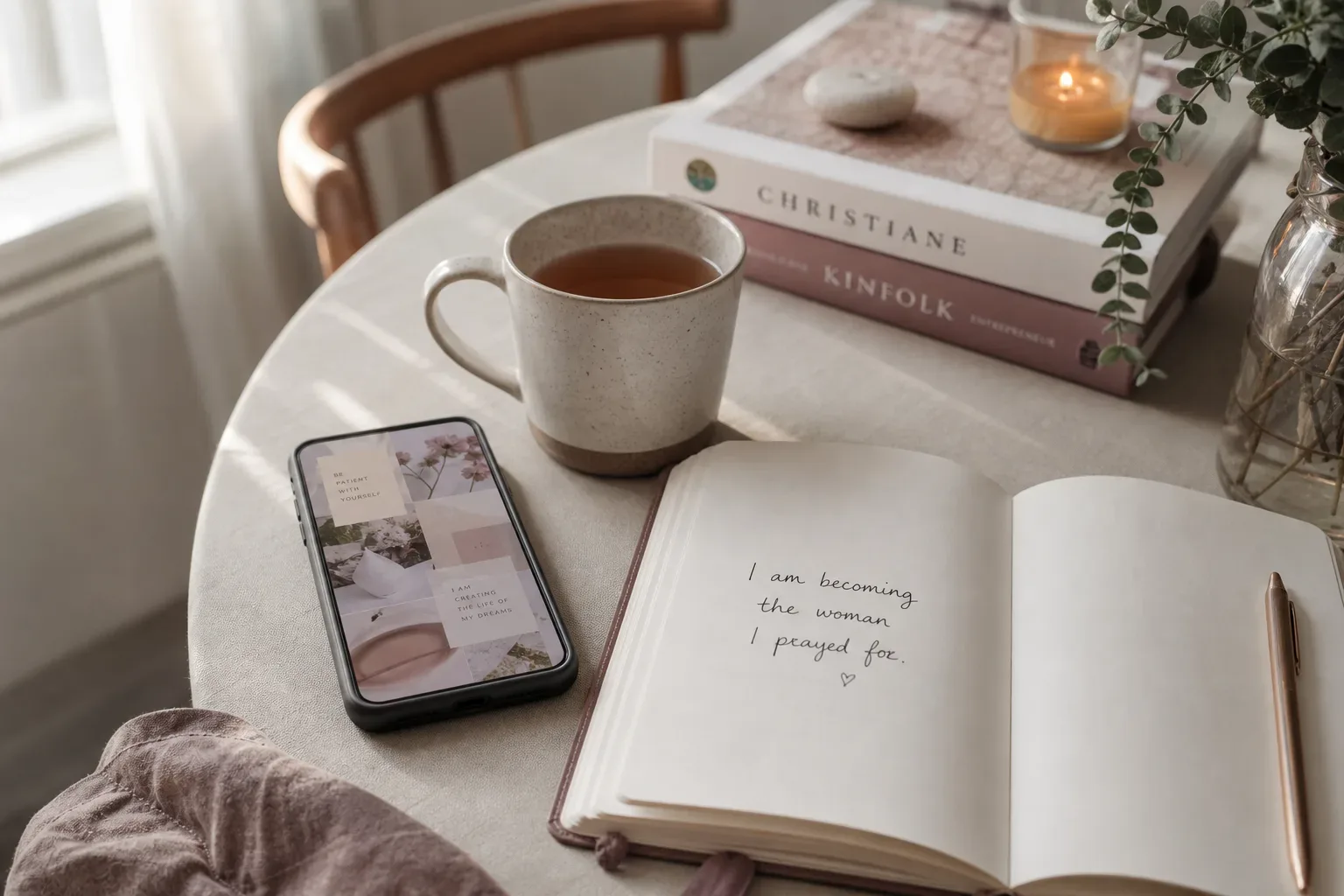
Your phone lights up on the kitchen table. A vision board wallpaper works best when you listen before you look: hear the future-self audio first, then let the image act as a quiet cue. The wallpaper isn’t the practice. It is the small visible aftertaste of a practice already begun.
Why should you listen before looking at a vision board wallpaper?
Listening first gives the wallpaper a memory to hold.
A phone image is quick. Too quick, sometimes. Reviews.org reported in 2023 that many Americans check their phones around 144 times a day, which means your lock screen can become either a small bell or more visual noise. The difference is what you place behind it. If you listen first, the image is no longer just a collage. It becomes a marker for a state you’ve already practiced.
The AYA Method is a daily audio manifestation practice. Each day you listen to a short personalized recording — your Dream-Self Moment — narrated from the version of you who has already manifested the life you intend. Listening is the practice. Repetition is the work. The audio is the method.
This matters because the screen is not very patient. It flashes. It asks. It pulls you toward messages, weather, errands, replies. Audio asks for a different kind of attention. A 2010 review by Emily Holmes and Andrew Mathews in Clinical Psychology Review described mental imagery as closely tied to emotion, often more strongly than verbal thought alone. Sound can help you enter the scene before you see its symbol.
A wallpaper can remind you, but listening teaches your body what the reminder means.
Neville Goddard called this living from the wish fulfilled. Joe Dispenza uses different language, often speaking about rehearsing a future self until it feels familiar. You don’t have to borrow every belief system to notice the practical point: repetition changes what feels normal. One minute of listening can make one glance less empty.
What makes a phone wallpaper different from a classic vision board?
A phone wallpaper is smaller, more frequent, and more easily ignored than a wall-based vision board.
A classic board asks you to stop and look. A phone wallpaper appears while you’re reaching for something else. Pew Research Center reported in 2024 that about 91% of U.S. adults own a smartphone, and among younger adults the number is even higher. That means the phone is often the most repeated visual surface in the day. Repetition is useful. Repetition is also how things disappear.
If your vision board only asks you to stare, it may become decoration.
A wall board can hold many images. A phone wallpaper cannot. It needs editing. Three images may work better than twenty. One sentence may be more useful than twelve. In habit research, Wendy Wood and David Neal wrote in 2007 that context cues help automatic behavior form over time. Your lock screen can be a cue, but only if it is simple enough to be recognized in less than 3 seconds.
| Format | Best use | Risk | Quiet correction |
|---|---|---|---|
| Wall vision board | Longer reflection | Too many wishes at once | Choose one area per month |
| Phone wallpaper | Frequent reminder | Becoming invisible | Pair it with audio first |
| Printed card | Desk or bedside cue | Getting misplaced | Keep it near one habit |
| App board | Flexible editing | Endless tweaking | Set a 7-day no-edit rule |
If you want a wider map of the practice, the manifestation guide gives the larger frame. For wallpaper, though, keep the frame narrow. Your phone is not a shrine. It is a door you open too often. Let the first thing you see be quiet enough to meet you there.
How do you make a vision board wallpaper that stays true?
Make it from one lived intention, three to five images, and one short phrase you can believe on an ordinary Tuesday.
Start after listening. Not before. When the audio ends, write down the scene that stayed with you. Maybe you saw yourself at a calm desk. Maybe you heard your own voice speaking with more steadiness. Maybe the only clear thing was light in a kitchen at 7:10 a.m. Small is not lesser. In many imagery studies, including sports psychology research reviewed across the 1990s and 2000s, specific rehearsal tends to outperform vague wishing because the brain has something concrete to repeat.
Then build the wallpaper around the smallest true signal. Use this order:
- Name the intention in one sentence.
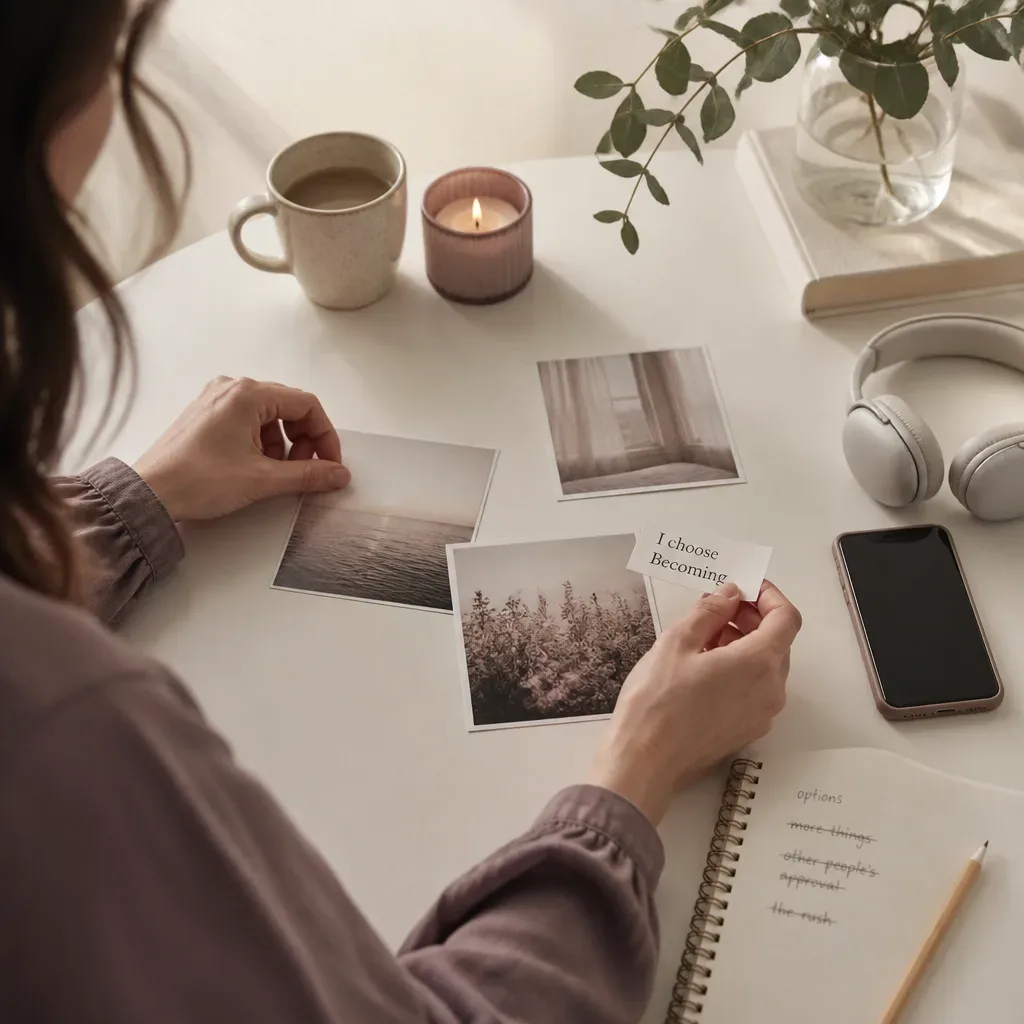
- Choose three to five images that match lived details.
- Add one phrase of six words or fewer.
- Leave empty space so the phone clock is readable.
- Set the image and keep it for 7 days.
The right image does not shout. It recognizes you.
Avoid images that make you feel late, behind, or falsely glossy. If a beach house makes your chest tighten, don’t use it. If a plain wooden table makes you breathe more slowly, trust that. Dr. Andrew Huberman has often noted in public teaching that visual focus and attention are linked through the nervous system. You don’t need a lab coat to test it. Notice what your eyes do. Notice what your shoulders do.
You can add words from your affirmations practice, but don’t crowd the screen. The daily affirmation can support the audio. It is not the center. The Manifestation Board can also hold a richer visual set inside the app. The wallpaper is just the tiny doorbell.
What should you listen to before you look?
Listen to a short future-self audio that describes the life as already lived, not as a demand you must chase.
The key is tense. A good Dream-Self Moment doesn’t scold you from the future. It speaks from the version of you who already knows the room, the rhythm, the ordinary details. That is why audio works differently from a written goal. A 2018 paper in Frontiers in Psychology on mental simulation noted that imagined future events can guide planning and emotion when they are vivid and self-relevant. Self-relevant is the whole thing.
You might listen for 60 to 180 seconds. That is enough for a small daily practice. The point is not to make yourself feel dramatic. The point is to return to a true inner picture often enough that it stops feeling like a performance.
Before looking at the wallpaper, listen for:
- one sentence that feels already true in your body
- one image you can place in a real room
- one action your future self takes that day
- one feeling that is steady rather than theatrical
- one word you can carry into the next hour
Some people like to pair this with astrology and manifestation, especially around new moons or personal transits. That can be a timing layer. Still, don’t let timing replace repetition. A moon phase can mark the page. Listening is what writes on it.
There is a quiet mercy in making the practice short. If it takes 45 minutes, you’ll start negotiating with it. If it takes 3 minutes, you can do it while the kettle warms.
How do you use the wallpaper without making your phone louder?
Use the wallpaper as a pause before the app, not as a reason to pick up the phone more often.
This is the part people forget. A vision board wallpaper lives on a device built to interrupt you. Data.ai has reported that people in many markets spend more than 4 hours a day on mobile devices, though exact time varies by country and age. So the question is not only what you put on the screen. It is how you meet the screen when it appears.
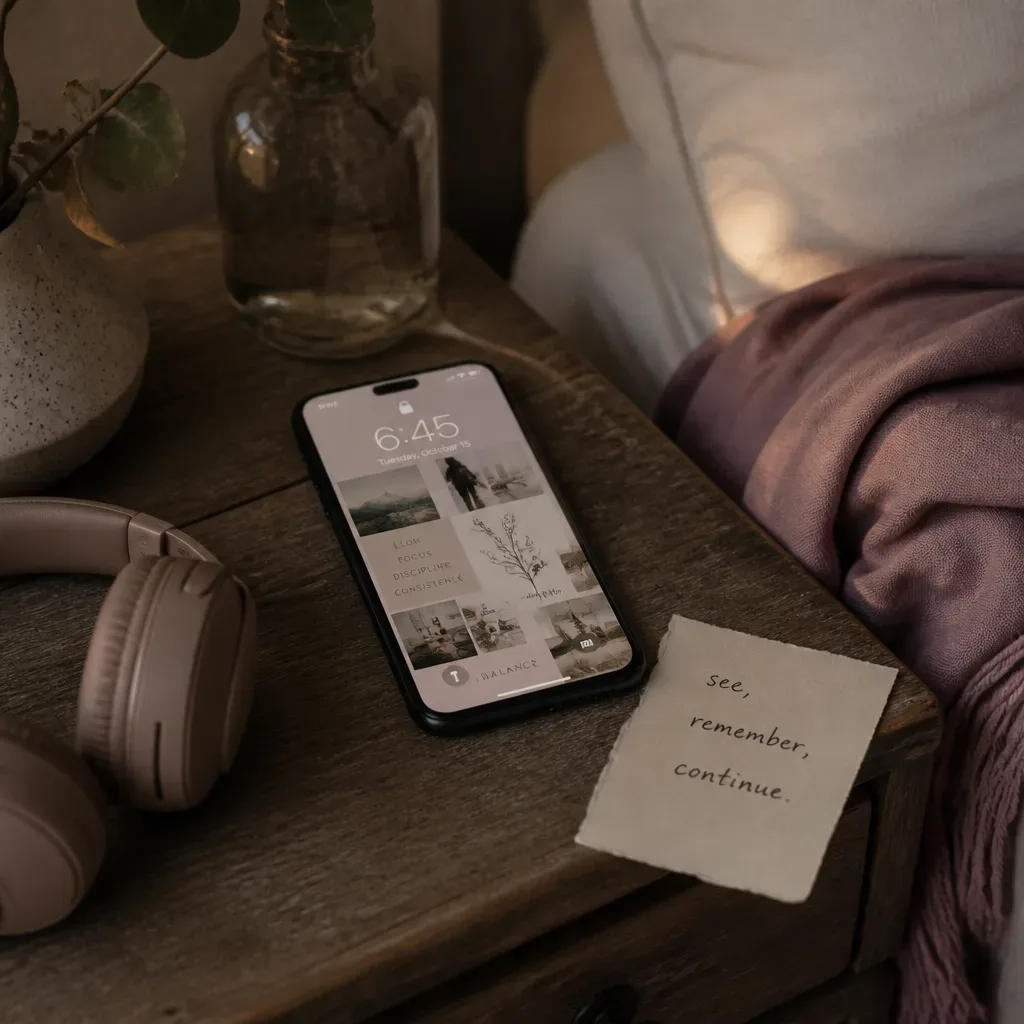
Try a one-breath rule. When the phone lights, look at the wallpaper for one inhale and one exhale before you unlock. If the breath feels like too much, use three words: see, remember, continue. You are not trying to turn every notification into ceremony. You are giving your attention a threshold.
The screen is not the spell; attention is.
A simple daily pattern can look like this:
- Morning: listen to your Dream-Self Moment before checking messages.
- After listening: look at the wallpaper once, slowly.
- During the day: use the one-breath rule only when you naturally pick up the phone.
- Evening: notice one action that matched the image, even if it was small.
If you use Aya’s Manifestation Board, let it hold the broader visual material. Let the wallpaper hold only the distilled version. If you’re reading more about vision board manifestation, keep this distinction close: the visible cue is a complement. The daily audio is the practice.
Princeton’s PEAR laboratory and later Global Consciousness Project reported small statistical anomalies in random event generator studies over decades; those findings are debated and shouldn’t be used as proof that a wallpaper changes reality. What you can say plainly is this: repeated attention changes choices. Choices change days.
How do you keep the wallpaper from becoming invisible?
Keep it stable long enough to matter, then review it before boredom turns into blindness.
The brain is very good at hiding what it sees too often. Psychologists call one part of this habituation: repeated exposure can reduce response. That is useful when you live near a train line. It is less useful when your lock screen was meant to wake you softly. A 7-day review is a kind compromise. Not frantic. Not stale.
Set a weekly note. Ask three questions, and answer them in under 5 minutes:
- Did I still notice the wallpaper this week?
- Did it connect to the audio, or has it drifted away?
- Did it lead to one real action, however small?
If the answer is yes, keep it. If the answer is no, change one thing only. Swap one image. Shorten the phrase. Remove clutter. Don’t rebuild the whole thing because you had one flat day. In behavior design, B.J. Fogg’s work at Stanford has emphasized tiny actions and reliable prompts. Your wallpaper is a prompt. It does not need to entertain you.
You may also rotate by season. Thirty days is a good container for one intention. It gives you enough repetition to feel the cue, and enough freshness to avoid numbness. If you use lunar timing, around 29.5 days matches a full lunar cycle. Use that if it helps you remember. Leave it if it makes the practice feel fussy.
The quietest test is this: when you see the wallpaper, do you come back to yourself or leave yourself?
What does a quiet seven-day practice look like?
A seven-day practice gives your vision board wallpaper enough repetition to become a cue without asking for a new personality by Friday.
Here is the simple version. It takes about 12 minutes to set up on day one, then 2 to 3 minutes each morning. James Clear popularized the idea that habits grow through cues, cravings, responses, and rewards, drawing from behavioral psychology rather than inventing the pattern. You don’t need the whole system here. You need a cue that points to a practiced state.
The seven days
| Day | Listening | Wallpaper action | Small proof |
|---|---|---|---|
| 1 | Hear the full audio | Set the wallpaper | Write the intention |
| 2 | Listen before messages | One-breath rule | Name one matching choice |
| 3 | Listen at the same time | Do not edit | Notice body response |
| 4 | Listen with eyes closed | Read the phrase once | Take one small action |
| 5 | Listen, then look | Keep the cue steady | Remove one distraction |
| 6 | Listen softly | Let the image be enough | Record one true detail |
| 7 | Listen and review | Keep or adjust one thing | Choose next week’s cue |
If you miss a day, don’t make the missed day interesting. Return the next morning. Research on habit formation by Phillippa Lally and colleagues in 2009 found that automaticity often took much longer than 21 days, with an average of 66 days in one study. Missing once did not erase the pattern. That is a relief.
The practice is not meant to make you stare harder at your life. It is meant to help you listen until the next honest action becomes easier to see.
You can keep the wallpaper. You can change it. Just don’t ask the image to do the listening for you.
Softly, the screen waits.