vision boards
Vision Board Categories After Your Dream-Self Audio
Choose vision board categories after your Dream-Self audio so the board stays quiet, specific, and true to the future self you heard.
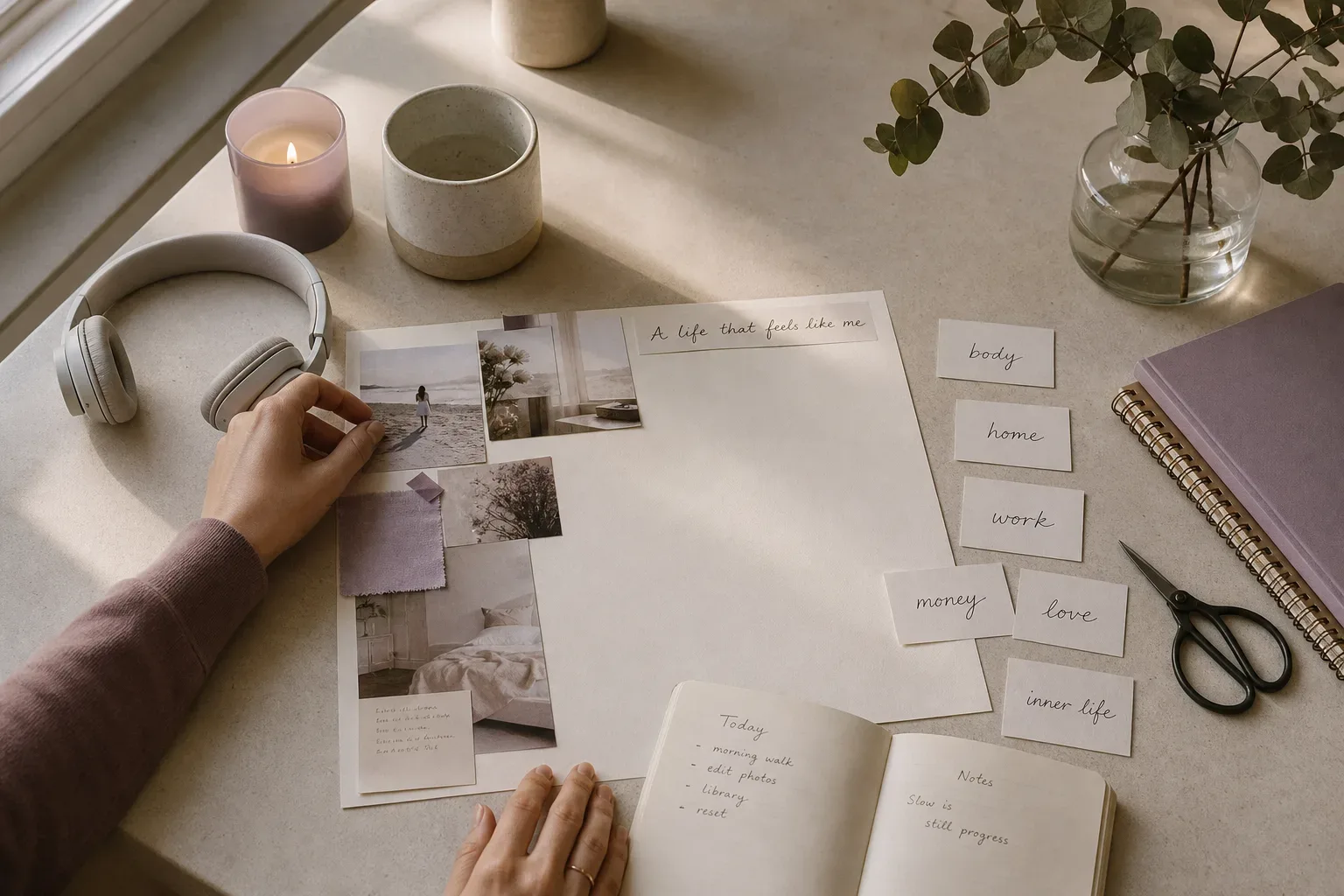
A cup sits beside your headphones. The audio has ended. The best vision board categories to choose now are the ones your future self made feel real: body, work, money, home, relationships, creativity, and inner life. Start with 5 to 7, then let the quietest category speak first.
Why choose vision board categories after the Dream-Self audio?
Choose categories after the audio because the sound gives the board its order.
The AYA Method is a daily audio manifestation practice. Each day you listen to a short personalized recording — your Dream-Self Moment — narrated from the version of you who has already manifested the life you intend. Listening is the practice. Repetition is the work. The audio is the method.
A vision board comes after that. It is not the center. It is the part you can see. If you build it before listening, the board can become a collage of other people’s symbols: white kitchens, soft bodies, wide desks, plane windows. After listening, you have a better question. Not, What should I want? But, What did I recognize?
That order matters because attention is limited. Cognitive psychologist Nelson Cowan’s 2001 review in Behavioral and Brain Sciences argued that working memory often holds about 4 meaningful chunks at once. A crowded board asks the mind to keep too many doors open. A quiet board gives the mind fewer doors, and clearer handles.
You are not decorating a future. You are naming what already felt true for 3 minutes.
If your Dream-Self Moment spoke with steadiness, your first category may be body. If it carried the feeling of being received, it may be relationships. If the voice sounded spacious, it may be home. This is why the wider practice of manifestation becomes steadier when it begins with listening rather than strain.
Which vision board categories deserve the first space?
The first space belongs to the category that produced recognition, not excitement.
Use the 7-category set below as a starting frame. You don’t have to use every word. You can rename each category so it sounds like yours. A board marked “home” may become “the room where I stop bracing.” A board marked “work” may become “clear service, clean calendar.” The name matters because labels guide attention; in a 2018 review in Trends in Cognitive Sciences, researchers described attention as a selective process, not a wide-open field.
| Category | What it holds | Good image signals |
|---|---|---|
| Body | Health, sleep, movement, ease | Water glass, walking shoes, linen sheets |
| Work | Craft, service, schedule, skill | Desk corner, hands working, calendar with white space |
| Money | Safety, receiving, clear numbers | Paid invoice, simple ledger, open wallet |
| Home | Place, rhythm, privacy, beauty | Window light, table, clean shelf |
| Relationships | Love, friendship, family, repair | Two cups, hands, a door held open |
| Creativity | Art, writing, voice, play | Notebook, brush, camera, half-made thing |
| Inner life | Prayer, silence, trust, self-respect | Candle, path, chair, morning shadow |
You can add one small phrase per category. Keep it under 6 words. Research on implementation intentions by Peter Gollwitzer, first formalized in 1999, showed that simple if-then planning can improve follow-through across many settings. A short phrase makes an image easier to act from.
A clear image is kinder than a dramatic one.
The point is not to make the board impressive. The point is to make it usable at 7:12 on an ordinary morning, when you are still half-asleep and deciding what kind of person you are practicing being.
How many categories are enough for one board?
Five to seven categories are enough for one vision board because the board should be remembered quickly.
If you choose 12 categories, you may feel thorough for one afternoon and lost by the next week. The brain likes pattern, but it also likes relief. In habit research, repetition and context do much of the work; a 2009 study by Phillippa Lally and colleagues in the European Journal of Social Psychology found habit formation took a median of 66 days, with wide variation. A board should support repetition for that long, not exhaust you on day 1.
Use this numbered sequence after you listen:
- Write down the 3 words that remained from the audio.
- Circle the word that feels most physical in your body.
- Choose 5 categories that serve that word.
- Add 1 optional category if something important is missing.
- Add 1 seasonal category if your life is in a clear passage, such as moving, healing, studying, or becoming a parent.
- Stop before the board starts explaining itself.
For example, if the 3 words are “steady,” “seen,” and “paid,” your board may need body, relationships, money, work, and home. Creativity can wait. Inner life may already be inside body and home. You are allowed to let one category rest.
This is a quiet rule: if you need to justify a category for more than 20 seconds, leave it out.
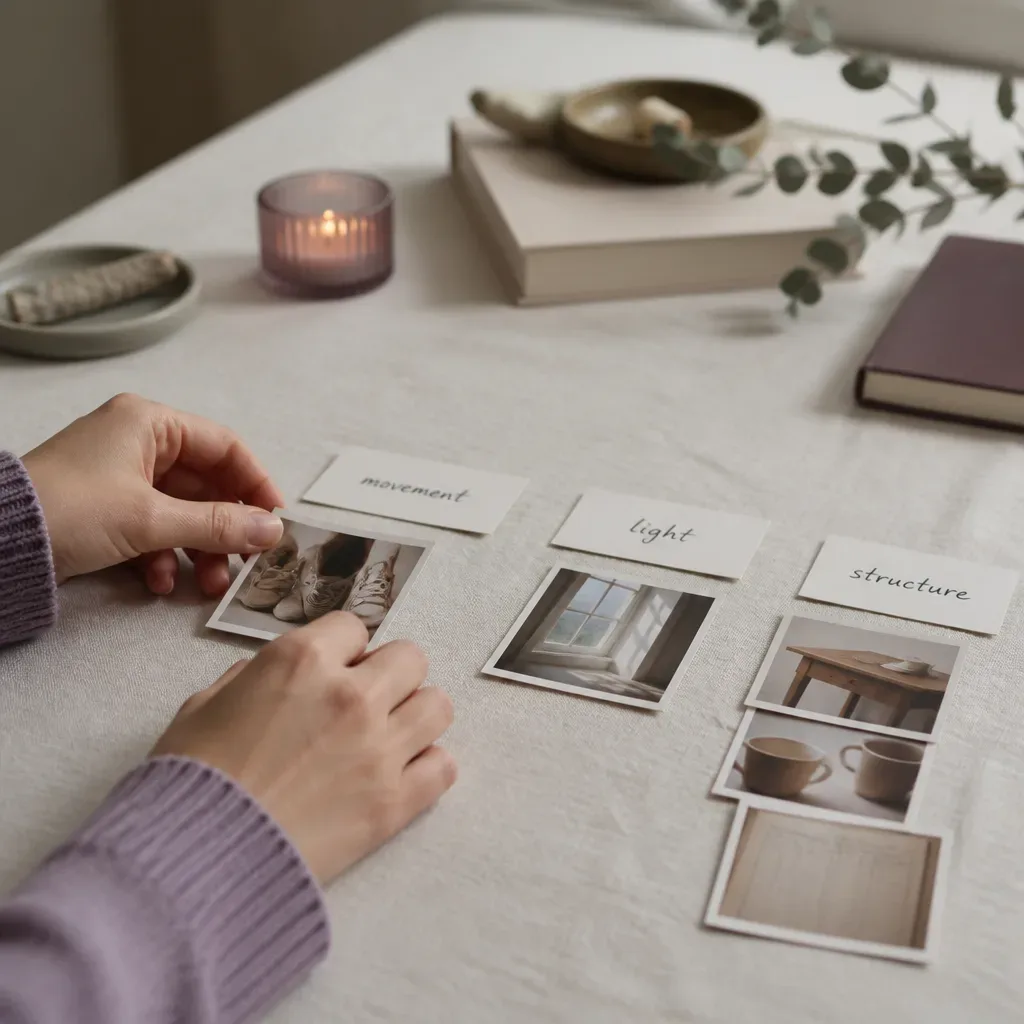
A good board has some blankness in it. In photography, negative space tells the eye where to land. In practice, negative space tells the self there is room to arrive.
What categories support body, home, work, and money?
Body, home, work, and money support the visible structure of your future self.
These 4 categories are often the most practical. They answer the questions that live close to the skin: How do I wake? Where do I sit? What do I do with my hours? What numbers do I need to face? The American Psychological Association has reported for years that money and work remain common stress sources in the United States; in its 2023 Stress in America reporting, adults continued to name money and the economy among major concerns.
For body, choose images that show care, not punishment. A glass of water. A walk after dinner. A hand on the chest. If you use a body image, make sure it gives you steadiness rather than comparison. Your nervous system can tell the difference before your mind admits it.
For home, choose what restores you in 10 seconds. A chair by a window. A key in a bowl. A made bed. The home category is not only about property. It is about the way your shoulders lower when you enter your own life.
For work, make the category specific. Not “success.” Use a photo of the tool, the page, the hand, the calendar. Dr. Andrew Huberman often speaks about the role of attention and deliberate practice in skill learning; the basic point is simple enough to carry here. What you repeatedly attend to becomes easier to return to.
For money, stay clean and adult. Use numbers if numbers help. A paid invoice for 1,200. A debt line crossed out. A savings note marked 500. Money images work best when they point to clarity, not fantasy.
The board is not asking you to perform certainty. It is asking you to practice contact.
What categories support relationships, creativity, and inner life?
Relationships, creativity, and inner life support the invisible weather around your choices.
These categories can become vague if you let them. Keep them tender, but concrete. For relationships, choose images of reciprocity: 2 cups on a table, a message answered, a doorway, a shared meal. A 2023 advisory from the U.S. Surgeon General named social connection as a public health concern, noting that social disconnection can carry risks comparable to well-known health factors. Connection is not decorative. It is biological.
For creativity, choose evidence of practice rather than praise. A notebook with 3 lines. A camera strap on a chair. A lump of clay. A draft. The category should remind you to make, not to be admired. Margaux’s rule from years behind a lens is plain: the image arrives after you stop trying to take it by force.
For inner life, be careful with borrowed symbols. Use what actually returns you to yourself. A candle if you light candles. A church step if you pray there. A bare floor if sitting still is your truest ritual. If you work with affirmations, let one line support the image. The affirmation is a complement. It is not the main practice.
You may also keep a small category for timing. Some readers like to pair visual practice with lunar or seasonal reflection; if that helps you notice cycles without outsourcing your choices, read astrology and manifestation with a grounded eye. The sky can be a calendar. It does not have to be a command.
Use these quiet category prompts:
- What kind of love do I practice when no one is watching?
- What do I make even before it is praised?
- What returns me to myself in under 5 minutes?
- What symbol feels old, honest, and mine?
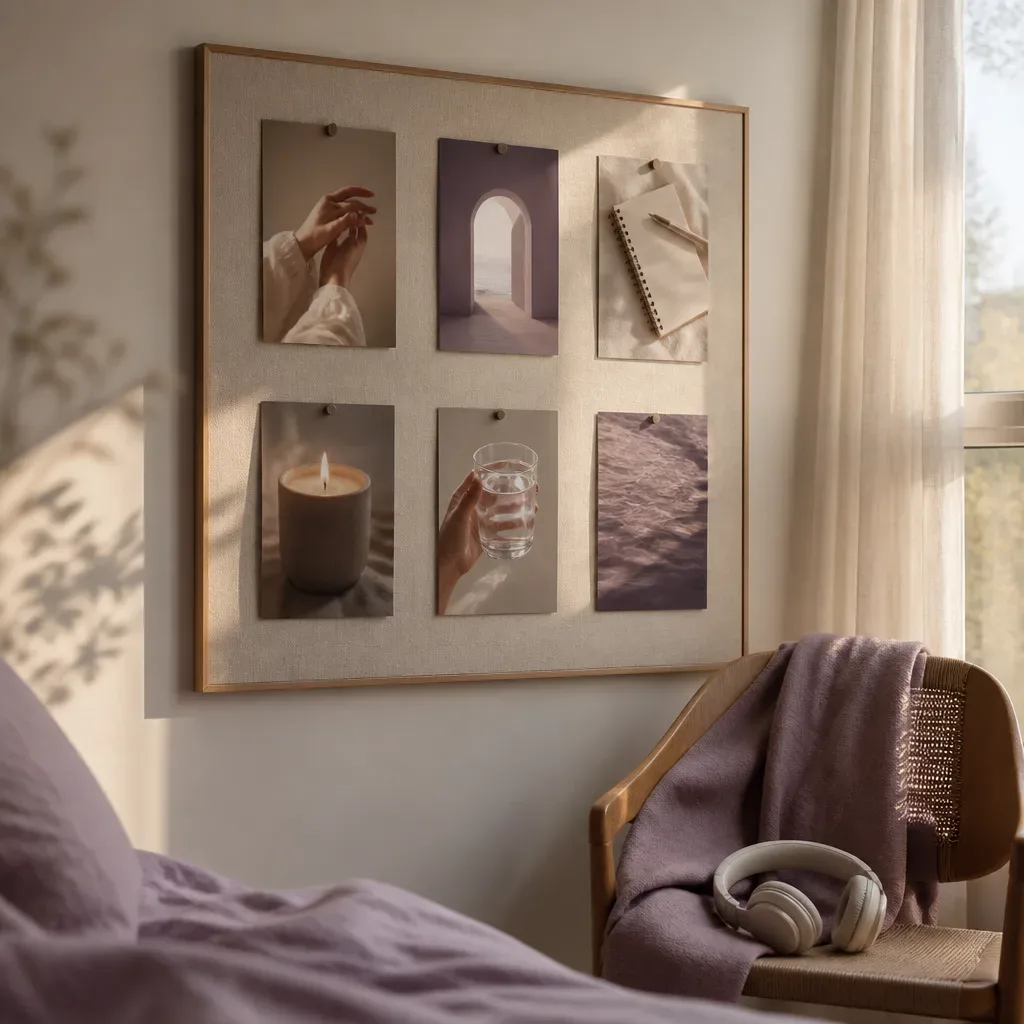
A category is true when it makes your next small action more visible.
How do you choose images once the categories are set?
Choose images that show evidence, not spectacle.
After your categories are named, give each one 3 to 5 images. That means a 6-category board may hold 18 to 30 images. More than that, and the board can become a wall of noise. The goal is not to cover every inch. The goal is to create recognition in under 30 seconds.
Here is a simple selection test:
| Test | Ask this | Keep it if |
|---|---|---|
| Body test | Do I soften when I see it? | Your breath changes within 3 breaths |
| Truth test | Is this mine or copied? | You can name why it matters |
| Action test | Does it suggest one behavior? | You know what to do today |
| Time test | Will it still speak in 30 days? | It feels steady, not trendy |
Mental contrasting research by Gabriele Oettingen, described in her 2014 work on WOOP, suggests that pairing a desired future with present obstacles can support action better than positive imagery alone. So let one image in each category show the bridge, not only the arrival. For body, the bridge may be walking shoes by the door. For money, it may be a budget page. For work, it may be a 25-minute timer.
This is where a visual board differs from a wish list. A wish list says, “There.” A board says, “Here is the next touch.”
If you use the Aya app, the Manifestation Board can sit beside the audio practice, and the daily affirmation can give language to one image. Still, when time is short, return to the audio. Listening comes first. The board waits its turn.
How do you keep the board quiet after it is made?
Keep the board quiet by reviewing it briefly, editing it monthly, and letting the audio remain the center.
A board becomes loud when it asks for too much attention. Give it a small ritual instead. Look at it for 60 to 90 seconds after your Dream-Self Moment. Choose one category. Take one action that belongs to that category before the day closes. That may be sending the message, drinking the water, opening the invoice, clearing the table, or writing 4 bad lines.
You can use this 30-day review rhythm:
- On day 1, make the board after listening.
- On days 2 through 7, only look. Do not edit.
- On day 14, remove any image that feels false.
- On day 21, add 1 bridge image if action is missing.
- On day 30, keep, simplify, or make a smaller board.
Thirty days is long enough to notice a pattern and short enough to stay honest. In clinical and behavioral settings, self-monitoring is often used because noticing changes behavior; a 2011 review in Psychological Bulletin found that monitoring progress toward goals is associated with better goal attainment, especially when records are made or shared.
If your board becomes a performance, lower the number of categories. If it becomes invisible, move it closer to where you listen. If it begins to shame you, take it down for 3 days. Nothing true needs to frighten you into becoming.
For more grounding, keep the manifestation overview close, and return to the AYA Method when you forget the order. Audio first. Image second. One small act after that.
The future self is not louder than you. She is nearer.
Stay with what you heard.
Listen on Aya
