manifestation 101
Visualization Manifestation When You Can’t Picture It
Visualization manifestation can feel closed to people who can’t picture clearly. Future-self audio offers another way to rehearse what’s becoming real.
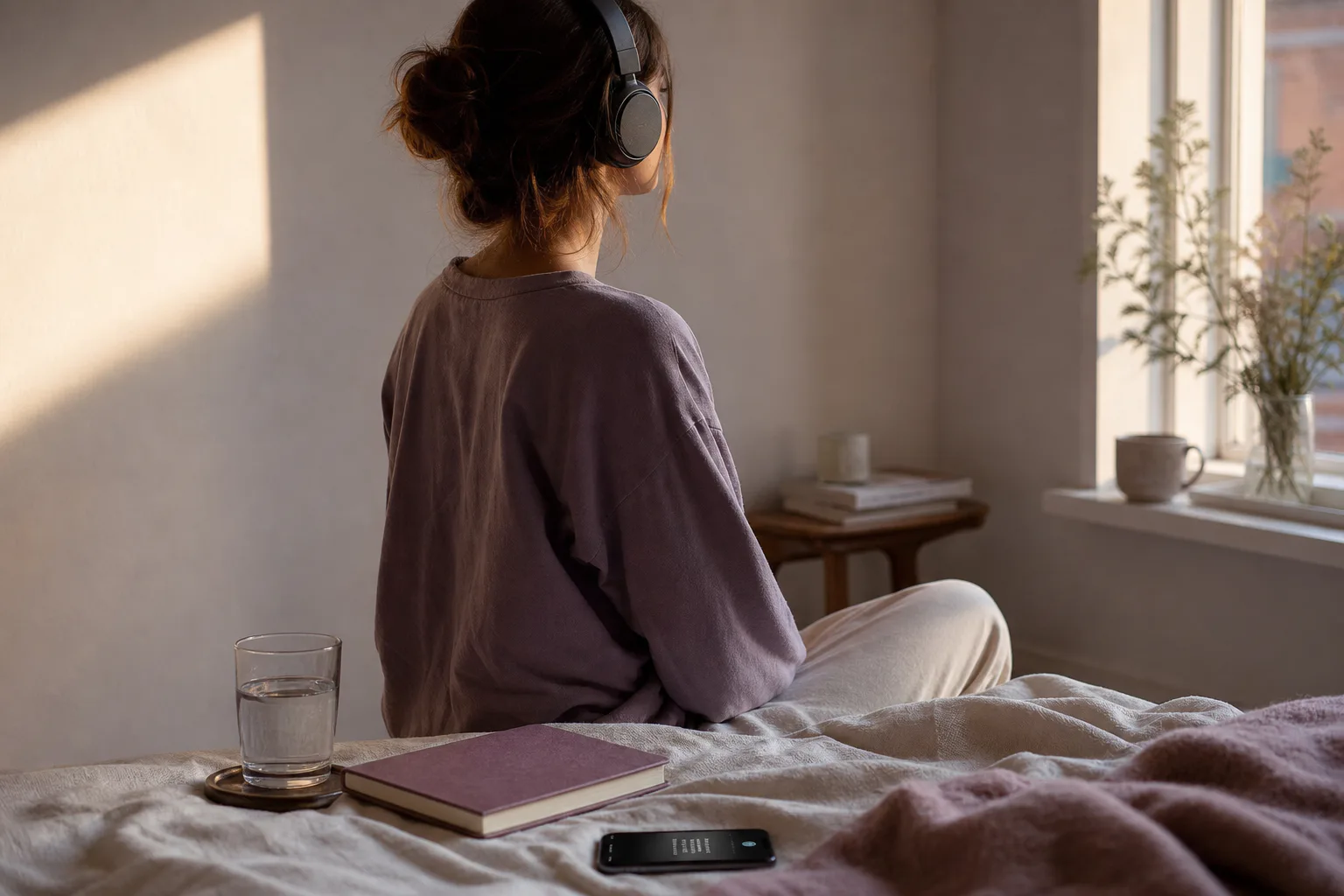
The ceiling is blank. So is the mind. Visualization manifestation can still be practiced when you can’t picture it, but the doorway may be sound instead of image. Future-self audio gives the nervous system a repeatable future to hear, remember, and slowly recognize as yours.
Why does visualization manifestation feel impossible for some people?
Visualization manifestation feels impossible when the practice asks for pictures your mind doesn’t make on command.
Some people close their eyes and see a kitchen, a face, a blue door, a future morning. Some people close their eyes and see nothing. Not darkness, exactly. Just no picture. Francis Galton wrote about these differences in mental imagery as early as 1880, when he asked people to describe their breakfast table and found wildly different answers. More than a century later, neurologist Adam Zeman and colleagues gave the name aphantasia to the lack of voluntary visual imagery. Estimates vary, but recent papers often place it around 1 to 4 percent of people.
That number matters. It means you’re not failing because you can’t build a bright scene in your mind. Your inner system may simply work with different materials. Some readers hear words clearly. Some know the shape of a future without seeing it. Some feel an answer in the chest, the throat, or the way the shoulders lower. A picture is one language. It isn’t the only language.
This is where a lot of manifestation advice gets too narrow. It tells you to see it clearly, as if clarity always looks visual. The wider practice of manifestation is about sustained attention, meaning, and repeated return. Mental imagery can support that. It can also become a locked door.
A practice that makes you feel defective is not a practice. It’s a room with bad lighting.
The research is careful here. Mental rehearsal has evidence in sport, skill learning, and behavior change, but it doesn’t mean an image alone causes an event. In a 1998 study by Shelley Taylor and colleagues, students who mentally rehearsed the process of studying tended to do better than those who only pictured the outcome. The lesson is quiet and practical: the mind benefits from rehearsal it can believe.
Is future-self audio still a form of visualization?
Future-self audio is a form of future rehearsal, but it doesn’t require the mind’s eye to perform.
When you listen to a future-self recording, you’re still meeting a version of yourself ahead of the current day. The difference is that the cue arrives through sound. Voice has structure. It has pacing. It has breath. It can carry the details your image system refuses to draw. Cognitive psychology has studied the phonological loop since Baddeley and Hitch described it in 1974. Put simply, the mind can hold and repeat sound-based information in ways that shape memory and attention.
This matters for people who can’t picture it. A sentence can become a room. A tone can become permission. A phrase repeated daily can become a handrail. If visual imagery says, see this, future-self audio says, listen until you know it.
Here is the clean difference:
| Practice | Main cue | Best for | Common friction |
|---|---|---|---|
| Visual imagery | Inner pictures | People with vivid mental scenes | Pressure to see details clearly |
| Scripting | Written language | People who think through words | Can become too long or performative |
| Future-self audio | Voice and repetition | People who respond to sound | Needs quiet daily return |
| Affirmations | Short present-tense phrases | People needing a small cue | Can feel thin without context |
The app also includes a daily affirmation and Manifestation Board as complements. They can help. They’re not the center. If you want the difference between short phrases and deeper rehearsal, the affirmations pillar is a useful place to read slowly.
A future that can’t be seen can still be heard.
In small studies on auditory imagery, people show wide variation in how vividly they can hear music, voices, or sounds in the mind. The same is true for visual imagery. A practice becomes kinder when it respects those differences instead of pretending every mind opens the same way.
Which works better when you can’t picture it?
Future-self audio usually works better than picture-based visualization when your mind doesn’t generate voluntary images.
The word better needs care. It doesn’t mean more magical. It means more usable. A practice you can repeat for 3 minutes every day will usually matter more than a practice you avoid for 30 minutes once a month. In habit research, repetition in a stable context is a central ingredient. A 2009 study by Phillippa Lally and colleagues found that habit formation took a median of 66 days, with wide variation across people and behaviors. The exact number isn’t a rule. The pattern is the point.
If image-based visualization makes you tense, you may spend the whole practice checking whether you’re doing it right. That self-monitoring becomes the real rehearsal. You rehearse not-enoughness. Future-self audio removes one layer of effort. You press play. You listen. You return tomorrow.
That doesn’t make visual practice useless. Some people with dim imagery still benefit from simple sensory prompts: the weight of a mug, the sound of keys in a door, the first email sent from a new desk. Others prefer words. Others prefer movement. The question isn’t what counts as real manifestation. The question is what your system can receive without bracing.
Use this simple comparison:
- If you can picture clearly, visual imagery may feel natural.
- If you know but don’t see, audio may fit better.
- If you think in language, scripting can help before listening.
- If you freeze under big goals, choose a 2-minute practice.
- If you want a visible reminder, add a board after the audio.
Research on future-self continuity, including work by Hal Hershfield, suggests that feeling connected to your future self can influence choices such as saving money and long-range planning. One well-known line of studies used age-progressed images to help people feel closer to their older selves. Audio can do something related without requiring an image: it lets the future self speak in a familiar voice.
The practice that works is the one you can bear to repeat.
How does the AYA Method use audio without making you force an image?
The AYA Method places the audio first, so you don’t have to create a scene before the practice can begin.
The AYA Method is a daily audio manifestation practice. Each day you listen to a short personalized recording — your Dream-Self Moment — narrated from the version of you who has already manifested the life you intend. Listening is the practice. Repetition is the work. The audio is the method.
That last sentence is not decorative. It protects the practice from becoming a list of tasks. You don’t need to stare at a board until you feel convinced. You don’t need to repeat a phrase 108 times, unless that helps you. You don’t need to produce a mental movie. You listen to the Dream-Self Moment, and the recording carries the frame for you.
This is especially useful when visual effort creates strain. A person might not be able to see herself in a calmer home, a different job, or a repaired relationship. But she may be able to hear the way she speaks after the change has settled. She may hear steadiness. She may hear less apology. She may hear a sentence she can almost believe.
There is also a time advantage. Many daily audio practices are short, often 2 to 5 minutes. That length matters because adherence drops when a practice feels too large for an ordinary day. Pew Research Center has reported for years that smartphones are near-constant companions for most adults in the United States; in 2024, smartphone ownership was above 90 percent among U.S. adults. A short audio practice fits the device people already touch before tea, trains, and email.
The quieter truth is this: audio doesn’t ask you to prove anything. It asks you to listen again.
What should you do when the picture doesn’t come?
When the picture doesn’t come, stop chasing it and give the future another sense to arrive through.
You can begin with sound. You can begin with one sentence. You can begin with the bodily fact that your jaw is unclenching. In mindfulness and behavior-change research, attention is often treated as trainable, not fixed. A 2011 review in Clinical Psychology Review found mindfulness-based interventions associated with improvements in anxiety and mood across many studies, though results vary. The point for manifestation practice is modest: attention can be practiced without making a perfect image.
Try a small reset before any visualization manifestation practice:
- Name the desire in 7 words or fewer.
- Notice one sound in the room.
- Place one hand somewhere steady.
- Listen to a future-self audio once.
- Write one sentence that felt true.
- Stop before you start performing.
This is not less than visualization. It’s another route into the same human need: to rehearse a truer way of living before the day has fully caught up. Neville Goddard taught the feeling of the wish fulfilled, and many readers remember that line as image-based. But feeling is not always visual. Sometimes feeling is the absence of the old flinch.
You can also use a visible support without asking it to do the whole job. A Manifestation Board can hold images, words, symbols, or colors. It can be plain. It can be a note in your phone. The visual object is useful when it points you back to the audio, not when it becomes another place to judge your taste.
If you like timing your practice with the moon or your birth chart, read astrology and manifestation as a companion, not a command. Timing can be tender. It shouldn’t become another test.

How do you choose between visualization and future-self audio?
Choose the practice that gives you the clearest return with the least inner force.
A good comparison is not a contest. It’s a way to stop wasting pain. If visual imagery feels alive to you, use it. Picture the room. Picture the email. Picture the face you make when you no longer bargain with your own knowing. If the picture is absent, don’t keep knocking on that door until your hand hurts.
Ask yourself these questions after 7 days, not after one attempt:
| Question | If yes | If no |
|---|---|---|
| Did I repeat it at least 5 days? | Keep testing | Make it shorter |
| Did my body soften during practice? | Continue | Change the cue |
| Did I act differently once this week? | Notice the action | Reduce the goal |
| Did I feel shame about doing it wrong? | Simplify | Choose audio first |
Seven days is not a miracle measure. It’s just enough to see a pattern. Behavior scientists often distinguish motivation from cue design. BJ Fogg’s work at Stanford, for example, emphasizes tiny behaviors and prompts because large changes often fail when they depend on mood. A future-self audio practice benefits from the same humility. Make the cue small. Make the return obvious.
For a broader foundation, keep visualization manifestation inside a real practice of attention, choice, and repetition. If you need the method itself, return to the AYA Method and let the Dream-Self Moment carry the part you’ve been trying to manufacture alone.
You’re allowed to manifest without seeing a single bright picture.
The room stays quiet, and you still know where to return.