audio manifestation
Walking Manifestation Meditation in 3 Minutes
Try a walking manifestation meditation with 3-minute Dream-Self audio: a quiet way to pair movement, attention, and future-self rehearsal.

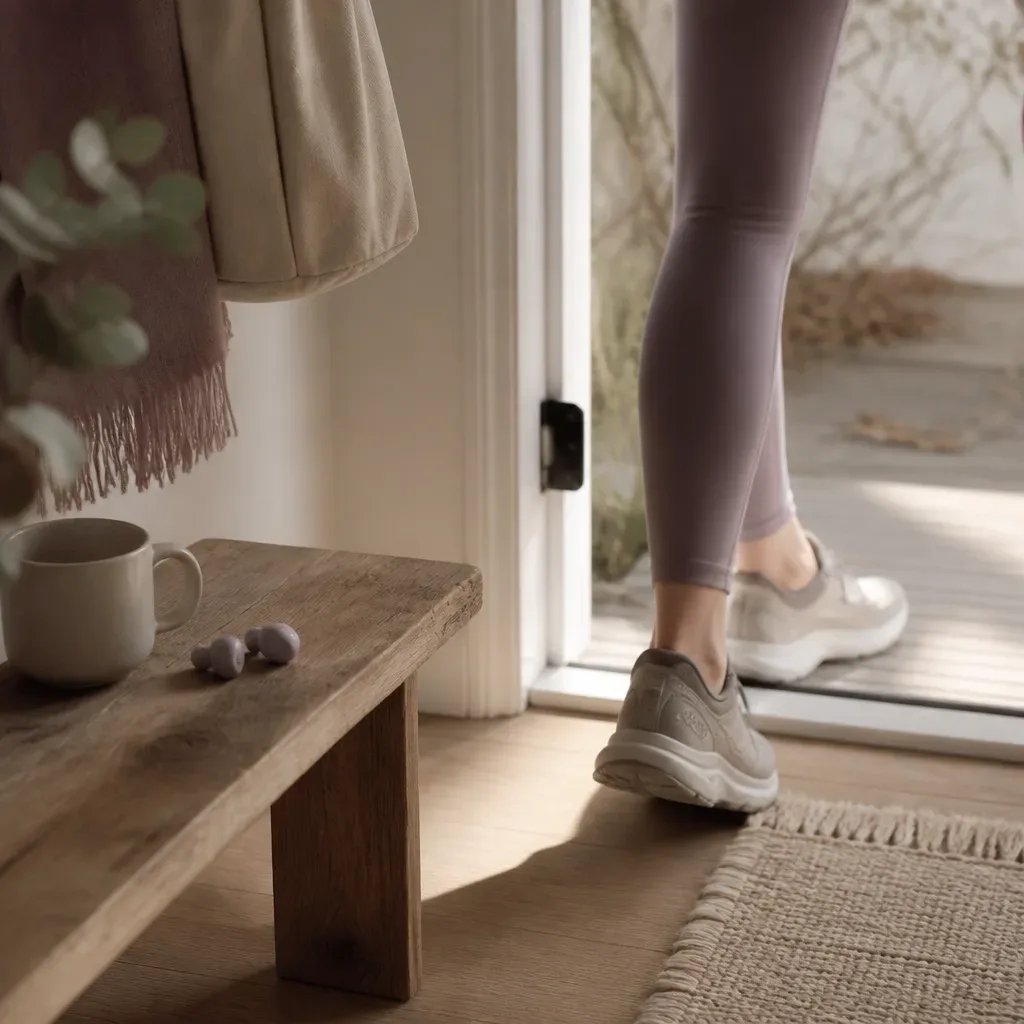
Shoes by the door. A walking manifestation meditation is a short walk where you listen to your Dream-Self audio and let the body rehearse belief. For this practice, use 3 minutes: settle your pace, play the recording, listen without forcing, and return once to the future self that already feels true.
What is walking manifestation meditation, really?
Walking manifestation meditation is future-self rehearsal done while your body moves at an easy, steady pace.
It is not a performance. It is not a long silent retreat. It is closer to walking to the kettle before dawn, still half inside sleep, and hearing one sentence that names the life you are practicing toward. The body is moving. The mind has a rail to hold. The audio keeps you from making the whole thing too hard.
The the AYA Method is a daily audio manifestation practice. Each day you listen to a short personalized recording — your Dream-Self Moment — narrated from the version of you who has already manifested the life you intend. Listening is the practice. Repetition is the work. The audio is the method.
That matters here. Walking is not replacing the audio. Walking is giving the audio a body. The daily affirmation and Manifestation Board can sit beside the practice, the way a cup sits beside a notebook. They are complements. The core remains the voice you hear, the version of you who speaks as if the intended life is already known.
Research gives this small ritual a practical spine. The 2018 U.S. Physical Activity Guidelines removed the old idea that movement had to last at least 10 minutes to count. Short bouts matter. The World Health Organization still suggests 150 to 300 minutes of moderate activity weekly for adults, but a 3-minute walk can be the thread that helps you begin.
A body in motion gives the mind fewer places to hide.
If you have read about manifestation, you already know the practice is not only wishing. It is attention, repetition, and identity rehearsal. Walking adds rhythm. A step can become a metronome for the sentence you are learning to believe.
Why does walking help the Dream-Self audio land?
Walking helps because steady movement can soften mental noise while keeping you awake enough to listen.
Most people know the strange split: sitting still can make the mind louder. Harvard psychologists Matthew Killingsworth and Daniel Gilbert reported in 2010 that people’s minds wandered 46.9% of the time in their sample of 2,250 adults. Walking gives that restless part of you something simple to do. Step. Breathe. Hear. Return.
There is also the matter of forward motion. Neuroscientist Dr. Andrew Huberman has often discussed optic flow, the visual motion that happens when you move through space, and its calming link to threat circuits. The research is wider and still developing, but you do not need to turn it into a theory. You can test the plain version. When your eyes and feet move forward, the mind often stops clenching so tightly.
A 2014 Stanford study by Marily Oppezzo and Daniel Schwartz found that walking increased creative output by about 60% compared with sitting in their tests. Creativity is not the same as manifestation, but both ask the mind to loosen its old edges. A Dream-Self audio can enter more gently when you are not staring at a wall, trying to become someone by force.
This is why 3 minutes is not too small. Three minutes is 180 seconds of paired cues: sound, movement, breath, and future-self language. In behavioral science, cues matter. Wendy Wood’s habit research often points to context repetition as a key part of automatic behavior. Same shoes. Same corner. Same voice. The mind begins to know where it is going.
Use this simple comparison:
| Practice choice | What it asks of you | Best use |
|---|---|---|
| Sitting visualization | Stillness and inner image | When you can focus quietly |
| Written scripting | Time, language, reflection | When you need clarity on details |
| Walking manifestation meditation | 3 minutes, headphones, safe route | When your mind is noisy but willing |
| Daily affirmation | One sentence repeated gently | As a complement before or after audio |
The walk does not need to be beautiful. It needs to be repeatable.
How do you prepare for a 3-minute walking manifestation meditation?
Prepare by removing decisions before you press play.
Choose a route so familiar that your mind does not need to manage it. A quiet hallway counts. A garden path counts. Around one block counts. If you are outside, keep the volume low enough to hear cars, bicycles, dogs, and other people. The National Highway Traffic Safety Administration reported 7,522 pedestrian deaths in the United States in 2022. Safety is not separate from practice. Safety is part of listening.
Then choose your time. Morning is tender because the mind has not yet collected as many messages. But if morning is crowded with children, work, tea, medication, or the weather, do not make it holy in a way that turns against you. A 3-minute practice at 2:10 p.m. is still a practice. Lally and colleagues, writing in the European Journal of Social Psychology in 2009, found habit formation averaged 66 days, with wide variation. Repetition is more important than mood.
Before you begin, let the app do what it is here to do. Use the Dream-Self Moment. If you also keep a daily affirmation, choose one sentence only. The affirmations page can help you understand why a short line works best when it is believable enough to repeat. Too many sentences make the mind bargain. One true sentence gives it a place to rest.
Here is a quiet setup:
- Put on shoes that do not ask for attention.
- Open the 3-minute Dream-Self audio.
- Set the volume low and kind.
- Stand still for one breath before moving.
- Start walking on the first sentence.
I learned this the way I learned most things from plants: not by rushing the leaves. In my greenhouse, rosemary takes its time after pruning. People do too. A small ritual done daily can be stronger than a grand one done once.
What should you do during the 3 minutes?
During the 3 minutes, let listening lead and let walking keep you present.
The first minute is for arriving. Feel the ground under the feet. Notice the air at the nose. Let the voice speak before you decide whether you believe it. Neville Goddard called this the feeling of the wish fulfilled, but the phrase can sound too large when you are tired. Make it smaller. You are not trying to convince the sky. You are letting one future-self sentence become familiar in the body.
The second minute is for receiving the scene. If your Dream-Self Moment names a home, a relationship, work, money, health, or peace, do not strain to see every detail. Strain is usually fear dressed as discipline. Let one detail come. The cup in your hand. The clean desk. The calm reply. Joe Dispenza often teaches mental rehearsal as a way the brain practices a future response before the outer event arrives. You can keep the useful part without making it loud.
The third minute is for belonging to it. Walk as if the intended life has already made room for your ordinary body. Not a different body. Not a perfect day. This one. Research on implementation intentions by psychologist Peter Gollwitzer has shown that if-then plans can improve follow-through across many goals. Your if-then can be very plain: if I put on my shoes, then I press play.
A simple 3-minute map:
- Minute 1: feet, breath, voice.
- Minute 2: one detail from the intended life.
- Minute 3: one sentence of belonging.
The future self becomes less distant when you stop arguing with the first step.
If thoughts interrupt, they have not ruined anything. In mindfulness-based interventions, including studies published in the Journal of Behavioral Medicine, the return of attention is often treated as the practice itself. You return to the voice. You return to the feet. You return without scolding.
How do you keep the practice from becoming another task?
You keep it soft by making the practice smaller than your resistance.
Do not add incense, candles, journaling, stretching, tea, cards, and a perfect playlist unless they truly help. I say this as a herbalist with too many jars. Ritual can become clutter when every object asks to be managed. The AYA app may also include a Manifestation Board and daily affirmation, but for this walk, the audio stays first. Three minutes is the fence around the garden.
The American Psychological Association has reported that stress affects attention, sleep, and decision-making for many adults, with its 2023 Stress in America survey noting money and health among common sources. When the mind is already carrying too much, a ritual should not behave like another unpaid bill. A walking manifestation meditation should feel possible on a plain Tuesday.
Set a low bar, then keep it. James Clear popularized the 2-minute habit rule, and the principle is old: make the beginning easy enough that you cannot hide from it. Here, the beginning is 3 minutes because the audio has a full shape. Still, the doorway is small. Shoes. Play. Walk.
You can also protect the practice with boundaries:
- No checking messages during the walk.
- No editing the Dream-Self audio while walking.
- No judging whether you felt enough.
- No turning one missed day into a verdict.
- No comparing your practice to anyone else’s.
The astrology and manifestation connection can be tender if timing helps you listen. A new moon walk, for example, may give your mind a clean marker. But the date is not the method. The audio is. The walk is how you carry it.
How can you make the Dream-Self audio feel more personal?
Make it personal by listening for the details that sound like your actual life, not a borrowed fantasy.
A Dream-Self Moment works best when it speaks from the version of you who has already crossed a real threshold. That may be the you who wakes without dread. The you who speaks kindly in the kitchen. The you who sends the application. The you who pays the bill with a steady hand. Specificity matters. In memory research, concrete cues tend to be easier to recall than vague ones, a pattern shown across decades of cognitive psychology.
If you want to refine what you are hearing, do it outside the walk. After the 3 minutes, jot down one line: what felt true, what felt false, what detail stayed. This is where audio manifestation becomes less abstract. The recording is not meant to impress you. It is meant to meet you at the exact door you are ready to open.
Princeton’s PEAR lab and the later Global Consciousness Project are often mentioned in manifestation circles. Their claims remain debated, and they should be held with care. You do not need uncertain science to justify a daily listening practice. The stronger ground is known: attention can be trained, habits can be cued, and mental rehearsal is used in fields from sport to therapy.
If the audio feels too far away, soften the language. The nervous system often resists sentences that sound false. A line like “I am safe in the next right step” may land better than a grand claim. The manifestation practice becomes steadier when it tells the truth at the edge of belief.
Your future self does not need to shout to be recognized.
The detail that matters is usually small. A calmer breath. A cleaner yes. A door you do not reopen.
What should you do after the walk ends?
After the walk, close with one breath and one remembered sentence.
Do not rush to measure the practice. The old mind will ask whether it worked. It may ask before you have even taken off your shoes. Let that question pass. A 3-minute walking manifestation meditation is not a slot machine. It is a daily vote for the self you are becoming familiar with. In habit studies, consistency usually beats intensity. In life, too.
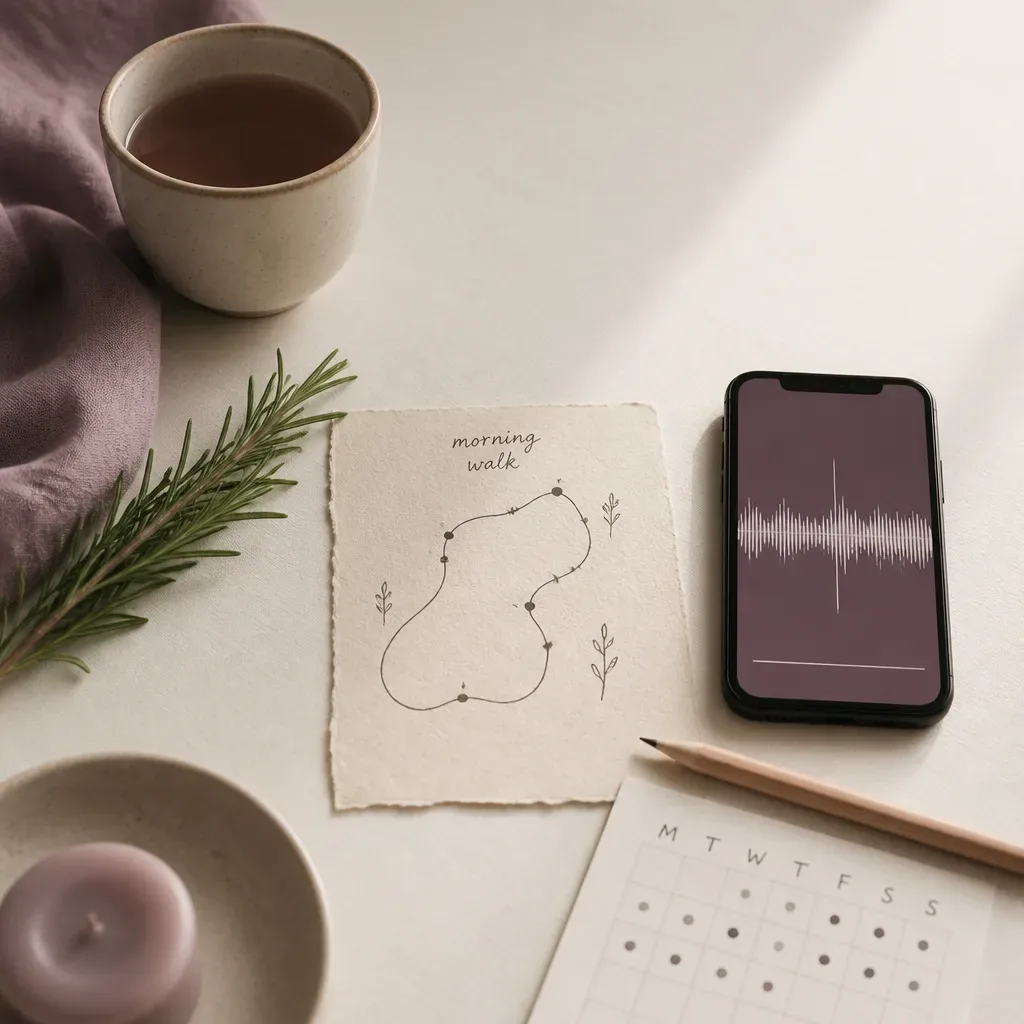
If you want a record, keep it almost too simple. Mark a dot on a calendar. Write one sentence. Save one word. The Manifestation Board can hold an image later, and a daily affirmation can echo the line you heard, but the closing should stay quiet. The practice ends when you have listened, not when you have explained it.
Here is a 10-second close:
- Stop walking.
- Put one hand over the heart or belly.
- Name the sentence that stayed.
- Say, softly: this is mine to practice.
- Return to the day.
The Centers for Disease Control and Prevention notes that regular physical activity can support brain health, sleep, and mood, and even brief walks can help some people interrupt long sitting time. That is enough reason to keep the body involved. The manifestation reason is quieter: the body begins to know the route back to your chosen self.
If you miss a day, begin again without drama. If you miss a week, begin again without a speech. The AYA Method is built for return because listening is simple enough to resume. You do not have to earn the voice. You press play. You walk. You remember.
Walk softly, and let the voice remember you.