frequencies binaural
432 Hz Manifestation: Play Dream-Self Audio First
A quiet 432 hz manifestation guide: why your Dream-Self audio comes first, where frequency music fits, and how to practice in seven minutes.
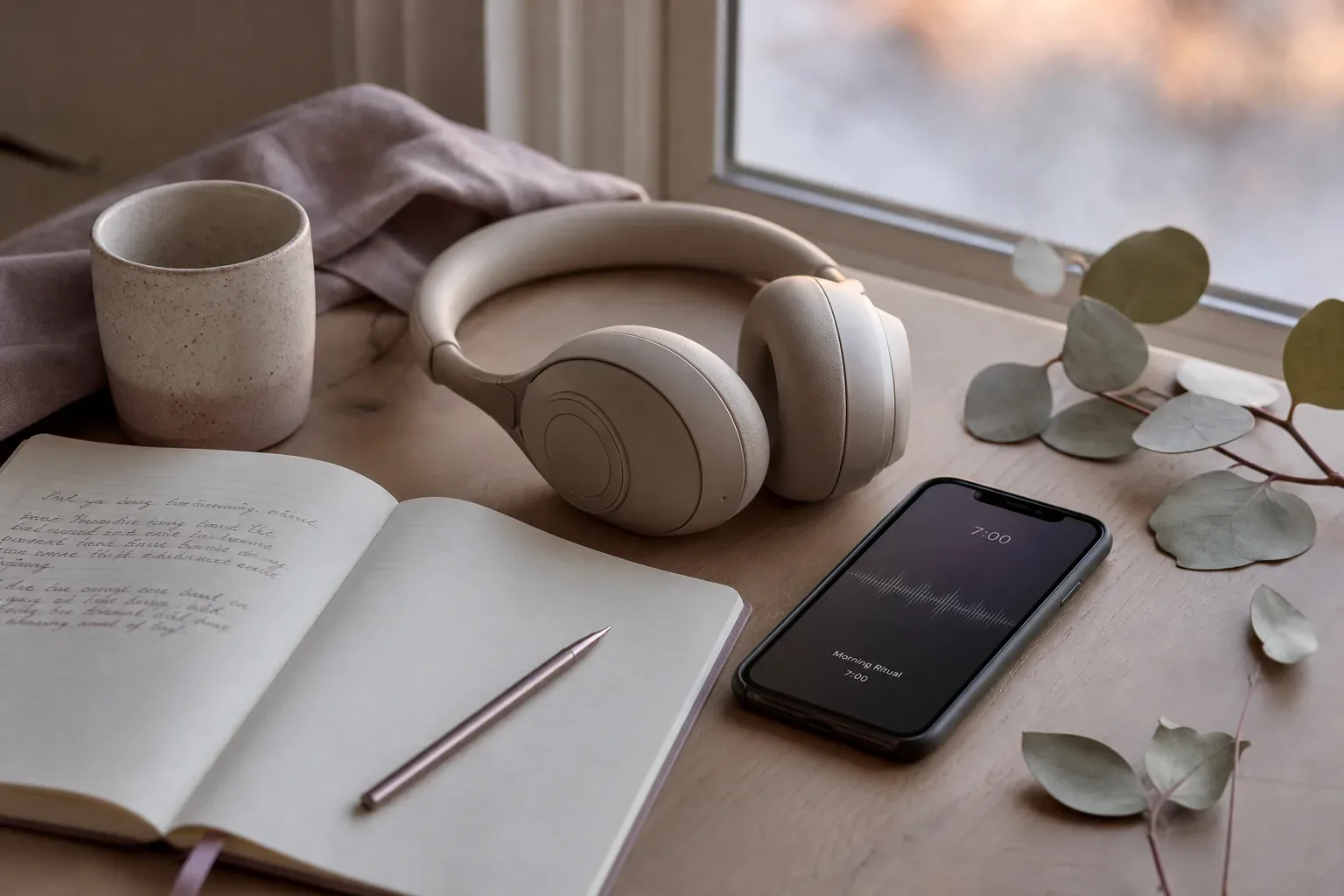
The kettle clicks off. Your headphones are already on the table. For 432 hz manifestation, play your Dream-Self audio first, then use 432 Hz music as a quiet background or closing track. The spoken future-self cue gives the practice meaning. The frequency only supports your attention.
What is 432 Hz manifestation, really?
432 Hz manifestation is the use of music tuned around A4 = 432 Hz to support a manifestation practice, not a proven shortcut by itself.
The number matters because most modern concert tuning uses A4 = 440 Hz. The International Organization for Standardization named 440 Hz as a reference pitch in ISO 16, first issued in the mid-20th century and reaffirmed later. A 432 Hz tuning is 8 Hz lower at A4. The difference is audible to many trained ears, but it is small. It changes the color of a piece more than the law of your life.
So the question becomes simple. What are you actually practicing? If the answer is only a frequency, you may be waiting for sound to do the work that attention has to do. If the answer is repeated contact with the self you intend to become, the frequency can be useful. It can make the room feel less sharp. It can give your nervous system a softer edge.
Research is more modest than the internet often sounds. A small 2019 study in the Journal of Evidence-Based Integrative Medicine compared 432 Hz and 440 Hz music in a brief listening setting and reported lower heart rate and slightly lower blood pressure with 432 Hz, but the sample was limited. That does not prove manifestation. It suggests some listeners may settle more easily.
A quiet room does not manifest for you. It helps you hear what you are willing to repeat.
If you are new to manifestation, keep the definition plain: manifestation practice is the repeated directing of attention, language, feeling, and behavior toward a chosen reality. The sound can make that repetition easier. It cannot replace it.
Why should Dream-Self audio come before frequency music?
Dream-Self audio should come first because speech gives your attention a specific future to recognize.
The AYA Method is a daily audio manifestation practice. Each day you listen to a short personalized recording — your Dream-Self Moment — narrated from the version of you who has already manifested the life you intend. Listening is the practice. Repetition is the work. The audio is the method.
That order is not decorative. In cognitive psychology, self-referential information is remembered better than neutral information. A classic 1977 study by Rogers, Kuiper, and Kirker found that words processed in relation to the self were recalled more strongly than words processed only for meaning or appearance. Your name, your details, your future tense made present: these are not extras. They are the handle.
Music can calm you, but it does not know what you want to rehearse. A 432 Hz track cannot say, I speak to my partner calmly now. It cannot name the work you have been avoiding. It cannot remind you that the version of you who is already there does not rush for proof at 6:42 a.m.
Use this order:
- Press play on your Dream-Self Moment.
- Let the voice stay clear and close.
- Add 432 Hz only if it helps you remain with the words.
- Close with one sentence you can remember at noon.
Dr. Andrew Huberman has often described attention as a limited resource, and laboratory work on attention has been saying the same thing for decades. Most people can hold only a small number of items in working memory at once; the often-cited 1956 Miller paper suggested 7 plus or minus 2, while later estimates are closer to 4. Give that small space a voice before you give it atmosphere.
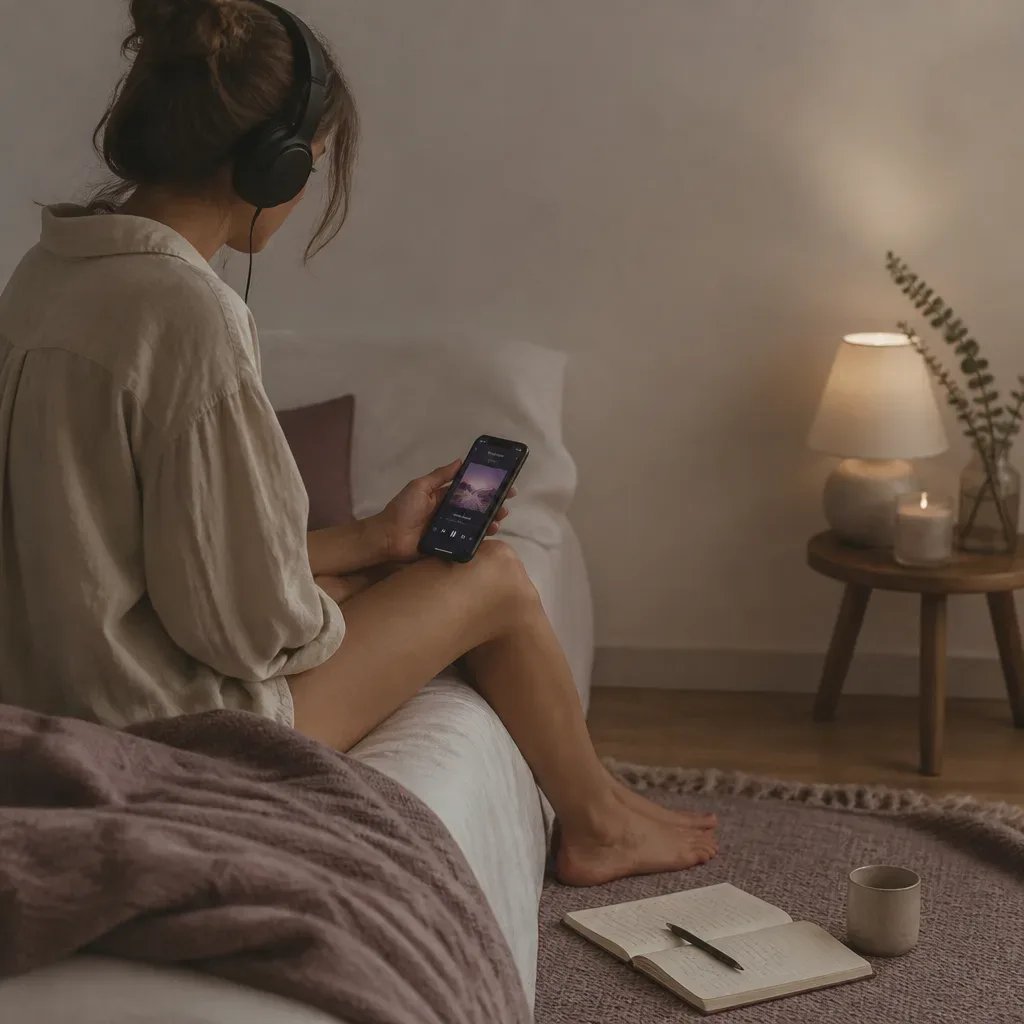
How do you do a seven-minute 432 Hz manifestation practice?
You do it by giving the first minutes to the audio, then letting 432 Hz music extend the stillness without taking over.
Here is a quiet seven-minute structure. It is short enough for a weekday and long enough to become real through repetition. The app session may vary, but the order stays the same.
| Minute | What you do | Why it matters |
|---|---|---|
| 0:00-1:00 | Sit, breathe, put on headphones | A 2023 Statista report estimated average daily mobile use at more than 4 hours in many countries; this minute marks a different use of the device |
| 1:00-4:30 | Play your Dream-Self Moment | Speech carries identity and direction |
| 4:30-6:30 | Play soft 432 Hz music, or leave silence | The body gets time to settle after the words |
| 6:30-7:00 | Write one sentence | Memory improves when listening is paired with retrieval |
Seven minutes is not a magic number. It is a mercy. In habit research, BJ Fogg and others have argued that behaviors survive better when they are small enough to repeat without negotiation. A 2010 study by Lally and colleagues in the European Journal of Social Psychology found that habit formation varied widely, from 18 to 254 days, with an average of 66 days. The point is not instant certainty. The point is return.
If you want a script, keep it spare:
- I am listening before I start proving.
- I let the voice be first.
- I let the music be background.
- I write one line and carry it quietly.
You can do this sitting on the floor, walking to the tram, or lying still with one hand on your chest. You do not need candles. You do not need a perfect morning. You need a cue, a recording, and the honesty to come back tomorrow.
The smaller the ritual, the less your mood gets a vote.
What should you listen for while the audio plays?
Listen for the sentence that makes your future self feel ordinary enough to practice today.
Not every line will land the same way. Some mornings, a sentence about work will catch. Other mornings, it will be the way your Dream-Self voice describes your body, your home, or your boundaries. In affirmations, wording matters because repetition can become either care or pressure. The same is true here. You are listening for language you can inhabit without forcing a performance.
A useful sign is recognition, not drama. Your shoulders drop by two percent. You stop arguing for one breath. You hear a line and think, yes, that is how I want to speak from now on. In mindfulness research, even brief daily practice has shown measurable effects on attention and stress in some groups. A 2014 meta-analysis in JAMA Internal Medicine reviewed 47 trials and found moderate evidence that mindfulness meditation programs improved anxiety, depression, and pain. This is not the same as manifestation, but it supports a plain idea: repeated attention changes what you notice.
Try listening for these four things:
- Identity: Who am I being in this recording?
- Behavior: What do I actually do differently today?
- Tone: Does the voice feel kind enough to repeat?
- Friction: Which sentence do I resist, and why?
Resistance is information. It may point to a fear, a stale self-story, or a desire you keep dressing up as practicality. Neville Goddard wrote often about assuming the feeling of the wish fulfilled. You do not have to accept every claim around his work to use one careful piece: rehearse from the fulfilled state, not from the begging state.
A sentence you can live is worth more than a paragraph you only admire.
Where do affirmations, boards, and astrology fit without taking over?
They fit after the audio, as complements that help you remember what you already heard.
The daily affirmation can be a small carryable line. The Manifestation Board can be the visual reminder you see later. Neither is the center of the AYA practice. The audio is. If everything becomes equal, the method gets noisy. Too many tools can make you feel productive while your attention stays scattered.
This is where discernment matters. A 2022 Pew Research Center report found that 30 percent of U.S. adults said they had consulted astrology, tarot, or a psychic at least once. People reach for symbolic systems because they want timing, meaning, and reassurance. That is human. But if you use astrology and manifestation, let it support reflection, not replace listening.
Here is a simple order for the extras:
- Audio first: Listen to the Dream-Self Moment.
- Affirmation second: Choose one line that matches the recording.
- Board third: Look at one image, not all of them.
- Timing last: If astrology is part of your life, use it as a check-in, not a command.
This order protects the practice from becoming a search for the perfect condition. There will always be another track, another moon phase, another phrase, another note about 432 Hz. But the work is close. Press play. Hear the self who has already crossed the threshold. Repeat until the language feels less like theater and more like home.
In behavior science, implementation intentions have shown reliable benefits across many studies. Peter Gollwitzer’s work on if-then planning found that linking a cue to an action improves follow-through. Your cue can be plain: after I plug in my headphones, I play my Dream-Self audio first.
How do you choose a 432 Hz track without getting lost?
Choose a track that stays quiet under the voice, has no sudden changes, and does not ask to become the main event.
The internet gives you thousands of options. That can feel like choice, but it often becomes delay. A 2000 study by Iyengar and Lepper found that shoppers presented with 24 jam options were less likely to buy than those presented with 6. Too many tracks can create the same problem. You are not curating an album. You are building a repeatable practice.
Use these filters before you save a track:
- It is instrumental, with no lyrics competing for language.
- It is steady for at least 10 minutes.
- It sits comfortably at a low volume.
- It does not include sharp bells or sudden rises.
- It leaves the Dream-Self audio easy to hear.
If you like numbers, keep them practical. Set the voice around 60 to 70 percent of your comfortable listening level. Set the 432 Hz track around 20 to 30 percent. Those are not clinical rules. They are listening rules. If your body strains to understand the words, the music is too high.
Be wary of grand claims. Human hearing generally ranges from about 20 Hz to 20,000 Hz in young healthy listeners, and sensitivity changes with age. The 432 Hz label usually refers to tuning, not a single tone doing hidden work inside you. You are allowed to enjoy the sound without making it responsible for everything.
The best track is the one you stop researching because it finally lets you practice.
How do you keep the practice honest for fourteen days?
You keep it honest by tracking the listening, not by grading your mood.
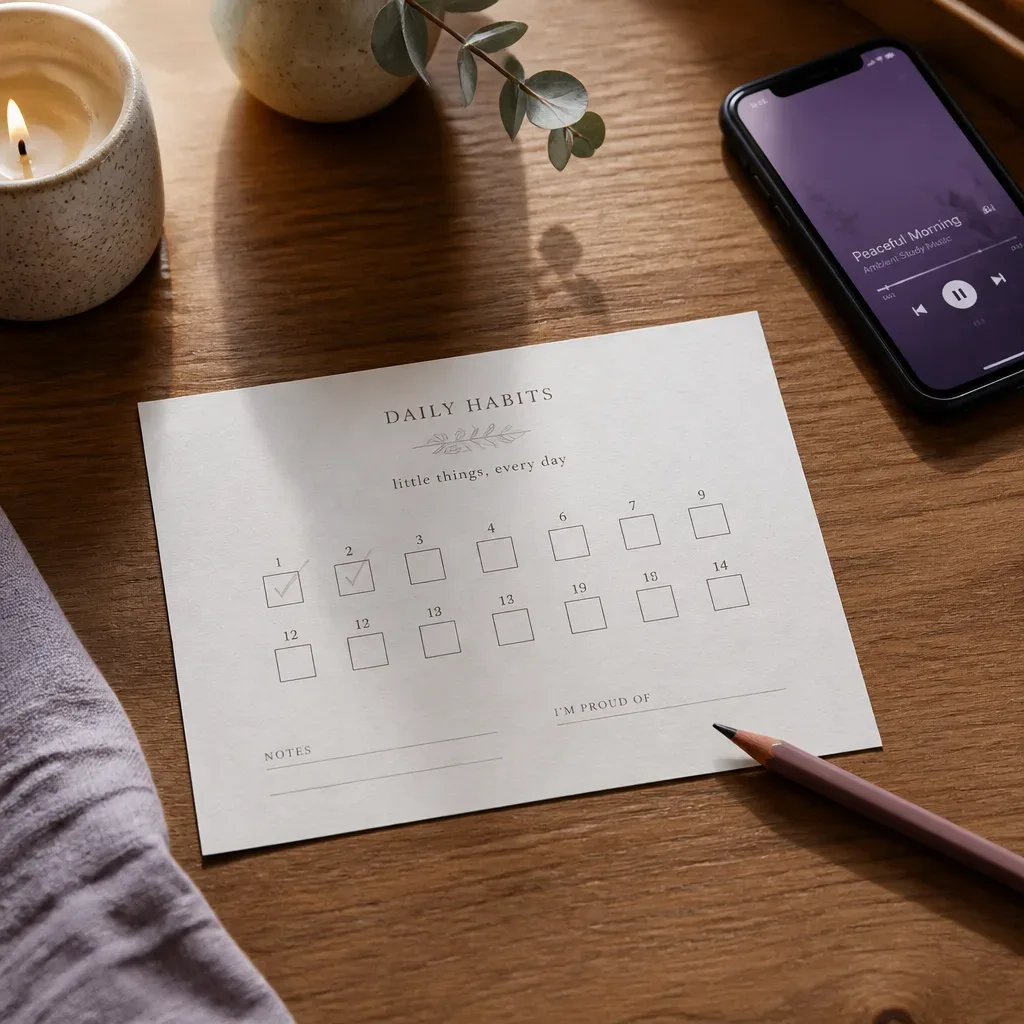
Fourteen days is long enough to see patterns and short enough not to scare the part of you that hates being managed. Use a notebook, a notes app, or the margin of a calendar. Make three columns: listened, one line remembered, one action taken. That is all.
A simple tracker might look like this:
| Day | Listened? | Line remembered | One action |
|---|---|---|---|
| 1 | Yes | I answer slowly now | Paused before replying |
| 2 | Yes | I keep promises to myself | Walked before email |
| 3 | No | None | Wrote the miss without blame |
Notice that the missed day stays in the record. It does not become a moral failure. In Lally’s 2010 habit study, missing one opportunity did not erase habit formation when people returned. That finding is kind. It matches real life. The practice is not a glass object. It can be picked up again.
At the end of 14 days, ask three questions:
- Did playing the Dream-Self audio first make the practice clearer?
- Did 432 Hz music help me stay with the words, or did it distract me?
- Which sentence changed one small behavior?
If the frequency helped, keep it. If silence worked better, keep silence. If another gentle track felt more honest, use that. The point of 432 hz manifestation is not loyalty to a number. It is the steady pairing of sound, self-recognition, and action.
You can read more about the wider frame in the manifestation guide, but do not let reading replace listening. The page can wait. The recording is short.
Play the voice that knows you first.