sleep science
90 Minute Sleep Cycle: When to Play Dream-Self Audio
Use the 90 minute sleep cycle to choose a soft time for Dream-Self audio before sleep, during a calm wake-up, or after a full cycle ends.
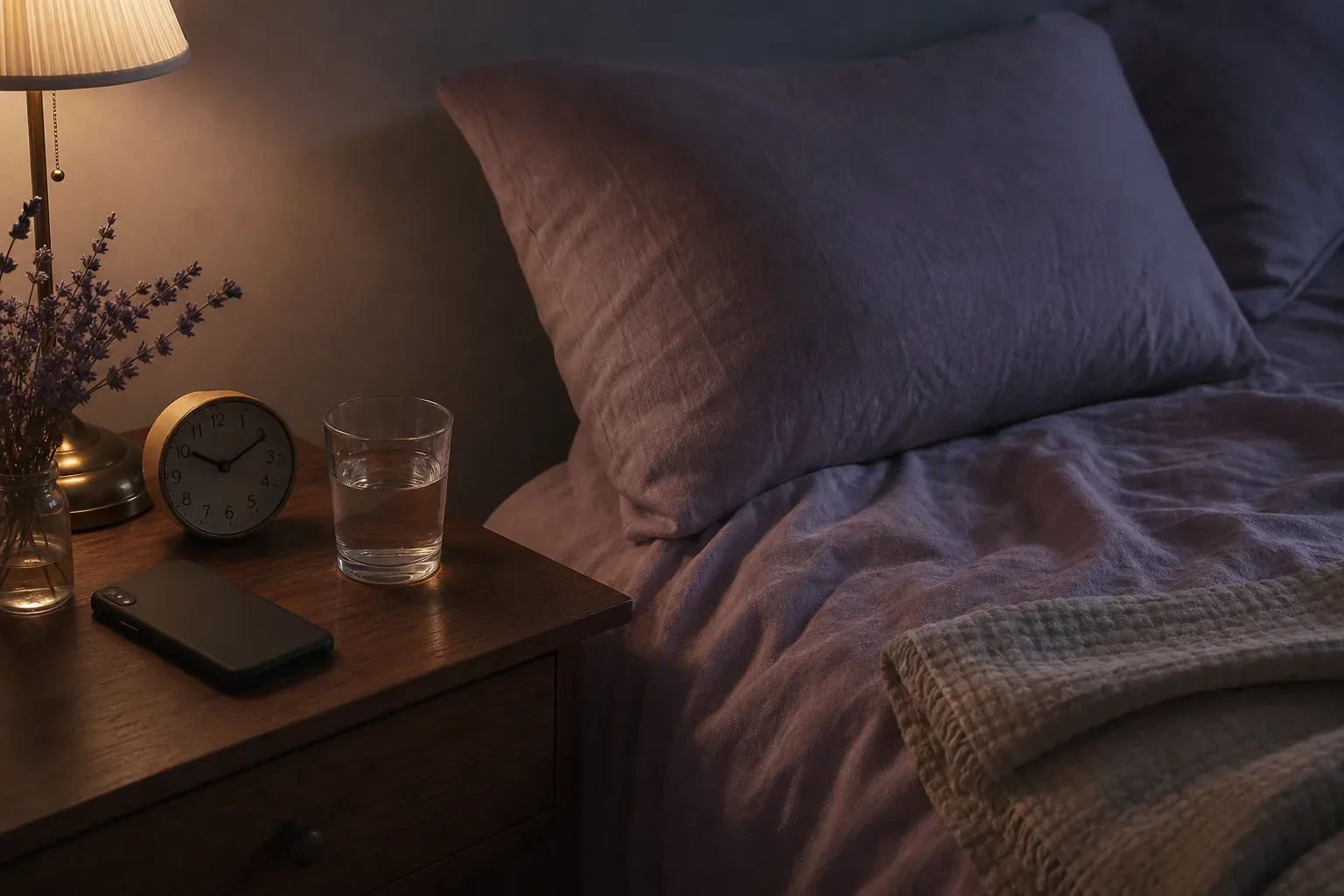
The lamp is already off. Your phone is face down. The 90 minute sleep cycle can help you choose when to play Dream-Self audio: before a cycle starts, after a natural wake-up, or in the first quiet minute of morning. Do not interrupt good sleep to catch a perfect window.
What is the 90 minute sleep cycle, really?
A 90 minute sleep cycle is an average pattern, not a promise your body signs every night.
Sleep moves through stages. First, lighter non-REM sleep. Then deeper non-REM sleep. Later, REM sleep, where dreaming is more common and the brain is active in a different way. Many sleep textbooks describe one adult cycle as about 90 minutes, but researchers such as Mary Carskadon and William Dement have long noted that a full cycle can range closer to 80 to 110 minutes. Your body is not late when it takes 102.
This matters because timing can become a little superstitious. You read 90 minutes and suddenly the night becomes arithmetic. Four cycles is about 6 hours. Five cycles is about 7.5 hours. Six cycles is about 9 hours. Those numbers can help you plan a gentler bedtime, but they should not turn sleep into a school exam.
The American Academy of Sleep Medicine and Sleep Research Society recommend at least 7 hours of sleep for most adults. That recommendation is more important than catching an exact REM window. If you have to choose between a neat cycle chart and a longer night, choose the longer night.
The body keeps time, but it does not like being managed too loudly.
For Dream-Self audio, the useful part of the 90 minute sleep cycle is simple: the transitions are tender. The edge before sleep, the small waking between cycles, and the first minutes after waking are all quieter than the middle of the day. You can meet the practice there.
When should you play Dream-Self audio at night?
Play Dream-Self audio before you fall asleep, not after you are already gone.
This is the plainest answer. Press play while you are in bed, lights low, still able to hear the words. The recording can become part of the descent. It should not be a noise that chases you into sleep. If you use the AYA Method, keep its definition close: The AYA Method is a daily audio manifestation practice. Each day you listen to a short personalized recording — your Dream-Self Moment — narrated from the version of you who has already manifested the life you intend. Listening is the practice. Repetition is the work. The audio is the method.
The method asks for listening. That means awareness matters. You do not need perfect attention, but you do need some part of you still present. A 2019 review in Current Biology looked at targeted memory reactivation during sleep and found that sound cues can affect memory, but the findings are narrow and carefully controlled. Your bedroom is not a sleep lab. Your practice can stay human.
A good night setup is small:
- Start the audio 5 to 15 minutes before your intended sleep time.
- Keep the volume low enough that you never brace.
- Use the same recording for a stretch of days.
- Let the final words be followed by silence.
- Do not replay it if you wake fully alert.
The first cycle of the night contains more deep sleep than later cycles, according to standard sleep architecture research. That is another reason to avoid placing a sound inside it. Deep sleep is repair work. Let it work.
Should you listen before bed, between cycles, or in the morning?
Bedtime is the most keepable time, but natural waking and morning can also work.
I like a table because it behaves like a library shelf. It does not persuade. It just lets you see where things belong.
| Time to listen | Best for | What to protect | Simple rule |
|---|---|---|---|
| Before bed | Most people | Falling asleep | Play once, then stop |
| Natural night waking | Light sleepers who wake anyway | Returning to sleep | Only if you are calm |
| After a full cycle | People using a gentle alarm | Sleep length | Count 7.5 or 9 hours back |
| Morning | Heavy sleepers | Memory and mood | Listen before the day speaks |
If you wake naturally after about 90, 180, 270, or 360 minutes, you may be near a cycle edge. But most people do not wake cleanly at every cycle. Sleep studies using polysomnography show that brief awakenings are common and often forgotten by morning. You do not need to catch them. You are not trying to become a night watchman.
For many readers, the best choice is a simple bedtime listen. It pairs the recording with an existing cue: bed. Habit researchers often point to context as a major part of repetition. In a 2009 European Journal of Social Psychology study by Phillippa Lally and colleagues, the median time for a new behavior to become automatic was 66 days, with wide variation. The cue matters because motivation gets tired.
If your practice includes written support, keep it secondary. A daily affirmation can be useful, and the affirmations guide can help you make the sentence clear. A visual board can help you see what is true. But for this method, the audio comes first.
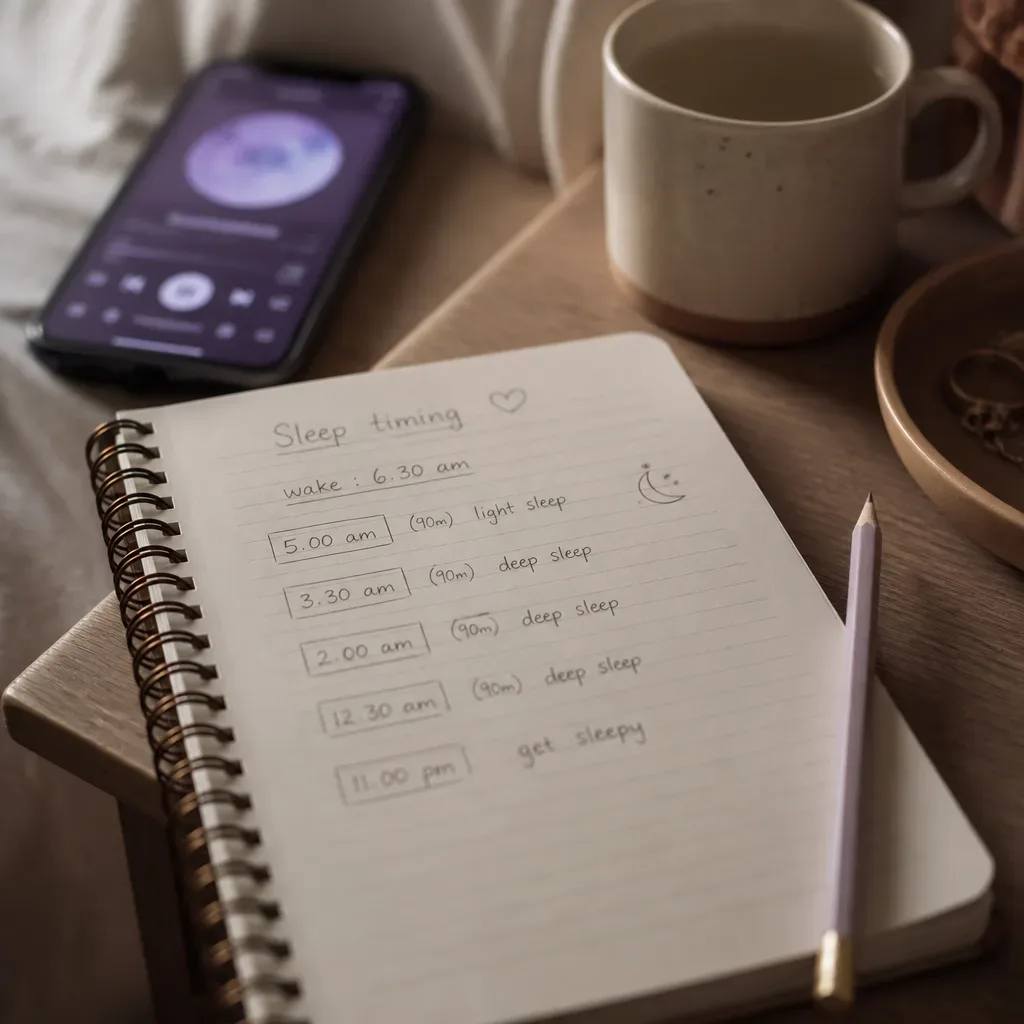
How do you set the timing without becoming strict?
Use the 90 minute sleep cycle as a soft ruler, then let your actual life vote.
Here is the small calculation. Choose when you need to wake. Count backward in 90 minute blocks. Then add 10 to 20 minutes to fall asleep. If you need to wake at 7:00, five cycles suggests sleep around 11:30. If you usually need 15 minutes to drift, you might press play at 11:10 or 11:15.
Try this for one week:
- Pick one wake time you can keep for 7 days.
- Count back 7.5 hours or 9 hours.
- Add your usual fall-asleep time.
- Play your Dream-Self audio once.
- Write one line in the morning: slept well, slept broken, or slept short.
- Change only one variable after 7 nights.
The National Sleep Foundation generally recommends 7 to 9 hours for adults ages 18 to 64. The CDC has reported that roughly 1 in 3 U.S. adults do not get enough sleep. Those numbers are not moral judgments. They are reminders that most people need a practice that fits inside tiredness.
A ritual that requires a better version of you may not survive the version of you who comes home late.
If you use a wearable, be modest with the data. Consumer sleep trackers can estimate sleep duration fairly well, but peer-reviewed comparisons show they are less reliable for exact sleep stages than lab equipment. Let the device advise you. Do not let it become the loudest voice in the room.
For a broader frame on intention, you can read the manifestation pillar. Then return to the simple act. Press play. Listen. Sleep.
What should the audio feel like at the edge of sleep?
It should feel close, familiar, and easy enough that your nervous system does not stand up.
Volume is not a small detail. The World Health Organization has noted that nighttime noise can disturb sleep even at relatively low levels, especially when sounds are sudden or meaningful. A voice is meaningful. That is why the tone, length, and timing of Dream-Self audio matter. You are not trying to impress your brain. You are trying to give it something it can receive without alarm.
Think of the recording as a hand on the banister. It helps you descend. If the words make you plan, argue, or rehearse tomorrow, the script may be too demanding for bedtime. Move that listen earlier, or choose a version that sounds already true rather than far away.
A good sleep-adjacent recording usually has:
- plain language you would actually say,
- a length under a few minutes,
- no sharp music changes,
- no instruction to force belief,
- one clear Dream-Self scene.
Dr. Andrew Huberman often speaks about light timing, temperature, and consistency as levers for sleep. Whether or not you follow every protocol, the quiet point is useful: the body listens to repeated cues. Your audio can become one of those cues if it arrives at the same time and asks very little.
The right bedtime practice does not make you feel larger. It makes the room feel safe enough to release you.
Some people like pairing audio with a line of writing. Keep it brief. One sentence is enough. If astrology is part of how you reflect on timing, astrology and manifestation can sit beside the practice. Just do not let any calendar overrule sleep.
What if you wake in the middle of a sleep cycle?
If you wake at night, protect your return to sleep before you protect the practice.
Night waking is common. The question is what happens next. If you wake and feel soft, you may choose a very low-volume listen, especially if the audio is short and known. If you wake anxious, do not add content. Use darkness, warmth, and a slow breath instead. The practice can wait for morning.
Cognitive arousal is one reason insomnia keeps itself alive. Clinical sleep guidance often asks people to reduce clock-checking because it can increase alertness. If you wake at 3:12 and start calculating cycles, you have already invited the clerk into the bedroom. I say this as a librarian. Not every hour needs records.
Use this decision tree:
- Did you wake naturally and feel calm?
- You may listen once, quietly.
- Did a noise, worry, or phone wake you?
- Do not play audio. Return to sleep first.
- Are you awake longer than about 20 minutes?
- Follow your usual sleep guidance, such as getting out of bed briefly in dim light if that is part of your clinician-approved plan.
- Are you tempted to restart the whole routine?
- Do less.
The 20-minute guideline appears often in cognitive behavioral therapy for insomnia materials, though it is not meant as a stopwatch. It is a way to keep the bed linked with sleep rather than effort.
For more on the method itself, return to the AYA Method. The audio is not a test of devotion. It is a daily listen.
How do you keep this practice gentle for a real life?
Make the practice small enough that you can keep it on an ordinary night.
Here is my librarian test. Would this book come back worn out, or would it come back unread and ambitious? A sleep practice should look a little boring from the outside. The boring ones get finished.
Seven nights is a fair first trial. Not thirty. Not forever. During those 7 nights, notice three things: how quickly you fall asleep, how often you wake, and whether you resist the audio. If resistance grows, the practice is too large or too late. The Journal of Behavioral Medicine has published many studies tying self-monitoring to behavior change, but the useful version here is tiny. One line in the morning. No spreadsheet required.
You can use this simple record:
| Morning note | Meaning | Adjustment |
|---|---|---|
| Slept well | Timing is probably fine | Keep it |
| Slept broken | Audio may be too late or too loud | Move earlier |
| Slept short | Bedtime is the issue | Count cycles again |
| Felt pressured | Script is too big | Make it more ordinary |
If you also use a daily affirmation, let it be a daytime complement. The affirmations pillar can help you keep wording clean and believable. If you are new to manifestation language, the manifestation guide gives the wider frame. At night, return to the narrow door.
A 90 minute sleep cycle can help you choose a time. It should not become a judge. Your body is allowed to vary. Your practice is allowed to be modest.
The night does not need you to win it.
Listen once, then let the room be dark.
Listen on Aya

