sleep science
Nap Length for Manifestation: Listen Before a Reset Nap
Use nap length gently: listen to your Dream-Self Moment, rest for 10 to 20 minutes, and wake with a small clear next step already near.

The phone is face down. The room is not dark, only quieter. The best nap length for a manifestation reset is usually 10 to 20 minutes after listening to your Dream-Self Moment. You give the mind one true direction, let the body rest briefly, then wake before grogginess takes over.
What nap length actually helps you reset?
A 10 to 20 minute nap is the clearest reset for most days.
Sleep researchers often call this a short nap, and it has a plain gift: you can wake before the heavier stages of sleep hold you. In a 2006 study in Sleep, Leon Lack and colleagues compared 5, 10, 20, and 30 minute naps; the 10 minute nap showed immediate improvements in alertness and performance, while longer naps were more likely to bring sleep inertia. That matters when you’re returning to an afternoon meeting, a child at the door, or a sentence you need to write.
A reset nap is not meant to replace a night of sleep. The American Academy of Sleep Medicine and Sleep Research Society recommend at least 7 hours of sleep for most adults. A nap is a bridge, not a house. It helps you cross one low point in the day without asking your nervous system to pretend it’s fine.
For manifestation, the length matters because the practice asks for a certain kind of attention. Not strain. Not fantasy. Attention. A nap that is too long can leave you foggy for 15 to 60 minutes, depending on timing and sleep debt, according to sleep inertia reviews in Sleep Medicine Reviews. A nap that is too short may be only a pause. Ten to twenty minutes sits in the middle.
A good reset nap is small enough to keep its promise.
Use 90 minutes only when you have the room for it. The National Sleep Foundation describes roughly 90 minutes as the length of a full sleep cycle for many adults, though cycles vary. If you wake after a full cycle, you may avoid the thickest grogginess. But if you only have 25 minutes between tasks, choose the smaller truth.
| Available time | Suggested nap length | Best use | Watch for |
|---|---|---|---|
| 12 minutes | 10 minutes | Quick reset | Not enough if very sleep deprived |
| 25 minutes | 15 to 20 minutes | Clear wake-up | Set a firm timer |
| 45 minutes | 20 minutes | Midday dip | Avoid drifting longer |
| 100 minutes | 90 minutes | Full cycle rest | Needs real space after |
Why listen before the nap instead of after?
Listening before the nap gives the mind a clear last input before rest.
The minutes before sleep are unusually receptive because outside demands are lowering. You do not need to make this mystical in a loud way. In cognitive science, memory consolidation during sleep has been studied for decades; a 2013 review by Rasch and Born in Physiological Reviews described sleep as active in stabilizing and reorganizing memory. What you place near rest is not magic. It is material.
This is where the AYA Method enters softly. The AYA Method is a daily audio manifestation practice. Each day you listen to a short personalized recording — your Dream-Self Moment — narrated from the version of you who has already manifested the life you intend. Listening is the practice. Repetition is the work. The audio is the method.
The daily affirmation and Manifestation Board can support the practice, but they are not the center. The center is the audio. If you want the wider foundation, the Manifestation pillar explains the bigger frame; here, the reset stays very small. You listen. You rest. You return.
NASA Ames research on planned cockpit rest is often cited for a reason. In a 1995 report led by Mark Rosekind, a 26 minute nap improved pilot performance by 34% and alertness by 54% compared with a no-rest group. You are not flying a plane, probably. Still, your afternoon deserves a mind that can land.
A manifestation nap works best when the audio is short enough that you do not begin negotiating with it. Two to five minutes is often enough. One clear scene. One sentence that feels near. One future self speaking in a voice you can believe on a tired Tuesday.
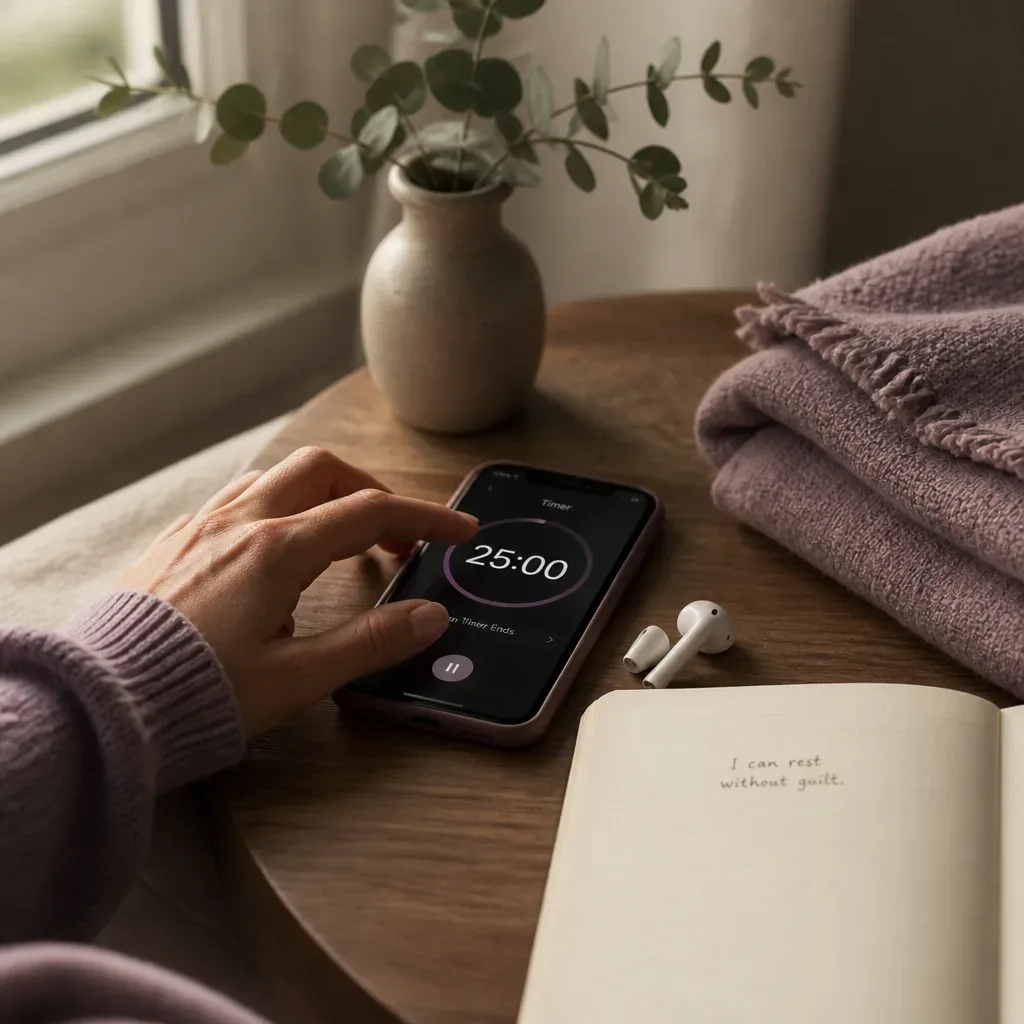
How do you do a 25-minute listen-and-nap ritual?
Use 25 minutes: a few minutes to listen, 10 to 20 minutes to nap, and one minute to return.
You do not need candles. You do not need a perfect room. You need a timer, a place to recline, and permission to stop performing readiness. A 2022 Gallup poll found that many U.S. adults report not getting enough rest several days a week; the exact pattern changes by group, but the human fact is familiar. People are tired while trying to improve their lives.
Here is the simplest version:
- Set the total timer for 25 minutes. If your audio is 3 minutes, you will have about 20 minutes to rest.
- Listen once. Do not repeat the recording to chase a stronger feeling.
- Place the phone away from your hand. Close enough to stop the timer. Far enough to keep you from scrolling.
- Let the nap be light. Drifting counts. Resting with closed eyes counts.
- Wake and write one line. Not a page. One next action.
The writing matters because it gives the practice a door back into ordinary life. A 2011 study in Science by Masicampo and Baumeister found that making specific plans reduced intrusive thoughts about unfinished goals. The note does not need to be noble. It might be: send the email, drink water, open the draft, walk for 8 minutes.
The point is not to wake as a new person. The point is to wake as someone who remembers.
If you’re using the app, let the Dream-Self Moment be the last thing you hear before the timer silence. If you also use a daily affirmation, keep it after waking or earlier in the day. The Affirmations pillar is useful when you want to refine the sentence you repeat. For the nap itself, keep the path narrow.
What if you only have 10 minutes?
If you only have 10 minutes, listen for 2 minutes and rest for 8.
This is not lesser practice. It is honest practice. In the 2006 Sleep study by Lack and colleagues, the 10 minute nap stood out because benefits appeared quickly and sleep inertia stayed low. You may not enter deep sleep. That is fine. A short reset is closer to rinsing a cup than rebuilding a room.
Use the smallest version when you’re between tasks or close to decision fatigue. Researchers often describe decision fatigue with caution because effects vary, but many studies show that sustained attention declines over time. The Pomodoro Technique, created by Francesco Cirillo in the late 1980s, uses 25 minute work blocks partly because attention likes edges. A 10 minute practice gives your afternoon an edge.
Try this tiny pattern:
- Sit or recline where you will not be fully claimed by sleep.
- Play one short Dream-Self Moment.
- Let one phrase stay.
- Close your eyes until the timer rings.
- Stand, breathe, and choose the next visible action.
Do not use the 10 minute version to argue with exhaustion. If you slept 4 hours, your body may ask for more than a ritual can give. The Centers for Disease Control and Prevention has reported that about 1 in 3 U.S. adults do not get enough sleep. Manifestation does not cancel biology. It has to be kind to it.
A practice that ignores the body will eventually be rejected by the body.
If you are curious about timing the practice with symbolic cycles, Astrology and manifestation can sit beside this. Keep the nap itself simple. The body does not need a chart to know when it is tired.
What if you wake up groggy?
Grogginess usually means the nap was too long, too late, or taken during heavy sleep pressure.
Sleep inertia is the name for that thick, underwater feeling after waking. It can last a few minutes or much longer. A 2019 review in Sleep Medicine Reviews noted that sleep inertia is strongest after waking from deeper sleep and can affect alertness, reaction time, and mood. This is why a 30 to 60 minute nap can be risky when you need to return quickly.
First, do not make grogginess mean the manifestation practice failed. It means your sleep timing gave you a slower landing. The audio still happened. The rest still counted. You simply need a better container next time.
Try adjusting one variable at a time:
- Shorten the nap. Move from 25 minutes of sleep to 15.
- Nap earlier. Many people do better before 3 p.m., though chronotype matters.
- Sit slightly upright. It can keep the nap light.
- Use a gentler alarm. A sudden alarm can make waking feel harsher.
- Get light after waking. Dr. Andrew Huberman often points to morning light for circadian timing; after a nap, ordinary daylight can also help your brain mark wakefulness.
Caffeine timing is another quiet lever. Caffeine has an average half-life of about 5 hours, though it varies widely. If you drink coffee at 4 p.m., part of it may still be active near bedtime. A reset nap should not borrow calm from the night ahead.

There is also the caffeine nap, where someone drinks coffee and then naps for about 15 to 20 minutes before the caffeine fully takes effect. Small studies have found benefits for alertness, especially in sleepy drivers, but it is not for everyone. If caffeine makes you anxious or harms your sleep, skip it. The gentler ritual is enough.
How does nap length connect to manifestation without forcing belief?
Nap length supports manifestation by protecting the state in which you can hear yourself clearly.
You do not have to believe every sentence at full volume. You only have to practice hearing a truer one often enough that it becomes available. Neville Goddard wrote often about feeling a wish as already real, and Joe Dispenza speaks about rehearsing a future self through repeated inner practice. You can take what is useful without turning rest into performance.
The Manifestation pillar gives the wider language for this. The reset nap gives you the body-level version. When the nap is short, you wake with enough clarity to act. When the audio is placed before rest, your last chosen input is not the inbox, the feed, or the old fear. It is the self you are practicing returning to.
Princeton Engineering Anomalies Research, often called Princeton PEAR, ran from 1979 to 2007 and studied mind-matter questions that remain debated. You do not need to lean on contested findings to make this ritual useful. The firmer ground is repetition, attention, and behavior. In clinical psychology, implementation intention research by Peter Gollwitzer has shown that if-then plans can improve follow-through across many domains. After the nap, your one next action is the bridge.
Here is a quiet comparison:
| Practice choice | What it does | Risk if overdone |
|---|---|---|
| Audio before nap | Sets a chosen inner cue | Chasing a feeling |
| 10 to 20 minute nap | Restores alertness lightly | Too short if exhausted |
| 90 minute nap | Allows a fuller cycle | Too much time for most days |
| One written action | Returns the practice to life | Turning it into a checklist |
Manifestation becomes steadier when it asks for one act, not a whole new personality.
If you want more language for the sentence itself, return to the Affirmations pillar. If you want a visible reminder, a Manifestation Board can help. But for this ritual, let the audio lead.
What should you do after the reset nap?
After the reset nap, do one small action within 10 minutes.
The first 10 minutes after waking are tender. Do not fill them with measurement. Do not open three apps to see whether you feel different. Stand up. Drink water. Let light touch your face if it is daytime. Then do the small action you wrote down.
Behavioral science keeps returning to specificity. In a 2006 meta-analysis in Advances in Experimental Social Psychology, Gollwitzer and Sheeran found that implementation intentions had a medium-to-large effect on goal achievement across studies. The sentence matters because it tells the future where to meet you: when I wake, I will send the note; after I drink water, I will open the file.
Keep the action under 5 minutes when you can. A reset nap should lower the cost of beginning, not create a second life you have to manage. The the AYA Method works by daily listening; the rest of the day answers in small movements. If your movement is tiny, it still counts.
You can use this rhythm three or four times a week without making it another rule. If naps interfere with your night sleep, reduce them. If you have insomnia, sleep apnea, depression, pregnancy-related fatigue, or a medical condition, speak with a clinician. The National Heart, Lung, and Blood Institute notes that untreated sleep disorders can affect mood, heart health, and daytime function. Care is part of the practice.
A final note for the honest days: sometimes you will listen and not nap. Sometimes you will nap and forget to write the line. The ritual is not broken by being human. Return the next day. Keep it small enough to survive your actual life.
Let the body sleep where the sentence can stay.
Listen on Aya

