audio manifestation
Audio Manifestation for Beginners: Listen Before You Script
Audio manifestation for beginners: learn why listening first makes scripting quieter, clearer, and easier to repeat in a daily practice.

Your notebook is open, but the page is too bright. Audio manifestation helps beginners start by listening, not inventing. A short future-self recording gives your mind a scene, a tone, and a believable sentence before scripting asks you to produce anything. The order matters: receive first, write second.
What is audio manifestation, really?
Audio manifestation is a listening practice where spoken future-self language becomes the rehearsal before action.
The cleanest version I know is the AYA Method: The AYA Method is a daily audio manifestation practice. Each day you listen to a short personalized recording — your Dream-Self Moment — narrated from the version of you who has already manifested the life you intend. Listening is the practice. Repetition is the work. The audio is the method.
That last sentence is the hinge. The audio is not decoration around the practice. It is the practice. Your daily affirmation can help. Your Manifestation Board can help. But the first doorway is sound.
A beginner often comes to manifestation with too many instructions. Visualize. Script. Feel it. Act as if. The list gets heavy. Audio manifestation removes one decision: you do not need to find the words first. You listen until one line finds you.
There is a simple reason this can feel easier. Hearing language and producing language are different tasks in the brain. Research on auditory imagery and speech perception shows that heard words can activate memory and emotion before you begin conscious analysis. In a 2021 Pew Research Center report, 85 percent of U.S. adults owned a smartphone, which means a listening practice can live in the object already beside your bed.
A room teaches you where to look. A recording teaches your attention where to return.
Why listen before you script?
You listen before you script because sound can quiet the need to perform before the page asks you to prove anything.
Scripting is useful. It can also make people stiff. The blank page has a way of turning desire into an essay exam. You start choosing the right tense, the right feeling, the right sentence. Ten minutes pass. You have written one careful line and judged it four times.
Listening changes the order. Instead of asking, what should I want, you ask, what did I hear that felt true. This is a smaller question. It asks for recognition, not invention.
James Pennebaker’s expressive writing research often used 15 to 20 minutes of writing across 3 or 4 days, and studies connected that structure with emotional processing. That is writing as release. Scripting is a different use of writing. Here, the page becomes a receipt for what your attention has already rehearsed.
The ear is less vain than the hand. It does not care how the sentence looks.
If you are new, try this order for 7 days. Listen to the same Dream-Self Moment. Then write only 3 lines. Not 3 pages. One line for what you heard, one line for what felt possible, one line for what you will do today. BJ Fogg’s behavior model, published in 2009, argues that behavior becomes more likely when motivation, ability, and a prompt meet. Audio gives the prompt. Brevity protects ability.
How do you begin without making it complicated?
Begin by choosing one listening window, one audio, and one small page after it.
The first design rule is placement. Put the practice where your day already has a doorway. After you sit up. After tea. Before the first message. Dr. Andrew Huberman has often described the importance of morning light for circadian timing, noting that early outdoor light can help set the body’s clock. You do not need to build a grand routine around that. You need a stable cue.
Try this beginner sequence:
- Put your phone on Do Not Disturb for 5 minutes.
- Sit in the same place each day if you can.
- Listen to your Dream-Self Moment once.
- Keep your eyes soft or closed.
- Write 3 to 5 lines after the audio ends.
- Choose one ordinary action that matches the self you heard.
If you use timing tools, keep them gentle. If lunar dates, birthdays, or personal cycles help you remember, read astrology and manifestation as a way to think about timing without handing your agency away.
Here is a simple comparison for beginners:
| Practice order | What happens first | Best for | Risk |
|---|---|---|---|
| Script then listen | You produce language | People who already know the desire | Over-editing |
| Listen then script | You receive language | Beginners and overthinkers | Wanting to perfect the audio |
| Listen only | You repeat the core practice | Tired mornings | Skipping reflection |
| Script only | You work through thought by hand | Writers | Turning practice into performance |
In my old architecture office, every drawing had a scale. A 1:100 plan could not show the same detail as a 1:5 joint. Your first week of audio manifestation is a 1:100 plan. It should show direction, not every hinge.

What should you listen for in the recording?
Listen for the sentence your body does not argue with.
Not every beautiful line is useful. Some sentences sound lovely and land nowhere. Others are plain and stay with you all day. The beginner’s task is to notice the difference.
After the audio, scan for three things:
- A scene you could almost see.
- A sentence you could repeat without tightening.
- A small action that seems natural, not dramatic.
Self-affirmation research is helpful here. A 2015 meta-analysis in Social and Personality Psychology Compass found that self-affirmation can reduce defensiveness in some settings, especially when it connects to values. The point is not to chant a sentence your whole system rejects. The point is to hear language that lets you stand nearer to what you already know.
This is where affirmations can support the audio. After listening, you might choose one line as a daily affirmation. But let the audio lead. The affirmation is the pocket version, not the house.
A true sentence often feels boring at first. That is not a problem. Most load-bearing walls are not dramatic either.
For example, I am safe to be seen may be too much today. I can send one honest message may be true. The second sentence has a door in it. You can walk through it before noon.
How do you script after listening?
Script as if you are taking notes from the future self you just heard.
Wait 10 breaths after the audio ends. Do not rush to capture everything. The useful material usually remains. The extra material fades. Memory researchers have found that retrieval strengthens learning; even a short pause before recall changes how you relate to what was heard.
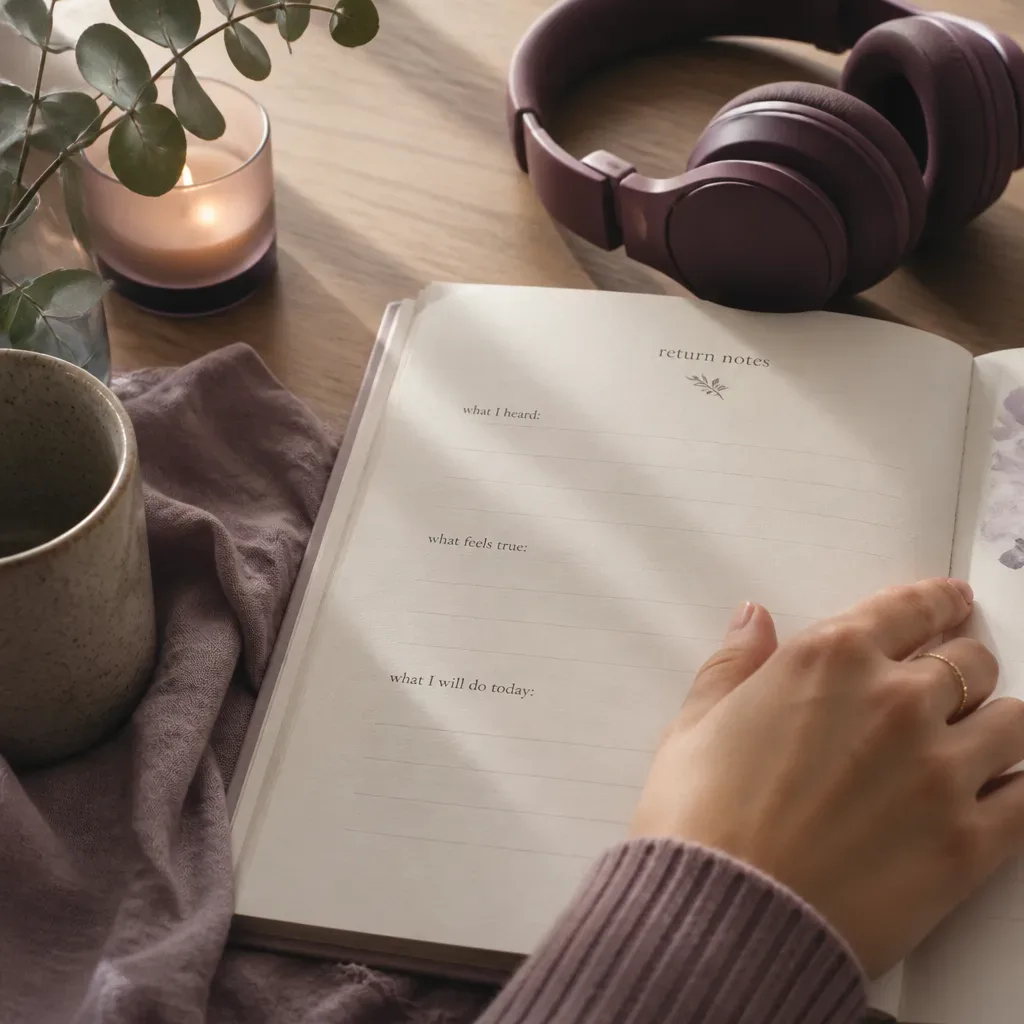
Use this three-part page:
- What I heard: write the exact sentence, image, or tone that stayed.
- What feels true now: write one present-tense line you can believe by at least 51 percent.
- What I will do today: write one action that can be completed in 10 minutes or less.
The 51 percent rule is not scientific. It is practical. If a sentence is barely believable but still believable, it can be worked with. If it drops below that, soften it. The nervous system does not need a louder claim. It needs a safer contact point.
Here is an example after listening to a Dream-Self Moment about creative work:
I heard: I protect the first hour of making.
What feels true now: I can give the first 20 minutes to the draft before I answer anyone.
What I will do today: Open the file before opening messages.
That is enough. One clean line can change the shape of a day more than a page written to impress yourself.
If you keep a Manifestation Board, add only what supports the audio. A board can show the direction. It should not become another room to clean.
What mistakes make audio manifestation harder?
The common mistakes are choosing audio that feels too far away, changing it too often, and treating the practice like a test.
Beginners often think discomfort means the practice is working. Sometimes discomfort is useful. Often it is just noise. If the recording describes a life so distant that your body goes numb, edit the language closer. Neville Goddard taught the feeling of the wish fulfilled, but feeling does not mean strain. It means inner contact.
Another mistake is changing the audio every day. Novelty feels productive. Repetition does the quieter work. In learning research, spaced repetition has been studied for more than a century, beginning with Hermann Ebbinghaus in the 1880s. Repeated contact helps memory stay available. Your Dream-Self Moment is not a song you discard when it stops surprising you.
A third mistake is listening while half-reading messages. Attention has a cost. A widely cited 2009 Stanford study on heavy media multitaskers found they performed worse on some attention-switching tasks than lighter multitaskers. You do not have to be perfect. But for 5 minutes, let one voice have the room.
If you miss a day, do not repair it with drama. Return the next day. A practice that can survive interruption is better than a practice that only works when life is tidy.
Keep these guardrails:
- Do not choose language you would be embarrassed to say softly.
- Do not measure the practice by instant mood.
- Do not make the script longer because you feel guilty.
- Do not confuse intensity with truth.
- Do not let the tool become more important than the listening.
The self you are practicing is built by return, not pressure.
How do you know it is working?
You know it is working when your choices begin to echo the audio in ordinary moments.
The sign is not always a large event. It may be that you pause before sending the old message. You choose the walk. You name the fee. You leave the room when your body has already said enough. These are small, measurable edits to the plan.
Track 3 things for 14 days: whether you listened, the sentence that stayed, and the action you took. Keep the record plain. A check mark is enough. Behavior change studies often show that self-monitoring improves follow-through, especially when the behavior is specific. The American Psychological Association has also noted that tracking can support habit change when it stays simple.
Do not ask the practice to prove itself every morning. Ask whether it is making one better choice easier to find. That is a kinder metric, and often a more accurate one.
You can also notice the quality of your scripting. At first, the page may sound like hope trying very hard. After a week or two, it may sound more like instruction. Fewer adjectives. More verbs. Less pleading. More remembering.
If you want a broader frame for how desire, attention, and action work together, keep manifestation nearby. But for this practice, stay close to the sound. The daily affirmation and Manifestation Board can remain in the room. The audio sits in the chair.
Tonight, let the first sentence come to you.