audio manifestation
Voice Note Manifestation: Record Once, Listen Daily
Voice note manifestation is a simple audio practice: record one future-self note, then listen daily until the new thought feels familiar.
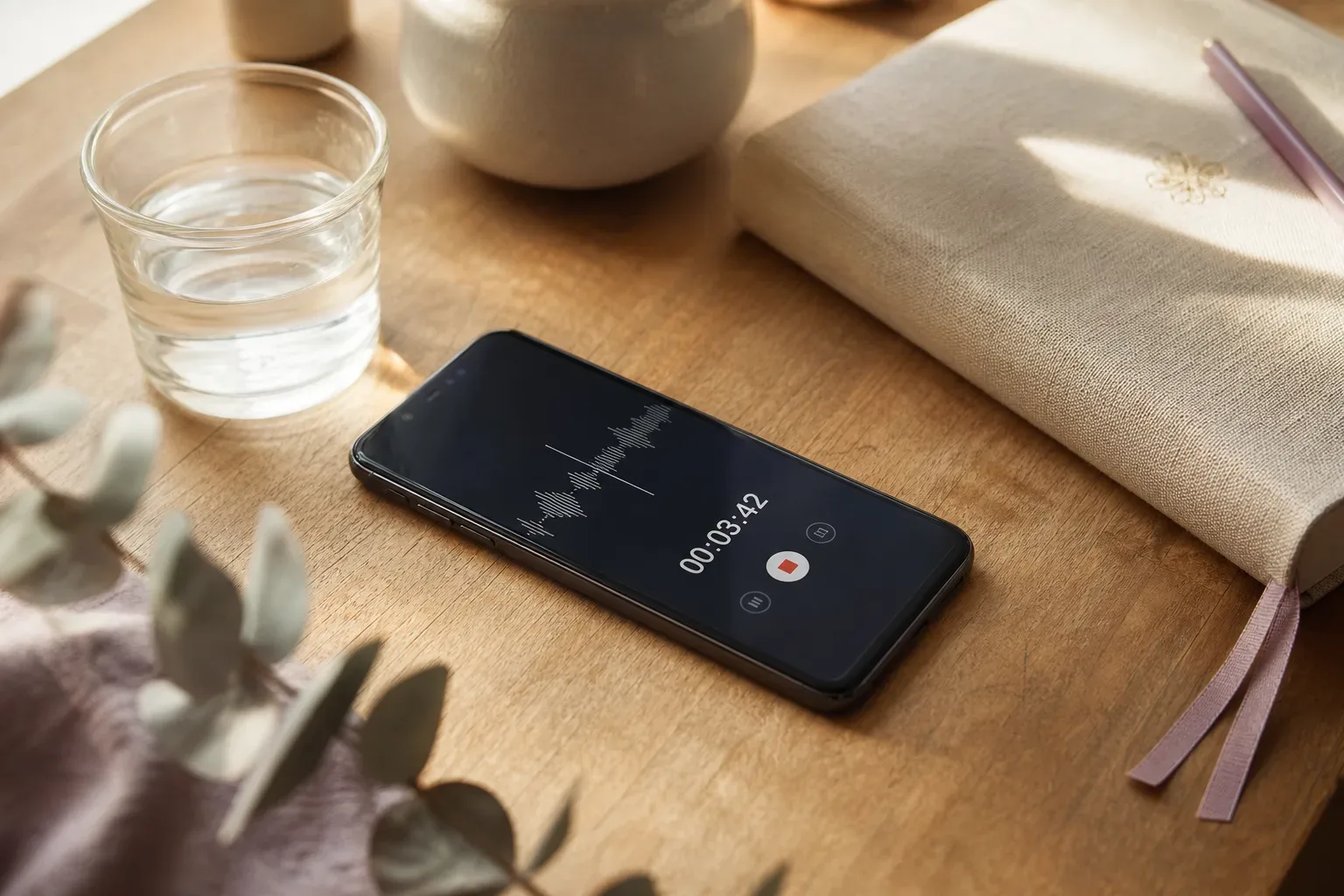
Your phone is on the table. The room is not ready, but you are. Voice note manifestation means recording one short future-self note, then listening to it every day so the thought becomes familiar in your body, not just interesting in your mind.
What is voice note manifestation, really?
Voice note manifestation is a recorded self-message you return to daily, spoken as if the life you intend is already here.
It is simple. You record once. You listen many times. The practice works best when the note sounds ordinary enough to believe. Not grand. Not theatrical. A true sentence, said slowly, can do more than 40 dramatic ones you secretly reject.
The useful part is repetition. In a 2009 study from University College London, Phillippa Lally and colleagues found that habit formation took a median of 66 days, with a wide range from 18 to 254 days. That number is not a law. It is a mercy. It says the nervous system often learns by return, not by force.
A voice note is different from writing because it brings tone. You hear breath. You hear pace. You hear the difference between a sentence you are performing and one you can live with. In self-affirmation research, Claude Steele’s early work in the 1980s and later reviews by Geoffrey Cohen and David Sherman point to one steady idea: chosen self-statements can protect a person’s sense of integrity under stress when they are connected to real values.
This is where the AYA Method enters quietly: The AYA Method is a daily audio manifestation practice. Each day you listen to a short personalized recording — your Dream-Self Moment — narrated from the version of you who has already manifested the life you intend. Listening is the practice. Repetition is the work. The audio is the method.
Your own voice note can be a handmade version of that principle. The sound carries the future back into the morning. One sentence heard daily can become a room you know how to enter.
Why record once and listen daily?
You record once so the message stays stable, and you listen daily so your attention can stop negotiating with it.
Changing the wording every morning can feel productive. Often, it is avoidance in clean clothes. The mind likes editing because editing keeps the future at a safe distance. Repetition removes that hiding place. The same 90-second note, heard 30 times, starts to reveal what you resist and what you already know.
Neuroscientist Andrew Huberman often speaks about attention, repetition, and state as core ingredients in neuroplasticity. The exact mechanisms are complex, and a voice note is not a medical treatment. Still, the practical lesson is plain: what you repeatedly attend to has a better chance of becoming available when life gets noisy.
There is also memory. In cognitive psychology, spaced repetition has been studied for more than a century, beginning with Hermann Ebbinghaus in the 1880s. The finding is almost humble: repeated exposure over time supports recall better than one long session. Manifestation is not only recall, but the body still benefits from known roads.
Record once, then let the note become a familiar object. Like a cup you reach for without looking. Like the route from bed to window.
Here is the quiet structure:
- Write one scene, not a speech.
- Record it in less than 2 minutes.
- Listen at the same time each day.
- After listening, take 3 slow breaths.
- Keep the note for at least 21 days before changing it.
In small behavior studies, 21 days is often too short for full habit formation, but it is long enough to stop treating the practice as a mood. A practice is what remains when the mood leaves.
How do you write the script without sounding fake?
You write the script by describing evidence from your future life, not by praising yourself into disbelief.
Start with one ordinary scene. Not the whole life. One morning. One email. One bank notification. One calm conversation. The mind can resist vague greatness, but it understands a kettle, a key, a calendar, a hand resting open on a table.
Pennebaker and Beall’s expressive writing studies, first published in the 1980s, asked participants to write for about 15 to 20 minutes over several days. Those studies were not about manifestation, but they showed that structured language can change how people process emotion and stress. Your voice note asks for less time. Maybe 10 minutes to write. Maybe 2 minutes to record. Still, language matters.
Use present tense. Use first person. Use sensory detail. If a line makes your jaw tighten, soften it. The voice note should stretch you by one honest inch, not ask you to become a stranger.
| Instead of this | Say this |
|---|---|
| I am rich and perfect | I check my account and feel calm enough to plan |
| Everyone admires me | I speak clearly in the meeting and do not abandon myself |
| My dream life is here | I wake in a room that feels like mine |
| I never worry | Worry comes, and I answer it slowly |
A believable line has weight. It does not need sparkle. It needs contact.
You can borrow from the manifestation pillar if you want the wider frame of intention, repetition, and identity. But keep the script small enough to carry. The more exact the image, the less the mind has to argue.
What should your voice note include?
Your voice note should include a present-tense scene, a felt emotional cue, one chosen identity, and one next action.
Think of it as four quiet rooms. The scene is where you are. The emotional cue is how your body knows it is safe to receive the change. The identity is who you are practicing being. The next action is how you live it today.
Research on implementation intentions by psychologist Peter Gollwitzer, including studies from the 1990s onward, found that if-then plans can improve follow-through across goals. Your voice note can use this without becoming rigid. For example: If I feel the old fear before sending the proposal, then I place both feet on the floor and send it anyway.
Here is a simple 120-second structure:
- 0:00 to 0:20: name the scene.
- 0:20 to 0:50: describe what is different now.
- 0:50 to 1:20: speak from the identity that already lives this.
- 1:20 to 1:45: name one small action for today.
- 1:45 to 2:00: close with a sentence you can believe.
A sample closing might be: I do not have to rush to prove this is real. I return by listening. That is enough for today.
If you already use affirmations, let one affirmation come from the voice note. Not ten. One. The daily affirmation is a complement, not the pillar. The audio is where you return. The sentence is what you carry when you are far from your headphones.
One true sentence, repeated daily, is not small. It is architecture.
When should you listen each day?
You should listen at the time you are most likely to repeat, not the time that sounds most spiritual.
For many people, that means morning. Cortisol tends to rise naturally in the first 30 to 45 minutes after waking, often called the cortisol awakening response in psychoneuroendocrinology research. That does not make morning magical. It makes morning memorable. The day has not gathered too much noise yet.
Evening can work too. Sleep researchers often note that pre-sleep routines affect how the mind settles. If your note is gentle, not demanding, listening before bed can give the mind a clean final image. Keep the volume low. Let the voice be near, not loud.
The rule is not early. The rule is repeatable.
Try one of these anchors:
- after brushing your teeth
- while making coffee or tea
- before opening messages
- during a short walk
- after closing your laptop
- before sleep, with the room already dim
If you miss a day, do not dramatize it. In the UCL habit study, missing one opportunity did not necessarily erase habit formation. The return mattered more than perfection. That is good news for real people with laundry, children, grief, deadlines, and weather.
You may also pair the note with your Manifestation Board if you use one. Let the image support the sound. Let the sound lead. A board can show the scene, but the listening teaches you how to inhabit it.
How do you record the note so you will actually listen?
Record it in a plain voice, with clean sound, and with no attempt to impress yourself.
Use your phone’s voice memo app. Sit near fabric if the room echoes. A curtain, coat, or pillow can soften sharp sound. Hold the phone about 6 to 8 inches from your mouth. Speak slower than feels natural. Most people speak at about 150 words per minute in conversation; for a calming note, closer to 110 or 120 can feel easier to receive.
Do not record 12 takes. Two is enough. The first take teaches you where the script is false. The second is the one you keep. If you keep chasing the perfect tone, you may lose the living tone. The small catch in your voice might be the part that makes the note yours.
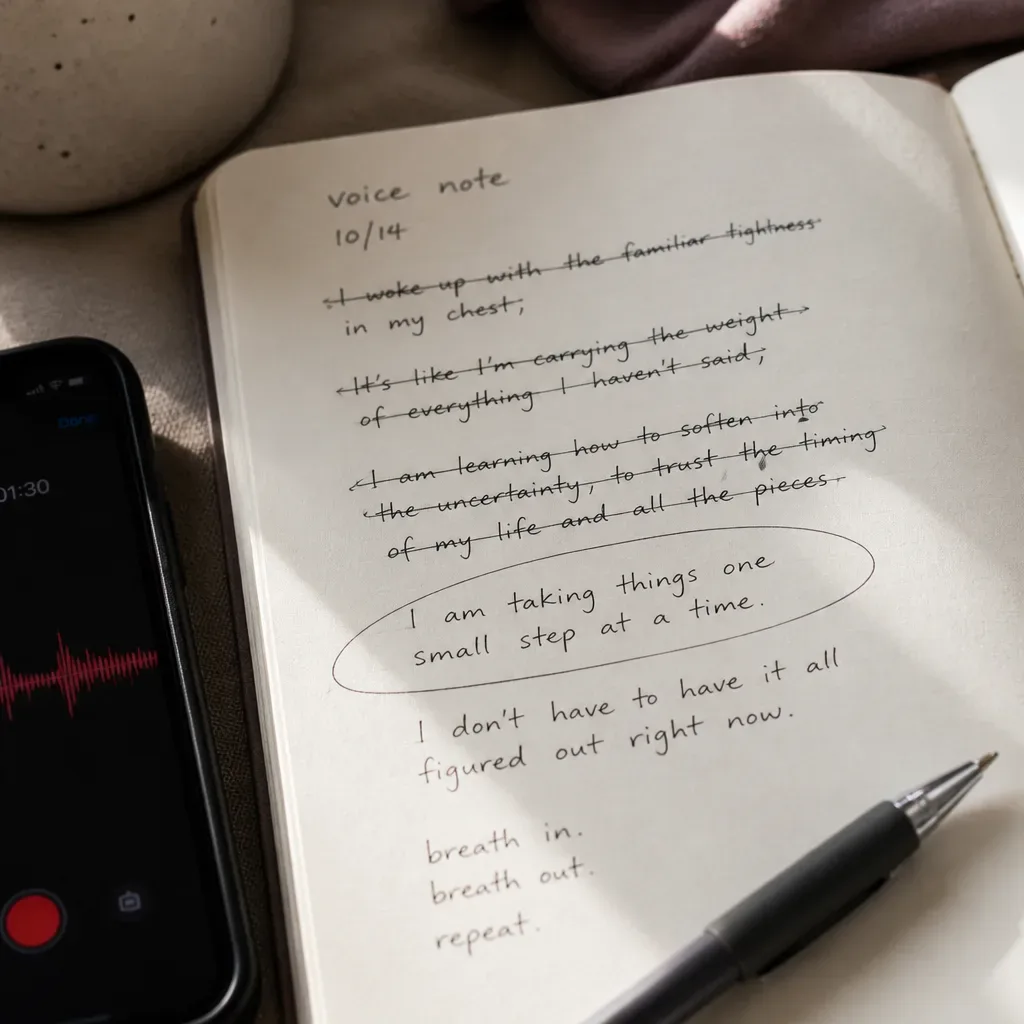
Before recording, read the script once out loud. Cross out any sentence that sounds like an advertisement. Add one physical detail. A window. A blue cup. Your hand on the door. Specifics bring the future down to earth.
You can use this short checklist:
- Is it under 2 minutes?
- Is it in present tense?
- Does it include one real scene?
- Does it name one action for today?
- Can I listen without rolling my eyes?
- Does my body soften by even 5 percent?
That last number is not clinical. It is a noticing tool. If your body moves from 70 percent guarded to 65 percent guarded, that counts. Quiet change often arrives in small measurements.
If your interest includes timing by moon phases, seasons, or personal cycles, astrology and manifestation can give symbolic structure. Keep the audio steady, though. Symbols can support the practice. They do not replace the listening.

How will you know it is working?
You will know it is working when the note changes your next small choice, not when you feel certain every day.
Certainty is not the measure. Watch behavior. Do you send the message a little sooner? Do you pause before answering from fear? Do you notice the old story before it takes the whole room? These are not fireworks. They are evidence.
In 2013, David Creswell and colleagues published work suggesting that self-affirmation can buffer stress responses under pressure, including effects on problem-solving performance in stressed participants. This does not mean every affirmation works for every person. It does suggest that identity-linked language can change how a person meets strain.
Track small signs for 14 days. Use notes, not judgment. Write one line after listening:
| Day | After listening, I noticed | One action I took |
|---|---|---|
| 1 | My chest felt tight | I rewrote the email |
| 5 | The scene felt less strange | I made the call |
| 10 | I remembered the line while walking | I chose the slower answer |
| 14 | I wanted to update the note | I kept listening anyway |
There is also a deeper measure: the note becomes less exciting and more normal. That is not failure. That is the point. When the future self stops sounding far away, you have begun to recognize her voice as yours.
If you want a wider practice around this, return to the AYA Method. The Dream-Self Moment is built for daily listening, with the audio at the center. You do not have to keep inventing the doorway. You only have to enter.
What becomes familiar becomes easier to choose.
What if your own voice feels hard to hear?
If your own voice feels hard to hear, begin with gentler narration or record as if you were speaking to someone you love.
Many people dislike recordings of their voice. There is a physical reason. Through bone conduction, you hear your live voice with lower frequencies that are missing in playback, so recordings can sound thinner or unfamiliar. That mismatch is common. It does not mean the practice is wrong for you.
Try recording in second person first. Say, You are safe to begin. You have done the quiet work. You answer slowly now. After 7 days, change the same script into first person if it feels possible. Or keep second person. The practice should meet the nervous system, not bully it.
You can also use a trusted audio method until your own voice feels less strange. The point is not authorship. The point is listening. A note can be yours because the intention is yours, even if the narration is guided.
Keep the promise small:
- I will listen once today.
- I will not fix my whole life before breakfast.
- I will let one sentence be enough.
- I will notice what changes in my next choice.
The Princeton Engineering Anomalies Research program and the later Global Consciousness Project are often mentioned in manifestation spaces. Their findings are debated, and they do not prove that thought alone changes events. For this practice, you do not need that claim. You are training attention, identity, and behavior through repeated audio. That is already enough to begin.
Record once. Listen daily. Let the voice become a place you can return to.
The room is still listening, too.