manifestation 101
Future Self Letter vs Dream-Self Audio
A future self letter can clarify what you want once. Dream-Self Audio helps you return to it daily through listening, repetition, and the body.

A future self letter sits on the desk. Dream-Self Audio goes with you. The letter helps you name the life you intend in one clear writing session; audio helps you listen to that same identity daily, until the body begins to recognize it as familiar.
What does a future self letter do best?
A future self letter is best for making a vague desire specific enough to hold.
You write to yourself from a later date. Six months from now. One year. Three years, if your body can stay with that distance. The point isn’t performance. It’s contact. A 2005 review of expressive writing research connected structured writing with small but measurable benefits in health and self-regulation, especially when people wrote about meaning as well as facts.
The letter works because it slows the wanting down. You can’t write everything at once. You have to choose. What does your morning look like? Who hears your voice differently? What no longer takes all your breath? In the work of James Pennebaker, early expressive writing studies often used 15 to 20 minutes of writing across 3 or 4 days. The container mattered. Too little time stayed on the surface. Too much sometimes became rumination.
A good future self letter does 3 quiet things:
- Names the life you’re practicing toward.
- Gives your mind a stable sentence to return to.
- Shows you where your body tightens around receiving it.
That third part matters to me most. As a somatic practitioner, I watch for the small signs. The jaw closing. The belly pulling back. The shoulder lifting before the hand writes the truth. The body often tells the truth before the paragraph does.
If you’re new to manifestation, the letter can be a gentle first form. It makes the invisible visible. It gives your intention a date, a room, a voice. But it’s still mostly a written object. You may love it on Sunday and forget it by Wednesday. That’s not failure. It’s how attention works. One study in Psychological Science found that people’s minds wandered about 47% of the time in daily life, using phone-based sampling. Attention needs return, not blame.
A letter can name the self you’re becoming. A daily sound can help your body remember her.
What does Dream-Self Audio do differently?
Dream-Self Audio turns the written intention into a daily listening practice.
The AYA Method is a daily audio manifestation practice. Each day you listen to a short personalized recording — your Dream-Self Moment — narrated from the version of you who has already manifested the life you intend. Listening is the practice. Repetition is the work. The audio is the method.
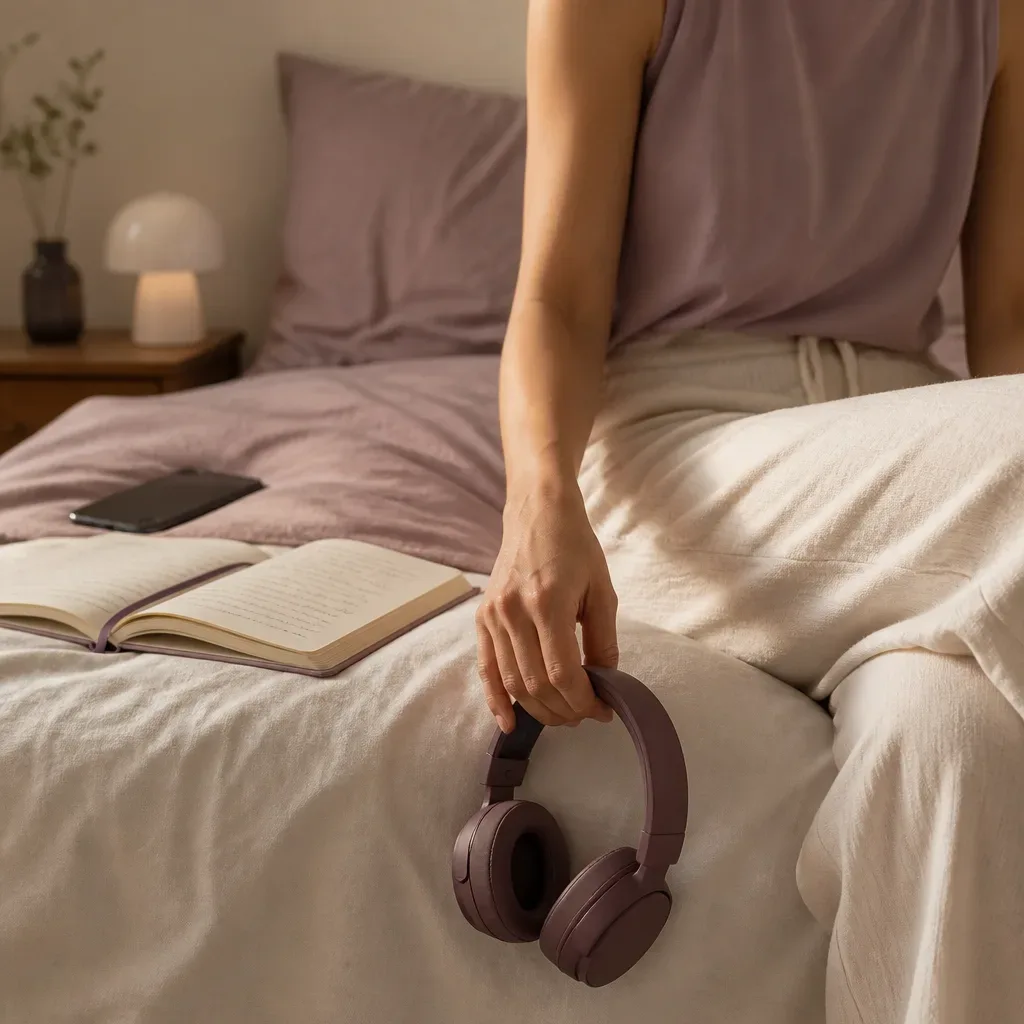
That distinction is small and not small. With a letter, you return by reading. With audio, you return by receiving. Your eyes can soften. Your hands can rest. You can listen while sitting at the edge of the bed, before your phone becomes the room. Most Dream-Self Moment recordings are short enough to fit inside 3 to 5 minutes, which matters because adherence drops when a practice asks for too much too soon.
Dr. Andrew Huberman often speaks about repetition, attention, and nervous system states in habit formation, though he’s careful to separate mechanism from certainty. The practical piece is plain: what you repeat becomes easier to access. A 2009 study in the European Journal of Social Psychology found habit formation took a median of 66 days, with wide variation. Some people needed far less. Some needed more than 200 days.
Audio also carries tone. Tone bypasses some of the argument. You may read “I’m safe being seen” and feel your mind start gathering evidence against it. But hearing your future self speak from steadiness can land differently. Not magically. Physically. Breath changes. The throat loosens by one degree. The sternum feels less guarded.
This is why the daily affirmation and Manifestation Board in the app are complements, not the main practice. An affirmation can give you one sentence. A board can give you images. The listening is where you return. The audio is the room you visit until it begins to feel like home.
Which one helps more with belief?
A future self letter can start belief, but Dream-Self Audio usually supports it better over time because belief needs repeated contact.
Belief is not a mood you win once. It’s a relationship with evidence, memory, and body sensation. Neville Goddard wrote often about entering the feeling of the wish fulfilled, not simply thinking about it. Whether you take his work spiritually or psychologically, the instruction is embodied: feel the later self now. That’s hard to do if the practice only lives on paper.
Writing gives you precision. Audio gives you repetition. Both affect belief differently.
| Practice | Best use | Main strength | Quiet risk |
|---|---|---|---|
| Future self letter | First clarity | Specific language | Can become a document you don’t revisit |
| Dream-Self Audio | Daily return | Repeated listening | Can become passive if you don’t let it land |
| Affirmation | One-sentence cue | Easy recall | Can feel thin if it’s not true enough |
| Manifestation Board | Visual reminder | Image memory | Can become decoration |
The Journal of Behavioral Medicine has published many studies on expressive writing and health, with mixed but meaningful findings depending on the population, topic, and method. That’s important. No single writing practice works the same for every nervous system. Some people feel clearer after writing. Others feel flooded. The dose matters.
Audio can reduce the effort of returning. You don’t have to reconstruct the whole letter. You press play. You listen. You notice where the body says yes, where it says not yet, where it says I need more time. A 2020 paper on auditory learning and memory noted that repeated sound cues can strengthen recall, especially when paired with attention and context.
There’s also the tenderness of being spoken to. Many people are tired of instructing themselves. They don’t need another command. They need a voice that sounds like trust. If the future self letter is a mirror, Dream-Self Audio is a hand on the back.
For more language-based practice, affirmations can help when they’re honest enough for the body to accept. “I’m calm” may be too far away. “I’m allowed to soften one breath at a time” may be close enough to enter.
Belief is not forced open. It’s visited until it stops hiding.
When should you write, and when should you listen?
Write when you need clarity; listen when you need continuity.
The future self letter belongs near beginnings. Write it when a desire is foggy. Write it when you keep changing the goal because none of the versions feel fully yours. Write it when you’re deciding between two lives that look similar from outside but feel very different in the ribs. Give yourself 20 minutes. Put a date at the top. Choose a time horizon you can feel: 90 days, 6 months, or 1 year.
Then stop trying to rewrite yourself every morning. That becomes another kind of pressure. The letter is the seed text. The daily practice is the watering. In behavior research, consistency usually beats intensity; one 2012 review on implementation intentions found that specific “when and where” plans helped people follow through across goals. Listening after brushing your teeth is stronger than promising to listen “more.”
A simple rhythm can look like this:
- Write the future self letter once, slowly, by hand if you can.
- Pull 3 to 5 true sentences from it.
- Let those sentences shape your Dream-Self Moment.
- Listen daily for at least 30 days.
- Revisit the letter only when your life or desire has clearly changed.
This is not about leaving the written practice behind. It’s about giving the written practice a body. In astrology and manifestation, timing can be used as a mirror for reflection. A new moon, birthday, or personal transit may be a good moment to write. But the daily listening is less dramatic. It’s ordinary on purpose.
Joe Dispenza’s work often emphasizes mental rehearsal and emotional state, and while his claims are debated in scientific spaces, the basic principle of rehearsing a chosen identity has roots in sports psychology and mental practice studies. Athletes have used imagery rehearsal for decades. A 1994 meta-analysis found mental practice had a positive effect on performance, though physical practice still mattered.
Your letter says, “This is where I’m going.” Your audio says, “Return here today.”
How do you compare them without making one wrong?
You compare them by asking what each practice asks from your attention.
The future self letter asks for language, time, and honesty. Dream-Self Audio asks for listening, repetition, and receptivity. Neither is more spiritual. Neither is more serious. They simply enter through different doors. Some days the mind needs a pen. Some days the body needs a voice.
A useful comparison is effort. Writing can take 20 to 40 minutes if you do it carefully. Listening can take 3 to 5 minutes. That difference matters on tired days. The American Psychological Association has reported for years that stress affects sleep, focus, and decision-making for many adults. A practice that survives stress has to be small enough to keep.
Here’s the quieter test:
- If you don’t know what you want, write.
- If you know what you want but keep forgetting, listen.
- If your body resists the sentence, soften the sentence.
- If the practice becomes checking, pause.
- If the desire changes, write again.
This is also why a manifestation practice can’t be only aesthetic. A pretty notebook is lovely. A playlist is lovely. But the work is contact. What do you return to when nothing looks different yet? What helps you stay close to the truth without gripping it?
In somatic work, I often use a scale from 1 to 10. If a sentence feels like a 10, too charged, too far, too much, bring it down to a 6. Instead of “I’m fully ready to be seen,” try “I’m practicing being seen in rooms that are safe enough.” The body trusts increments. Intention travels at the speed of tissue, not the speed of thought.

What if your future self letter feels false?
If the letter feels false, it’s usually too far away, too polished, or written for someone else’s approval.
This happens often. The letter becomes a performance of certainty. It says all the right things. It has the apartment, the partner, the body, the work, the calm breakfast. But when you read it, your chest goes flat. That flatness is data. Not doom. In trauma-informed somatic practice, numbness is often understood as a protective response, not a lack of desire.
Bring the letter closer. Reduce the time horizon from 5 years to 90 days. Replace perfect images with sensory truth. “I wake at 6 and meditate for an hour” may not be honest. “I wake and don’t reach for my phone for the first 3 breaths” may be real. The nervous system believes what it can rehearse without bracing.
Research on self-affirmation theory, first developed by Claude Steele in the 1980s, suggests people are more open to difficult information when their sense of self-integrity is supported. That matters here. A future self letter shouldn’t attack your current self. It should speak to her like she’s already worthy of care.
Try these revisions:
- Change “I am” to “I’m learning to be.”
- Change “always” to “more often.”
- Change “I never” to “I’m noticing sooner.”
- Add one ordinary scene, not only a grand result.
- Read one paragraph aloud and watch your breath.
Then let audio carry the truest version. A Dream-Self Moment doesn’t need to be dramatic. It needs to be listenable. If you can hear it every day without your body leaving the room, you’ve made something useful.
The right sentence doesn’t impress the body. It lets the body stay.
What is the quiet answer: letter or audio?
The quiet answer is both, but not equally often: write the future self letter once, then listen daily.
Use the letter as source material. Use Dream-Self Audio as the practice. This keeps you from rewriting your desire every time fear gets loud. It also keeps you from treating audio like decoration. The written page gives the recording its truth. The recording gives the page a daily pulse.
A simple comparison may help you choose what to do next:
| If you feel… | Choose… | Time needed |
|---|---|---|
| Foggy | Future self letter | 20 minutes |
| Forgetful | Dream-Self Audio | 3 to 5 minutes |
| Resistant | Softer wording | 5 minutes |
| Inspired but scattered | One affirmation | 1 minute |
| Visually drawn | Manifestation Board | 10 minutes |
The AYA app also includes a daily affirmation and Manifestation Board as complements, but the center remains listening. That matters because daily practice has to be repeatable. Pew Research Center has reported that a large majority of adults keep smartphones nearby through much of the day. The device is already close. The question is whether one small use of it can bring you back to yourself.
If you want a clean way to begin, write one page tonight. Not ten. One. Date it. Begin with, “I’m writing from the day this became normal.” Name what changed in your mornings, your work, your body, your private speech. Then tomorrow, listen. Let the Dream-Self Moment meet you before the old story has fully put its shoes on.
There’s no need to choose a winner. The page knows how to name. The voice knows how to return. Together, they make manifestation less like wishing and more like remembering, one ordinary day at a time.
One page on the desk. One voice in the morning. Stay near.