manifestation 101
Law of Attraction for Beginners: Listen First
Law of attraction for beginners starts with listening: a quiet daily audio practice before visualization, scripting, or vision boards.

A cup sits beside the bed. Your phone is face down. Law of attraction for beginners starts best when you listen before you visualize: hear a short future-self audio, let the body recognize it, then choose images and actions from that quieter place.
Manifestation gets noisy when it starts with pictures. The car. The house. The face in the mirror. The desk near the window. Some images are true. Some are borrowed. A beginner often can’t tell the difference yet.
Listening gives desire a voice before the mind tries to decorate it.
This is why audio comes first here. Not as background sound. Not as mood. As method. Research on mental imagery has been mixed for more than 20 years. Gabriele Oettingen’s work on positive fantasy, including a 2011 paper with Heather Kappes in the Journal of Experimental Social Psychology, found that indulging in desired futures can lower effort when it isn’t paired with reality and action. That doesn’t make vision wrong. It means the order matters.
What does law of attraction for beginners actually mean?
Law of attraction for beginners means practicing a chosen relationship with attention, belief, feeling, and daily action.
At its simplest, the law of attraction says that what you repeatedly hold in attention shapes what you notice, choose, and rehearse. Some teachers speak of it in spiritual terms. Neville Goddard, writing in the mid-20th century, asked students to feel the wish fulfilled. Joe Dispenza often speaks about rehearsing a future state until the body begins to know it. Psychology uses different words: attention, salience, identity, expectation, and behavior.
The beginner mistake is treating the practice like a vending machine. Think the thought. Get the thing. That is too thin. It turns a quiet inner discipline into pressure. The more useful frame is this: manifestation is not wishing harder; it is practicing a chosen relationship with attention.
There is science around pieces of this. The brain’s reticular activating system helps filter what seems relevant from the thousands of signals around you. Cognitive scientists often estimate that conscious attention can hold only about 4 chunks at once, following Nelson Cowan’s 2001 review in Behavioral and Brain Sciences. What you repeat becomes easier to see. Not because life becomes obedient, but because your noticing changes.
A beginner needs three things:
- A clear direction, not a perfect script.
- A daily cue that brings the direction back.
- A small action that proves you heard yourself.
If you want a wider foundation, keep the Manifestation pillar nearby. It holds the larger map. But do not begin with every tool at once. Begin with one sound. One sentence that feels true. One small return.
Why should you listen before you visualize?
You should listen before you visualize because sound can reach the body before the mind starts performing.
Visualization is often taught as the first move. Close your eyes. See the outcome. Add detail. Repeat. For some people, this is easy. For others, it turns into strain. A 2015 review in Cortex discussed aphantasia, the inability or difficulty some people have with voluntary visual imagery. Estimates vary, but studies often place strong aphantasia around 1 to 4 percent of people. Many more simply don’t think in sharp pictures.
So if you’re new, listening is kinder. A voice gives pace. It tells the nervous system, you don’t have to invent the whole scene right now. You only have to receive. Dr. Andrew Huberman has often spoken about how auditory cues and breath can help regulate attention and physiological state. The exact practice matters, but the principle is plain: sound can guide focus without asking the mind to create everything from scratch.
A picture can become a cage when it arrives before the feeling is known.
This is where the AYA Method enters quietly: The AYA Method is a daily audio manifestation practice. Each day you listen to a short personalized recording — your Dream-Self Moment — narrated from the version of you who has already manifested the life you intend. Listening is the practice. Repetition is the work. The audio is the method.
Notice the order. You hear first. You let the future self sound ordinary. Then, if an image comes, it comes from recognition rather than performance. The app also includes a daily affirmation and Manifestation Board, but those are complements. They help you remember. They are not the center.
How is listening different from affirmations, scripting, and vision boards?
Listening is different because it asks you to receive before you produce.
Affirmations use language. Scripting uses writing. Vision boards use image. All can be useful. The Affirmations pillar explains how repeated statements can shape inner speech, especially when they are believable enough to practice. But beginners often make affirmations too grand. The sentence becomes a costume. The body refuses it.
Scripting has another risk. It can become a way to control every detail. Three pages about the future apartment. The exact email. The exact person. The exact number in the bank. There is nothing wrong with detail, but detail should serve truth. It should not become a bargaining ritual.
Vision boards are visible, which is their strength and their danger. In a 2016 survey from TD Bank, 67 percent of small business owners said they believed pictures of goals helped them map and reach business plans. That is interesting. It is not proof that images create outcomes by themselves. It suggests images may help people remember and act.
| Practice | What it asks first | Best use for a beginner | Common trap |
|---|---|---|---|
| Listening | Receive a future-self voice | Build daily repetition | Treating it like background noise |
| Affirmations | Speak or read a sentence | Change inner speech | Making claims you don’t believe |
| Scripting | Write the desired scene | Clarify details | Trying to control every inch |
| Vision board | See symbols and images | Keep direction visible | Choosing borrowed dreams |
The future becomes less theatrical when you hear it speak in an ordinary voice.
A beginner doesn’t need to abandon visual tools. You only need a sequence. Listen. Let the body settle. Then choose one phrase, one image, or one line that still feels true five minutes later.

What happens in the brain when you repeat a future-self audio?
When you repeat a future-self audio, you train attention, memory, and self-reference around a chosen identity.
The brain learns through repetition. That is not mystical. It is biological. Neuroplasticity research has shown for decades that repeated mental and physical practice can alter neural pathways. A well-known 1995 study by Pascual-Leone and colleagues found that mental practice of a piano sequence produced measurable changes in the motor cortex, though physical practice produced stronger effects. The lesson is modest and useful: rehearsal matters.
Audio adds another layer. You are not only thinking about the future. You are hearing it narrated. Speech carries rhythm, pacing, and emotional tone. Those cues can make the practice easier to remember. Studies on self-talk in sport psychology, including reviews in the 2010s, have found that instructional and motivational self-talk can improve performance in specific tasks. The size of the effect depends on the task and the person, but the pattern is clear enough to take seriously.
In manifestation language, you might say you’re becoming familiar with a version of yourself before the outer proof has arrived. In psychology language, you are rehearsing identity-based attention. Both point to the same daily act. Hear the person you are practicing to become. Then behave in one small way that does not contradict her.
Try this after listening:
- Name one sentence you heard that felt true.
- Write one action that matches it and takes less than 10 minutes.
- Do the action before you check for signs.
- Return to the same audio tomorrow, even if nothing dramatic happened.
The fourth step is where most people leave. A 2009 habit study by Phillippa Lally and colleagues found that automaticity took anywhere from 18 to 254 days, with an average of 66. Daily repetition is not decorative. It is the work itself.
How do you begin if you do not trust manifestation yet?
Begin by treating manifestation as attention practice, not as a belief test.
You do not have to force certainty. In fact, forced certainty often feels brittle. A beginner can start with a softer statement: I am willing to practice seeing myself differently for 5 minutes a day. That is enough. You are not signing a contract with an idea you don’t yet trust. You are testing a daily return.
This matters because belief is not a switch. Studies of behavior change, including the COM-B model published by Michie, van Stralen, and West in 2011, suggest that behavior depends on capability, opportunity, and motivation. If your practice requires too much belief before it begins, motivation collapses. A 3-minute audio asks less of you. It gives you a structure when your mind is tired.
You can hold skepticism and still practice. Many contemplative traditions have done this for centuries: repeat the form, then notice what changes. Modern mindfulness research also supports modest daily repetition. In clinical studies, mindfulness programs often run for 8 weeks, not because 8 is magic, but because repeated attention needs time to show itself.
Use this beginner agreement:
- I do not need perfect belief today.
- I will listen once.
- I will notice what sentence stays with me.
- I will take one small action.
- I will not punish myself for doubt.
Doubt is not the enemy of manifestation. Disconnection is.
If you want another lens, Astrology and manifestation can be used as timing language, not as a cage. Some people like dates, moons, and seasons because they give the practice a rhythm. Keep it simple. Let timing support the listening, not replace it.
What is a simple listening-first practice for the first 7 days?
A simple first week is one short audio each day, one written line, and one small matching action.
Do not build a morning routine that requires you to become a different person by Monday. Start where you already are. If you have 4 minutes, use 4. If you only have the train ride, use that. The practice should be small enough to survive a bad mood.
Here is a 7-day structure:
- Day 1: Listen once. Do nothing else. Notice whether your body softens or resists.
- Day 2: Listen and write one phrase. Keep the phrase under 12 words.
- Day 3: Listen and choose one action. Make it smaller than your pride wants.
- Day 4: Listen at the same time. Repetition builds a cue.
- Day 5: Listen and remove one contradiction. Cancel, clear, delete, or say no.
- Day 6: Listen and add one visible reminder. A note. A photo. A line.
- Day 7: Listen and review. Ask what felt real, not what looked impressive.
This is close to how behavior designers think. BJ Fogg’s Tiny Habits model, popularized in 2019, argues that very small behaviors become more reliable when tied to an existing cue. A 2-minute version often succeeds where a 30-minute version fails. Your cue might be brushing your teeth, sitting in the car, or turning off the lamp.
The daily affirmation can help after the audio. So can a board. But the order remains important: audio first, words and images second. If you want to study the language side, return to the Affirmations pillar after your first week. If you want the larger frame, return to manifestation basics when you have practiced enough to know your own questions.
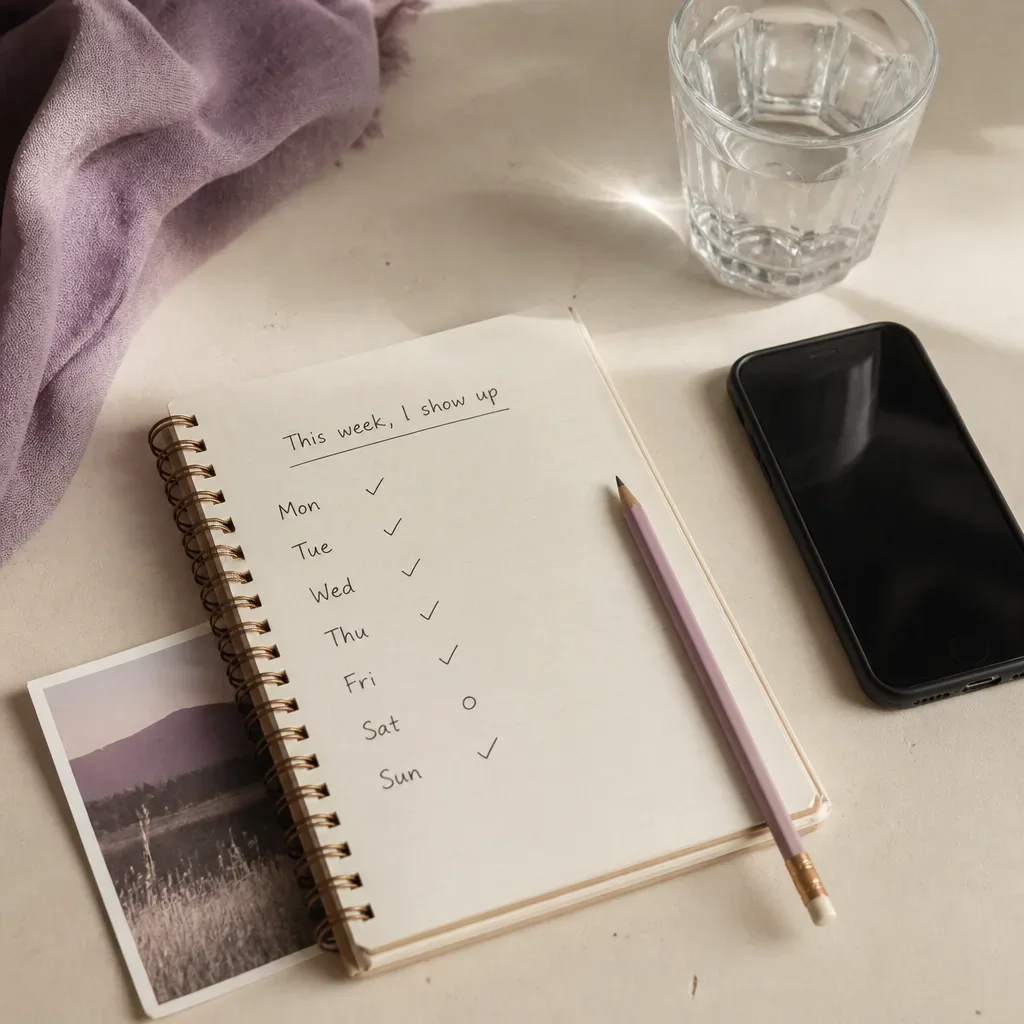
How do you know whether the practice is working?
You know the practice is working when your choices begin to resemble the self you keep hearing.
Do not measure only by outer arrival. That can make you miss the first signs. A beginner should track behavior, attention, and emotional recovery. Did you notice a better opportunity because you were less scattered? Did you answer the email you avoided for 9 days? Did you spend 20 minutes building the skill instead of rehearsing fear? These are not small things. They are the path becoming visible under your feet.
Use a simple weekly measure. Score each line from 0 to 2:
| Sign | 0 | 1 | 2 |
|---|---|---|---|
| I listened daily | Not yet | Some days | Most days |
| I remembered the future-self sentence | Not yet | Once or twice | Often |
| I took matching action | Not yet | Small action | Repeated action |
| I recovered from doubt faster | Not yet | Sometimes | Yes |
| I chose fewer borrowed desires | Not yet | One clear no | Several clear no’s |
A total of 6 or more is enough to keep going. A total below 6 is not failure. It is information. Reduce the length. Make the cue clearer. Choose a recording that sounds more like you.
There is also the matter of emotional safety. If a practice makes you blame yourself for illness, loss, money stress, or another person’s choices, pause. That is not care. The law of attraction is often taught badly when it pretends that thought is the only cause. Life has systems, histories, bodies, other people, and chance. Princeton’s Global Consciousness Project, started in 1998, has collected data on random number generators during major world events, but interpretations remain disputed. Curiosity is allowed. Certainty should stay humble.
A true practice makes you more honest, not more frantic.
What should a beginner remember before trying to visualize?
Remember that visualization should follow recognition, not replace it.
After 7 days of listening, you may be ready to let images come. Not forced images. True ones. The room you keep seeing. The posture. The way your hand rests on the table. The way your voice sounds when you no longer need to explain yourself. These details matter because they arrive from the practice, not from comparison.
When you do visualize, keep it short. Research on mental simulation suggests that process imagery, picturing the steps, can be more useful than only picturing the outcome. Oettingen’s mental contrasting work pairs desired futures with present obstacles. In practice, this means you might see yourself finishing the proposal, then also see the 3 p.m. slump and plan for it. That is not negative thinking. It is respect for reality.
Try this order:
- Listen to the Dream-Self Moment.
- Write the sentence that stayed.
- Let one image appear.
- Ask what action would make the image less imaginary.
- Do that action within 24 hours.
This keeps the practice grounded. It also protects you from collecting other people’s symbols. The beach house might be beautiful and not yours. The public praise might look bright and feel false. The relationship might be desired because it proves something to someone who isn’t even in the room.
For beginners, the best manifestation practice is the one that brings you back to yourself without making you perform certainty.
Listening first is not smaller than visualizing. It is earlier. It is the hand on the door before the room is furnished. It is the voice that says, softly, this is what is true enough to practice today.
Put the sound on low. Stay here.