audio manifestation
Manifestation Audio for Focus Before Deep Work
Use manifestation audio for focus before deep work with a 12-minute listening ritual that settles the body, narrows attention, and makes starting easier.
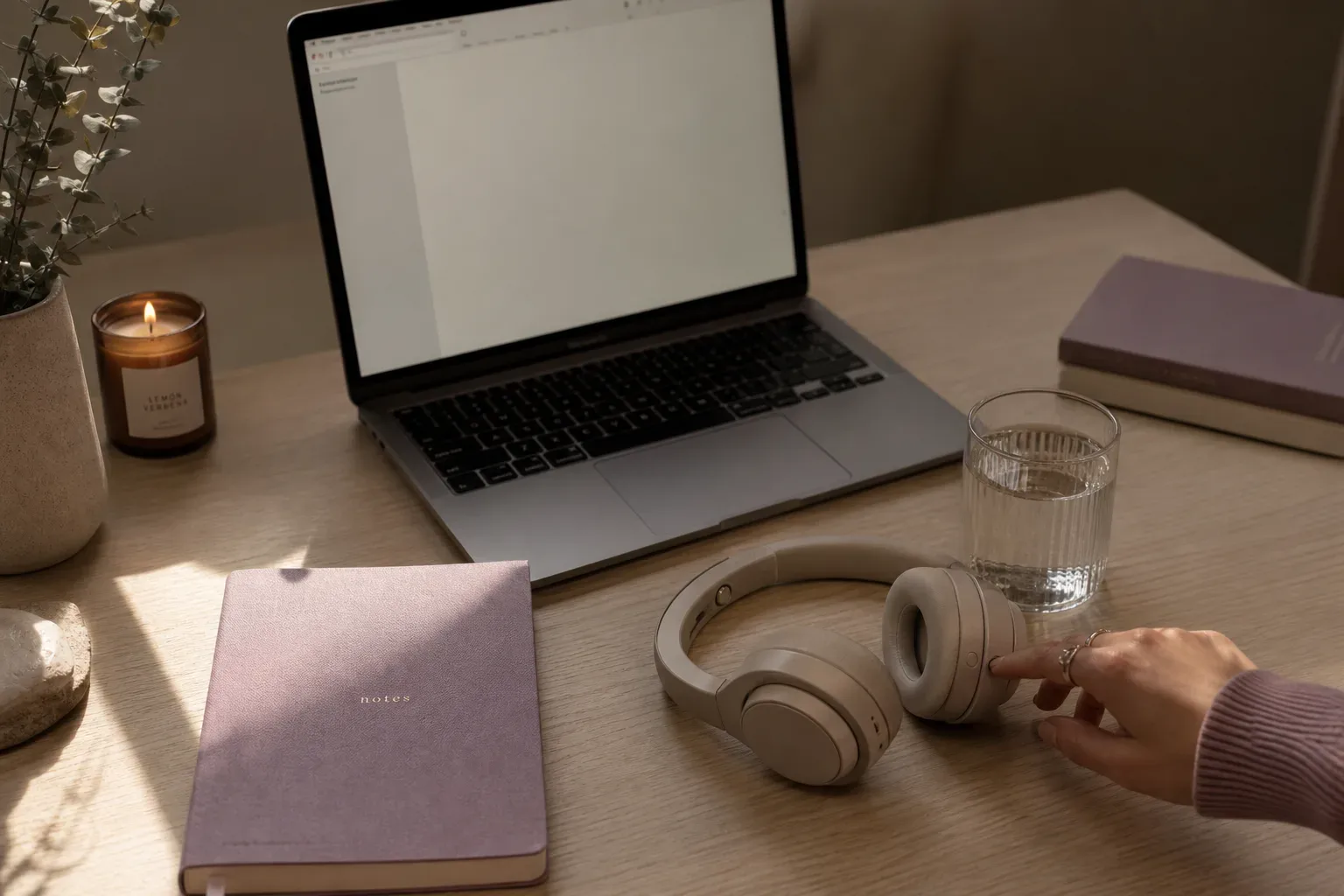
Your laptop is open, and the room has gone quiet. Manifestation audio for focus works by giving your attention one spoken future to rehearse before deep work starts. Listen for 8 to 12 minutes, let the body settle, name one task, then begin before your mind asks for more proof.
What is manifestation audio for focus before deep work?
Manifestation audio for focus is a short listening practice that helps your mind and body enter one chosen task with less inner noise.
Deep work asks for a clean threshold. Cal Newport defines deep work as cognitively demanding work done without distraction, and he often points to blocks of 60 to 90 minutes as useful containers. Most of us do not enter that kind of work cleanly. We arrive with five browser tabs open, a text message still in the chest, and a small argument with ourselves about whether we are ready.
The AYA Method is a daily audio manifestation practice. Each day you listen to a short personalized recording — your Dream-Self Moment — narrated from the version of you who has already manifested the life you intend. Listening is the practice. Repetition is the work. The audio is the method.
For deep work, that matters because attention is not only mental. It is physical. The shoulders lift. The eyes harden. The breath shortens. A 2015 Microsoft attention report popularized the number 8 seconds, though that exact figure is often overstated. The truer point is simpler: fragmented attention has become normal enough that starting one hard thing can feel strange.
A focus ritual does not need to be grand. It needs to be repeatable. The audio gives your nervous system a known beginning. Your daily affirmation and Manifestation Board can support the practice later, but they are not the center. Listening is the center.
| Part of practice | What it does before deep work | Time |
|---|---|---|
| Dream-Self Moment | Gives attention one future to hear | 8 to 12 minutes |
| First task note | Turns intention into a visible next action | 1 minute |
| Work block | Keeps one demand in front of you | 45 to 90 minutes |
A focused state is not something you force. It is something you give fewer reasons to leave.
Why use audio before deep work instead of silence?
Audio gives the mind a track to follow when silence would become another place to wander.
Silence can be beautiful. It can also be too wide when you are about to write, code, study, design, or make a hard decision. If your mind is already moving in 12 directions, silence may not settle it. It may simply make every direction louder. A spoken recording narrows the opening. You do not have to invent the state from nothing. You receive it.
The American Psychological Association has reported that task switching can cost as much as 40 percent of productive time in some contexts, especially when work is complex. Gloria Mark and colleagues at the University of California, Irvine, also found in a well-known 2008 study that it took workers about 23 minutes and 15 seconds to return to a task after interruption. That number is not a law, but it is a warning. The cost of leaving is higher than it feels.
Manifestation audio for focus helps because it creates one sensory cue before the first sentence, formula, sketch, or call. The voice becomes a small handrail. The body learns: when I hear this, I am not scanning the whole day. I am entering this one piece of work.
This is close to what psychologist Peter Gollwitzer called implementation intentions in 1999: if a specific cue appears, a specific action follows. If headphones go on and the Dream-Self Moment ends, the document opens. The sequence matters more than the mood.
You can read more about the wider practice at Manifestation, but for focus, keep the frame modest. This is not about becoming a different person before noon. It is about making it easier to start as the person you already mean to be.

How do you set up a 12-minute focus ritual?
Set up the ritual by choosing one task, listening to one recording, and beginning within 30 seconds after the audio ends.
Twelve minutes is long enough to let the body arrive and short enough not to become avoidance. Dr. Andrew Huberman has often discussed 10 to 20 minute NSDR practices as useful for rest and recovery, and while manifestation audio is different, the time scale is helpful. The body can shift in a few minutes when the conditions are simple.
Use this before a 45, 60, or 90 minute work block. Do not use it to plan the whole week. Do not use it to solve your entire identity. A deep work threshold should be narrow. One door. One room. One chair.
- Write one task. Use a sentence like: Draft 600 words of the proposal, review the first 20 rows, or outline slide 3.
- Remove one known pull. Put your phone in another room, close the inbox, or turn off the one alert that always reaches you.
- Press play. Listen to your Dream-Self Moment without multitasking. If you need an anchor, place one hand on the sternum.
- Catch one phrase. Let one line from the audio stay with you. Not five. One.
- Begin within 30 seconds. Open the file before your mind starts asking whether the ritual worked.
The 30-second rule is not sacred. It is practical. Behavioral scientist BJ Fogg often points to tiny actions as reliable starters because they lower the demand. In the same way, beginning quickly after the audio keeps the state from becoming a thing you evaluate.
A ritual is a bridge, not a destination. If you keep standing on the bridge, you are still not inside the work.
For a fuller map of how spoken intention works, Affirmations can help. Just remember the order here. The audio leads. The written line follows.
What should you listen for in the Dream-Self Moment?
Listen for the felt evidence that your future self already knows how to stay with one important thing.
The words matter, but the body matters too. Notice the part of you that believes the voice for half a second before doubt returns. That half second is not small. In somatic work, I watch rooms change when someone stops trying to fix the whole body and simply notices one hand unclenching. Specificity is kind.
Neville Goddard wrote often about assuming the feeling of the wish fulfilled. Whatever your view of his metaphysics, the practical instruction is clear: rehearse the inner state, not just the outer result. Joe Dispenza has also popularized mental rehearsal as a way of pairing intention with felt state. Neither name needs to become a doctrine. The useful question is ordinary: can your body recognize the person who finishes?
During the audio, listen for three things:
- A posture cue. Maybe your future self sits with the ribs soft and the back awake.
- A time cue. Maybe the work block has a real edge: 50 minutes, not forever.
- A behavior cue. Maybe the future self returns to the page after distraction without drama.
The phrase you carry into work should be plain enough to use under pressure. Examples: I stay with the first page. I return without scolding. I do the next visible thing. Each one is short enough to remember after an interruption.
Research on self-talk is mixed by context, but a 2014 study by Ethan Kross and colleagues found that using your own name or second-person language can support emotional regulation during stressful tasks. This is one reason audio can feel different from silent thought. The voice gives just enough distance.
Your future self is not a fantasy figure. It is the part of you that can act before every feeling agrees.
How do you keep the body from bracing while you work?
Keep the body from bracing by checking for tension at predictable intervals and softening only 5 percent.
Deep work can invite a strange kind of gripping. The jaw sets. The belly tightens. The eyes lean toward the screen. None of this is failure. It is the body trying to help. But after 30 or 40 minutes, effort can become armor, and armor is tiring.
Use gentle body checks instead of long breaks. Set a quiet timer for 25 minutes, close your eyes for one breath, and ask where the work has gathered. The Pomodoro Technique uses 25-minute intervals for a reason: the unit is short enough to repeat and long enough to enter a task. You do not need to follow it exactly. You only need a moment of contact.
Try these small returns:
- Soften the tongue from the roof of the mouth.
- Let the shoulders drop 1 centimeter.
- Widen the eyes before reading the next line.
- Feel both feet for 3 breaths.
- Touch the desk and name the next action.
In workshops, I often ask people to soften only 5 percent because 50 percent sounds like a new assignment. The nervous system does not like being ordered to relax. It responds better to a smaller invitation.
This is where Astrology and manifestation can be a gentle mirror for some readers, especially when timing and reflection help them listen inward. Still, do not outsource the work to a chart. The body at the desk is the place you can actually meet.
Focus is not a clenched face. Focus is a repeated return.

What should you do when focus breaks?
When focus breaks, name the break, return to the body, and restart with the smallest visible action.
It will break. A message will arrive. A thought will rise. You will remember a bill, a sentence from last night, the laundry in the machine. The goal is not unbroken purity. The goal is less punishment when you come back. In Gloria Mark’s later work, including her 2023 book on attention, she describes attention as rhythmic rather than fixed. That feels true in the body. We pulse.
Use a 3-step reset when you notice you have left:
- Name it softly. Say: I left the work.
- Touch one physical point. Hand on ribs, feet on floor, or fingers on the edge of the desk.
- Restart with a verb. Read, write, calculate, cut, send, sketch.
Do not replay the whole audio every time focus breaks. That can become a hidden way to avoid the next line. Save the full recording for the threshold. During the block, use one remembered sentence from the Dream-Self Moment as your return cue.
A 2010 Harvard study by Killingsworth and Gilbert found that people’s minds wandered about 47 percent of the time in their sample, though the exact rate varies by task and person. Wandering is common. The practice is learning not to make it personal.
If you use manifestation audio daily, the return becomes easier because the cue becomes familiar. Familiarity is not glamorous. It is how the body starts to trust a practice.
How often should you use manifestation audio for focus?
Use it before your most important deep work block, once a day, for at least 7 days before judging it.
Daily repetition gives the cue time to become known. One listen can help. Seven listens can teach the body what comes next. Research on habit formation from Phillippa Lally and colleagues in 2009 found that automaticity took 66 days on average, with a wide range from 18 to 254 days. That range is the honest part. Bodies learn on different timelines.
Start smaller than your ambition. Choose one daily block, not every task. If you use the audio before email, meetings, errands, and creative work, the cue may become blurry. Let it belong to deep work first. The clearer the pairing, the stronger the threshold.
Here is a simple 7-day test:
| Day | Before listening | After listening | Work block |
|---|---|---|---|
| 1 | Name one task | Start in 30 seconds | 25 minutes |
| 2 | Close one distraction | Carry one phrase | 35 minutes |
| 3 | Hand on sternum | Write first line | 45 minutes |
| 4 | Feet on floor | Return without scolding | 45 minutes |
| 5 | One breath longer | Open hardest file | 50 minutes |
| 6 | Same headphones | Begin before doubt | 60 minutes |
| 7 | Same task type | Notice what changed | 60 minutes |
If your life is full, let the block be 25 minutes. If your work is demanding and the day is open, use 90. The number matters less than the kept promise. A small kept promise teaches the body more than a dramatic plan you abandon by Wednesday.
You can return to the AYA Method whenever you need the full frame. For deep work, keep the practice this plain: listen, receive the future cue, begin the next visible action.
The first sentence can wait for you.
Listen on Aya

