manifestation 101
Manifestation Journal Prompts for Future-Self Audio
Use manifestation journal prompts to write a truthful future-self script, then turn it into short daily audio you can hear each morning with the AYA Method.
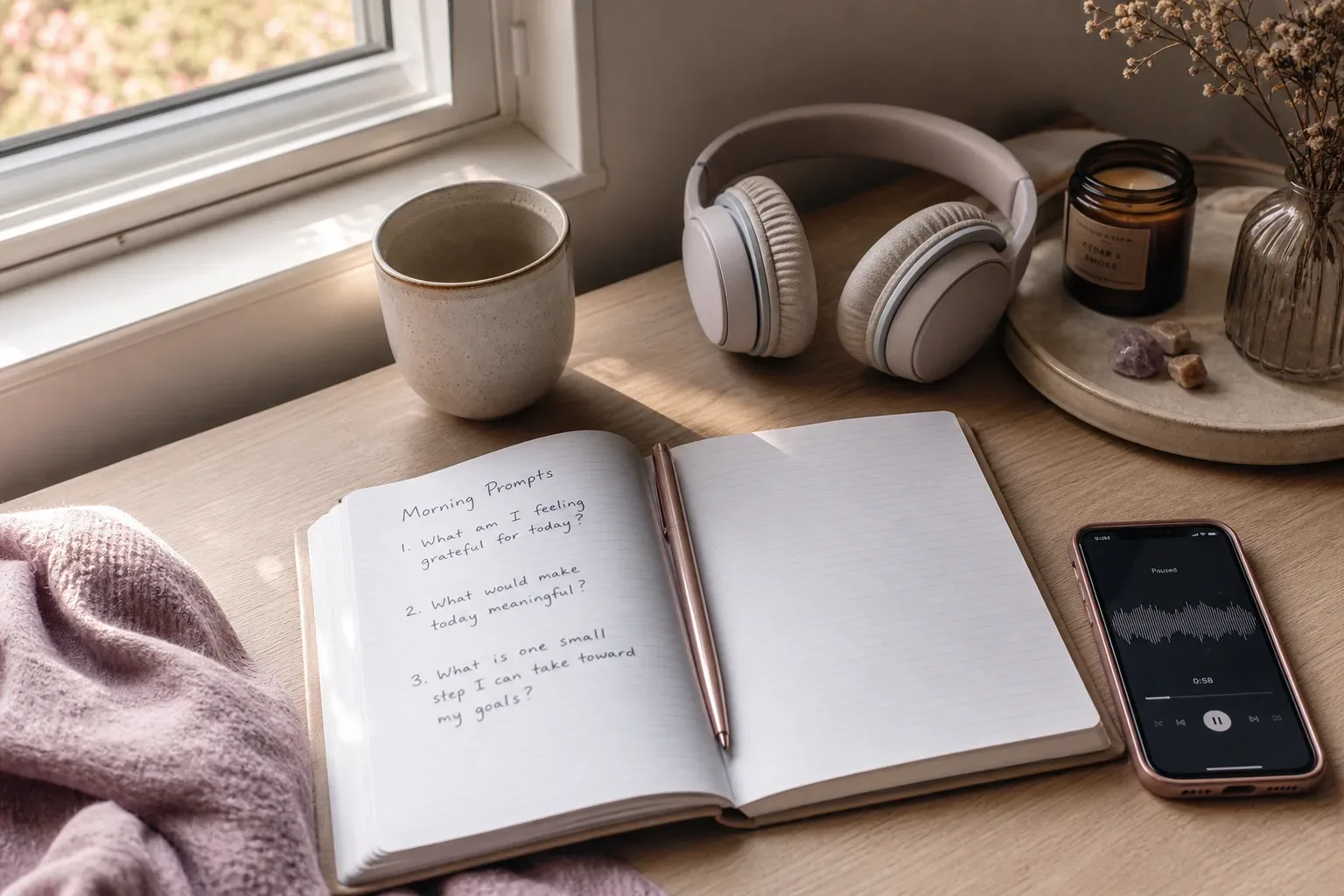
The notebook is open beside your headphones. Manifestation journal prompts work best when they become spoken, heard, and repeated. Write toward one future-self scene, choose the lines that feel true, shape them into a short present-tense script, then listen daily as audio. The page prepares it. Listening makes it practice.
What should manifestation journal prompts do before they become audio?
Manifestation journal prompts should turn a vague desire into a scene you can recognize.
A good prompt doesn’t ask you to perform certainty. It asks you to notice. What time of day is it in the life you’re practicing toward? What are you no longer apologizing for? Who sees the change before you announce it? These are small questions, but they make the future less decorative and more usable.
Psychologist Laura King published a 2001 study on writing about one’s “best possible self,” and participants who wrote for 20 minutes across several days showed improved mood compared with control writing. That doesn’t mean a journal grants outcomes. It means structured future-oriented writing can change attention, emotion, and behavior. A sentence can become a place you return to.
Start narrow. One desire per session is enough. The nervous system tends to respond better to something it can rehearse than to a whole life revised in one sitting. In expressive writing research associated with James Pennebaker, common protocols use 15 to 20 minutes of writing for 3 or 4 sessions. You don’t need a grand ritual. You need a page that tells the truth without shouting.
Use prompts that create evidence:
- What do I do differently on an ordinary Tuesday?
- What do I stop explaining?
- What does my home sound like in this version of life?
- What decision becomes easier?
- What old sentence about myself has gone quiet?
If you’re new to manifestation, keep the language grounded. Manifestation is not a substitute for care, planning, therapy, work, rest, or repair. It is a practice of attention and identity. The future self is not a fantasy version of you. It is the part of you asking for a clearer cue.
The best prompt doesn’t make you sound certain. It makes you sound honest.
Which prompts create the clearest future-self script?
The clearest prompts ask for specific evidence, not perfect outcomes.
When you’re writing for audio, the ear matters. A sentence that looks beautiful on a page may sound stiff when spoken. Short lines carry better. Concrete nouns help. A script made of “I am successful and fulfilled” has less grip than “I close the laptop at six and don’t reopen it from guilt.” The second line gives your mind a picture and your day a behavior.
Here are 12 manifestation journal prompts you can turn into future-self audio:
- What does one calm morning look like after this desire is real?
- What do I say no to without overexplaining?
- What do I now believe is normal for me?
- What does my body do when I feel safe in this new life?
- What do I no longer check, chase, or rehearse?
- Who benefits from me becoming more honest?
- What is the smallest visible proof that I’ve changed?
- What does money, love, work, or health feel like on an ordinary day?
- What promise do I keep when nobody praises me?
- What sentence would my future self whisper to me tonight?
- What do I do after a setback now?
- What is already here that I haven’t been counting?
The “best possible self” writing exercise often asks people to picture life after things have gone as well as they realistically could. In positive psychology studies, that exercise is usually timed at about 15 minutes. The useful part is the word realistically. Your script should stretch you, but it should not humiliate your current life.
Try this quick filter after you write. Circle any line that is sensory, behavioral, or relational. Cross out lines that sound like a poster. Audio needs intimacy. It should feel like someone who knows your exact kitchen, your exact fatigue, your exact courage.
| Journal line | Audio-ready version |
|---|---|
| I am confident. | I speak slowly, and I don’t rush to fill the silence. |
| I am loved. | I let love arrive without testing it every hour. |
| I have enough money. | I open my banking app without holding my breath. |
| I am healthy. | I keep the appointment, drink water, and rest before I crash. |
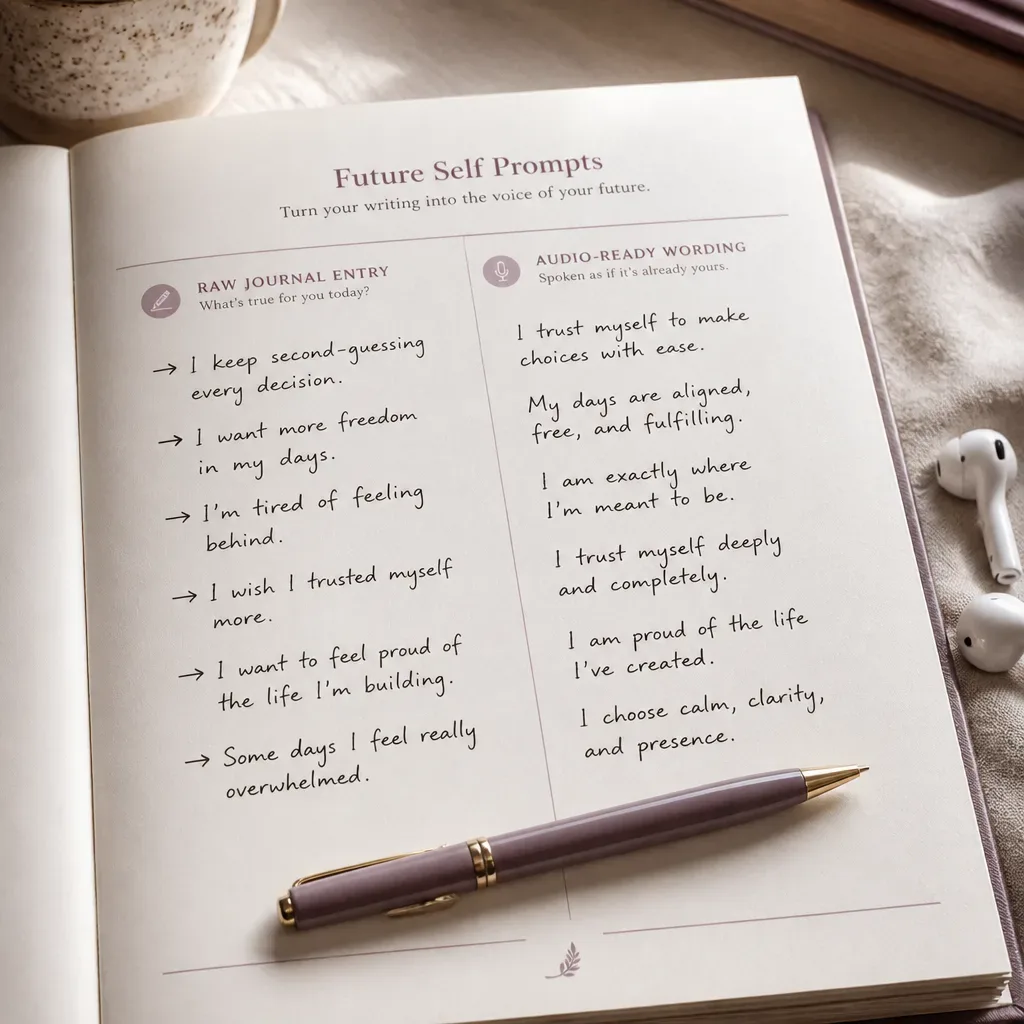
How do you choose which journal lines belong in the recording?
Choose the lines your body believes enough to practice again tomorrow.
This is where quiet discernment matters. You are not looking for the most impressive answer. You are looking for the sentence that lands. Sometimes it makes you breathe out. Sometimes it feels almost plain. Plain is not a problem. Most real change has very little theater in it.
A 2009 study by Joanne Wood and colleagues found that very positive self-statements could make some people with low self-esteem feel worse, especially when the statement felt unbelievable. That finding is often misunderstood. It doesn’t mean affirming language is bad. It means the distance matters. If the sentence creates inner argument every time you hear it, soften it until it becomes usable.
Use this selection method:
- Read your journal answers aloud once.
- Mark any sentence that feels physically easier to say the second time.
- Remove any sentence that depends on someone else becoming different.
- Keep 5 to 8 lines that show how you think, choose, speak, rest, or receive.
- Add one line for repair: what you do when the old pattern returns.
Your future-self audio should not be all shine. It needs a way back. If your script only works on a good day, it won’t become a companion on a hard one. Include language like, “When I forget, I return gently,” or “I don’t turn one hard hour into a verdict.”
This is also where affirmations can help, if you use them carefully. An affirmation is a sentence. Audio is a relationship with that sentence over time. The daily affirmation can complement the practice, but it is not the center. In the AYA Method, the center is the listening.
The AYA Method is a daily audio manifestation practice. Each day you listen to a short personalized recording — your Dream-Self Moment — narrated from the version of you who has already manifested the life you intend. Listening is the practice. Repetition is the work. The audio is the method.
A believable sentence repeated daily can become a room inside you.
How do you write the future-self audio script?
Write the script as if your future self is speaking from the life you intend, in words you would actually receive.
Begin with a simple address. “You are here.” “I know you forgot for a minute.” “Listen.” The first line should lower the volume inside you. Then move into present-tense evidence. Avoid long explanations. Audio gives language to the part of the mind that learns through rhythm, cue, and repetition.
Dr. Andrew Huberman has often discussed the role of repeated cues in habit formation and nervous system learning, pointing to attention, timing, and state as practical variables. The broader habit literature supports that repetition tied to a cue matters. In the 2009 University College London study by Phillippa Lally and colleagues, automaticity took a median of 66 days, with wide variation from 18 to 254 days. So write for repeat listening, not novelty.
A simple future-self audio structure:
- Opening cue, 10 to 20 seconds. Tell yourself you’re safe enough to listen.
- Future-self scene, 30 to 60 seconds. Name one ordinary moment after the desire is real.
- Identity sentences, 30 to 60 seconds. Say what you now choose, allow, and stop rehearsing.
- Repair line, 10 to 20 seconds. Name how you return when the old pattern appears.
- Closing instruction, 5 to 10 seconds. Give yourself one small action for today.
Here is a rough example:
You don't have to earn this morning by rushing.
You wake and know what matters first.
Your phone can wait.
You drink water before you answer the world.
You choose the work that is yours to do today.
When fear asks for proof, you give it one honest action.
You don't need to become louder to become real.
Begin with the smallest true thing.
Notice the scale. No grand promise. No pressure to feel perfect. Just a voice you can live with. If you’re building a broader practice, you can also read manifestation techniques with the same test: does this make my next action clearer, or only make my longing prettier?
How should you record it so it feels true when you hear it?
Record it slowly enough that your future self sounds like someone with nothing to prove.
You don’t need studio gear. A phone voice memo can be enough. What matters is pace, warmth, and restraint. Read the script once before recording. Remove any phrase that makes you self-conscious. If you wouldn’t say it to yourself at 7:13 a.m. on a tired Tuesday, don’t put it in the audio.
Speech rate research often places conversational English around 150 words per minute, though it varies by speaker and context. For future-self audio, slower is usually kinder. Aim for 110 to 130 words per minute. Leave a breath between sentences. Silence is not empty. It gives the words somewhere to land.
Use this small recording checklist:
- Sit where your shoulders can drop.
- Put the microphone 6 to 10 inches from your mouth.
- Read with less performance than you think you need.
- Keep the first version under 3 minutes.
- Listen once, then change only what feels false.
There is a reason audio matters here. Reading is active. Listening is receptive. When you hear your future-self script, you don’t have to generate every word again from effort. The words arrive. The body has a chance to practice receiving them.
If astrology is part of how you mark time, keep it as a timing lens, not a command. You might write during a new moon or review during a personal transit, then let the audio carry the daily work. The quieter frame in astrology and manifestation is not prediction. It is attention with a calendar.

When should you listen, and how often should you revise it?
Listen once a day at a stable cue, and revise only when the words stop being accurate.
Morning is useful because it places the audio before the inbox, but it is not holy. Night works. A walk works. The seat of your parked car works. The best cue is the one that survives your real life. BJ Fogg’s behavior model, taught at Stanford, emphasizes making habits small and tying them to existing prompts. That is the spirit here. Put the audio after something already automatic: brushing teeth, boiling water, putting on shoes.
Use a 7-day test before rewriting. Many people edit too soon because the mind likes novelty more than practice. Listen for one week. Track one small mark each day. At the end, ask three questions:
- Which line did I remember during the day?
- Which line made me argue with myself?
- Which line led to one visible action?
Then revise with mercy. A script is not a contract. It is a living cue. You may need to soften “I never doubt myself” into “Doubt can sit beside me without driving.” You may need to replace a money sentence with a boundary sentence. Good manifestation journal prompts keep telling the truth as you get closer.
Keep the complements in their right size. The app may also include a daily affirmation and a Manifestation Board, and both can help you see the practice. But the audio is the method. If you only have 2 minutes, listen.
The practice that counts is the one you can return to without becoming someone else first.
What are the best prompts to keep reusing each month?
The best monthly prompts reveal what has become easier, what still feels tender, and what wants a clearer cue.
Repetition does not mean copying the same desire forever. It means meeting the same desire with more honesty. Once a month, sit with your old script and your journal. Date the page. Give yourself 15 minutes. That number is small on purpose. It is long enough to see a pattern and short enough to begin before resistance builds.
A useful monthly review has 3 columns:
| Prompt | What to listen for | Script change |
|---|---|---|
| What line became true in small ways? | Evidence you almost missed | Make it more specific |
| What line still creates pressure? | Inner argument or tightness | Soften the claim |
| What did I do differently this month? | Behavior, not mood | Add a visible action |
| What desire changed shape? | More truthful wording | Rename the scene |
You can also borrow from mental contrasting research by Gabriele Oettingen, whose WOOP method pairs a wish with outcome, obstacle, and plan. The useful part is not pessimism. It is honesty. A future-self audio that names the obstacle can be more steady than one that pretends the obstacle vanished.
Here are 8 monthly manifestation journal prompts to return to:
- What did I stop forcing this month?
- What proof did I miss because it looked ordinary?
- Where did I keep one promise to myself?
- What old fear got quieter by 5 percent?
- What boundary protected the life I’m practicing toward?
- What sentence from my audio stayed with me?
- What does my future self want me to stop dramatizing?
- What is the next small true action?
If you want the larger frame again, return to the manifestation pillar and read it slowly. Then come back to the page. The page is where you hear your own wording. The recording is where that wording begins to keep you company.
The page can wait; listen first.