audio manifestation
Manifestation Podcast or Future-Self Audio?
A manifestation podcast can teach the practice, but future-self audio may fit daily repetition better. Here is the quiet comparison.

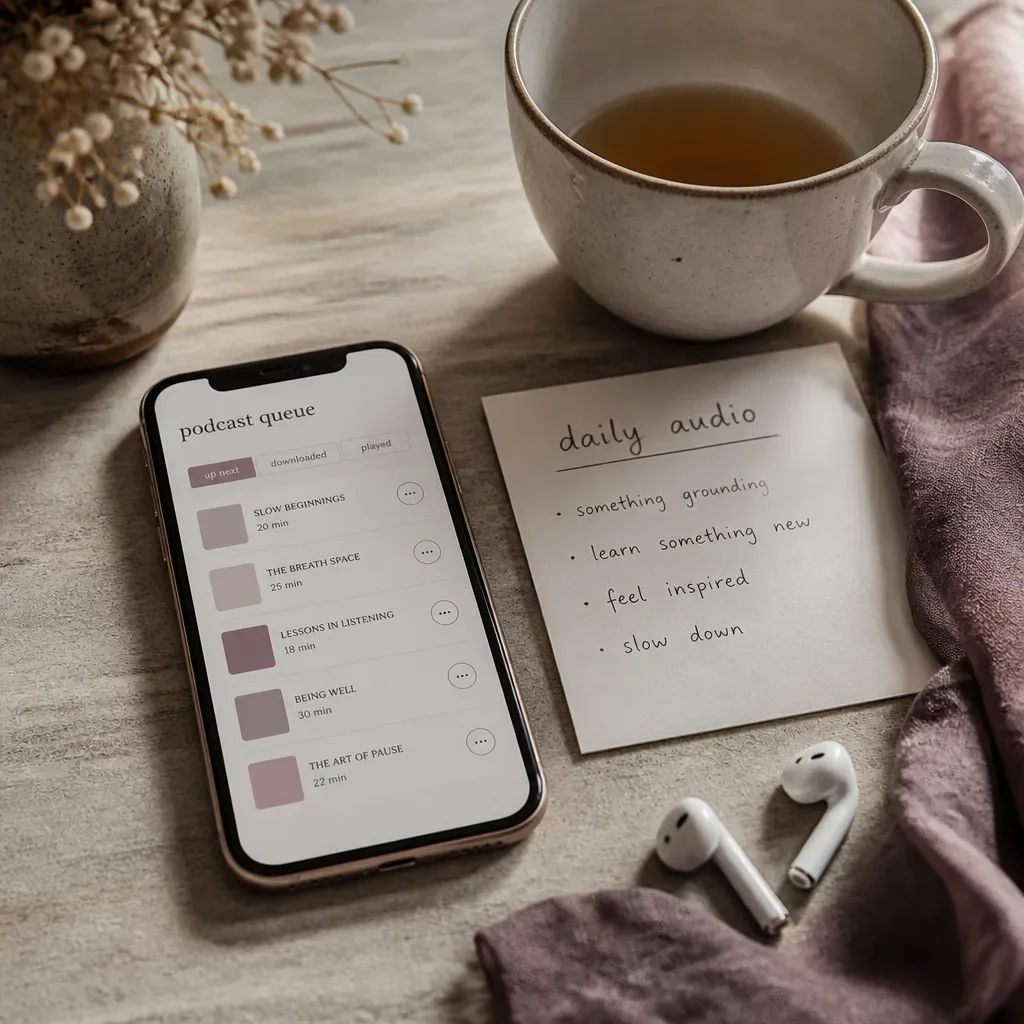
Your earbuds are already in your hand. A manifestation podcast can teach you new language and keep you company, but future-self audio is usually better for daily practice because it repeats one personal signal. Use the podcast for learning. Use the short recording when you need to remember who you’re becoming.
What are you really choosing when you press play?
You’re choosing between public guidance and private rehearsal.
A manifestation podcast speaks to many people at once. It may give you a teacher, a story, a framework, or a weekly reason to keep going. That matters. Pew Research Center reported in 2023 that 49% of Americans had listened to a podcast in the previous year, and Edison Research’s Infinite Dial 2024 placed monthly podcast listening in the United States at 47% of people age 12 and older. The medium is familiar now. It sits beside walking, cleaning, driving, waiting.
Future-self audio is different. It doesn’t try to introduce a new topic every week. It brings you back to one chosen version of your life, spoken in a way that feels close enough to believe and clear enough to repeat. A podcast gives you range. Future-self audio gives you a return point.
A podcast can teach the idea; a future-self audio asks your body to rehear the choice.
This distinction matters for manifestation because attention is not endless. A 2015 Microsoft attention report is often overquoted, but the more useful point is simpler: modern listening happens in fragments. You might have 4 minutes before the first message of the day. You might have 12 minutes on the tram. You might have one soft pocket before sleep. A daily practice has to fit the real day, not the fantasy day.
The question is not which format is more interesting. The question is which one you can repeat without negotiating with yourself. Repetition is where the mind starts to recognize a path.
How does a manifestation podcast help you learn?
A manifestation podcast helps by giving you language, examples, and a sense that someone else is practicing too.
There is comfort in hearing a real voice explain what has felt private. A good episode can name resistance, show how desire gets tangled with fear, or offer a new way to work with attention. If you’re still finding your words, podcasts can be useful. They make the abstract less lonely. In a 2023 Pew survey of podcast listeners, 87% said they listened to learn, and 71% said they listened for entertainment. That mix is exactly why the format travels so easily.
A podcast is especially helpful when you’re comparing schools of thought. You might hear one teacher speak from Neville Goddard’s assumption practice, another from Joe Dispenza’s work on mental rehearsal, and another from a psychological frame. You can place affirmations, visualization, scripting, and nervous-system regulation beside each other, then notice what stays true for you.
A manifestation podcast may support you when you need:
- a longer explanation before you trust a practice
- stories from people who have worked with belief over time
- a walk companion that keeps your attention soft
- a reminder that you don’t have to make meaning alone
- a way to compare ideas, including astrology and manifestation, without making astrology do all the work
Still, a podcast changes by design. New guest. New title. New mood. New method. That freshness can be beautiful, but it can also keep you collecting. The practice becomes another shelf of saved episodes. A 2022 Reuters Institute report found that many digital news and audio users feel worn down by too much choice; the same principle can show up in wellness listening. More input is not always more devotion.
When every episode gives you a new doorway, it can take longer to enter the room.
How does future-self audio work differently?
Future-self audio works by repeating one personal scene until it becomes easier to return to it.
The AYA Method is a daily audio manifestation practice. Each day you listen to a short personalized recording — your Dream-Self Moment — narrated from the version of you who has already manifested the life you intend. Listening is the practice. Repetition is the work. The audio is the method.
That definition is plain on purpose. It doesn’t ask you to perform belief for an hour. It asks you to listen. The daily affirmation and Manifestation Board can support the practice, but they are not the center. The center is the Dream-Self Moment. A voice from the life you intend, close enough to meet before the day begins.
There is research nearby, even if manifestation itself is not a laboratory term. Laura King published a 2001 study in the Journal of Personality and Social Psychology showing that writing about one’s best possible self was linked with increased well-being. Hal Hershfield’s work on future-self continuity, including research published around 2011, suggests people make different choices when they feel connected to their future selves. The mechanism is not mystical. It is recognition.
Future-self audio tends to work best when it includes 3 things:
- A specific future scene. Not a vague wish. A room, a morning, a sentence, a way your shoulders feel.
- A believable voice. Not forced certainty. Something you can hear without flinching.
- A daily cue. The same time, or the same ordinary act: kettle, shoes, lamp, pillow.
Lally and colleagues’ 2010 habit study in the European Journal of Social Psychology found that automaticity took a median of 66 days, with a wide range from 18 to 254 days. That range is merciful. It says people are different. It also says the practice needs to be small enough to survive the uneven weeks.
Listening is not passive when the voice is teaching you where to place your attention.
Which is better for daily practice?
Future-self audio is usually better for daily repetition; a manifestation podcast is usually better for study and widening your view.
Daily practice asks a different question than inspiration does. Inspiration asks, Do I feel moved right now? Practice asks, Can I return tomorrow? A 45-minute podcast can be generous, but it is also a bigger ask. Edison Research has reported that many podcast listeners use audio while multitasking, and common sessions often sit inside commuting, chores, and exercise. That is useful for learning. It is less reliable for a tiny daily ritual that needs to happen even when the room is quiet and your will is thin.
Here is the simple comparison:
| Need | Manifestation podcast | Future-self audio |
|---|---|---|
| Learning concepts | Strong | Light |
| Daily repetition | Variable | Strong |
| Personal detail | General | Specific |
| Time required | Often 20 to 60 minutes | Often 2 to 5 minutes |
| Emotional steadiness | Depends on the episode | Built through repetition |
| Best use | Weekly study, walks, reflection | Morning, night, reset moments |
A podcast can bring you a wise sentence at the exact right time. Future-self audio gives you the same sentence until it stops feeling foreign. That is the difference.
The American Psychological Association has published often on implementation intentions, a field shaped by psychologist Peter Gollwitzer since the late 1990s. The basic finding is practical: if-then cues help people act on intentions. If I finish brushing my teeth, then I listen. If I sit on the train, then I press play. Short audio fits that kind of cue better than long-form listening.
This is why audio manifestation feels different when it is treated as a daily cue rather than background sound. It is not content to consume. It is a place to return.
What should you listen to on low-belief days?
On low-belief days, listen to the format that asks the least from you and returns you to the clearest self-image.
Some days you will not want a lesson. You will not want to hear five reasons to trust the process. You will not want a guest interview, even a gentle one. Low-belief days are often not a failure of desire. They are often a sign that the nervous system is tired. Kristen Neff’s early self-compassion research from 2003 helped formalize something many people know in the body: harsh self-correction rarely creates steadiness.
Future-self audio can be useful here because it does not require debate. You do not have to agree with every word forever. You only have to listen today. In affect-labeling research by Lieberman and colleagues, published in 2007, naming emotion was linked with reduced amygdala response in brain imaging. That doesn’t prove a manifestation claim. It does suggest that language can change how an inner state is held.
If your belief is low, try this small order:
- Put on the same recording, not a new one.
- Let your body stay unconvinced.
- Notice one sentence that feels 5% true.
- Carry only that sentence into the next hour.
The app can also hold visual and verbal complements. A vision board for manifestation can help you see the life you’re practicing toward, and an affirmation can give you one line to keep. But the audio remains the method. The picture and the sentence are companions.
You don’t need full belief to begin; you need one honest point of contact.
How can you combine both without making it noisy?
Use the podcast for weekly learning and the future-self audio for daily return.
There is no need to choose forever. The quiet choice is about roles. Let the manifestation podcast be a teacher you visit. Let future-self audio be the voice that meets you at home. Gabriele Oettingen’s WOOP research, summarized in her 2014 book Rethinking Positive Thinking, is useful here because it pairs wish with obstacle, then plan. Desire alone is not the whole practice. A plan makes it livable.
A simple weekly rhythm can look like this:
- Daily, 2 to 5 minutes: listen to your Dream-Self Moment before checking messages or before sleep.
- Once or twice a week, 20 to 45 minutes: listen to a manifestation podcast while walking, cooking, or commuting.
- After the podcast: write down only one sentence worth keeping.
- At the end of the week: ask whether your daily audio still feels true, or whether one detail needs softening.
This prevents spiritual overconsumption. It also respects ordinary time. The Bureau of Labor Statistics American Time Use Survey regularly shows that working adults have limited discretionary hours on weekdays; in 2023, employed people worked an average of 7.9 hours on days they worked. A daily ritual has to live inside the day you actually have.
If a podcast episode helps, keep it. If it scatters you, pause it. If your future-self audio starts to feel stiff, rewrite one image, not the whole life. The goal is not to become a perfect listener. It is to become familiar with the self you keep saying is yours.
For wider context, read the full manifestation guide when you want the larger frame. Return to the AYA Method when you want the practice itself. The distinction will save you many hours.
Put the voice close, and let the day stay quiet.