audio manifestation
Manifestation While Driving: Future-Self Audio
Manifestation while driving can be safe and simple when you use future-self audio, keep eyes on the road, and make listening the whole practice.
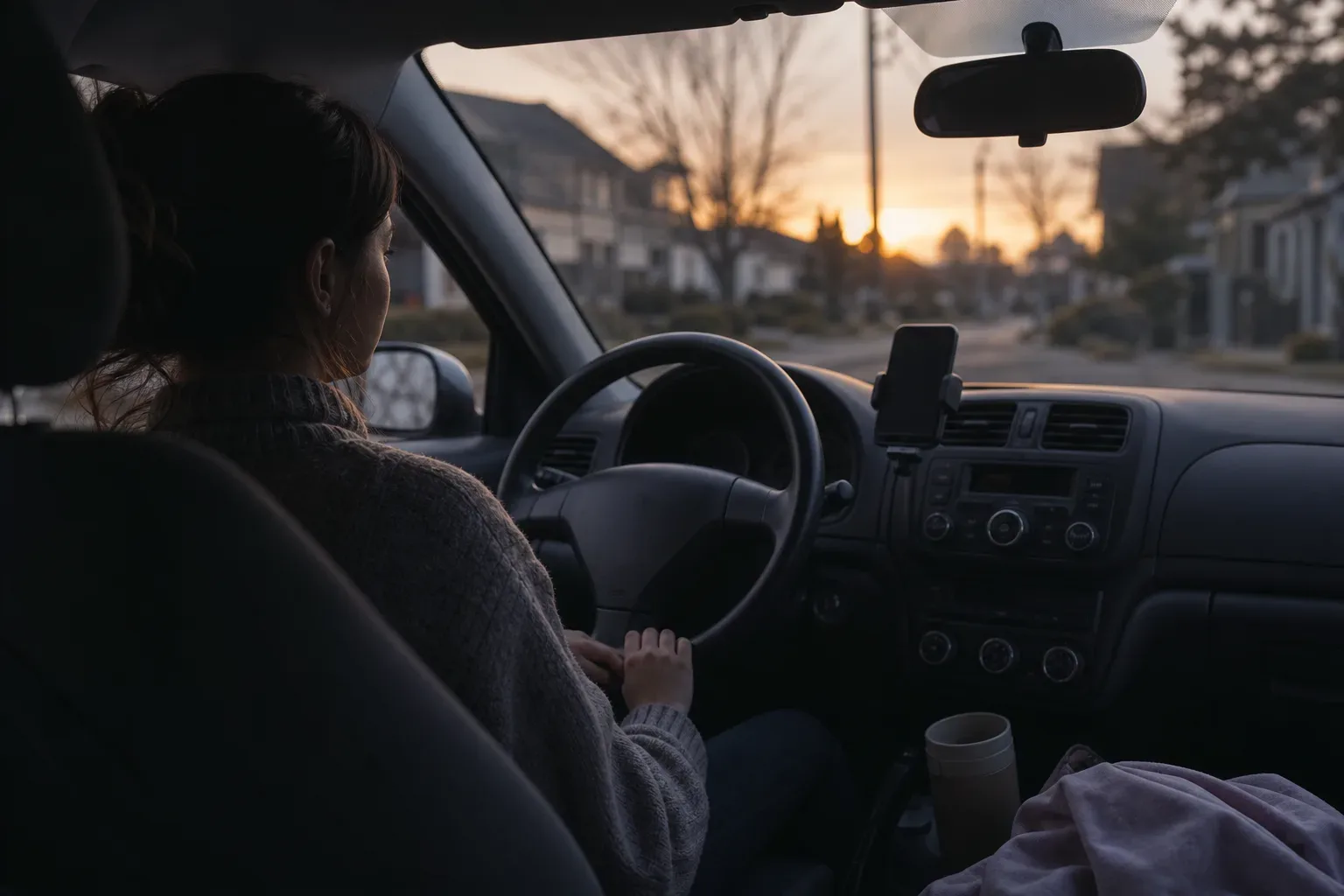
The car is already a room you enter every day. Manifestation while driving works when it stays audio-only: you listen to a short future-self recording before or during a familiar route, without touching your phone, closing your eyes, or asking the road to share attention.
Is manifestation while driving actually safe?
Manifestation while driving is safe only when it asks nothing from your eyes, hands, or decision-making.
The first rule is plain. Driving remains the task. Not the background. Not the container for a complicated ritual. In 2022, the U.S. National Highway Traffic Safety Administration reported 3,308 deaths involving distracted driving. That number is not symbolic. It is a boundary. Any practice that makes you look down, type, read, cry hard, or leave the present road is not a car practice.
So the car version has to be smaller than the sofa version. No candle. No notes app. No breathing pattern that changes your alertness. No closed-eye rehearsal. The only form that belongs here is listening. A voice. A few minutes. Already queued before the engine moves.
This is the quiet distinction: attention can be warmed without being divided. Many people already listen to podcasts, navigation, or the same song 40 times on a commute. Edison Research’s 2024 Infinite Dial report found that 47% of Americans age 12 and older had listened to online audio in the past week. Audio is familiar in the car. That does not make every audio wise. It means the format fits the room.
A future-self recording for the car should feel like a calm passenger. It does not demand eye contact. It does not ask you to prove anything. It says what you are practicing becoming, then leaves you enough space to steer.
The road does not need your vision board. It needs your sight.
If you know a certain route makes you tense, start elsewhere. If night driving already uses all your attention, do this in daylight. Safety is not a mood. It is the structure that lets the practice stay clean.
What kind of future-self audio belongs in the car?
The best car audio is short, spoken, personal, and easy to leave at any moment.
Three to eight minutes is enough for most drives. A 2023 AAA Foundation report continued to warn that cognitive distraction can remain even after a task ends, especially when the task asks for mental work. That matters here. Your recording should not require analysis. It should not lead you through a decision tree. It should not ask you to picture ten scenes in detail while traffic changes around you.
This is where the AYA Method sits naturally. The AYA Method is a daily audio manifestation practice. Each day you listen to a short personalized recording — your Dream-Self Moment — narrated from the version of you who has already manifested the life you intend. Listening is the practice. Repetition is the work. The audio is the method.
That definition matters in the car because it keeps the work in the ear. The Dream-Self Moment is not a performance. It is not a list you have to memorize. It is a return. The app also includes a daily affirmation and a Manifestation Board, but those belong around the audio, not in place of it. In the driver’s seat, the audio is the method.
If you are new to manifestation, choose language that is close enough to believe. “I handle money with steadiness” is often better than a sentence that makes your whole body argue. A small true line can enter where a grand line cannot.
Use this test before you save a recording for the car:
- Can I listen without touching the screen?
- Can I miss a sentence and still be fine?
- Does the pace keep me awake?
- Does it make me softer without making me foggy?
- Would I feel safe hearing this in rain, traffic, or a narrow lane?
The right audio does not take you away from the road. It helps you meet the road as the person you are practicing being.
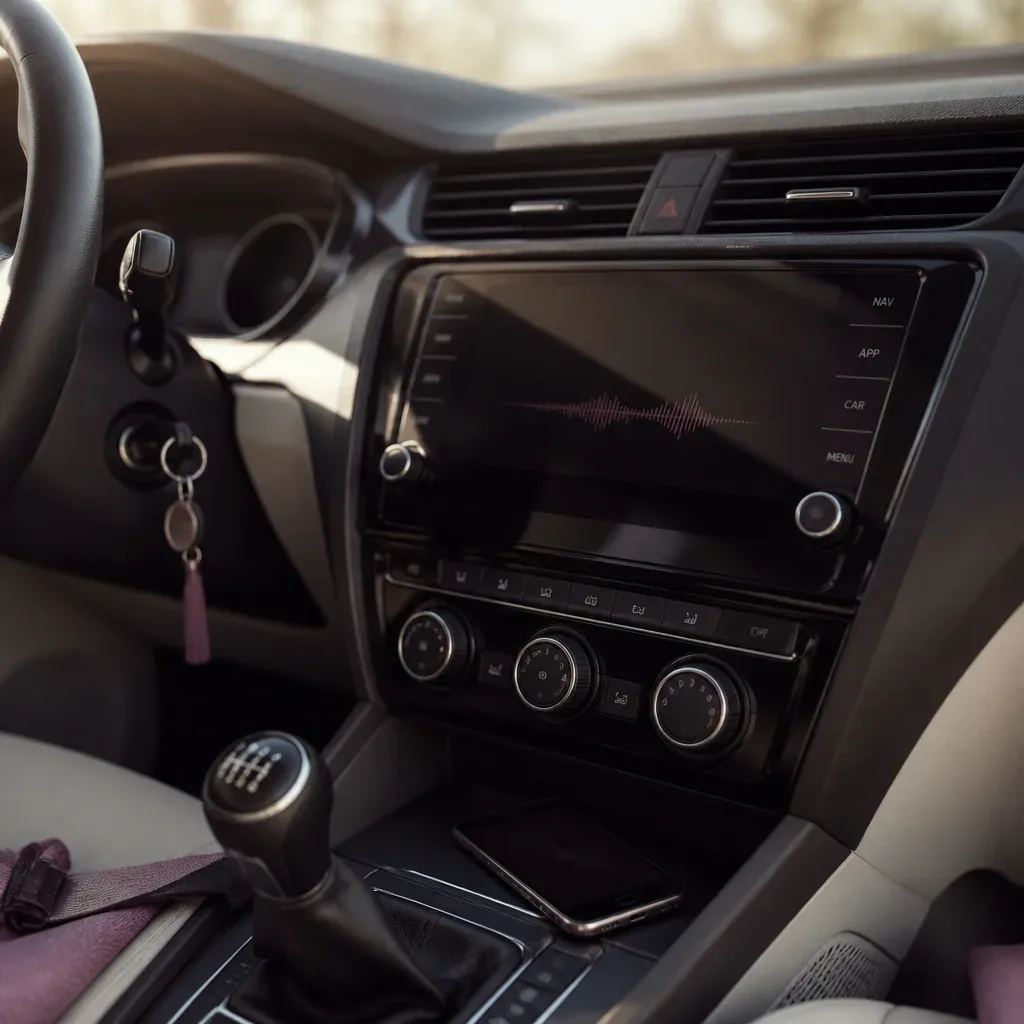
How do you set it up before the engine starts?
You set up manifestation while driving before you drive, not while you drive.
Design the practice like an entryway. In architecture, the entry tells the body what kind of room it is entering. A temple, a clinic, a classroom, a home. Your car has an entry too. The ten seconds before you shift into drive teach your nervous system what comes next.
Here is the safe setup:
- Park fully. Seatbelt on. Engine on or off, but the car still.
- Open the recording you will use.
- Set the volume lower than music, high enough to hear without strain.
- Put the phone on do-not-disturb or driving focus.
- Place it where you cannot casually touch it.
- Say one simple cue: “I listen. I drive.”
- Begin only when the road has your full attention.
Apple introduced Driving Focus in iOS 15, and Android Auto has similar attention-protecting settings. Use them. Tools do not make you disciplined, but they do make the easier choice easier. In behavioral design, that matters. BJ Fogg’s behavior model, published through Stanford’s Behavior Design Lab, frames action as motivation, ability, and prompt meeting at the same time. Here, the prompt is the car. Ability comes from removing friction before motion.
Keep the practice tied to one route at first. The familiar drive home. The quiet road to the train station. The 12 minutes after school drop-off. A single cue repeated over two weeks teaches the body faster than a heroic plan done twice. In a 2009 European Journal of Social Psychology study, Phillippa Lally and colleagues found habit automaticity took 18 to 254 days, with an average of 66 days. That range is mercy. It means you are not late.
A ritual becomes kind when it is easy to repeat on an ordinary day.
If the recording ends before the drive ends, let it end. Silence is part of the plan. You do not have to fill every mile with becoming.
How do you listen without leaving the present road?
You listen by treating the recording as weather, not instruction.
Let it be there. Let the road be primary. This is not passive in the weak sense. It is disciplined. You are choosing not to chase every sentence. You are letting repetition do what repetition does. Neville Goddard wrote often about feeling the wish fulfilled, but he did not write traffic law for a reason. The driver’s seat has its own ethics.
A simple rule helps: if the audio competes with the road, the road wins. Always. Miss the sentence. Lower the volume. Turn it off. There is no lost practice. There is only the next safe return.
| Driving moment | What to do | What to avoid |
|---|---|---|
| Heavy traffic | Turn the audio down or off | Trying to “hold the vision” |
| Open familiar road | Listen softly | Drifting into daydreaming |
| Red light | Keep eyes ahead | Checking the app |
| Emotional line lands | Breathe normally and keep driving | Following the feeling too far |
| Arrival | Park, then notice one sentence | Journaling before the car is still |
The National Safety Council has long warned that hands-free does not mean risk-free, because the mind can still be occupied. That is why the recording has to be low-demand. Think of it as a bell in a room, not a lecture at a desk.
Dr. Andrew Huberman has often discussed the link between visual attention, alertness, and the nervous system. For driving, the practical point is simple: eyes forward keeps the body oriented. Your gaze is part of your safety system. Do not soften it into a trance. Do not blur the world to feel more spiritual. The lane marking, the cyclist, the brake light ahead. These are sacred enough.
If one phrase stays with you, let it be small. “I know how to begin again.” “I can answer slowly.” “I am allowed to be steady.” One phrase is a handrail. Ten phrases are clutter.
For people who also use affirmations, keep them after the audio or before you move. A single affirmation can be a doorframe. The room itself is still the listening.
What should your car script actually say?
Your car script should describe the future self in plain sensory language, with no instructions that interrupt driving.
A good future-self audio does not sound like a command. It sounds like recognition. Joe Dispenza’s readers often talk about rehearsing a future state, while research in psychology gives a more grounded note: mental rehearsal works best when paired with cues, repetition, and behavior. In goal-setting research, Edwin Locke and Gary Latham found that specific goals tend to improve performance more than vague intentions across many settings. Specific does not mean crowded. It means true enough to aim the day.
For the car, write in present tense or near-present tense. Keep sentences low and bodily. Mention the person you are becoming through ordinary scenes: how you answer an email, how you sit in a meeting, how you pause before spending money, how you speak to someone you love.
Try this structure for a three-minute recording:
- Opening cue, 15 seconds: “You are driving. Your eyes are open. Your hands are steady.”
- Future-self scene, 90 seconds: One ordinary moment from the life you intend.
- Identity lines, 45 seconds: Three simple sentences about how you act now.
- Return, 30 seconds: “The road is here. You are here. Nothing has to be forced.”
Here are lines that belong in the car:
- “You answer slowly now.”
- “You do not spend your whole morning proving your worth.”
- “You let one clear decision be enough.”
- “You come home to yourself before you enter the room.”
Here are lines that do not belong in the car:
- “Close your eyes and see it.”
- “Feel it so strongly that nothing else exists.”
- “Pick up your phone and write this down.”
- “Repeat after me while breathing in a strict count.”
The difference is respect. The script respects the body that is driving. It respects the person who may be tired, late, or carrying three errands in her head. It gives her a cleaner room inside the same day.
If you use astrology and manifestation together, you can still keep the car script simple. A moon phase may shape the theme. The drive should not become a chart reading. Let the audio hold one theme at a time.
The future self is not louder than the present road.
How often should you use future-self audio in the car?
Use it often enough to become familiar, and lightly enough that you do not make the car another place to perform.
Start with three drives a week. Same route, same recording, same setup. After two weeks, notice what happened. Not whether your whole life changed. Something smaller. Did you arrive less braced? Did you answer one message with more care? Did you remember one sentence at the exact moment you needed it?
The World Health Organization has reported that road traffic crashes cause about 1.19 million deaths each year worldwide. Any driving practice has to keep humility near the wheel. If you are tired, skip it. If you are angry, choose silence. If the weather is difficult, let the rain be enough. Manifestation is not proven by doing it under strain.
You can track the practice in a parked moment with three marks:
- Listened: yes or no.
- Road felt safe: yes or no.
- One line remembered: write it later, not at the wheel.
That is enough data. You are not building a dashboard for your soul. You are noticing whether the room you enter every day is teaching you something useful.
A weekly review can take two minutes. Sit in the parked car or at your kitchen table. Ask: which line followed me into real life? Which line felt false? Which drive was not a good container? Edit from there. Design is not decoration. Design is decision.
If you want the wider practice, begin with audio manifestation and let the car be one doorway. The daily affirmation and Manifestation Board can support the work when you are still, but they are not the pillars. The listening is. The Dream-Self Moment is the room you return to.
Repetition is not proof that nothing is happening. Repetition is how the new floor learns to hold weight.
One day, the recording will end and you will keep driving, quieter than before.
The road stays here. So do you.